
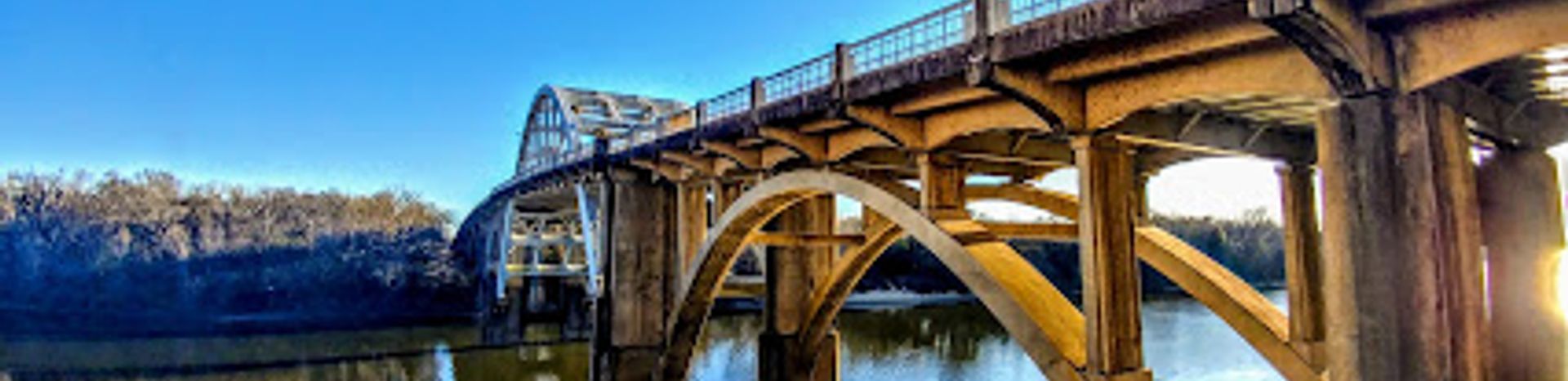
Edmund Pettus Bridge: A Civil Rights Landmark
Walk in the footsteps of history on the Edmund Pettus Bridge, a pivotal landmark of the Civil Rights Movement in Selma, Alabama.
The Edmund Pettus Bridge, spanning the Alabama River in Selma, is a powerful landmark in American history [5, 9, 18]. Built in 1940, the four-lane bridge is named after Edmund Winston Pettus, a Confederate general and Grand Dragon of the Alabama Ku Klux Klan [2, 7, 8, 9]. Despite its controversial namesake, the bridge has become a symbol of the Civil Rights Movement [5, 6, 10]. On March 7, 1965, known as "Bloody Sunday," civil rights marchers were violently attacked by law enforcement officers as they attempted to cross the bridge during a march from Selma to Montgomery in support of voting rights [5, 6, 7, 8, 9, 10]. The brutal scene was televised, galvanizing national support for the movement and leading to the passage of the Voting Rights Act of 1965 [8, 9, 10]. Today, the Edmund Pettus Bridge is a National Historic Landmark and a key site on the U.S. Civil Rights Trail [6, 7, 9, 10]. Visitors can walk across the bridge, visit the nearby Selma Interpretive Center, and reflect on the events that took place there [3, 4, 6, 12]. The bridge serves as a reminder of the struggle for civil rights and the ongoing fight for equality [5, 6].
Local tips
- Walk across the bridge to experience the history and reflect on the events of Bloody Sunday [3, 6].
- Visit the Selma Interpretive Center at the foot of the bridge to learn more about the Selma to Montgomery marches [3, 4, 12].
- Explore the nearby National Voting Rights Museum and Institute for an in-depth look at the struggle for voting rights [3, 4, 12].
- Consider visiting Brown Chapel AME Church, a historic meeting place for civil rights leaders [12, 18].

A brief summary to Edmund Pettus Bridge
- Selma, Alabama, 36703, US
- +1800-457-3562
Getting There
-
Walking
From downtown Selma, the Edmund Pettus Bridge is easily accessible on foot [4]. Head south on Broad Street toward the Alabama River. The bridge will be directly in front of you [4]. The walk is approximately 5-10 minutes from most downtown locations, including the Selma Interpretive Center and the National Voting Rights Museum [4]. There are sidewalks on both sides of Broad Street leading to the bridge [4].
-
Driving
If driving from outside of Selma, follow U.S. Highway 80 Business (US 80 Bus.) into downtown [4]. US 80 Bus becomes Broad Street [4]. Continue on Broad Street, and the Edmund Pettus Bridge will be directly ahead as you approach the Alabama River [4]. Limited street parking is available near the bridge [4]. Additional parking can be found in downtown Selma, a short walk away [4]. Be aware of parking regulations and time limits [4].
-
Public Transport
Public transportation options in Selma are limited [4, 13]. However, regional bus services may connect Selma to other cities [4, 13]. From the Selma Greyhound Bus Station, taxis or rideshare services like Uber and Lyft can provide a ride to the Edmund Pettus Bridge, located downtown on Water Avenue [4, 13]. A short taxi or rideshare ride will cost approximately $5 - $10 [4].


