
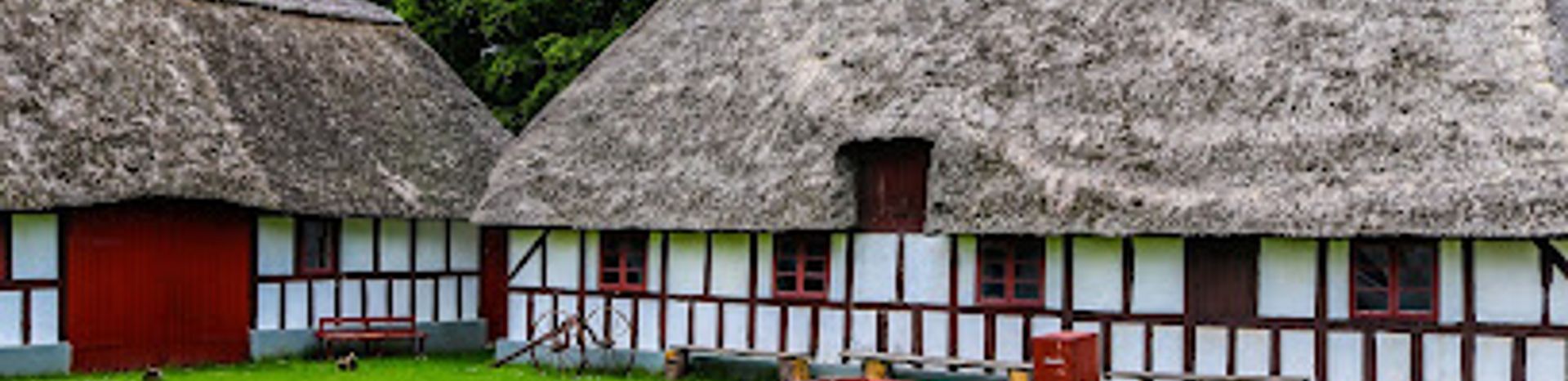
Høgdal Cultural-Historical Visitor Farm, Them
An 18th‑century visitor farm near Them where historic buildings, farm animals and simple countryside routines reveal the quiet charm of old Danish rural life.
A farm where time stands almost still
Høgdal sits in the countryside near Them, framed by soft fields and the forested landscapes of Søhøjlandet. At first glance it looks like a modest cluster of whitewashed, thatched farm buildings, but step through the gate and you enter a farmstead whose roots reach back to 1796. The layout of courtyard, barns and stables still follows traditional rural patterns, forming a sheltered world that feels intimate and self-contained. The atmosphere is strikingly calm. Gravel crunches underfoot, swallows trace low arcs above the roofs, and the faint smell of woodsmoke and animals lingers in the air. This is not a polished country estate but a working farm frozen in an earlier era, where worn thresholds, uneven cobbles and patched beams quietly tell their own stories.From family homestead to living visitor centre
Høgdal was founded by Jens Jensen Lemming at the end of the 18th century, and the property remained in the same family for five generations. Over time it grew into a self-sufficient holding, adapting slowly to new tools and methods but never losing its traditional structure. The last farmers, brothers Jens and Peder Jensen, lived here until the 1970s and are central to the story the visitor centre now shares. Rather than being modernised beyond recognition, the farm was preserved, allowing its interiors, workshops and outbuildings to reflect everyday routines from a not‑so‑distant past. Today Høgdal is run as a cultural-historical farm where volunteers and staff keep those stories alive through activities, maintenance of the buildings and care for the animals that still roam the yard.Everyday life in an old Danish farmhouse
Inside the low farmhouse you find small rooms with painted wooden doors, simple furniture and practical objects set out as if the household has just stepped outside. Cast-iron stoves, coffee mills, spinning wheels and enamel jugs speak of a rhythm of life shaped by seasons and manual work. The scale is human and homely rather than grand, making it easy to imagine the sound of boots in the hallway or quiet evening conversations by lamplight. Workshops and group visits dive deeper into traditional crafts. Activities might include carding and spinning wool, making small figures from beeswax or felt, grinding grain in hand‑cranked mills, or playing old-fashioned farmyard games. These are not staged spectacles so much as practical demonstrations that reveal how much effort once went into the simplest daily tasks.Courtyard animals and open-air discoveries
Even when the buildings are closed, the grounds around Høgdal invite gentle exploration. Goats may peer over fences, cats sun themselves on stone steps, and chickens wander across the yard, adding a playful, living layer to the historic setting. The surrounding meadows and tree lines create sheltered corners where birdsong replaces traffic noise. Paths lead around the edges of the property, offering changing views of the farm against the wider Søhøjlandet landscape. Many visitors bring a packed lunch to enjoy at one of the outdoor tables or simply sit on a bench in the courtyard, watching light move across timber and brick while the farm animals provide low-key entertainment.Seasonal events in the Lake District countryside
Throughout the year Høgdal hosts small cultural-historical events that make use of both farm and surrounding nature. Mushroom walks, animal-tracking excursions, fiddle music gatherings and thematic days connected with old rural traditions all feature on a changing programme. These activities highlight the close relationship between the farm and the forests, fields and weather that sustained it. Groups and schools can arrange tailored visits that combine storytelling, craft sessions and time with the animals. Whether you join a scheduled event or simply wander through on a quiet day, Høgdal offers a rare chance to slow down, notice details and experience rural Danish heritage in its original setting rather than behind glass.Local tips
- Check current opening days and event listings in advance, as access to interiors, workshops and toilets is typically limited to specific days and seasons.
- Wear sturdy, closed shoes; paths, yards and barn interiors can be uneven, muddy or slippery in wet weather.
- Bring a packed lunch and drinks to enjoy in the courtyard or nearby meadows, as on-site food options are limited or seasonal.
- Families should plan extra time for the resident goats, cats and chickens, which are often a highlight for children.
- If you are sensitive to dust, hay or animal hair, consider bringing any necessary allergy medication for comfort during your visit.

A brief summary to Høgdal
- Høgdalvej 4, Them, 8653, DK
Getting There
-
Car from Silkeborg
From central Silkeborg, driving to Høgdal near Them typically takes around 20–25 minutes, depending on traffic. The route follows main regional roads through gently hilly countryside and is straightforward for drivers used to rural conditions. Parking is usually available close to the farm buildings, though spaces can feel limited during school visits or special events. There is no entrance toll road, and fuel is the main cost for this option.
-
Regional bus and short walk
You can travel by regional bus from Silkeborg to Them in about 25–40 minutes, depending on the specific line and intermediate stops. A one-way ticket generally costs in the range of 25–35 DKK within the local public transport system. From the bus stop in Them, expect an additional walk of roughly 20–30 minutes along country roads to reach Høgdal, which may include gentle inclines and limited roadside pavements. Services run more frequently on weekdays than at weekends, so it is important to check timetables in advance.
-
Cycling from Them or Silkeborg
The rural setting makes Høgdal a pleasant destination by bicycle in suitable weather. From Them the ride usually takes about 10–20 minutes, while from Silkeborg you should allow around 35–50 minutes, depending on your pace and chosen route. Expect rolling terrain with some gentle hills and a mix of smaller roads and possible cycle paths. There is no dedicated cycle parking infrastructure at the farm, but bikes can normally be left near the entrance; bring a lock and appropriate lights if returning later in the day.


