
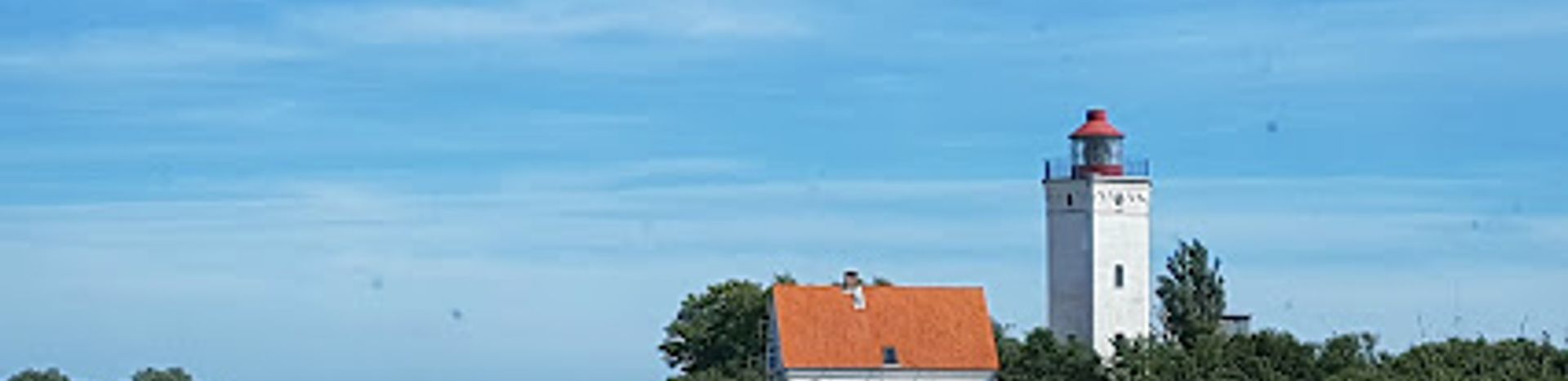
Gedser Lighthouse
A quietly evocative 19th-century beacon on Falster’s southern tip, where wind, sea and sky meet at the edge of Denmark and ships slide past on the Baltic horizon.
Beacon at the edge of Denmark
Gedser Lighthouse rises above low dunes and fields at the very southern tip of Falster, a few kilometres from the town of Gedser. Built in the early 1800s, it was among Denmark’s earlier coastal lights, guiding ships through the busy waters between Denmark and Germany. Its location makes it one of the last fixed points of land before the open Baltic, and even today large freighters and ferries slide past on the horizon. From a distance the lighthouse is modest rather than monumental, but that understatement suits the flat, exposed landscape around it. The tower’s form is clean and functional, a practical answer to fog, storms and long winter nights out on Gedser Odde. Together with the small cluster of former service buildings, it forms a compact maritime ensemble that feels firmly rooted in its windswept surroundings.From coal fire to coastal landmark
The story of Gedser Lighthouse mirrors the evolution of navigation along this coast. It began as a coal-fired light in the early 19th century, later upgraded with a mirror apparatus to project a clearer, more reliable beam. Over time, equipment and optics were modernised as ship traffic through the Fehmarn Belt increased and navigation became more precise. While lightvessels such as the famed Gedser Rev once marked the dangerous offshore reef, the land-based lighthouse served as a fixed point in a wider safety network. Even with GPS and electronic charts now standard, the tower remains a visual reference for mariners and a tangible reminder of how vulnerable wooden sailing ships once were to shoals and storms in these shallow waters.Coastal atmosphere and sea views
Visiting Gedser Lighthouse is as much about the setting as the structure itself. The air here tastes of salt and seaweed, and the constant wind carries the cries of seabirds that patrol the shoreline. On clear days, the view stretches across the Fehmarn Belt, with ship silhouettes etched against the horizon and Germany faintly visible in the distance. Paths and informal tracks skirt the cliffs and beaches nearby, linking the lighthouse area with the famous Sydstenen marker at Scandinavia’s southernmost point. The light’s yellow-toned buildings stand out against the blue of the sea and the muted colours of the fields, making it a photogenic subject in almost any weather. In summer the scene feels bright and spacious; on grey days it turns more austere and dramatic, a reminder of the storms the lighthouse was built to withstand.Reading the landscape
Around the lighthouse, the low coastline tells its own story. Erosion has gnawed at the soft cliffs for centuries, continually reshaping the shore. Glacial stones lie scattered on the beach, carried here long ago by ice. Between the grass-topped dunes, wildflowers and hardy shrubs cling to sandy soil that must endure salt spray and strong gales. Birdlife is active in this stretch of coast, especially during migration seasons, when flocks funnel along the Baltic flyway. Watching the sky and sea from near the lighthouse can reveal lines of geese and swans on the move, terns diving for fish, and the occasional bird of prey riding thermals over the fields. It adds a quiet, natural drama to the maritime setting.A slow, contemplative stop
Gedser Lighthouse is not a large, heavily developed attraction; its appeal lies in its simplicity and unhurried rhythm. A visit often combines a stroll, some time spent studying the tower and its details, and long moments just looking out to sea. The sense of being near a national "edge" gives the place a slightly introspective mood, perfect for those who enjoy space, sky and horizon. Whether you come for coastal photography, an interest in Denmark’s shipping history or simply a peaceful break from busier parts of the country, the lighthouse offers a compact but memorable stop. It pairs easily with other Gedser sights such as the southernmost point marker and the old water tower, forming a small circuit of places that together evoke both Denmark’s maritime past and its quietly beautiful present-day borderlands.Local tips
- Bring a windproof layer even in summer; the exposed coastline around the lighthouse is often breezy and can feel much cooler than inland.
- Combine your stop with a walk to Sydstenen, Denmark’s southernmost point, to appreciate the wider coastal landscape and sea views.
- Plan extra time around sunrise or late evening if you enjoy photography; the low light and open horizon create striking silhouettes of the tower.
- Wear sturdy shoes suitable for sand and uneven ground if you intend to explore the nearby beach and low cliff sections.

A brief summary to Gedser Lighthouse
- Gedser Fyrvej 2B, Gedser, 4874, DK
Getting There
-
Regional bus from Nykøbing Falster
From Nykøbing Falster, take the regional bus service towards Gedser, which typically runs at least once per hour on weekdays and less frequently on weekends. The ride to Gedser town takes around 35–45 minutes and uses standard local fares in Danish kroner. From the bus stop in Gedser, allow roughly 45–60 minutes to walk along paths and quiet roads to the lighthouse, following generally level terrain that may feel exposed in windy weather.
-
Car from Nykøbing Falster and central Falster
Driving from Nykøbing Falster to Gedser Lighthouse usually takes 30–40 minutes via the main southbound route across Falster. Roads are paved and straightforward, but the final stretch towards the southern tip is on smaller rural roads with occasional narrow sections. Parking is typically informal and limited near the coast, so be prepared to walk a short distance on uneven ground from where you leave the car, especially in busy summer periods.
-
Ferry and onward travel from Rostock, Germany
Travelers arriving by ferry from Rostock reach Gedser ferry terminal in about 2 hours. From the terminal, it is roughly a 4 km journey to the lighthouse area. Taxis are not always waiting at the pier, so it is advisable to arrange one in advance or be prepared for a 45–60 minute walk on largely flat terrain exposed to wind and weather. There is no separate fee to visit the lighthouse grounds, beyond the ferry fare already paid.


