

Træ-cirklerne ved Birkendegård, Kalundborg Travel Guide
Free Guide: Subtle traces in the fields east of Kalundborg reveal a vast Neolithic ring monument, Denmark’s “Stonehenge”, encircling the hill of Overdrevsbakken.


A brief summary of Træ-cirklerne ved Birkendegård
Subtle traces in the fields east of Kalundborg reveal a vast Neolithic ring monument, Denmark’s “Stonehenge”, encircling the hill of Overdrevsbakken.
On the fields east of Kalundborg, the enigmatic Træ-cirklerne ved Birkendegård – often dubbed “Denmark’s Stonehenge” – mark the site of a vast Neolithic ring monument. Today no stones stand, but subtle traces in the landscape reveal three great concentric circles, once formed by hundreds of posts or megaliths encircling the hill of Overdrevsbakken. Simple paths, open farmland and big skies create an atmospheric spot for imagining prehistoric solstice ceremonies and early sun worship on the Kalundborg plain.
On-site amenities
 Information boards
Opening hours
- MonClosed
- Tue10 am–4 pm
- Wed10 am–4 pm
- Thu10 am–4 pm
- Fri10 am–4 pm
- Sat10 am–4 pm
- Sun10 am–4 pm
Opening hours as listed on the venue’s Google Business Profile. Hours can change for services and special events, so check with the venue before you go.
- Address
- 4400 Kalundborg
- Website
Getting there
Regional train and local taxi from Kalundborg
Car from Kalundborg and the rest of Zealand
Bicycle from Kalundborg
Discover more about Træ-cirklerne ved Birkendegård
A hidden ritual landscape on the Kalundborg plain
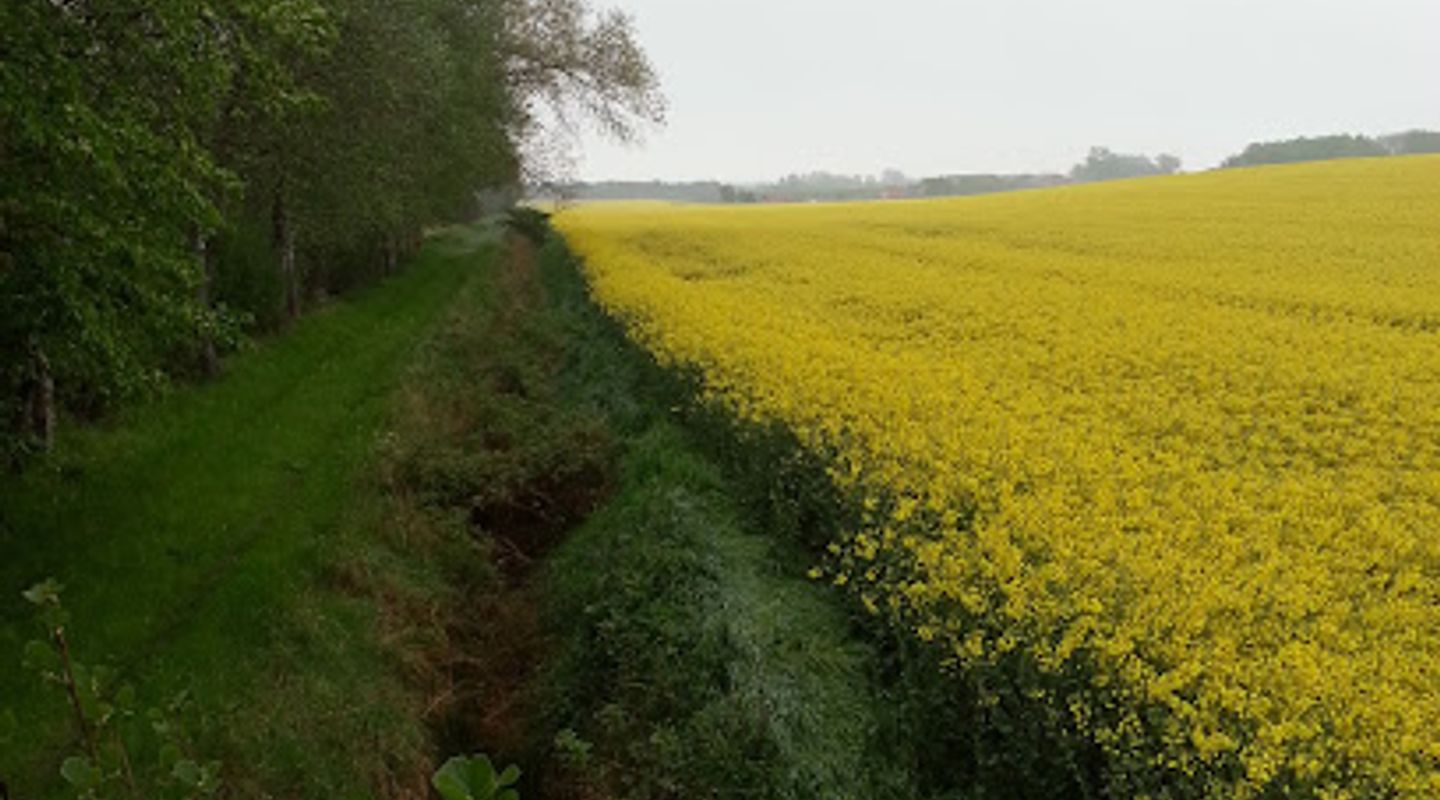
East of Kalundborg, the farmland around Birkendegård looks ordinary at first glance: rolling fields, a rounded hill, and wind sweeping across the open plain. Yet beneath this quiet landscape lies one of Denmark’s most intriguing prehistoric monuments. Around the hill known as Overdrevsbakken, archaeologists have identified three huge concentric circles that once formed a ritual enclosure in the Neolithic era.The outer ring is thought to have stretched close to a kilometre in circumference, making the monument far larger than it appears when you stand here today. Instead of obvious megaliths, you see gentle contours and agricultural land, but the scale becomes easier to imagine once you picture the circles wrapping around the base of the hill like a vast ceremonial fence.
From aerial photograph to archaeological sensation
The story of Træ-cirklerne ved Birkendegård begins in the 1960s, when an aerial photograph taken over the fields revealed faint circular patterns in the crops. An archaeologist studying the image recognised the tell-tale marks of buried structures: arcs of darker patches forming near-perfect rings around Overdrevsbakken.Subsequent excavations confirmed the interpretation. Archaeologists uncovered rows of stone and post holes, evidence for several hundred uprights forming multiple circles. These would have required careful planning and huge communal effort, suggesting that Birkendegård was an important ceremonial centre within the wider Neolithic landscape of northwestern Zealand.
Reconstructing a vanished stone circle
No great stones stand here today because the original blocks were likely quarried away long ago, many reused in medieval church building after royal decrees demanded the removal of pagan monuments. What remains are the traces: impressions where timber or stones once stood, now recorded through archaeological survey and aerial photography.Standing by the hill, you must reconstruct the monument in your mind. Visualise two to three hundred stones weighing several tons each, encircling the slope. The rings would have created a powerful theatrical setting, channelling movement, sound and sightlines as people processed, gathered or watched the sky. The absence of visible structures adds a certain poignancy, inviting quiet reflection on how landscapes preserve memory even when monuments have been dismantled.
Sun, seasons and possible solstice rituals
Researchers have noted alignments suggesting that parts of the complex pointed towards the midsummer sunrise, hinting at a strong connection with the sun’s annual cycle. Although the details of any ritual calendar remain uncertain, it is likely that gatherings here marked key turning points in the year, such as solstices and harvest.With the hill rising gently above the plain, the site offers broad sky views. It would have been an excellent natural observatory, where the changing position of sunrise and sunset could be tracked against the horizon. For modern visitors, this connection is still palpable on clear days, when the light over the fields shifts dramatically with the passing clouds and seasons.
Visiting an almost-invisible monument
Today Træ-cirklerne ved Birkendegård is a subtle destination, best suited to travellers who enjoy imagination, archaeology and big skies rather than dramatic stone silhouettes. There may be simple information on site or in the wider Kalundborg area, but much of the experience lies in using maps, sketches or pre-visit reading to interpret the landscape.Comfortable shoes are useful, as you will likely walk along field tracks or grassy edges around Overdrevsbakken. The setting is peaceful and rural, with wind turbines and farm buildings in the distance underscoring how the land continues to be used and reshaped. Allow time simply to stand, trace the invisible rings in your mind and consider how people here once watched the same sun rise over the Kalundborg plain thousands of years ago.
Evendo Review Centre
 Google
Guest reviews
Best time to go
Quietest: Jan, Feb & Nov · before 8am or at 8pm
Busy times are Evendo estimates for a typical year, to help you plan. Actual crowds vary with events, school holidays and the weather.
Explore Træ-cirklerne ved Birkendegård on the map
A handpicked selection of must-see spots near Træ-cirklerne ved Birkendegård, mapped for you.
Get your free copy of our complete guide to Træ-cirklerne ved Birkendegård, delivered straight to you.
Everything on this page, from opening hours and how to get there to Eve’s tips and the best time to go, in one PDF you can read offline, print or share.
Already have an account? Sign in
Your Træ-cirklerne ved Birkendegård guide is ready.
We'll send it to · Not you? Sign out

Getting your guide ready…
We are putting together a fresh copy of the Træ-cirklerne ved Birkendegård guide. This can take up to a minute.
This can take a few moments. If your browser asks, choose Allow so the download can start. You'll find the guide in your Downloads folder.
Nothing happened? Download it again
Sorry, the guide is taking longer than usual. Please try again in a minute, or get it by email instead.
Other nearby places you may find interesting
The closest places of the same kind, if this one is not quite what you had in mind.
-
-
-
-
-


Swipe for more places
More to explore near Træ-cirklerne ved Birkendegård
-
 Best experiences near Træ-cirklerne ved Birkendegård
-
 Best hotels near Træ-cirklerne ved Birkendegård
-
 Best landmarks near Træ-cirklerne ved Birkendegård
-
 Best attractions near Træ-cirklerne ved Birkendegård
-
 Best shops near Træ-cirklerne ved Birkendegård
-
 Best restaurants near Træ-cirklerne ved Birkendegård
-
 Best bars near Træ-cirklerne ved Birkendegård


Do you manage this location?
Take control to get all the benefits, like improved information, better appearance, and stronger visibility across AI-powered discovery.
Explore more

Explore more of Kalundborg
Discover Kalundborg, a picturesque Danish town with rich history, stunning landscapes, and a vibrant cultural scene. Perfect for nature lovers and history enthusiasts alike.
Explore Kalundborg
Explore more of Denmark
Discover Denmark: A perfect blend of history, modern design, and the cozy concept of hygge. Explore vibrant cities, serene landscapes, and world-class cuisine.
Explore Denmark
