Elia Sculpture, Herning
A colossal black steel dome on Herning’s edge, Elia blends industrial drama, fire, and open sky into one of Northern Europe’s most arresting contemporary sculptures.
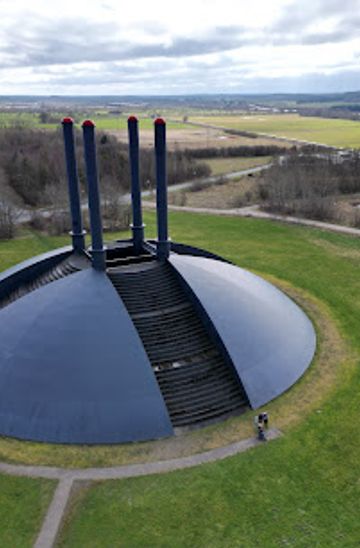
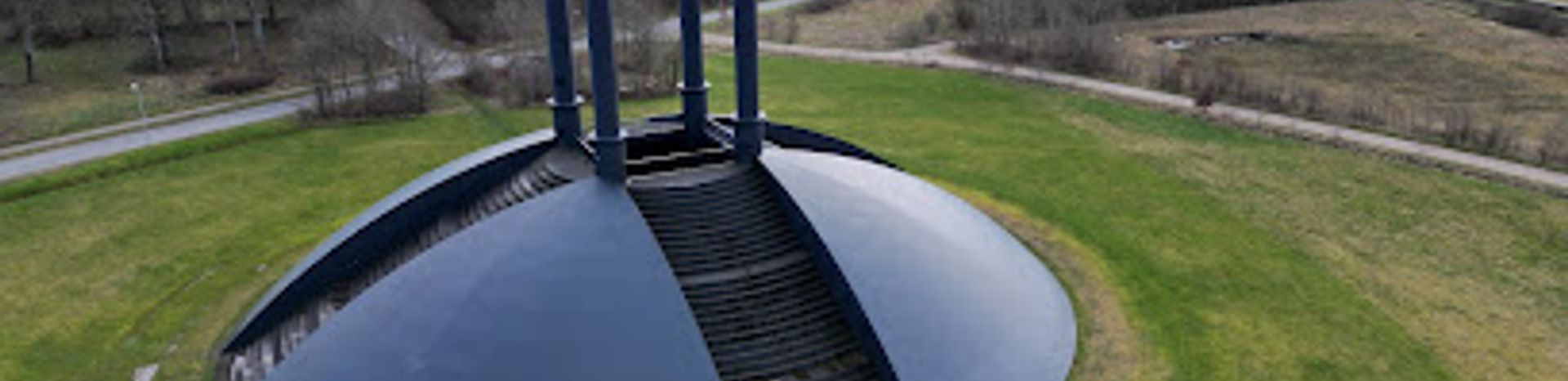
Elia is a monumental black steel sculpture rising from the open lawns of Birk Centerpark on the eastern edge of Herning. Created by Danish artist Ingvar Cronhammar as a bold marker of the new millennium, the hemisphere spans 60 m in diameter, crowned by four 32 m towers and a central gas torch that periodically shoots flames into the sky. Wide staircases draw you up to a circular platform, where industrial drama meets wide views over the surrounding heathland and cultural campus.
A brief summary to Elia
- Birk Centerpark 15, Herning, 7400, DK
- Click to display
- Duration: 0.5 to 1.5 hours
- Free
-
 Outdoor
- Mobile reception: 4 out of 5

Know before you go
Hi, I'm Eve. Here are a few practical things to know before exploring Elia.
- Wear sturdy shoes: the stair treads are high and exposed, and the steel surfaces can be slippery in rain, frost, or snow.
- Visit in late afternoon or near sunset for softer light on the black steel and expansive views over the surrounding landscape.
- Bring an extra layer on windy days; the exposed platform at the top can feel significantly colder than ground level.
- If you are sensitive to heights or steep steps, take your time on the staircases and use the side edges for extra stability.
- Combine Elia with nearby HEART and the Carl-Henning Pedersen & Else Alfelts Museum to turn your visit into a half-day art circuit.
Do you manage this location?
Take control to get all the benefits, like improved information, better appearance, and stronger visibility across AI-powered discovery. Learn more
Activate your presenceOther nearby places you may find interesting

Getting There
-
Train and local bus from Herning Station
From Herning Station, take a local bus towards the Birk or Hammerum area; typical lines serving Birk Centerpark run every 20–30 minutes on weekdays and less frequently in evenings and on weekends. The ride to the Birk district takes about 10–15 minutes, followed by a short, signposted walk through open lawns to the sculpture. A single-zone ticket within Herning usually costs in the range of 20–30 DKK, and tickets can be bought from machines, apps, or on board depending on the operator.
-
Car or taxi from central Herning
Driving from central Herning to Birk Centerpark typically takes 10–15 minutes, following main urban and ring roads toward the eastern outskirts. Parking is generally available in the Birk campus area near the museums and business buildings, from where you walk through landscaped grounds to reach Elia. Taxis from the town centre or the station usually cost around 120–180 DKK one way, depending on traffic and time of day.
-
Bicycle from Herning centre
Cycling from Herning’s central districts to Birk Centerpark usually takes 20–30 minutes along a mix of urban streets and designated cycle paths that are common in Danish towns. The route is mostly flat and suitable for regular city bikes. Strong winds and wet conditions can make the ride more demanding, so dress for the weather and use lights during the darker months.
For the on-the-go comforts that matter to you
-
 Seating Areas
-
 Trash Bins
-
 Information Boards
Discover more about Elia
A monumental horizon of steel outside Herning
Elia appears on the outskirts of Herning like a low, dark planet that has settled into the landscape. Set in Birk Centerpark’s open fields, the sculpture is a 60 m wide hemispherical dome of black steel rising gently from a shallow bowl cut into the ground. Above it, four towering pillars thrust 32 m into the air, their silhouettes visible from trains, roads, and neighboring museums long before you arrive.The work was inaugurated in 2001 as a statement piece for the new millennium and for Herning’s long-standing appetite for ambitious contemporary art. Commissioned for this cultural campus of museums, schools, and businesses, Elia anchors the area with a single, uncompromising form that blurs the line between land art, architecture, and sculpture.Ingvar Cronhammar’s industrial imagination
Elia is the creation of sculptor Ingvar Cronhammar, known in Denmark for monumental works that fuse industrial engineering with a sense of drama and unease. Here he uses simple geometric forms on a colossal scale: a dome, four chimneys, one central tube. The materials are equally straightforward—hundreds of tons of steel and concrete—yet the effect is theatrical, almost cinematic, especially under heavy skies.Cronhammar conceived Elia not as a puzzle to be solved, but as an open invitation to reflection. There is no single prescribed meaning: some see a futuristic power plant, others a ritual arena, a dark temple, or an abstracted machine sunk into the earth. The black surface, the stark lines, and the sheer size all play into that ambiguity, encouraging you to project your own associations onto the structure.Climbing to the viewing ring
Four wide staircases cut into the dome at the cardinal points, drawing you slowly upward. Each stairway is about 10 m across, with high steps that feel more like a series of low platforms than a standard staircase. As you climb, the curve of the dome reveals a circular walkway at the top, forming a continuous ring around a central opening.From this upper platform, you can look outward across the gently rolling heath, the white buildings of Birk’s art museums, and the low skyline of Herning. Turning inward, the view drops into the sculpture’s resonant interior space, a vast void that amplifies sound and concentrates the sense of scale. Even on quiet days, your own footsteps and voices seem to hang in the air a little longer than usual.Fire, thunder, and engineered spectacle
At the heart of Elia stands a fifth, slimmer column: a gas burner designed to send a jet of flame up through the opening at irregular intervals. When active, the flame can reach more than 8 m high, a sudden orange column against the black steel and grey skies. The timing is deliberately unpredictable within broad cycles, and safety systems prevent ignition when wind is high or people are too close.The sculpture also interacts with the elements in subtler ways. Its concave undercroft acts as a giant acoustic chamber, turning distant thunder into a deep, rolling drum. Rain and wind play across the steel skin, while at night the capped tops of the pillars can glow, adding a quiet, otherworldly presence to the darkened landscape.Safety, scale, and the weight of the earth
Elia’s size comes with serious engineering. Beneath your feet lies a complex of structural steel, thick sheeting, and reinforced concrete, supported by thousands of cubic metres of earth that were excavated and reshaped to form the bowl. The dome alone contains hundreds of tons of metal, giving the work a literal and figurative weight that you feel as you stand on its surface.Over time, safety features have been added around the central opening and within the structure, acknowledging both the sculpture’s magnetism and its inherent risks. These measures sit discreetly within the overall design, allowing the raw impact of the piece to remain intact while ensuring that visitors can explore the upper platform with greater reassurance.A free gateway to Herning’s art landscape
Elia is freely accessible at all hours, integrating seamlessly into the daily life of the Birk district. Locals cut across the site on walks, students from nearby institutions use the steps as informal seating, and art lovers fold it into a wider circuit that includes HEART Herning Museum of Contemporary Art and the Carl-Henning Pedersen & Else Alfelts Museum.Whether you stay for a few minutes or linger to watch the shifting light, the sculpture works as a threshold into Herning’s broader art scene. It is both an object to be inspected and a platform from which to look out, an industrial-age monument recast as a contemplative landscape experience.Explore the best of what Elia has to offer













More about West Jutland

Discover West Jutland: Denmark's scenic coastal region with vast beaches, historic towns, and rich cultural heritage, perfect for nature lovers and history enthusiasts.
Tell me more about West Jutland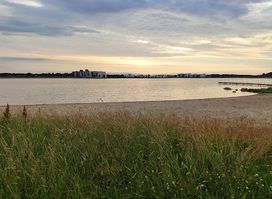
A breezy bathing lake on Herning’s northern edge, blending sandy shores, easy walking trails and simple outdoor fun in a wide, sky-filled Jutland landscape.

A colossal steel hemisphere on the Herning plain where industrial design, random bursts of fire and wide Jutland skies turn contemporary sculpture into a full-body experience.