Jægerspris Castle Travel Guide
Free Guide: Royal hunting lodge turned democratic-era residence, Jægerspris Castle weaves Frederik VII, Countess Danner, sculpture-filled parkland and deep forests into one evocative estate.


A brief summary of Jægerspris Castle
Royal hunting lodge turned democratic-era residence, Jægerspris Castle weaves Frederik VII, Countess Danner, sculpture-filled parkland and deep forests into one evocative estate.
Set between Roskilde Fjord and Isefjord on the Hornsherred peninsula, Jægerspris Castle is one of Denmark’s oldest royal residences, surrounded by historic woodland and a spacious park. Once a hunting lodge and later the beloved home of King Frederik VII and Countess Danner, it now serves as a museum and foundation, with interiors preserved from the 1850s, a sculpture-filled memorial grove, evocative rune and memorial stones, and tranquil paths that link royal history, social reform and serene nature in a single, atmospheric estate.
On-site amenities
 Restrooms
 Seating areas
 Picnic areas
 Trash bins
 Information boards
 Visitor centre
 Drink options
 Food options
Opening hours
- Every day11 am–4 pm
Opening hours as listed on the venue’s Google Business Profile. Hours can change for services and special events, so check with the venue before you go.
- Address
- Slotsgården 20, 3630 Jægerspris
- Phone
- Website
Getting there
Train and bus from Copenhagen
Car from Copenhagen
Bus from Roskilde
Discover more about Jægerspris Castle
Royal retreat between the fjords
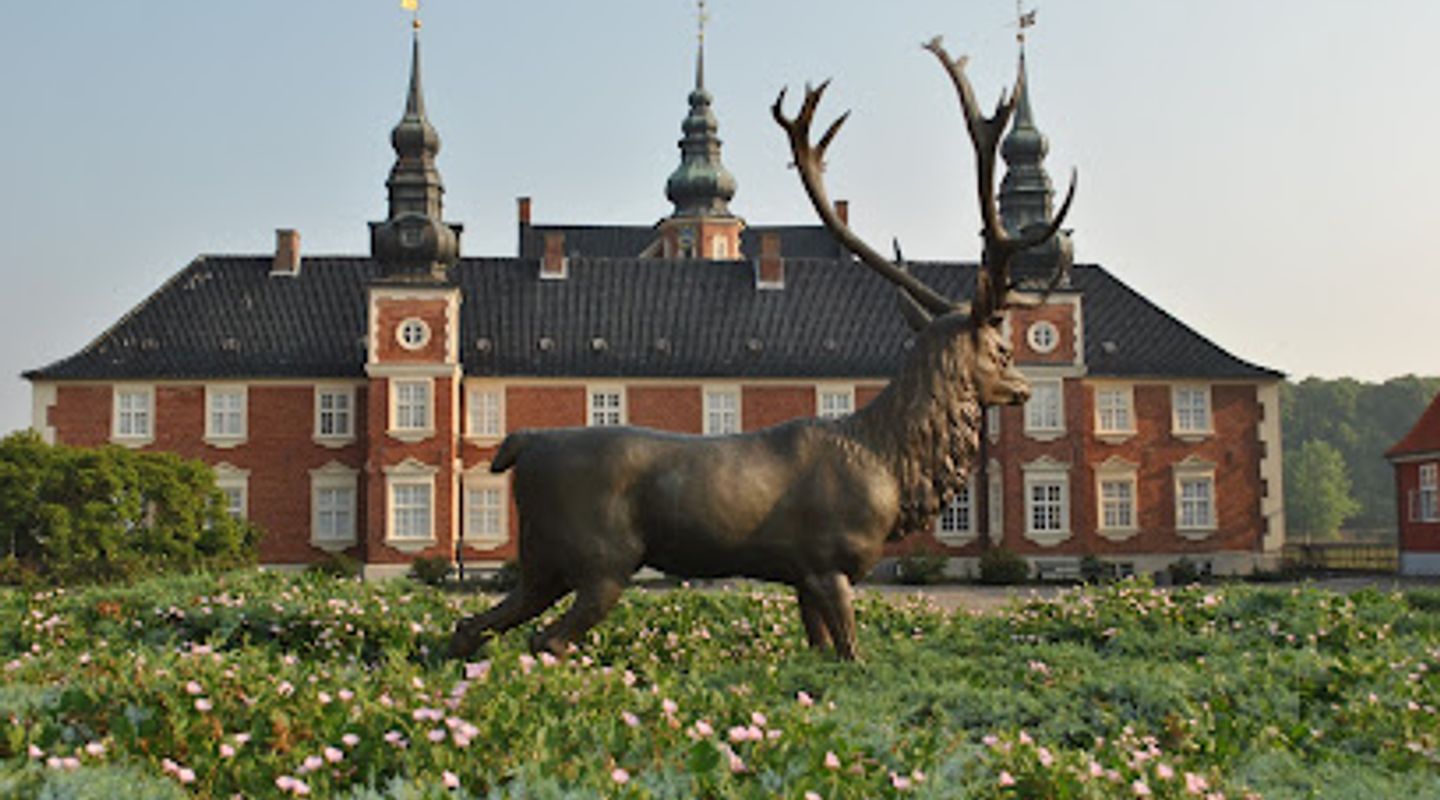
Jægerspris Castle sits on the wooded Hornsherred peninsula, framed by Roskilde Fjord and Isefjord, in a landscape of gentle fields, bays and low forest. For centuries this was a royal hunting ground, and the castle itself grew from a medieval manor into a favoured country retreat for Danish monarchs seeking fresh air and privacy away from Copenhagen. Approaching the complex today, you step into a self-contained world of cobbled courtyards, mellow brick facades and low, winged buildings that still feel more like a working estate than an isolated monument.The setting is key to its character. Trails radiate from the castle into the surrounding forest, where old oaks and beeches line sandy paths once used by royal hunting parties. The nearby village developed around the estate in the 19th century, but the castle still reads as a distinct enclave, with long axial views across lawns, gentle slopes and tree-lined avenues that emphasise its role as both residence and landscape focus.
From medieval stronghold to Frederik VII’s home
The story of Jægerspris reaches back to at least the 13th–14th centuries, when a fortified manor occupied this strategic spot between the fjords. Over time, successive kings remodelled and expanded the buildings, adding new wings, gables and interiors that reflected changing tastes and needs. In the 18th century it was modernised as a comfortable baroque hunting lodge, linked to the great forests that still encircle the estate.Its most defining chapter came in the mid-1800s, when King Frederik VII, Denmark’s last absolute monarch, chose Jægerspris as his personal refuge. After signing the constitution in 1849 and ushering in a constitutional monarchy, he increasingly retreated here with his partner, later wife, Louise Rasmussen, better known as Countess Danner. Their years at the castle bound the place tightly to the birth of modern Danish democracy and to a much-discussed royal love match that crossed class lines.
Inside a preserved 1850s residence
The castle interiors were largely frozen in time after Frederik VII’s death, turning his rooms into an unusually intact mid‑19th‑century royal home. Exhibition spaces preserve his study, audience hall and private apartments, alongside Countess Danner’s own rooms. Richly patterned wallpapers, wall‑to‑wall carpets and upholstered furniture convey her taste and the comfort the couple sought in this country refuge.Portraits, personal objects and everyday possessions tell parallel stories: the political transformation of Denmark in the 1850s and 1860s, the fascination with new technologies, and the lives of a royal couple whose partnership defied convention. Countess Danner later ensured that this domestic world became a memorial museum, allowing future generations to glimpse how a constitutional king actually lived away from the formality of the capital.
Countess Danner’s legacy and social mission
Beyond the royal narrative, Jægerspris Castle is also a landmark of social reform. After inheriting the property, Countess Danner used part of the estate to establish a children’s home, embedding philanthropy into the fabric of the castle. Over time, the foundation created in Frederik VII’s name continued to run social institutions on the grounds, turning a royal retreat into a place of care and education.This dual identity – aristocratic residence and social institution – remains visible. Sturdy 19th‑century wings, once stables and service buildings, now frame courtyards where daily life still unfolds. Information in and around the museum explains the foundation’s work and the broader 19th‑century context of poor relief, orphan care and the gradual expansion of social rights in Denmark, all linked back to decisions taken within these walls.
Castle park, memorial grove and ancient stones
The extensive park behind the castle spreads out as a carefully composed landscape of lawns, forest edges and shaded paths. Near the main building lies Countess Danner’s grave, a modest but powerful focal point that anchors her story in the terrain. From here, a long axis draws you into the Memorial Grove, laid out in the 1770s to honour notable Danish figures with a sequence of sculpted monuments.These memorial stones, created by the sculptor Johannes Wiedewelt, form an outdoor gallery of national memory, stretching from the formal gardens into the forest. Interspersed among them are ancient burial mounds and rune stones that were gathered here in the 19th century, giving the park an archaeological layer that reaches back to the Viking Age. The blend of manicured avenues, historic monuments and wilder woodland makes the estate as much an open‑air museum as a traditional castle garden.
Exploring the wider estate and seasons
Jægerspris is more than a single building; it is the nucleus of a wider cultural landscape. Forest trails link the park to surrounding hills, heaths and viewpoints across the fjord, inviting quiet walks under tall trees and occasional glimpses of water between the trunks. In spring and summer the lawns fill with picnicking families and the woodland feels soft and green; in autumn the beech leaves turn copper, casting a warm glow over the memorial stones and avenues.Even when interior rooms are closed for renovation, the grounds remain an atmospheric destination in their own right. The combination of royal history, memorial art, social legacy and accessible nature gives the castle a multi‑layered character: part country house museum, part sculpture park, part everyday green space for the surrounding community.
Evendo Review Centre
 Google
Guest reviews
Best time to go
Quietest: Jan, Feb & Mar · before 8am or at 9pm
Busy times are Evendo estimates for a typical year, to help you plan. Actual crowds vary with events, school holidays and the weather.
Explore Jægerspris Castle on the map
A handpicked selection of must-see spots near Jægerspris Castle, mapped for you.
Get your free copy of our complete guide to Jægerspris Castle, delivered straight to you.
Everything on this page, from opening hours and how to get there to Eve’s tips and the best time to go, in one PDF you can read offline, print or share.
Already have an account? Sign in
Your Jægerspris Castle guide is ready.
We'll send it to · Not you? Sign out

Getting your guide ready…
We are putting together a fresh copy of the Jægerspris Castle guide. This can take up to a minute.
This can take a few moments. If your browser asks, choose Allow so the download can start. You'll find the guide in your Downloads folder.
Nothing happened? Download it again
Sorry, the guide is taking longer than usual. Please try again in a minute, or get it by email instead.
Other nearby places you may find interesting
The closest places of the same kind, if this one is not quite what you had in mind.
-
-
-
-
-


Swipe for more places
More to explore near Jægerspris Castle

 Best experiences near Jægerspris Castle
 Best hotels near Jægerspris Castle
 Best landmarks near Jægerspris Castle
 Best attractions near Jægerspris Castle
 Best shops near Jægerspris Castle
 Best restaurants near Jægerspris Castle
 Best bars near Jægerspris Castle
Do you manage this location?
Take control to get all the benefits, like improved information, better appearance, and stronger visibility across AI-powered discovery.
Explore more

Explore more of North Zealand
Explore North Zealand, Denmark's enchanting region of castles, beaches, and royal estates, perfect for history buffs, nature enthusiasts, and seaside lovers.
Explore North Zealand
Explore more of Denmark
Discover Denmark: A perfect blend of history, modern design, and the cozy concept of hygge. Explore vibrant cities, serene landscapes, and world-class cuisine.
Explore Denmark