
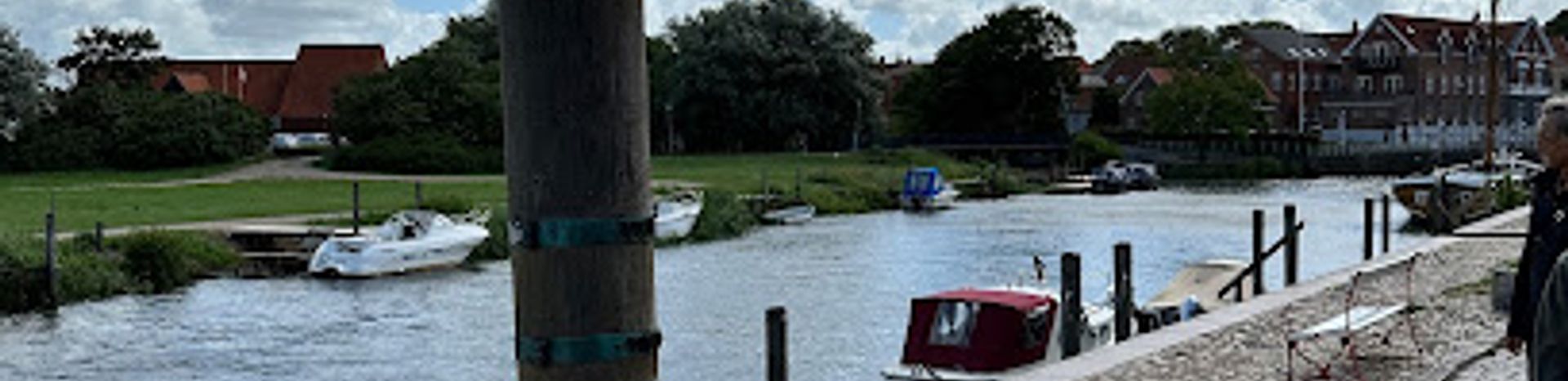
Flood Column in Ribe (Stormflodssøjlen)
A slender wooden column on Ribe’s harbour that turns tranquil waterfront views into a powerful, six-metre-high lesson in storm surges, memory and resilience.
Rising beside Ribe’s historic harbour at Skibbroen, the wooden Flood Column is a stark, elegant marker of just how high the storm surges of the Wadden Sea have climbed over Denmark’s oldest town. Metal rings record centuries of catastrophic floods, with the highest more than 6 m above normal water level, commemorating the devastating 1634 storm that drowned thousands in the region. This simple yet powerful landmark turns a pretty waterfront stroll into a vivid encounter with natural forces, engineering resilience and coastal history.
A brief summary to Flood column in Ribe
- Skibbroen 25, Ribe, 6760, DK
- Duration: 0.5 to 1.5 hours
- Free
-
 Outdoor
- Mobile reception: 4 out of 5
Local tips
- Stand right at the base of the column and look up to the top ring to truly grasp how high the 1634 storm surge rose above today’s calm harbour.
- Combine a stop at the Flood Column with a slow stroll along Skibbroen to appreciate how the historic harbourfront would have looked under floodwater.
- Visit in calmer weather with clear visibility; wind and driving rain can make it harder to linger and read the markings comfortably.
- Use the column as a storytelling spot if you are visiting with children, explaining each ring as a different chapter in Ribe’s battle with the sea.
- Bring a light jacket, even in summer; the exposed harbourfront can feel noticeably cooler and breezier than the more sheltered town streets.

For the on-the-go comforts that matter to you
- Trash Bins
- Information Boards
- Seating Areas
- Restrooms
- Food Options
- Drink Options
Getting There
-
Train and short walk from Esbjerg
From Esbjerg, take the regional train to Ribe Station; services usually run at least once an hour and the journey typically takes 30–35 minutes. A standard adult ticket generally costs around 60–90 DKK one way, depending on time and fare type. From Ribe Station it is an easy, mostly level walk of about 10–15 minutes through the old town streets to the harbour at Skibbroen, suitable for most visitors but with cobblestones that may feel uneven for those with mobility issues.
-
Car from the wider South Jutland area
Arriving by car from towns in South Jutland, plan for a travel time of roughly 30–60 minutes from nearby centres such as Esbjerg, depending on traffic and starting point. Public parking areas are available within walking distance of Ribe’s historic core; expect to pay in the region of 10–20 DKK per hour in central zones, with time limits in the most convenient spots. From the main parking areas, allow around 10–20 minutes on foot along largely flat, cobbled streets to reach the harbourfront and the Flood Column.
-
Bus connection from nearby towns
Regional buses link Ribe with neighbouring communities in South and West Jutland, with typical journey times ranging from 30 minutes to just over an hour depending on distance and intermediate stops. Single tickets on local and regional buses usually fall between 30 and 80 DKK, based on zones travelled. Buses generally stop near the town centre; from there, you should allow 10–15 minutes to walk on level streets towards Skibbroen. Timetables and frequency can be reduced in the evening and on weekends, so checking current schedules before travel is advisable.
Flood column in Ribe location weather suitability
-
 Clear Skies
-
 Mild Temperatures
-
 Any Weather
-
 Cold Weather
-
 Windy Conditions
Discover more about Flood column in Ribe
A quiet harbour and a dramatic story in wood and iron
Standing on the quay at Skibbroen, amid moored boats and red-tiled merchants’ houses, the Flood Column in Ribe looks disarmingly simple: a tall wooden post, weathered by sea winds, banded with metal rings. Yet this modest structure tells one of Denmark’s most dramatic coastal stories. Each ring marks the water level reached during a historic flood, transforming the column into a vertical archive of storm surges that have repeatedly threatened this low-lying town. The column stands only a short distance from the river, so it is easy to imagine the harbour underwater. Looking from the cobbles up to the rings, you can trace how the sea has risen over the centuries, turning streets into temporary seabeds and ground floors into channels.The great drowning of 1634 etched at the summit
The highest ring, more than six metres above the usual water level, records the infamous storm surge of 1634, sometimes called the Great Drowning of the Wadden Sea. That night, a violent North Sea tempest drove water far inland, overwhelming dikes and sweeping across farms, villages and market towns. Historical accounts suggest that many thousands of people perished across the wider region as buildings collapsed and livestock, crops and entire households were torn away. On the column, this catastrophe is not described in words but in height. Standing beneath the top ring, you effectively stand inside the volume the water once occupied. The sheer difference between the calm river at your feet and the mark far above your head conveys the event more forcefully than any plaque.Ribe between marsh, dikes and the Wadden Sea
Ribe grew up on flat marshland near the Wadden Sea, trading with the wider North Sea world since Viking times. Its prosperity has always depended on the same tidal forces that occasionally turned against it. Over the centuries, the town and surrounding countryside endured repeated flooding, prompting the construction of dikes and, in the modern era, storm sluices and reinforced embankments. The Flood Column helps explain why these defences exist. Nearby embankments and the wider ring of coastal dikes are responses to the levels recorded on the pole. Even relatively recent storm surges, long after the medieval period, led to evacuations and renewed efforts to strengthen protection, ensuring that Ribe’s half-timbered lanes and cathedral were not lost to the sea.Reading the column as a timeline in space
Rather than dates on a horizontal line, the column arranges history vertically. Lower rings correspond to serious but less catastrophic floods; higher ones, spaced further up the timber, signal exceptional events. You can move your gaze from the bottom to the top as if climbing through time, noting how often the town has come close to disaster. In this way, the Flood Column doubles as a lesson in risk and resilience. It shows that dramatic floods are not distant anomalies but recurring features in a tidal landscape. For many visitors, that realisation fosters a new respect for the calm harbour and broad marshes stretching beyond the town.A small stop that deepens a visit to Denmark’s oldest town
Viewed in isolation, the Flood Column is a brief stop: there is no elaborate exhibition, no ticket queue, no enclosing building. Yet in the context of Ribe’s cobblestone streets, Viking heritage and medieval cathedral, it adds an essential layer. It links the picturesque waterfront directly to the natural forces that shaped the town’s destiny. Pause here during a walk along Skibbroen, listen to the creak of rigging and the slap of water against the quay, and then look up the column. In a single glance, you see why dikes were built, why houses cluster where they do, and how a charming harbour once became a dangerous edge between land and sea.For the vibe & atmosphere seeker
- Scenic
- Tranquil
- Unique
- Casual
For the architecture buff
- Historic
- Landmarks
- Viewpoints
For the view chaser and sunset hunter
- Iconic Views
- Waterfront
- Sunset Spots
For the social media creator & influencer
- Photo Spots
- Architectural Shots
- Reel-Friendly
For the eco-conscious traveler
- Low Impact
- Public-Transport Accessible
For the kind of experience you’re after
- Cultural Heritage
- Photowalk
- Day Trip
- Roadtrip Stop
- Mindfulness
For how adventurous you want the journey to be
- Easy Access
Location Audience
- Family Friendly
- Senior Friendly
- Child Friendly
- Teen Friendly
- Solo Friendly
- Couple Friendly
- Solo Female Friendly
- Vegetarian Friendly
- Vegan Friendly
- Business Friendly


