Kastrup Enge Wetlands by Gelså
Quiet South Jutland wetlands where straightened streams, open meadows and big skies invite slow observation rather than structured sightseeing.
Gelså Meadows on the South Jutland Plain
Kastrup Enge forms part of the Gelså river system, a broad band of low-lying meadows where water, grassland and agriculture meet on the open South Jutland plain. The land lies only modestly above sea level, so the fields close to the stream stay moist, with drainage ditches and straightened channels guiding the water towards the larger river valleys. From the raised farm tracks you look out over a flat, open scene of fields, grazing patches and long shelterbelts of trees. Despite the straightened course of the main waterway through the meadows, the area still reads clearly as a floodplain landscape. In wetter periods you may see standing water in depressions and darker, lush vegetation marking the lowest spots. Subtle variations in elevation shape where cattle graze, where reeds dominate and where hedgerows and scattered trees find a footing.Between Canal-Like Streams and Natural Curves
Here the stream is distinctly canal-like, with engineered banks and a fairly uniform width, a reminder of decades of land reclamation and drainage works carried out to improve farmland in this part of Denmark. Yet the wider river system quickly gives way to more natural meanders further downstream, and Kastrup Enge sits at this transition between managed landscape and more free-flowing river sections. The contrast is part of the character: straight cuts of water, crisp field edges and wind turbines in the distance speak of a working countryside, but the calls of birds, the rustle of reed beds and the slow move of water insist that this is still very much a living wetland environment. On calm days the mirror-smooth surface of the channel reflects sky, clouds and the silhouettes of passing geese.Wetland Nature and Birdlife
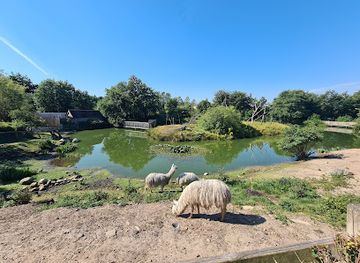
The meadows and adjacent marshy patches provide habitat for typical lowland wetland species. Reeds and wet grassland along the water’s edge shelter waterfowl and waders, while the network of ditches, banks and fence posts becomes a perching ground for small birds of open country. The flatness of the landscape makes it easy to scan for movement across wide distances. Later in the day you may notice swallows skimming low over the water or small flocks of ducks lifting from the river. In spring and early summer, the wet meadows can carry a subtle haze of flowers among the grasses, with dragonflies darting above the drainage channels. Even without rare species, the sense of seasonal change and the interplay of water, vegetation and open sky are central to the experience.A Quiet Stop in the Working Countryside
Kastrup Enge is not set up as a formal destination with visitor centers or marked nature trails. Instead, it is a low-key pause point in an otherwise busy agricultural landscape. Farm access roads and field tracks offer simple vantage points over the meadows, and you quickly notice how sound carries: distant tractors, wind in the grass, and the occasional splash from the river. This simplicity is part of the appeal. There is space here for unhurried observation rather than a checklist of sights. Photographers find long horizons, layered fields and big skies; walkers encounter changing light, shifting clouds and the quiet company of grazing animals. It is a place to sense how human cultivation and wetland ecology coexist on the same flat canvas.Light, Seasons and Sense of Space
Because the land is so open, the quality of light shapes each visit. Bright days pull sharp lines out of the drainage ditches and hedges, while misty mornings soften the edges and make the meadows feel more enclosed. In winter, low sun and bare trees create a near-monochrome palette, with the river standing out as a dark ribbon. Across the seasons, water levels, vegetation height and agricultural use change the texture of the landscape. Fresh growth in spring, tall summer grasses, and stripped-back winter fields all reveal different patterns. Returning at different times of year highlights how dynamic even a seemingly static, flat meadow system can be.Experiencing the Enge at a Slow Pace
Time at Kastrup Enge is best measured in slow minutes rather than a packed schedule. A short stop is enough to appreciate the setting, but lingering lets the quieter details emerge: ripples from a passing fish, insects over the water surface, or the gradual shift of wind across the grass. With no formal infrastructure to distract, attention naturally turns outward to the line of the horizon and the play between land and water.Local tips
- Wear waterproof or sturdy shoes; the low meadows and field edges can be soft and muddy, especially after rain or in early spring.
- Bring binoculars or a camera with a zoom lens to make the most of birdlife and long, layered views across the open fields.
- Dress in windproof layers; the flat, exposed terrain means breezes feel stronger and there is little natural shelter.
- Plan refreshments in advance as there are no cafés or shops directly by the meadows and facilities are very limited.
A brief summary to Kastrup Enge
- Gelsåvej 4, Toftlund, 6520, DK
Getting There
-
Car from Toftlund town center
Driving from central Toftlund to the Kastrup Enge area typically takes around 10–15 minutes, using local country roads that pass through open farmland. The roads are paved but narrow in places, with limited shoulder and occasional agricultural vehicles. Parking is informal, usually on small lay-bys or widened verges near farm tracks, so avoid blocking field access. There are no parking fees or designated lots, and lighting is minimal after dark, making daytime visits more practical.
-
Bicycle from Toftlund surroundings
Cycling from the wider Toftlund area to Kastrup Enge takes roughly 20–35 minutes depending on your starting point and wind direction. The route uses quiet rural roads with gentle gradients across mostly flat terrain. Surfaces are generally good, but expect occasional rough edges and farm traffic. There are no formal bike racks by the meadows, so bring a lock and be prepared to leave your bicycle at a field entrance, ensuring it does not obstruct gates or farm machinery.
-
Regional bus plus short rural walk
Regional buses serve Toftlund from larger towns in Southern Jutland several times a day, with typical fares in the range of 20–60 DKK depending on distance and ticket type. From a bus stop in or near Toftlund, reaching the Kastrup Enge area requires an onward walk of at least 20–30 minutes along rural roads, with no pavements and occasional fast-moving traffic. This option suits confident walkers prepared for variable weather and basic roadside conditions, as there are no shelters or services en route.