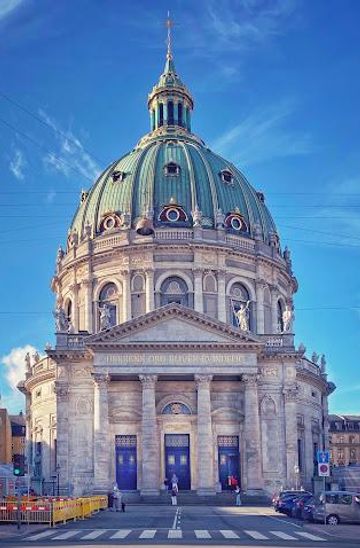
Frederik's Church (The Marble Church)
A soaring copper-green dome, centuries of royal ambition, and a luminous marble interior make Frederik’s Church one of Copenhagen’s most compelling sacred landmarks.
Crowning Copenhagen’s elegant Frederiksstaden district, Frederik’s Church—better known as the Marble Church—pairs a vast copper-green dome with a luminous circular nave of marble columns, frescoes and symbolic sculpture. Conceived in the 18th century as a royal monument and only completed in 1894 after a century of abandonment, it is today both a working Evangelical-Lutheran parish church and one of Denmark’s most striking architectural landmarks, with seasonal access to a dome walkway for sweeping city views.
A brief summary to Frederik's Church
- Frederiksgade 4, Copenhagen, Indre By, 1265, DK
- Click to display
- Click to display
- Duration: 0.5 to 1.5 hours
- Free
-
 Mixed
Mixed
- Mobile reception: 5 out of 5
- Monday 10 am-5 pm
- Tuesday 10 am-5 pm
- Wednesday 10 am-5 pm
- Thursday 10 am-5 pm
- Friday 10 am-5 pm
- Saturday 10 am-5 pm
- Sunday 12:30 pm-5 pm

Know before you go
Hi, I'm Eve. Here are a few practical things to know before exploring Frederik's Church.
- Visit in the late morning or late afternoon when soft light filters through the high windows, giving the marble columns and dome frescoes especially atmospheric colour.
- Check current dome opening times and any fees in advance, as access is usually limited to set hours and can be seasonal or weather dependent.
- Remember this is an active parish church: keep voices low, avoid flash photography during services, and dress respectfully, especially if you plan to sit through a ceremony.
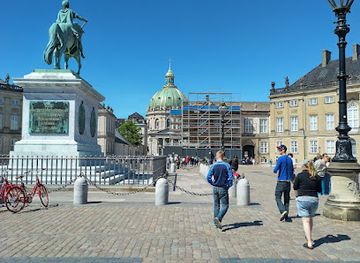
- Combine your visit with a short stroll along the axis between the church and Amalienborg Palace to appreciate how the dome anchors the design of the entire district.
- If you are sensitive to heights, enjoy the nave from ground level; the dome climb includes narrow stairways and sections that may feel exposed.
Do you manage this location?
Take control to get all the benefits, like improved information, better appearance, and stronger visibility across AI-powered discovery. Learn more
Activate your presenceOther nearby places you may find interesting

Getting There
-
Metro from central Copenhagen
From central Copenhagen hubs such as Nørreport or Kongens Nytorv, take the M3 Cityringen or M4 line to Marmorkirken Station, which sits almost directly beside the church. Trains run every few minutes, and the ride typically takes 3–8 minutes depending on your starting station. A single-zone ticket within the city costs roughly 20–30 DKK and is valid across metro, bus and local trains within its time limit.
-
City bus within Copenhagen
Several city bus routes serve the Frederiksstaden and Amaliegade area, with stops a short walk from Frederik’s Church. From central locations such as Rådhuspladsen or the main station, expect a journey of about 10–20 minutes depending on traffic. Standard bus fares match metro prices at around 20–30 DKK for a city ticket, and buses run frequently during the day, with reduced frequency in the late evening.
-
Bicycle from inner-city districts
Cycling is often the quickest and most pleasant way to reach the Marble Church from inner-city neighbourhoods like Vesterbro, Nørrebro or Østerbro. Journey times usually range from 10–20 minutes on mostly flat, well-marked cycle lanes. You can use personal bikes or app-based city bikes, which typically cost around 15–30 DKK for a short single ride. Be mindful of busy commuter flows on weekdays and always follow local cycling rules.
-
On foot from historic centre
If you are staying in the historic centre around Strøget or Kongens Nytorv, walking to Frederik’s Church takes roughly 10–20 minutes at a relaxed pace. The route is flat and follows pedestrian-friendly streets through older quarters and the Frederiksstaden district. Surfaces are generally even, though some stretches include cobblestones that may be less comfortable for travellers with limited mobility or wheeled luggage.
For the on-the-go comforts that matter to you
-
 Restrooms
-
 Seating Areas
-
 Trash Bins
-
 Information Boards
Discover more about Frederik's Church
A dome that reshaped Copenhagen’s skyline
Frederik’s Church rises at the heart of Frederiksstaden like a great stone crown, its copper-green dome hovering above the low cityscape of central Copenhagen. Inspired by St Peter’s Basilica in Rome, the dome spans about 31 metres across and is carried by 12 monumental pillars, placing it among the largest church domes in Europe. From the outside, the church’s colonnaded drum, sculpted pediments and statues of religious figures create a powerful silhouette that anchors the ceremonial axis linking the church to nearby Amalienborg Palace and, across the harbour, the Opera House.Step closer and you notice the layered stonework: lower sections in Norwegian marble and upper parts in limestone and Danish Faxe marble, a compromise that allowed an ambitious royal dream to be realised without the ruinous cost of an entirely marble structure. The exterior is richly decorated yet balanced, a blend of Rococo vision and later neo-Baroque precision that feels both grand and surprisingly harmonious within the intimate streets around it.From royal dream to century-long ruin
The story of Frederik’s Church begins in the mid-18th century, when King Frederik V set out to create a prestigious new district honouring 300 years of the Oldenburg royal dynasty. At its centre he placed a commemorative church, designed by court architect Nicolai Eigtved. The foundation stone was laid in 1749 amid ceremony and optimism, but the project soon encountered misfortune. Eigtved died in 1754, plans were reworked by the French architect Nicolas-Henri Jardin, and mounting costs turned Norwegian marble from proud symbol into financial burden.By 1770, construction was halted and the project effectively abandoned. For more than a century the unfinished structure stood as a picturesque ruin, its half-built drum and scattered stone blocks provoking schemes for everything from a concert hall to a gas tank. Only in the late 19th century did the industrialist Carl Frederik Tietgen step in, acquiring the site on the condition that a church be completed. Architect Ferdinand Meldahl reinterpreted the original ideas within stricter budgets, substituting much of the marble with limestone while preserving the monumental dome. On 19 August 1894, some 145 years after that first stone was laid, the Marble Church was finally consecrated.An interior of light, colour and symbolism
Inside, the church reveals a circular nave bathed in soft, shifting light. Tall windows set high in the drum send daylight glancing across pale stone columns and gilded details, while the dome above is ringed with frescoes of the Apostles painted in the late 19th century. Between the windows run 12 great pillars that seem to grow into the dome itself, subtly drawing the eye upward to the painted heavens. Below, medallions and inscriptions reference the Psalms, and the baroque-style altar glows with carved detail and warm metal, anchoring the space with a sense of calm focus.The acoustic is clear and resonant, ideal for organ music and choral singing. The church’s organ fills the dome with sound that lingers in the circular space, making services and concerts feel particularly immersive. Around the perimeter, statues and reliefs honour key figures in Danish church history, while fine woodcarving and sculpted fonts reflect the craftsmanship that went into completing the interior long after the original designs were drawn.Visiting a living parish church
Despite its monumental appearance, Frederik’s Church functions first and foremost as a parish church within the Evangelical-Lutheran Church in Denmark. The doors open daily for quiet reflection, prayer, and the simple pleasure of sitting beneath the dome in silence. Weddings are a frequent sight, the long aisle and rich decoration making it a cherished setting for ceremonies, and the sound of bells on Fridays and Saturdays often signals another couple emerging into the square outside.At set times, particularly in summer, visitors can access a guided dome walk for an additional fee. The climb rewards you with close-up views of the dome’s structure and a remarkable panorama taking in the rooftops of Frederiksstaden, the royal palace, and the waterfront stretching towards the Øresund. Even without ascending, many visitors linger on the steps outside or in the surrounding streets, using the dome as a landmark while exploring nearby royal and harbour-front sights.A quiet axis of faith, power and city life
Part of the allure of Frederik’s Church lies in its placement. Stand in the square and you feel drawn along a straight line from the palace courtyards to the church façade, an intentional dialogue between monarchy, faith and the urban fabric. The church’s bulk seems to hold the district together, yet its atmosphere remains gentle: candles flicker inside, the murmur of prayers and camera shutters mingles, and outside, cyclists glide past on their daily routines.This combination of working church, architectural icon and urban anchor makes the Marble Church a rewarding stop whether you stay for a few contemplative minutes or delve into its layered history. It embodies Copenhagen’s blend of modesty and ambition, a long-delayed project that ultimately gave the city one of its most distinctive silhouettes.Explore the best of what Frederik's Church has to offer













More about North Zealand
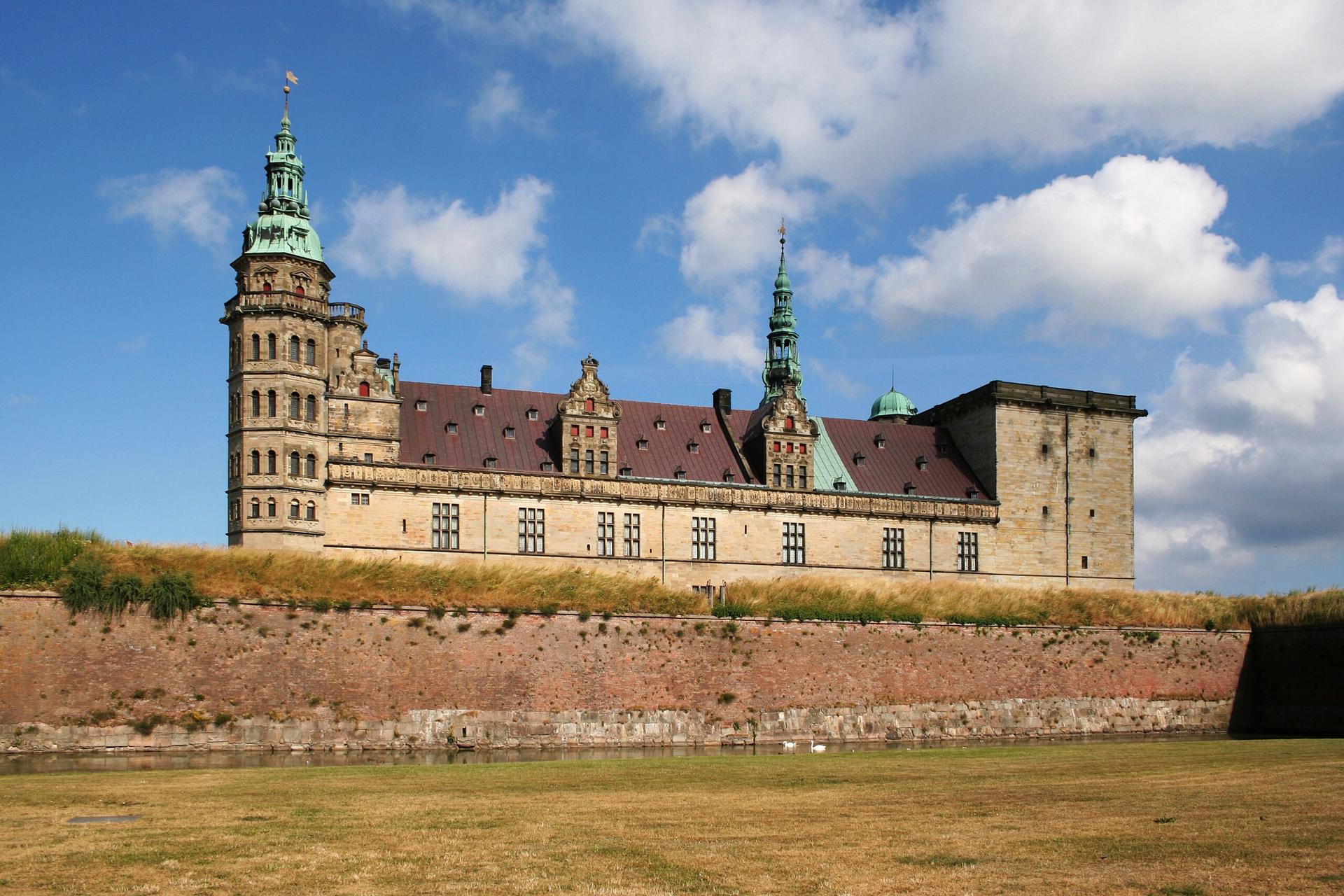
Explore North Zealand, Denmark's enchanting region of castles, beaches, and royal estates, perfect for history buffs, nature enthusiasts, and seaside lovers.
Tell me more about North Zealand
Historic yellow naval barracks turned living neighborhood, where Nyboder’s compact row houses and the Nyboder Memorial Rooms reveal 400 years of Copenhagen seafaring life.
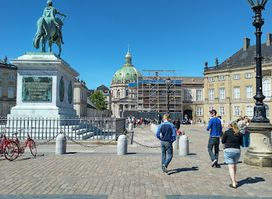
Step behind the facades of Copenhagen’s royal square to explore intimate apartments, glittering gala halls and Fabergé treasures at Amalienborg Palace Museum.