
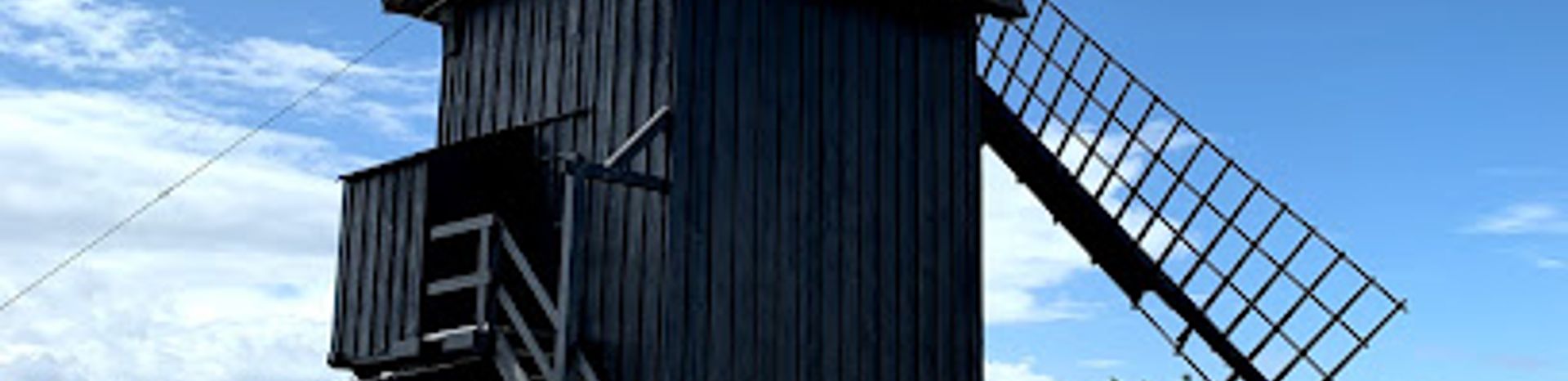
Brundby Stubmølle
One of Denmark’s oldest post mills, Brundby Stubmølle pairs centuries-old milling history with wide Samsø views from a peaceful hill just above the village.
A hilltop windmill with centuries of stories
Brundby Stubmølle crowns a small rise just north of the village of Brundby on Samsø, its weathered wooden body and long sails instantly drawing the eye across the open fields. This is not just any windmill: it is a classic post mill, a type where the whole timber structure pivots around a massive central post to face the wind. The mill’s origins reach back to the 1600s, when it stood on the island of Endelave before being sold to Samsø in 1683. First erected on the hill of Dansebjerg south of Brundby, it was moved again in 1817 to its current position, where it served the farming community until 1939. Standing close, you can trace the age of the building in its darkened planks, iron fittings and sturdy beams, all shaped for work rather than ornament. The simple, functional silhouette against the sky speaks of a time when harnessing the wind was cutting‑edge technology and vital to rural survival.Inside the workings of a post mill
On selected summer afternoons the doors of Brundby Stubmølle open, and you can climb inside the compact wooden shell. Here, the mill’s interior reveals itself as a vertical workshop. Thick beams carry the weight of the structure, while heavy gears, shafts and millstones show how wind power was translated into grinding force. The entire body of the mill once rotated around the central post using a tailpole and wheel, allowing the miller to catch even slight shifts in the breeze. Within the dim interior you can imagine the dust, clatter and rhythmic creak of the machinery when the mill was in full operation. Interpretive information, when available, helps explain each component, from the sails and brake wheel to the stones that turned grain into flour for the surrounding farms. It is an intimate, tactile way to understand pre‑industrial engineering.Views over Samsø’s soft landscape
Even if the mill itself is closed, the hillside setting makes the visit rewarding. A short walk up from the access track brings you to a grassy plateau around the structure, where simple benches and tables offer a natural pause. From here, views open across southern Samsø’s patchwork of fields, hedgerows and scattered farmsteads, with the sea shimmering in the distance on clear days. The exposed position means you are almost always aware of the wind, the very force that once powered the mill. On a bright afternoon the sails cast moving shadows on the ground; on a more brooding day, clouds race overhead and the structure feels like a steadfast landmark anchoring the landscape.A quiet stop woven into village life
Brundby Stubmølle sits just beyond Brundby’s houses and gardens, close enough to feel part of village life yet set apart on its own small hill. The approach is along a public path and farm track rather than a busy road, so the mood is unhurried and rural. Birds call from nearby hedges, and you may hear distant tractors instead of traffic. It is easy to incorporate a visit into a wider exploration of Samsø, linking it with nearby villages, coastlines and farm shops. Because the site is compact and open, it suits both a brief photo stop and a lingered picnic. The simple arrangement encourages a slower rhythm: sitting on a bench, walking a loop around the structure to see it from every angle, and watching how it changes against the sky as light shifts.Living heritage of Danish windmills
Today Brundby Stubmølle is protected as a historic structure and maintained as part of Denmark’s dwindling collection of post mills. With only a handful of these early windmills still standing, each surviving example helps tell the story of how wind power transformed rural economies long before electricity. Here, that story is unusually complete: a mill that has moved from island to island, adapted to new settings, and outlived the very farming systems it once supported. Visiting this modest yet significant structure offers a sense of continuity between past and present. The mill no longer grinds grain, but it still reads the wind, still commands its hill, and still links today’s visitors with centuries of island life on Samsø.Local tips
- Time your visit for a summer Monday or Thursday afternoon if you want the chance to step inside the mill’s interior and see the wooden machinery up close.
- Bring a picnic and use the benches near the mill; the spot is exposed to wind and sun, so pack an extra layer and perhaps a hat on bright days.
- Wear comfortable shoes for the short but slightly uphill walk from the parking area along the public track and grassy path.
- Combine the mill with a stroll through Brundby village and other nearby viewpoints on Samsø to make a relaxed half-day outing.

A brief summary to Brundby Stubmølle
- Brundbyvej 23A, Samsø Municipality, 8305, DK
- +4586592150
- Monday 1 pm-4 pm
- Thursday 1 pm-4 pm
Getting There
-
Bus and short walk from Tranebjerg
From Tranebjerg, use the local Samsø bus service toward Brundby; the ride typically takes about 10–15 minutes, with standard Danish island bus fares in the range of 20–35 DKK one way depending on ticket type. Services run several times a day in the main season but can be less frequent outside summer. From the nearest stop in Brundby village, expect an easy 10–15 minute walk on minor roads and a rural track to reach the mill’s hilltop position.
-
Bicycle from Ballen or Tranebjerg
Cycling is one of the most pleasant ways to reach the mill on Samsø’s quiet roads. From Ballen harbour, the ride via Tranebjerg to Brundby generally takes 25–40 minutes at a relaxed pace, with gentle hills but no demanding climbs. Rental bikes on the island usually cost around 80–150 DKK per day depending on type and season. The final approach to the mill follows a short gravel track and grassy path, which most standard bikes can handle if you dismount for the last stretch.
-
Car or taxi from Sælvig ferry harbour
Arriving by ferry at Sælvig, you can drive to Brundby Stubmølle in roughly 20–25 minutes on well-maintained island roads. There is informal parking along the access track partway up the hill, after which a brief uphill walk leads to the mill. Hiring a taxi for the trip typically costs in the region of 150–250 DKK one way depending on season and waiting time; advance booking is advisable during busy summer weeks.


