Slottsberget, Gothenburg Travel Guide
Free Guide: A compact, timber‑roofed hill on Lindholmen where medieval origins meet 19th‑century shipyard housing and intimate city views.


A brief summary of Slottsberget
A compact, timber‑roofed hill on Lindholmen where medieval origins meet 19th‑century shipyard housing and intimate city views.
Slottsberget is a small, characterful hill and historic neighbourhood on Lindholmen, Hisingen, overlooking the Göta älv in Gothenburg. Once the site of a medieval stronghold, the area later became a tightly packed working‑class quarter where shipyard workers built timber houses in informal clusters. Today it reads as a compact pocket of layered history: narrow lanes, weathered wooden façades, city views across the river and a sense of lived‑in continuity that links medieval origins with industrial‑era working life.
On-site amenities
 Seating areas
 Trash bins
 Information boards
Opening hours
- Every dayOpen 24 hours
Opening hours as listed on the venue’s Google Business Profile. Hours can change for services and special events, so check with the venue before you go.
- Address
- Slottsberget, 417 57 Göteborg
Getting there
Tram and Bus
Ferry + Walk
Taxi or Rideshare
Discover more about Slottsberget
A hill with layers: from medieval stronghold to workers’ settlement
Slottsberget occupies a modest rocky rise on Lindholmen with roots that reach back to the medieval period when a fortified site known as Lindholmen stood here. That early castle and royal residence played a role in regional politics centuries ago, though little of the original stonework remains above ground today. Over time the stronghold vanished while the prominence of the site persisted as a named feature in local maps and stories.
Wooden houses without a plan: how the neighbourhood took shape
In the later 19th century, as Lindholmens varv and related industries expanded, the hill was parcelled informally for workers’ housing. Small timber cottages and multi‑family houses rose in a close‑knit arrangement; rows and clusters of simple gabled façades, narrow alleys and shared courtyards create the intimate feel that still defines Slottsberget. The buildings and the way they were erected reflect vernacular craft and the social conditions of a labouring community rather than a municipal master plan.
A contested landscape: saving the hill in the 20th century
Slottsberget’s survival is in part the result of 20th‑century debates about industrial expansion and urban change. Proposals at various times envisaged heavy redevelopment, yet the area avoided wholesale demolition and successive generations adapted the place to new realities. That continuity preserved a built environment that serves as a living document of working‑class housing practices and local resilience in the face of industrial restructuring.
The look and feel today: materials, textures and riverside outlooks
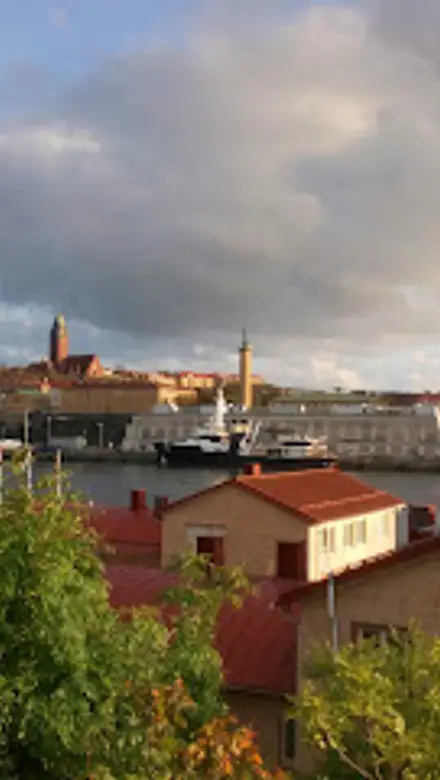
Approach the hill and you’ll notice weathered wood, painted clapboard, tin roofs and narrow stairways stepping the slope. Vegetation presses through fissures in the granite; small gardens and container plantings soften the compact volumes. From higher points on Slottsberget there are framed views across the Göta älv toward central Gothenburg — an important visual reminder that this residential patch sits directly adjacent to one of the city’s major waterways and industrial histories.
Everyday life and creative reuse
Since industrial decline the quarter has attracted a mix of long‑term residents, artists and students; some houses were adapted for studios or communal uses while others retained traditional domestic layouts. The area’s modest scale encourages walking, conversation and small community projects. Architectural details — hand‑made fences, painted shutters, and the occasional tiled stove seen through a window — signal a neighbourhood where craft and everyday practicality remain visible.
Significance for the city: memory, identity and urban texture
Slottsberget functions as a piece of Gothenburg’s urban memory: a site where medieval strategic importance, 19th‑century shipyard labour and 20th‑century preservation intersect. It stands as an example of how small, unplanned neighbourhoods contribute to a city’s character, offering a contrast to planned terraces and modern developments and reminding visitors that urban identity often resides in modest, tightly woven places rather than grand monuments.
Evendo Review Centre
 Google
Guest reviews
Best time to go
Quietest: Jan, Feb & Nov · before 3am
Busy times are Evendo estimates for a typical year, to help you plan. Actual crowds vary with events, school holidays and the weather.
Explore Slottsberget on the map
A handpicked selection of must-see spots near Slottsberget, mapped for you.
Get your free copy of our complete guide to Slottsberget, delivered straight to you.
Everything on this page, from opening hours and how to get there to Eve’s tips and the best time to go, in one PDF you can read offline, print or share.
Already have an account? Sign in
Your Slottsberget guide is ready.
We'll send it to · Not you? Sign out

Getting your guide ready…
We are putting together a fresh copy of the Slottsberget guide. This can take up to a minute.
This can take a few moments. If your browser asks, choose Allow so the download can start. You'll find the guide in your Downloads folder.
Nothing happened? Download it again
Sorry, the guide is taking longer than usual. Please try again in a minute, or get it by email instead.
Other nearby places you may find interesting
The closest places of the same kind, if this one is not quite what you had in mind.
-
-
-
-
-


Swipe for more places
More to explore near Slottsberget

 Best experiences near Slottsberget
 Best hotels near Slottsberget
 Best landmarks near Slottsberget
 Best attractions near Slottsberget
 Best shops near Slottsberget
 Best restaurants near Slottsberget
 Best bars near Slottsberget
Do you manage this location?
Take control to get all the benefits, like improved information, better appearance, and stronger visibility across AI-powered discovery.
Explore more

Explore more of Gothenburg
Discover Gothenburg: Sweden's coastal gem where cultural richness meets natural beauty. Enjoy stunning archipelagos, historic districts, and a vibrant culinary scene.
Explore Gothenburg
Explore more of Sweden
Discover Sweden's breathtaking landscapes, vibrant cities, and rich cultural heritage. From the Northern Lights to historic castles, experience the essence of Scandinavia.
Explore Sweden