

Edward VII Statue, Aberdeen Travel Guide
Free Guide: Aberdeen’s grand Edward VII Statue stands in full ceremonial robes, a striking granite and bronze tribute to the British monarch at the heart of the city.


A brief summary of Edward VII Statue
Aberdeen’s grand Edward VII Statue stands in full ceremonial robes, a striking granite and bronze tribute to the British monarch at the heart of the city.
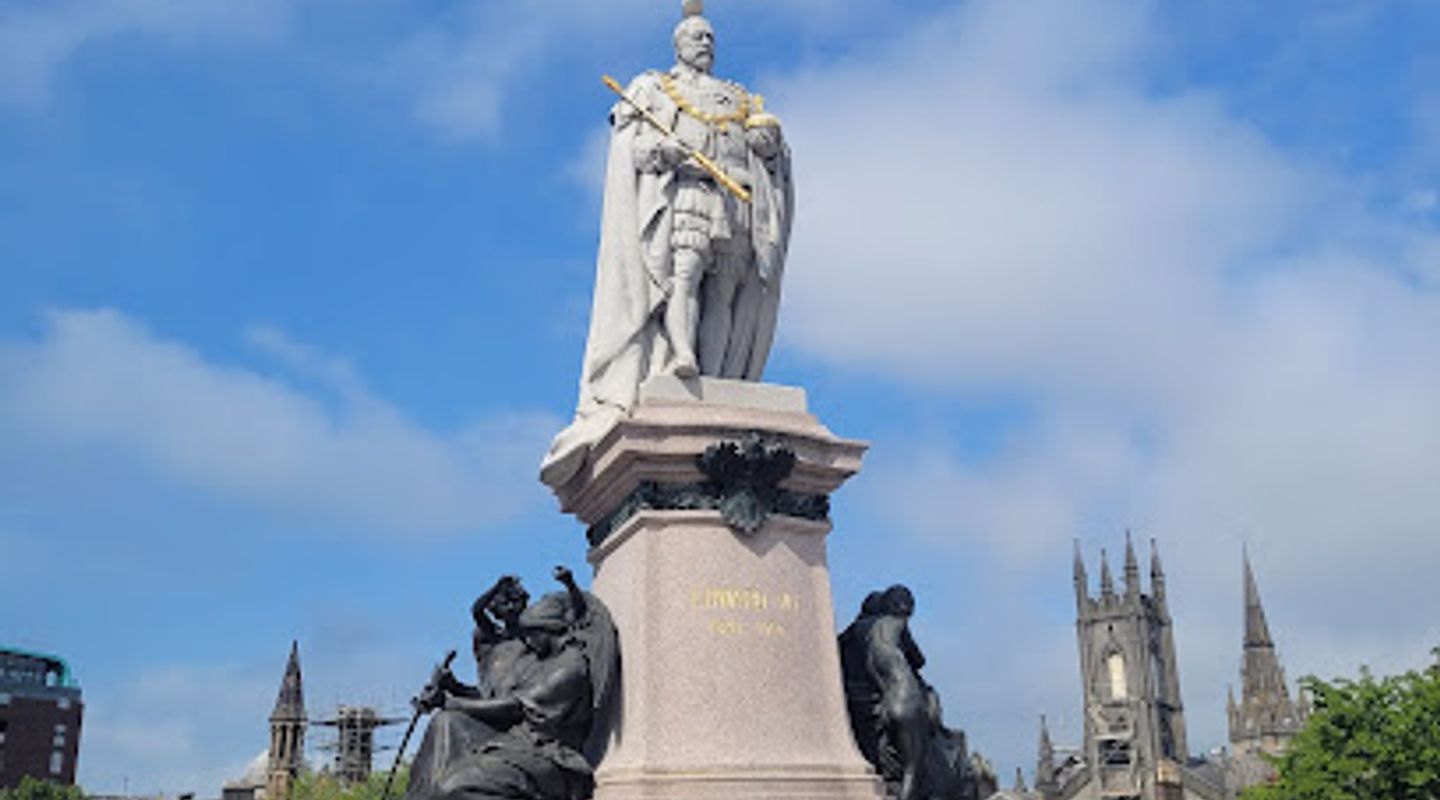
Standing proudly at the corner of Union Terrace and Union Street, Aberdeen’s Edward VII Statue is a striking granite and bronze monument to the British monarch. Designed by Alfred Drury and carved by James Philip, this elaborate sculpture shows King Edward VII in full ceremonial robes, holding a sceptre and orb. Below, a bronze frieze features symbolic figures of Britannia, St Andrew, and imperial unity, all set on a polished red Peterhead granite plinth. It’s a fine example of early 20th‑century civic sculpture in the heart of the Granite City.
On-site amenities
 Seating areas
 Trash bins
 Information boards
Opening hours
- Every dayOpen 24 hours
Opening hours as listed on the venue’s Google Business Profile. Hours can change for services and special events, so check with the venue before you go.
- Address
- Union Terrace, Aberdeen AB11 6SL
- Phone
- Website
Getting there
On foot from city centre
From Union Terrace Gardens
Discover more about Edward VII Statue
A Grand Tribute in Granite
Erected in 1914, the Edward VII Statue stands as one of Aberdeen’s most elaborate civic sculptures, a dignified tribute to King Edward VII, who reigned from 1901 to 1910. Crafted in granite and bronze, the statue was designed by the renowned sculptor Alfred Drury RA and carved by local stonemason James Philip. The king is depicted in the full regalia of the Order of the Garter, holding a sceptre and orb, symbolising royal authority and the unity of the realm. The polished red Peterhead granite plinth elevates the figure, anchoring this imperial presence in the heart of the Granite City.
Symbolism in Stone and Bronze
The monument’s lower section features a richly detailed bronze ornamental frieze that tells a story of empire and national identity. To the left, Britannia appears as a figure of peace, breaking a sword. In the centre stands St Andrew, Scotland’s patron saint, a reminder of the nation’s distinct heritage within the United Kingdom. On the right, three allegorical figures represent imperial unity: Britannia with her arm around figures symbolising India and Africa, while a fourth figure, representing Canada and Australia, reaches out in friendship to ‘The Mother of Nations’. The Latin motto ‘Honi soit qui mal y pense’ – ‘Shame on him who thinks evil of it’ – reinforces the chivalric and imperial ideals of the time.
Setting Among the Granite City’s Landmarks
Located at the junction of Union Terrace and Union Street, the statue occupies a prominent position in Aberdeen’s historic core, just steps from Union Terrace Gardens and near major cultural institutions like His Majesty’s Theatre and Aberdeen Art Gallery. The surrounding architecture, largely built from the city’s distinctive grey granite, provides a sober, enduring backdrop that contrasts with the statue’s ornate detailing. This setting makes the Edward VII Statue not just a standalone monument, but a key element in the city’s streetscape, linking commercial thoroughfares with green spaces and civic buildings.
A Living Part of the City’s Story
The statue has witnessed over a century of change in Aberdeen, from the early 20th‑century heyday of the British Empire to the modern, multicultural city of today. Its unveiling in 1914 coincided with a period of civic pride and investment in public art, and it has since become a familiar landmark for residents and visitors alike. While its imperial symbolism reflects the values of its time, the statue now also serves as a point of reflection on history, heritage, and how cities choose to remember their past. It remains a popular subject for photography and a quiet place to pause amid the bustle of the city centre.
Evendo Review Centre
 Google
Guest reviews
Best time to go
Quietest: Jan, Feb & Mar · before 3am
Busy times are Evendo estimates for a typical year, to help you plan. Actual crowds vary with events, school holidays and the weather.
Explore Edward VII Statue on the map
A handpicked selection of must-see spots near Edward VII Statue, mapped for you.
Get your free copy of our complete guide to Edward VII Statue, delivered straight to you.
Everything on this page, from opening hours and how to get there to Eve’s tips and the best time to go, in one PDF you can read offline, print or share.
Already have an account? Sign in
Your Edward VII Statue guide is ready.
We'll send it to · Not you? Sign out

Getting your guide ready…
We are putting together a fresh copy of the Edward VII Statue guide. This can take up to a minute.
This can take a few moments. If your browser asks, choose Allow so the download can start. You'll find the guide in your Downloads folder.
Nothing happened? Download it again
Sorry, the guide is taking longer than usual. Please try again in a minute, or get it by email instead.
Other nearby places you may find interesting
The closest places of the same kind, if this one is not quite what you had in mind.
-
-
-
-
-


Swipe for more places
More to explore near Edward VII Statue

 Best experiences near Edward VII Statue
 Best hotels near Edward VII Statue
 Best landmarks near Edward VII Statue
 Best attractions near Edward VII Statue
 Best shops near Edward VII Statue
 Best restaurants near Edward VII Statue
 Best bars near Edward VII Statue
Do you manage this location?
Take control to get all the benefits, like improved information, better appearance, and stronger visibility across AI-powered discovery.
Explore more

Explore more of Aberdeen
Discover Aberdeen's sparkling granite architecture, rich maritime heritage, and scenic coastal beauty along Scotland's northeast coast.
Explore Aberdeen
Explore more of United Kingdom
Discover the United Kingdom: A blend of rich history, stunning landscapes, and vibrant cities, offering a unique travel experience for every visitor.
Explore United Kingdom
