10 Downing St, London Travel Guide
Free Guide: Britain's most iconic address—where centuries of political power unfold behind a famous black door.


A brief summary of 10 Downing St
Britain's most iconic address—where centuries of political power unfold behind a famous black door.
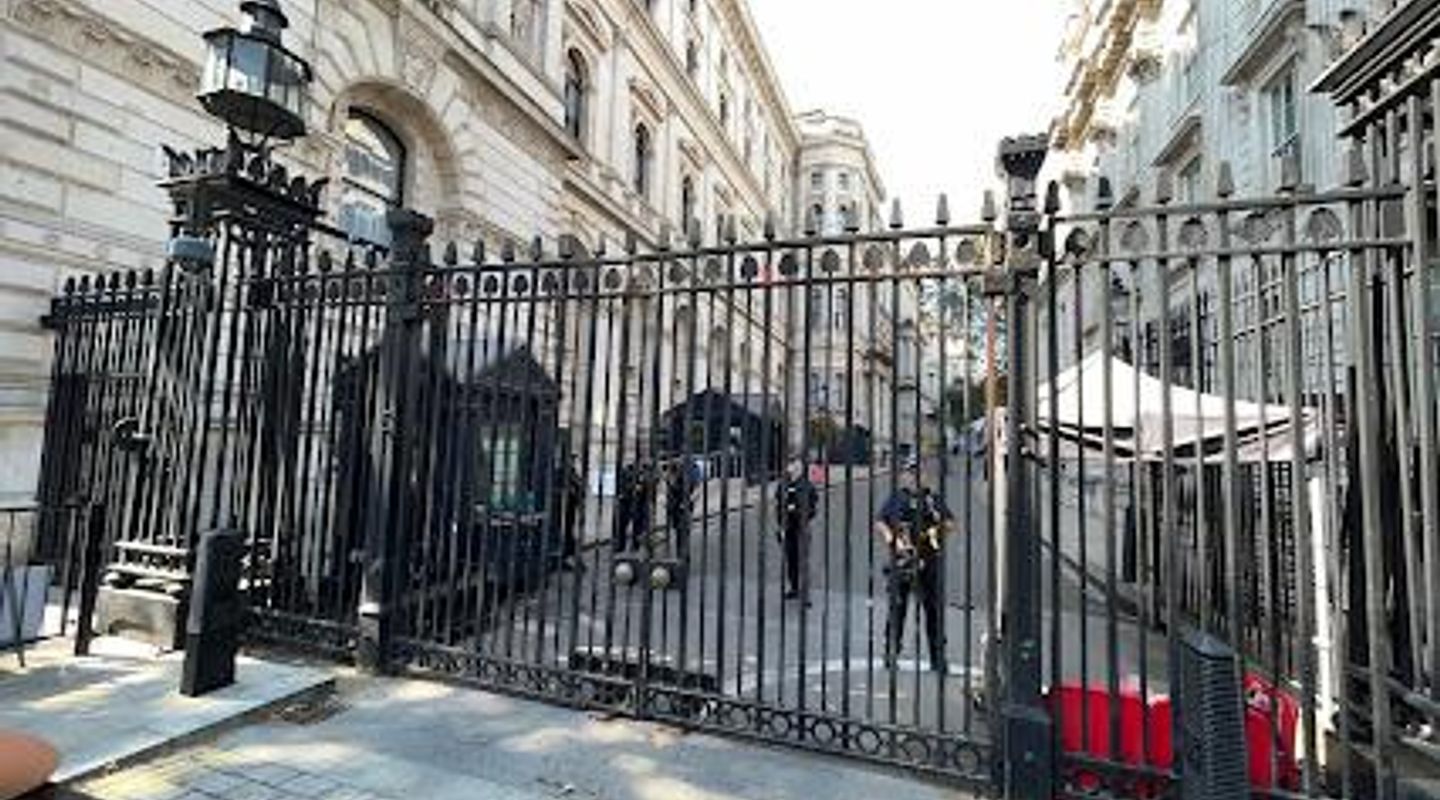
The iconic official residence and office of the British Prime Minister since 1735, 10 Downing Street is a Georgian townhouse of immense historical significance located in Westminster, London. Behind its famous black door, this deceptively modest-looking building has witnessed centuries of pivotal moments in British governance, from wartime speeches to landmark political decisions. Though not open to the general public, the building remains one of the world's most recognizable addresses and a powerful symbol of British democracy and political power.
On-site amenities
 Information boards
- Address
- 10 Downing St, London SW1A 2AB, UK
Getting there
London Underground
London Bus
Walking from Central London
Taxi or Ride-Share
Discover more about 10 Downing St
From Humble Beginnings to Seat of Power
The story of 10 Downing Street begins not with grand ambitions but with pragmatic real estate speculation. Sir George Downing, a diplomat and former spy for Oliver Cromwell who later switched allegiance to King Charles II, purchased land south of St James's Park in 1654 with the intention of building profitable townhouses for the political elite. When the lease on the existing Hampton House expired in 1682, Downing demolished the structure and parceled the land into building lots, laying out the street that now bears his name. The original buildings constructed here were modest affairs, built cheaply on boggy ground with poor foundations—a fact that would haunt the property for centuries to come.The specific building that became Number 10 has an even older pedigree. Parts of it trace back to the Middle Ages, when a brewery operated on the site under the Abbey of Abingdon. By the early 17th century, the land had been leased to Sir Thomas Knyvet, one of Queen Elizabeth I's favoured courtiers and the man responsible for uncovering the Gunpowder Plot of 1605. The building evolved through successive occupants, eventually becoming the property of Count Bothmer, a diplomat whose residence faced onto St James's Park rather than the street itself.
Walpole's Transformation and the Birth of a Tradition
The transformation of Number 10 into a residence befitting Britain's most powerful politician occurred in the 1730s. King George II offered the property to Sir Robert Walpole, the First Lord of the Treasury and widely regarded as Britain's first Prime Minister, as a gift to match his elevated status. Walpole's acceptance came with a crucial condition: the house would belong to the office, not to him personally, ensuring that future First Lords of the Treasury could occupy it. This decision established a precedent that continues unbroken to the present day.Before Walpole could move in, the property underwent a dramatic transformation. The architect William Kent, a master of Palladian design, was commissioned to join the existing houses together and remodel them into a coherent residence worthy of a statesman. The work took three years and proved far more expensive than anticipated, with costs likely exceeding £20,000—an enormous sum in the 1730s. On 22 September 1735, Walpole formally took possession, moving his family from their previous residence in St James's Square. The following day, he held his first levee at the new address, and within three days, Queen Caroline herself visited to take breakfast with Lady Walpole, a clear mark of royal approval.
A Deceptively Complex Interior
What appears from the street as a modest Georgian townhouse conceals a far more complex and extensive interior. The building comprises multiple structures amalgamated over decades, with grand reception rooms on the first and second floors designed for entertaining dignitaries, royalty, and world leaders. The ground floor served as Walpole's business quarters, establishing the pattern of combining residence and office that persists today. Over the subsequent centuries, successive Prime Ministers and architects left their mark on the interior. Sir John Soane designed the State Dining Room and Small Dining Room in the 19th century. Lord North, Prime Minister from 1770 to 1782, added the iconic lion's head doorknocker and the distinctive black-and-white chequerboard floor in the entrance hall. During William Gladstone's tenure in 1884, electric lighting was installed and the first telephones connected. Central heating arrived in 1937, and the attic rooms were converted into a flat for the Prime Minister's private use.The building's structural challenges proved persistent. Poor foundations laid on boggy ground meant that windows and doors constantly moved out of true, requiring a permanent on-site carpenter to make continuous adjustments. The fire risk was so acute that an industrial fireman had to be employed full-time to watch over the building. These problems were not adequately addressed until the substantial rebuilding undertaken during Harold Macmillan's premiership in the late 1950s and early 1960s. The Crawford Committee, appointed in 1957, concluded that despite the deteriorating condition of Numbers 10, 11, and 12 Downing Street, the historical associations of these buildings were too valuable to permit demolition. The reconstruction preserved the historic first-floor State Rooms and Cabinet suite while modernizing the building's services, foundations, and structural integrity. For the first time in over 200 years, the building became truly robust and fit for purpose.
Centre Stage for British History
Throughout the 20th century, 10 Downing Street became the focal point for some of the most significant moments in British and world history. In 1908, suffragette leaders including Emmeline Pankhurst chained themselves to the railings outside Number 10, generating enormous publicity for their campaign for women's voting rights. In 1938, Prime Minister Neville Chamberlain emerged from the building waving the Anglo-German Agreement of Friendship, proclaiming "Peace with honour" after his meeting with Adolf Hitler in Munich—a moment that would prove tragically premature. A year later, Chamberlain broadcast from the Cabinet Room the sombre announcement that Britain had declared war on Germany.During World War II, Winston Churchill made the building his command centre, famously conducting business from his bed while smoking cigars and dictating speeches and letters to his secretaries. On 8 May 1945, Churchill chose the formal setting of the Cabinet Room to broadcast the VE Day message announcing Victory in Europe. The building itself did not escape the London Blitz unscathed; in February 1944, a bomb fell on nearby Horse Guards Parade, destroying some of the drawing-room windows. The decades that followed saw the building witness further historic moments: Brexit negotiations, lockdown briefings, leadership changes, and the weekly Cabinet meetings that shape British policy. The building has also served as a gathering place for protest and dissent, with anti-Vietnam War demonstrators marching there in the 1960s and anti-Iraq War protesters in 2005.
Symbol and Substance of Power
The term "Downing Street" has transcended its geographical meaning to become synonymous with British government itself. When media outlets report that "Downing Street announced today," they are referring not merely to a location but to the authority and decision-making power of the Prime Minister and Cabinet. The street itself comprises three significant buildings: Number 10, the Prime Minister's residence and office; Number 11, the official home of the Chancellor of the Exchequer; and Number 12, used for press and staff functions. Together, they form the physical heart of British executive power.The iconic black door of Number 10, with its gleaming brass number plate, has become one of the most photographed and recognizable entrances in the world. Yet the building's true significance lies not in its appearance but in the decisions made within its walls and the historical weight it carries. Prime Ministers from Robert Walpole to the present day have grappled with the nation's most pressing challenges within these rooms. Margaret Thatcher, who lived at Number 10 longer than any other 20th-century Prime Minister, described it as "one of the most precious jewels in the national heritage." Harold Wilson reflected on the building's power to inspire, noting that without a sense of history and tradition, a Prime Minister cannot properly address the problems of the present. Today, despite its complicated and meandering layout—the result of centuries of architectural adjustments—10 Downing Street remains a house full of history, intrigue, and power, preserved as a living monument to British governance.
Evendo Review Centre
 Google
Guest reviews
Best time to go
Quietest: Jan, Feb & Nov · before 6am or at 10pm
Busy times are Evendo estimates for a typical year, to help you plan. Actual crowds vary with events, school holidays and the weather.
Explore 10 Downing St on the map
A handpicked selection of must-see spots near 10 Downing St, mapped for you.
Get your free copy of our complete guide to 10 Downing St, delivered straight to you.
Everything on this page, from opening hours and how to get there to Eve’s tips and the best time to go, in one PDF you can read offline, print or share.
Already have an account? Sign in
Your 10 Downing St guide is ready.
We'll send it to · Not you? Sign out

Getting your guide ready…
We are putting together a fresh copy of the 10 Downing St guide. This can take up to a minute.
This can take a few moments. If your browser asks, choose Allow so the download can start. You'll find the guide in your Downloads folder.
Nothing happened? Download it again
Sorry, the guide is taking longer than usual. Please try again in a minute, or get it by email instead.
Unlock the best of 10 Downing St
Skip-the-line tickets, guided tours with entry, and walking tours of the area, booked in a few clicks.
 Tour with entry
Podcast Tour London A Thousand Years of British Power
from $6.38 Tour with entry
Classic London Tour & Changing the Guards— History In Action
from $31.44 Tour with entry
History of London: City Centre guided tour
from $59.26 Tour with entry
Westminster Small Group Guided Tour with Changing of the Guard
from $126.85


Other nearby places you may find interesting
The closest places of the same kind, if this one is not quite what you had in mind.
-

-
-
-
-


Swipe for more places
More to explore near 10 Downing St

 Best experiences near 10 Downing St
 Best hotels near 10 Downing St
 Best landmarks near 10 Downing St
 Best attractions near 10 Downing St
 Best shops near 10 Downing St
 Best restaurants near 10 Downing St
 Best bars near 10 Downing St
Do you manage this location?
Take control to get all the benefits, like improved information, better appearance, and stronger visibility across AI-powered discovery.
Explore more

Explore more of London
Explore London: A city of iconic landmarks, rich history, vibrant culture, and endless attractions that cater to every taste, making it a must-visit destination.
Explore London
Explore more of United Kingdom
Discover the United Kingdom: A blend of rich history, stunning landscapes, and vibrant cities, offering a unique travel experience for every visitor.
Explore United Kingdom