David Hume Statue, Stirling Travel Guide
A classical tribute to Edinburgh’s Enlightenment philosopher, famed for his polished toe and complex legacy on the Royal Mile.
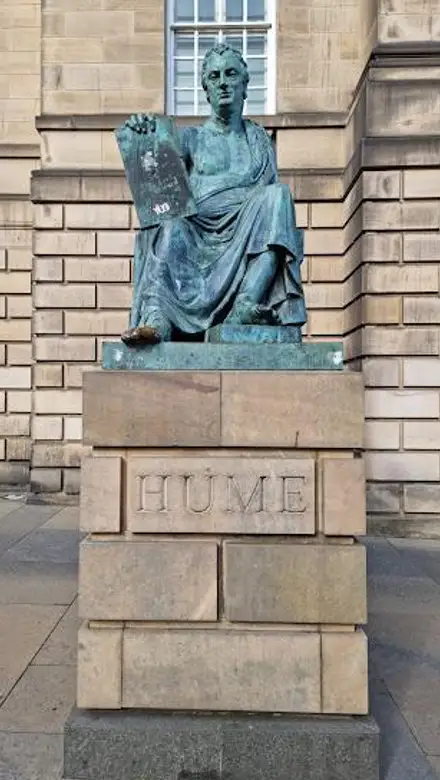
Located at 379-381 High Street, Edinburgh, the David Hume Statue honors the influential 18th-century Scottish philosopher known for his skepticism and contributions to the Scottish Enlightenment. Sculpted in classical Greek style by Alexander Stoddart, the statue is famous for its polished toe, rubbed by visitors for luck. It stands prominently near the High Court, offering a glimpse into Edinburgh’s rich intellectual history and complex legacy.
A brief summary to David Hume Statue
- 379-381 High St, Edinburgh, EH1 1PW, GB
- Duration: 0.25 to 1 hours
- Free
-
 Outdoor
- Mobile reception: 5 out of 5

Know before you go
Hi, I'm Eve. Here are a few practical things to know before exploring David Hume Statue.
- Avoid rubbing the toe excessively to help preserve the statue’s condition.
- Visit early morning or late evening to avoid crowds around the statue.
- Take a moment to look behind the statue to see the figure of Helios, symbolizing Enlightenment.
- Combine your visit with nearby landmarks like St Giles’ Cathedral and the Heart of Midlothian.
Do you manage this location?
Take control to get all the benefits, like improved information, better appearance, and stronger visibility across AI-powered discovery. Learn more about listing your business on Evendo
Activate your presenceOther nearby places you may find interesting
The closest places of the same kind, if this one is not quite what you had in mind.




Explore David Hume Statue on the Map
A handpicked selection of must-see spots near David Hume Statue, mapped for you.
Unlock the Best of David Hume Statue
Buy tickets
-
No tickets available
Book tours with entry


Getting There
-
Bus
Take Lothian Buses routes 35 or 36, which run frequently from Edinburgh city center to stops near the Royal Mile. Journey times range from 10 to 20 minutes. Tickets cost approximately £1.80–£2.00. Note that buses may be crowded during peak hours.
-
Tram and Walk
Use the Edinburgh Tram to St Andrew Square stop, then enjoy a 15-minute walk along Princes Street and the Royal Mile to the statue. Trams run every 7–10 minutes with tickets priced around £1.80–£3.50 depending on zones.
-
Walking
From Edinburgh Waverley Station, it is a 15–20 minute walk along Princes Street and the Royal Mile to the statue. The route is mostly flat and accessible, suitable for most visitors.
For the on-the-go comforts that matter to you
-
 Restrooms
-
 Drink Options
-
 Food Options
-
 Seating Areas
-
 Information Boards
Discover more about David Hume Statue
A Tribute to a Scottish Enlightenment Giant
The David Hume Statue, situated on Edinburgh’s historic Royal Mile outside the High Court, commemorates one of Scotland’s most influential philosophers. Born in 1711, Hume was a central figure of the Scottish Enlightenment, a period marked by remarkable advances in philosophy, science, and literature. His work on empiricism, skepticism, and human nature shaped modern Western thought and influenced many later philosophers, including Immanuel Kant. The statue captures Hume in the guise of an ancient Greek philosopher, a classical representation that contrasts with his 18th-century Scottish identity.Artistic Design and Symbolism
Created by sculptor Alexander "Sandy" Stoddart and unveiled in 1997, the statue portrays Hume seated with his right foot’s big toe dangling over the plinth’s edge. This toe has become a focal point for visitors, polished to a bright shine from centuries of being rubbed for good luck or wisdom, despite Hume’s own rejection of superstition. Behind the statue, Stoddart included a figure of Helios, the Greek sun god, symbolizing enlightenment and reason, surrounded by snakes representing anti-intellectualism. This artistic layering invites reflection on Hume’s intellectual legacy and the ongoing struggle between reason and superstition.Historical Context and Controversy
While Hume is celebrated for his philosophical achievements, his legacy is complex. He held views on race that are now widely regarded as racist, particularly his assertions about the supposed inferiority of non-white peoples. These views have sparked debate about the appropriateness of public monuments honoring him. Edinburgh’s community and visitors are encouraged to engage with this nuanced history, recognizing both Hume’s profound contributions and the problematic aspects of his thought within the context of 18th-century colonialism and racial theories.Connection to Edinburgh’s Intellectual Heritage
The statue’s location on the Royal Mile places it at the heart of Edinburgh’s historical and cultural fabric. Nearby landmarks include St Giles’ Cathedral and the Mercat Cross, sites deeply intertwined with Scotland’s political and religious history. Hume himself lived and worked in Edinburgh, including serving as chief librarian to the Advocate’s Library, which granted him access to vast knowledge resources. His modest tomb in Old Calton Cemetery, designed by Robert Adam, reflects his wish for simplicity, bearing only his name and dates.Visitor Experience and Local Traditions
Visitors to the statue often partake in the ritual of rubbing Hume’s toe, a practice that has turned the bronze into a gleaming golden sphere. This tradition, while ironic given Hume’s skepticism, adds a lively and engaging element to the site. The statue attracts philosophy students, tourists, and locals alike, providing a tangible connection to Edinburgh’s Enlightenment past. The surrounding area buzzes with the energy of the Royal Mile, offering a mix of historic ambiance and contemporary urban life.Reflecting on Legacy and Memory
The David Hume Statue stands as a testament to the enduring influence of Enlightenment thought and the complexities of commemorating historical figures. It invites contemplation of the progress of ideas, the evolution of societal values, and the importance of critical engagement with history. As you stand before the statue, you are invited to consider not only Hume’s intellectual achievements but also the broader conversations about race, philosophy, and public memory that continue to shape Edinburgh today.












Your all‑in‑one travel companion app
Explore expert travel guides, compare and book tours, experiences, hotels, and more—all from the palm of your hand. Download now for seamless trip planning wherever your wanderlust takes you.


Explore More of Stirling
Looking beyond David Hume Statue? Discover Stirling for broader travel guides, local hot-spots, and regional highlights.
Explore Stirling
Discover Edinburgh’s medieval heritage through the intricately carved High Street Wellhead, a historic water source nestled in Old Assembly Close.

A granite heart marking Edinburgh's most infamous prison, where superstition meets Scottish history on the Royal Mile.