George IV Bridge, Stirling Travel Guide
Free Guide: Historic elevated street connecting Old Town to the South Side, lined with Victorian architecture and cultural institutions.


A brief summary of George IV Bridge
Historic elevated street connecting Old Town to the South Side, lined with Victorian architecture and cultural institutions.
George IV Bridge is an elevated historic street in Edinburgh's city centre, spanning the Cowgate and connecting the Royal Mile to the South Side. Completed in 1836 and designed by architect Thomas Hamilton, this 300-metre stone thoroughfare is lined with elegant Victorian buildings and hosts significant cultural institutions including the National Library of Scotland and Edinburgh Central Library. The bridge showcases architectural heritage, literary history, and serves as a vital pedestrian and vehicular route through Scotland's capital.
On-site amenities
 Restrooms
 Drink options
 Food options
 Seating areas
 Information boards
 Visitor centre
- Address
- Edinburgh
Getting there
Walking from Princes Street
Bus from City Centre
Walking from Waverley Station
Taxi or Ride-Share
Discover more about George IV Bridge
A Bridge Born from Urban Vision
George IV Bridge stands as one of Edinburgh's most significant architectural achievements, an elevated street that fundamentally reshaped the city's geography and connectivity. Designed by the renowned architect Thomas Hamilton, the bridge was constructed between 1827 and 1836 as part of the Edinburgh Improvement Act of 1827. The foundation stone was laid on 15 August 1827, marking the beginning of a transformative project that would connect Edinburgh's disparate districts. Measuring 300 metres in length, the bridge spans across the historic Cowgate and Merchant Street, linking the Lawnmarket section of the Royal Mile in the north with Chamber Street and the university district in the south. The bridge was named in honour of King George IV, whose visit to Edinburgh in 1822 had elevated Scotland's profile as a visitor destination and inspired civic pride.
Architectural Transformation and Urban Renewal
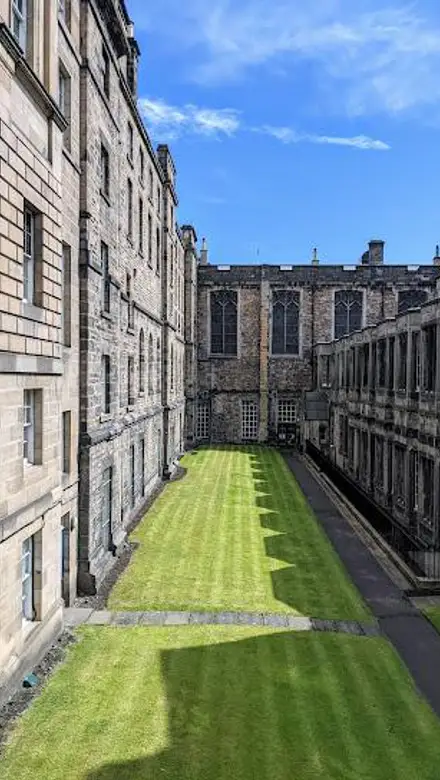
The construction of George IV Bridge required significant urban sacrifice. Two of Edinburgh's traditional Old Town streets, Old Bank Close and Libberton's Wynd, were demolished to make way for the new thoroughfare. The well-known John Dowie's Tavern, a historic establishment on Libberton's Wynd, was lost in the process. The Oz Bar in Candlemaker Row suffered heavy damage during construction, and workers discovered a hidden back entrance to Brown Square, a residential development for the wealthy built in the early 1760s that was itself demolished to accommodate the bridge. Despite these losses, the bridge represented progressive urban planning, creating a logical linear connection aligned with Bank Street and The Mound, which linked to Princes Street and the New Town. The street itself features elegant stone buildings constructed in the Victorian era, many with distinctive architectural details and carefully preserved facades that reflect Edinburgh's commitment to architectural quality.
Cultural and Institutional Significance
George IV Bridge evolved into a centre of intellectual and cultural life. During the Victorian period, the street became renowned as a hub for publishers and booksellers, with numerous literary establishments occupying its premises. The National Library of Scotland, designed by architect Reginald Fairlie and completed in 1958, occupies a prominent position on the bridge. This imposing classical-modern structure features stylised bas-relief sculptures by Hew Lorimer, whose figures, though darkened by Edinburgh's industrial past, remain striking examples of mid-twentieth-century craftsmanship. Opposite the National Library stands Edinburgh Central Library, a beautiful Victorian building designed by Scottish architect George Washington Browne in French Renaissance style. Built between 1887 and 1903 with funding from philanthropist Andrew Carnegie, the library bears Carnegie's motto "Let There be Light" on its facades. The building incorporates 17th-century door lintels from Sir Thomas Hope's house, built in 1616, preserving fragments of Edinburgh's medieval past within its Victorian structure.
Religious Heritage and Architectural Repurposing
The bridge's history reflects Edinburgh's evolving spiritual and social landscape. The Reformed Presbyterian Church, built at the end of the 1850s, later became the Frankenstein's Bar, a popular establishment that occupies a converted place of worship. The Augustine United Church and the former Elim Pentecostal Church, now a public house, demonstrate how religious buildings have been repurposed to serve contemporary community needs. At the southern end of George IV Bridge, the Bedlam Theatre occupies what was once the New North Free Church, built in 1848. This building underwent multiple transformations throughout the twentieth century, serving as the New North United Free Church, the New North Church of Scotland, and the University of Edinburgh Chaplaincy before becoming a vibrant theatre venue. The theatre's name recalls the lunatic asylum that once stood on the site, a reminder of Edinburgh's medical and social history.
Visible Heritage and Historical Markers
Two arches of George IV Bridge remain externally visible where it crosses the Cowgate, and during summer months, the Underbelly festival uses the underside of these arches as performance spaces, bringing contemporary culture into dialogue with historic infrastructure. A plaque at the base of one arch commemorates James Connolly, a major figure in Ireland's political uprising against British rule, who was born in a tenement on the Cowgate in 1868. The bridge offers distinctive vantage points for viewing Greyfriars Graveyard and distant perspectives towards Holyrood Palace and Arthur Seat. At the southern junction with Candlemaker Row stands the statue of Greyfriars Bobby, Edinburgh's most famous dog, while the junction with Chambers Street marks the location of the National Museum of Scotland. The street continues south to a Y-junction where it diverges into Bristo Place and Forrest Road, both of which were created as part of the same urban improvement initiative that transformed this quarter of the city.
Evendo Review Centre
 Google
Guest reviews
Best time to go
Quietest: Jan, Feb & Mar · before 6am or from 11pm
Busy times are Evendo estimates for a typical year, to help you plan. Actual crowds vary with events, school holidays and the weather.
Explore George IV Bridge on the map
A handpicked selection of must-see spots near George IV Bridge, mapped for you.
Get your free copy of our complete guide to George IV Bridge, delivered straight to you.
Everything on this page, from opening hours and how to get there to Eve’s tips and the best time to go, in one PDF you can read offline, print or share.
Already have an account? Sign in
Your George IV Bridge guide is ready.
We'll send it to · Not you? Sign out

Getting your guide ready…
We are putting together a fresh copy of the George IV Bridge guide. This can take up to a minute.
This can take a few moments. If your browser asks, choose Allow so the download can start. You'll find the guide in your Downloads folder.
Nothing happened? Download it again
Sorry, the guide is taking longer than usual. Please try again in a minute, or get it by email instead.
Unlock the best of George IV Bridge
Skip-the-line tickets, guided tours with entry, and walking tours of the area, booked in a few clicks.
 Tour
TourTOP Edinburgh : Private Guided Tour with your mobile
from $10.66 Tour
TourBig Bus Edinburgh 24 or 48 hour Hop On Hop Off Sightseeing Tour
from $24.97 Tour
TourCity Sightseeing Edinburgh Hop-On Hop-Off Bus Tour + Kids Go Free
from $25.22 Tour
TourBig Bus Edinburgh Hop-On Hop-Off City and Britannia Bus Tour
from $34.05
Other nearby places you may find interesting
The closest places of the same kind, if this one is not quite what you had in mind.
-
-
-
-
-


Swipe for more places
More to explore near George IV Bridge

 Best experiences near George IV Bridge
 Best hotels near George IV Bridge
 Best landmarks near George IV Bridge
 Best attractions near George IV Bridge
 Best shops near George IV Bridge
 Best restaurants near George IV Bridge
 Best bars near George IV Bridge
Do you manage this location?
Take control to get all the benefits, like improved information, better appearance, and stronger visibility across AI-powered discovery.
Explore more

Explore more of Stirling
Discover Stirling: A city where history comes alive amidst stunning landscapes and cultural richness in the heart of Scotland.
Explore Stirling
Explore more of United Kingdom
Discover the United Kingdom: A blend of rich history, stunning landscapes, and vibrant cities, offering a unique travel experience for every visitor.
Explore United Kingdom