
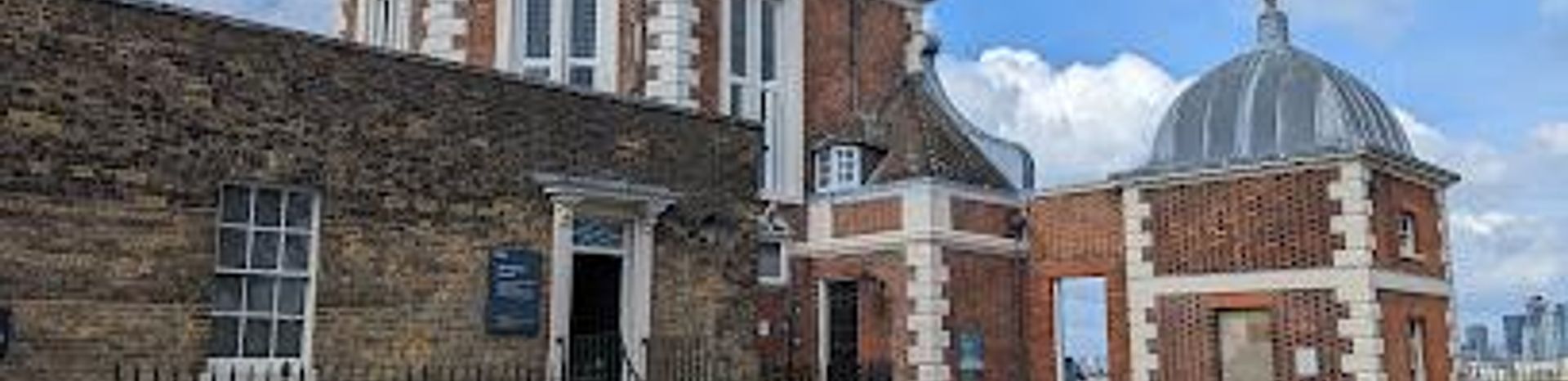
Royal Observatory Greenwich
Home of Greenwich Mean Time and the Prime Meridian, where the world’s time begins and one foot can stand in each hemisphere.
Where Time and Longitude Were Born
Founded in 1675 by King Charles II and designed by Sir Christopher Wren, the Royal Observatory was created to solve the critical problem of longitude at sea. Its original purpose was to map the stars with such precision that sailors could determine their position and avoid disastrous shipwrecks. Over centuries, it became the heart of British astronomy and the keeper of time itself. The observatory’s work laid the foundation for Greenwich Mean Time (GMT), which in 1884 was adopted as the world’s Prime Meridian, dividing east from west and shaping the global time zone system we still use today.Walking the Meridian and the Great Equatorial Telescope
The most famous moment for most visitors is standing on the Meridian Line in the courtyard, with one foot in the eastern hemisphere and one in the western. This line, defined by the Airy Transit Circle telescope, became the global reference for zero degrees longitude. Nearby, the Great Equatorial Telescope, housed in its distinctive onion dome, is one of the UK’s largest historic refractors. Visitors can step inside to appreciate its scale and learn how it helped astronomers peer deeper into the universe. The observatory also preserves the original Time Ball, which has dropped daily at 1pm since 1833, once signaling the exact time to ships on the Thames.Timekeepers, Instruments and the Octagon Room
Inside Flamsteed House, the Time Galleries trace the evolution of navigation and timekeeping, with a highlight being John Harrison’s revolutionary marine chronometers. These precision clocks solved the longitude problem and transformed maritime safety. The Octagon Room, the oldest part of the observatory, was Wren’s elegant solution for a stable, level platform for astronomical instruments. Today, it’s a beautifully preserved space where visitors can imagine 17th-century astronomers at work, surrounded by period instruments and clocks. The museum also displays a 4.5-billion-year-old meteorite and other fascinating astronomical and navigational tools.A Hilltop with a View and a Modern Astronomy Hub
Beyond the historic buildings, the Observatory sits at the top of Greenwich Park, offering one of London’s most celebrated panoramic views. From the hill, the skyline unfolds with the River Thames, the City of London, Canary Wharf, and the dome of St Paul’s Cathedral. The site now also functions as a modern astronomy centre, with interactive galleries and live science demonstrations that bring space and the cosmos to life for all ages. While the Peter Harrison Planetarium is currently closed for a major renovation, the observatory continues to host talks, tours, and hands-on activities that deepen the experience of astronomy and the history of time.Local tips
- Book timed tickets online in advance, especially on weekends and holidays, to guarantee entry and avoid long queues.
- Wear comfortable shoes; the walk up the hill from Greenwich town or the park entrance is steep and can be tiring.
- Download the free audio guide before your visit to get the most out of the exhibits and historical context at your own pace.
- Visit early in the day or late afternoon to avoid the biggest crowds and enjoy clearer views across London.
- Combine your visit with the nearby National Maritime Museum, Queen’s House, and Cutty Sark for a full day in Greenwich.

A brief summary to Royal Observatory Greenwich
- Blackheath Ave, London, SE10 8XJ, GB
- +442083126608
- Visit website
- Monday 10 am-5 pm
- Thursday 10 am-5 pm
- Friday 10 am-5 pm
- Saturday 10 am-5 pm
- Sunday 10 am-5 pm
Getting There
-
Public Transport
From central London, take the DLR or National Rail to Greenwich Station, then walk about 15 minutes uphill through Greenwich Park to the Observatory. The route is well signed and passes the National Maritime Museum and Queen’s House.
-
Public Transport
Alternatively, take the DLR to Maze Hill Station and enter Greenwich Park via the Maze Hill gate, then follow the path uphill to the Observatory in about 10–15 minutes.
-
Riverboat
Take a Thames Clipper riverboat to Greenwich Pier, then walk about 15 minutes through the park, passing the Cutty Sark and the National Maritime Museum on the way to the Observatory.
-
Walking
From central Greenwich town, walk up the hill through the park entrance near the National Maritime Museum; the climb is steep but well paved and takes about 10–15 minutes.


