
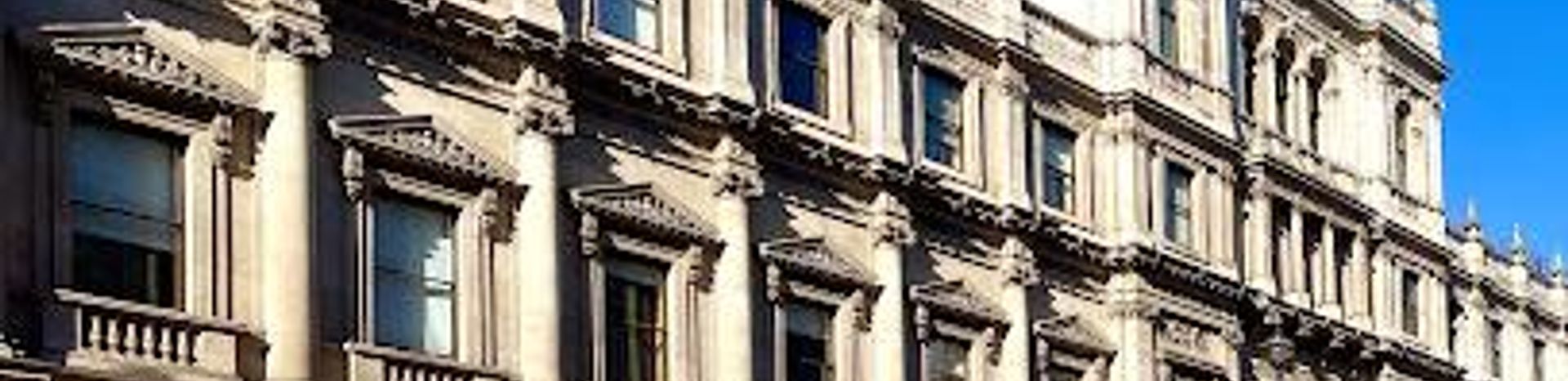
Burlington House
London's Palladian jewel and home to the Royal Academy of Arts and five learned societies.
From Private Mansion to Palladian Masterpiece
Burlington House began its life in 1664 as a red-brick mansion commissioned by Sir John Denham, Surveyor-General to King Charles II. Denham was granted the land by the Crown in recognition of his loyalty during the English Civil War, and he built the original house to receive his new bride. The unfinished property was sold in 1668 to Richard Boyle, the 1st Earl of Burlington, whose name the building has carried ever since. The 1st Earl completed the house and lived there until his death in 1697, after which it passed through his descendants. The true transformation came under Richard Boyle, the 3rd Earl of Burlington (1694–1753), known as "the architect earl" and "Apollo of the Arts." Following his European Grand Tours between 1714 and 1719, where he carried Andrea Palladio's architectural treatise as both reference and notebook, the Earl became the principal patron of the Palladian movement in Britain. Around 1717–1718, he commissioned architect Colen Campbell to redesign his own home in strict Palladian style. William Kent, another key figure in the movement, was brought in to redesign the interiors, creating the surviving Saloon—credited as the first "Kentian" interior in England. This collaboration between Burlington, Campbell, and Kent established Palladian architecture as the dominant aesthetic for decades, with its influence still visible in London today.A Gathering Place for Enlightenment Minds
During the 3rd Earl's lifetime, Burlington House became the regular meeting place of London's leading wits, poets, and scholars. The guest list read like a who's who of Georgian intellectual life, including Alexander Pope, Dean Swift, and John Gay. The house embodied the spirit of the age—a place where art, architecture, and learning converged. When the Earl died in 1753, the property passed to his widow and then to their grandson William Cavendish, the 5th Duke of Devonshire. The Cavendish family maintained the house's cultural significance, and notably, Henry Cavendish, the scientist who discovered hydrogen, lived there for several years in his youth. In 1815, the 6th Duke of Devonshire leased the house to his uncle, Lord George Cavendish, who worked with architect Samuel Ware to make subtle but considerable alterations between 1815 and 1818. By Lord Cavendish's order in 1819, the elegant Burlington Arcade was constructed along the western side of the property, becoming one of London's most celebrated shopping passages.Government Purchase and Institutional Home
In 1854, the British government purchased Burlington House for £140,000, initially considering demolishing it to make way for the University of London. Strong public opposition prevented this fate, and instead the building was allocated to learned societies and the Royal Academy of Arts. The Royal Academy, founded by King George III in 1768, took over the main block on a 999-year lease in 1867 at the nominal rent of one pound per year. Architects Charles Barry and R.R. Banks designed additional accommodation in the West and East wings and gateway blocks between 1869 and 1873, enclosing the Royal Academy's courtyard in Portland Stone. Since 1874, Burlington House has been home to an extraordinary constellation of institutions. The Geological Society moved to its present apartments that year, followed by the Linnean Society in 1856 (though some sources indicate 1874 as the formal establishment of multiple societies). The Royal Society of Chemistry, Royal Astronomical Society, and Society of Antiquaries joined over subsequent decades. The building has continued to evolve, with Sidney Smirke adding a third floor for the Diploma Galleries, and later Norman Foster overseeing a 1991 remodelling of the Diploma Galleries, now known as The Sackler Wing of Galleries. The John Madejski Fine Rooms represent the restoration of the former state rooms, including the celebrated Saloon.Architectural Significance and Design Legacy
The exterior of Burlington House is constructed from Portland Stone, a material that has weathered centuries of London weather while maintaining its dignified appearance. The building represents a pivotal moment in English architectural history—the point at which Palladian design transitioned from the isolated experiments of Inigo Jones in the 17th century to a dominant national style. The 3rd Earl's patronage and vision, combined with Campbell's architectural expertise and Kent's interior genius, created a template that influenced country houses and urban mansions throughout Britain for generations. The surviving interiors, particularly the Saloon with its Kent-designed features, showcase the sophistication of Georgian design. The building's evolution through multiple phases of alteration—from the original red-brick mansion through Palladian transformation to Victorian expansion and modern conservation—tells the story of architectural taste and institutional needs across three centuries. Today, visitors encounter a palimpsest of styles and periods, each layer reflecting the values and aspirations of its era.Local tips
- The courtyard is accessible to the public and provides a peaceful retreat from busy Piccadilly, with views of the surrounding historic architecture and the elegant gateway blocks.
- Many of the learned societies host public lectures, exhibitions, and events throughout the year—check individual society websites for upcoming programmes on art, science, and natural history.
- The Royal Academy's exhibitions and galleries are open to the public and showcase contemporary and historical art; the John Madejski Fine Rooms offer a glimpse of the building's Georgian interiors.
- Visit Burlington Arcade, the elegant shopping passage built in 1819 along the western side, to experience the Regency-era retail environment that complements the main building's history.
- The building's architectural details—from the Palladian façade to the Portland Stone exterior—reward close observation; allow time to appreciate the craftsmanship and design choices across different periods.

A brief summary to Burlington House
- Piccadilly, London, W1J 0BD, GB
Getting There
-
London Underground
Piccadilly Circus station (Piccadilly and Bakerloo lines) is approximately 250 metres away, with a walking time of 3–4 minutes. Exit towards Piccadilly and follow the main street eastward; Burlington House is located on the north side of Piccadilly between Fortnum & Mason and the Ritz Hotel. The station is accessible and serves as the most direct public transport option.
-
Bus
Multiple bus routes serve Piccadilly, including routes 6, 9, 14, 19, 22, and 38. Journey times from central London typically range from 10–20 minutes depending on traffic and starting point. Buses stop directly on Piccadilly; alight at the Piccadilly Circus or Fortnum & Mason stops and walk to Burlington House on the north side of the street.
-
Walking
From Green Park station (Victoria, Jubilee, and Piccadilly lines), Burlington House is approximately 400 metres away via a 5–7 minute walk through Green Park and along Piccadilly. This route offers pleasant views of the park and is fully accessible on paved surfaces. From Charing Cross or Leicester Square, allow 15–20 minutes on level, well-lit streets.
-
Taxi or Ride-Share
Taxis and ride-share services (Uber, Bolt) can drop passengers directly on Piccadilly outside Burlington House. Journey times from central London vary from 5–15 minutes depending on traffic; expect fares of £8–20 from nearby areas. Parking on Piccadilly is restricted; use nearby paid car parks such as the Piccadilly Circus or Fortnum & Mason car parks if arriving by private vehicle.


