Discover more about Sant'Eustachio
Historic Heart of Rome
Sant'Eustachio occupies a privileged position in Rome's Centro Storico, situated between two of the city's most iconic landmarks: Piazza Navona and the Pantheon. This intimate district has been a center of Roman life for nearly two millennia, evolving from its origins as the heart of the ancient Campus Martius (Field of Mars) into one of Rome's most culturally significant neighborhoods. The district's compact size belies its historical importance and architectural richness, making it an essential destination for those seeking authentic Roman experiences beyond the most heavily trafficked tourist routes.Ancient Origins and Medieval Transformation
During antiquity, Sant'Eustachio served as the central hub of Campus Martius, where numerous official buildings and temples once stood. Though most of these ancient structures have vanished, their legacy permeates the district's layout and cultural identity. The neighborhood takes its name from Saint Eustace, a second-century Christian martyr whose legend—featuring a miraculous vision of a crucifix between a stag's antlers—became deeply embedded in Roman religious consciousness. During the Middle Ages, Sant'Eustachio underwent significant reconstruction, with private houses replacing grand public buildings as the area became home to middle and lower-class residents. Many of the district's narrow alleys retain names derived from the crafts historically practiced there, preserving memories of medieval artisans and merchants.Architectural Masterpieces
The Basilica di Sant'Eustachio stands as the district's spiritual and architectural centerpiece. Founded in the 8th century as a diaconia—a charitable institution serving Rome's poor and sick—the church has undergone multiple transformations. The current structure, largely rebuilt in the 17th and 18th centuries, showcases Roman Baroque splendor designed by master architects including Cesare Corvara, Antonio Canevari, and Giovanni Domenico Navone. The church's distinctive façade features a stag's head bearing a cross at its tympanum, a striking symbol of Saint Eustace's conversion. Inside, visitors encounter gilded wooden baldachins, ornate chapels, and the Chapel of the Annunciation, completed in 1874. The ancient campanile, begun in 1196, represents one of Rome's finest examples of Romanesque bell tower architecture.Nearby stands Palazzo Madama, constructed upon the ruins of Emperor Nero's ancient baths and completed in 1505 by the Medici family. This Renaissance palace hosted Catherine de Medici before her marriage to Henry II of France and later became the seat of the Italian Senate. The palazzo exemplifies the district's role as a center of humanist culture and political power during the Renaissance.Chiesa di Sant'Ivo alla Sapienza, built between 1642 and 1660 by Francesco Borromini, represents a pinnacle of Roman Baroque innovation. This architectural masterpiece, now housing Rome's State Archives, was originally the chapel of La Sapienza University. Sant'Agostino, one of Rome's first Renaissance churches, contains Caravaggio's celebrated Madonna di Loreto and a fresco by Raphael, alongside the historic Biblioteca Angelica library.Cultural and Intellectual Legacy
Sant'Eustachio has long served as Rome's intellectual epicenter. During the Renaissance, the Basilica di Sant'Eustachio became the spiritual home of the Roman University's faculty, who held religious meetings and maintained archives within its walls. The district attracted scholars of the Florentine Academy, who gathered at Palazzo Madama to advance humanist thought. This tradition of learning and cultural exchange continues today through institutions like the Paul VI Cultural Centre at Sant'Ivo alla Sapienza, which facilitates dialogue between faith, culture, and contemporary society.Contemporary Character
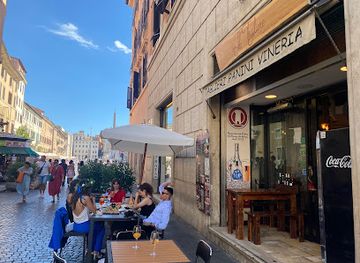
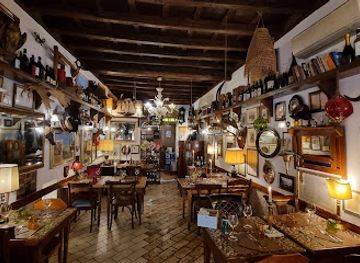
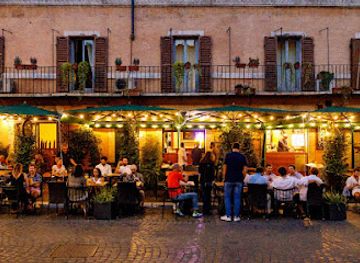
Today, Sant'Eustachio balances its historical significance with vibrant modern life. The district is renowned for its exceptional Italian cafes and traditional trattorias, where locals and visitors alike experience authentic Roman cuisine and hospitality. Sant'Eustachio il Caffè, operating since 1938, has become legendary for its commitment to fair-trade, organic Arabica beans roasted on-site. The neighborhood's side streets reveal hidden courtyards, artisan shops, and residential spaces where Romans continue daily life amid centuries-old architecture. Most major historical sites lie within walking distance, making Sant'Eustachio an ideal base for exploring Rome's Centro Storico while enjoying the neighborhood's distinctive character and local flavor.



 Restrooms
 Drink Options
 Drinking Water
 Food Options
 Seating Areas
 Sheltered Areas
 Information Boards
 Visitor Center