The ability to understand and interpret ancient languages offers a profound connection to the past, allowing us to access the thoughts, beliefs, and experiences of civilizations long gone. From the groundbreaking discovery of the Rosetta Stone to the ongoing efforts to decipher the Indus Valley script, the quest to unlock these linguistic mysteries has captivated scholars for centuries.
This article explores the fascinating history of decipherment, highlighting key moments and the brilliant minds that have illuminated our understanding of ancient writing and communication. It delves into the challenges that remain and the innovative technologies that are paving the way for future discoveries.
A Stone's Throw to Understanding: The Rosetta's Discovery
The story of deciphering ancient languages often begins with a single, pivotal artifact: the Rosetta Stone. Its discovery in July 1799 during Napoleon's campaign in Egypt was a stroke of serendipity that would forever change our understanding of ancient Egyptian civilization. French soldiers, while digging the foundations for an addition to Fort Julien near the town of Rashid (Rosetta) in the Nile Delta, unearthed the stone, which had been built into a very old wall. The officer in charge, Pierre-François Bouchard, recognized the importance of the discovery.
The Rosetta Stone is not made of basalt as was previously thought, but of granodiorite, a dark-colored, coarse-grained igneous rock. The stone is an irregularly shaped slab, measuring approximately 112.3 cm (44.2 in) high, 75.7 cm (29.8 in) wide, and 28.4 cm (11.2 in) thick and weighing around 760 kilograms (1,680 lb). Its surface is inscribed with three versions of the same decree issued in 196 BC during the Ptolemaic dynasty, on behalf of King Ptolemy V Epiphanes. The inscriptions are in ancient Egyptian using hieroglyphic and Demotic scripts, and in ancient Greek.
The presence of these three scripts on a single stone immediately sparked excitement among scholars. It was quickly realized that the parallel texts held the key to deciphering Egyptian hieroglyphs, a writing system that had been lost to understanding for centuries. The stone was initially in French hands, but with Napoleon's defeat, it became the property of the British under the terms of the Treaty of Alexandria in 1801. In 1802, the Rosetta Stone was accessioned into the British Museum, where it has remained on almost continuous public display, becoming its most visited object.

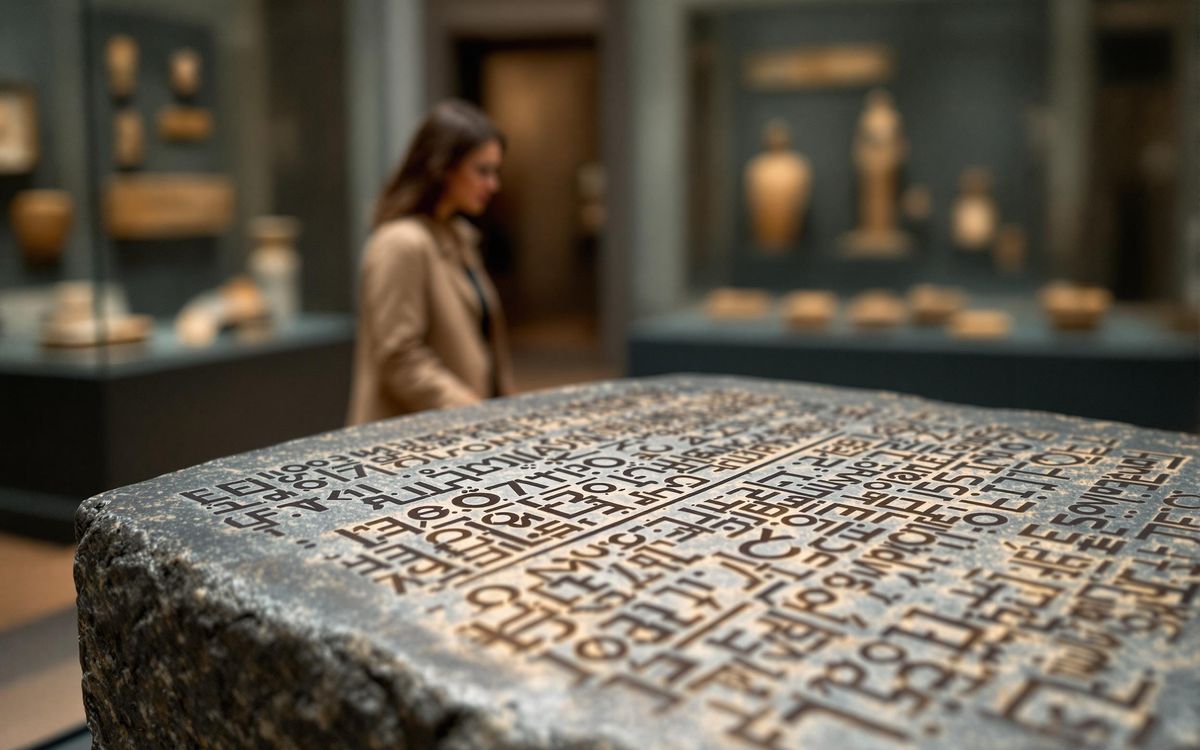
Image Description: A close-up shot of the Rosetta Stone on display at the British Museum. The stone fills the frame, with the three distinct scripts (hieroglyphic, demotic, and Greek) clearly visible. The lighting is even to highlight the inscriptions. The focus is sharp on the center of the stone, with a slight depth of field to give a sense of the stone's texture and age. The purpose of the image is to showcase the Rosetta Stone as a symbol of decipherment and ancient knowledge. The angle is straight on, capturing the full width and height of the visible portion of the stone. Objects include the stone itself and subtle museum display elements. The subjects are the inscriptions, emphasizing their historical and linguistic significance. The season is not relevant, as the stone is indoors and the lighting is artificial. The photo was taken on August 1, 2025.
Style Instructions: Serene, Focus sharply on the inscriptions, even lighting, shot with a wide-angle lens to capture as much of the stone as possible, ISO 200, f/8 aperture, shutter speed 1/60, taken on August 1, 2025.
The Rosetta Stone quickly became an object of intense study. The first complete translation of the Greek text was published in 1803, providing a crucial foundation for understanding the other scripts. Scholars like A.I. Silvestre de Sacy and J.D. Akerblad made initial progress in identifying proper names in the Demotic text and assigning phonetic values to some of the signs. However, the major breakthrough came with the work of Thomas Young and Jean-François Champollion.
The Cracking Code: How the Rosetta Stone Unlocked Hieroglyphs
The Rosetta Stone served as the essential key to deciphering Egyptian hieroglyphs because it presented the same text in three different scripts. Ancient Greek, already understood by scholars, provided a known reference point for interpreting the hieroglyphic and Demotic inscriptions. This unique juxtaposition allowed researchers to gradually unlock the meanings of the ancient Egyptian symbols.
Thomas Young, a British scientist, made significant initial contributions. He began studying the Rosetta Stone in 1814 and correctly surmised that the cartouches—hieroglyphs enclosed in ovals—contained the phonetic spellings of royal names, including Ptolemy. Young also identified some correct phonetic values for hieroglyphs, laying the groundwork for further advancements.
Jean-François Champollion, a French scholar, built upon Young's work and achieved the ultimate breakthrough. Champollion realized that hieroglyphs recorded the sound of the Egyptian language and identified the hieroglyphs used to write the names of non-Egyptian rulers. In 1822, he announced his discovery, demonstrating that the Egyptian writing system was a combination of phonetic and ideographic signs.
Champollion's approach was based on the understanding that the hieroglyphic text on the Rosetta Stone was a translation from the Greek, not the reverse. He recognized that some signs were alphabetic, some syllabic, and some determinative, standing for the whole idea or object previously expressed. By comparing the hieroglyphic, Demotic, and Greek texts, Champollion was able to establish an entire list of signs with their Greek equivalents, effectively unlocking the secrets of the ancient Egyptian language.
With the mysteries of the Egyptian script unlocked, scholars were able to confirm that the Rosetta Stone represented three translations of a single text. The content of that text, already known from the Greek version, was a decree in the name of King Ptolemy V Epiphanes. The decree, issued by a synod of priests in Memphis on March 27, 196 BCE, celebrated the coronation of Ptolemy V and outlined the honors and benefits he would bestow upon the temples and clergy.

Image Description: A photograph of Jean-François Champollion, the French scholar who deciphered Egyptian hieroglyphs. He is depicted as a young man with dark hair and intense eyes. He is wearing a formal coat and vest. The setting is a detailed study with ancient scrolls, tablets, and writing tools scattered around, suggesting his dedication to Egyptology. The lighting is warm and scholarly, highlighting his face and the details of his surroundings. The purpose is to portray Champollion as a brilliant and dedicated linguist. The angle is a medium shot, focusing on his upper body and facial expression. The objects are scrolls, tablets, and writing tools. The subject is Jean-François Champollion. The season is not applicable. The photo was taken on August 1, 2025.
Style Instructions: Portrait, Warm lighting, focus on face, captured with a 50mm lens, ISO 400, f/2.8 aperture, shutter speed 1/100, taken on August 1, 2025.
Beyond the Stone: Other Pivotal Moments in Decipherment History
While the Rosetta Stone holds a place of honor in the history of decipherment, other significant moments have also shaped our understanding of ancient scripts. These discoveries often involved overcoming unique challenges and employing innovative methods.
The Behistun Inscription, located in the Kermanshah Province of Iran, played a role similar to that of the Rosetta Stone in deciphering cuneiform. Carved into a cliff at Mount Behistun, the inscription contains the same text in three languages: Old Persian, Elamite, and Babylonian (a variety of Akkadian). The inscription, commissioned by Darius the Great sometime between his coronation in 522 BC and his death in 486 BC, recounts his autobiography and his suppression of rebellions throughout the Persian Empire.
Sir Henry Rawlinson, an officer in the British East India Company army, began studying the inscription in 1835. Despite its inaccessibility, Rawlinson scaled the cliff and copied the Old Persian inscription. By comparing the known Persian names and titles with the cuneiform script, Rawlinson and other scholars were able to decipher the Old Persian cuneiform texts. This breakthrough then allowed them to decipher the Elamite and Babylonian versions, unlocking the languages of the ancient Near East.
Another pivotal moment in decipherment history was the cracking of Linear B, a syllabic script used for writing Mycenaean Greek. Linear B was discovered at Knossos on Crete by Arthur Evans at the beginning of the 20th century. For decades, the script remained a mystery, with theories ranging from an Anatolian language to Etruscan.
Michael Ventris, a British architect and self-taught linguist, deciphered Linear B in 1952, based on the research of American classicist Alice Kober. Ventris recognized patterns in Linear B suggestive of inflection and applied this idea to place-names. He realized that the language of the inscriptions was Greek, pushing the earliest known examples of written Greek back to more than 3,000 years ago. The decipherment of Linear B revealed a wealth of administrative and economic information about Mycenaean civilization.

Image Description: A photograph of the Behistun Inscription carved into a cliff face in Kermanshah Province, Iran. The relief shows Darius I, followed by two escorts, with his foot on the chest of a figure lying supine. There are nine prisoners bound by a rope. The inscription is in three languages: Old Persian, Elamite, and Babylonian. The lighting is natural, highlighting the details of the carving and the surrounding rock formations. The purpose is to illustrate the Behistun Inscription as a key to deciphering cuneiform scripts. The angle is a wide shot, capturing the entire relief and inscription. The objects are the cliff face, carvings, and inscriptions. The subjects are Darius I and the conquered peoples. The season is summer. The photo was taken on August 1, 2025.
Style Instructions: Landscape, Natural lighting, wide shot, captured with a 24mm lens, ISO 100, f/11 aperture, shutter speed 1/250, taken on August 1, 2025.
Challenges Remain: Undeciphered Scripts and the Future of Linguistics
Despite the remarkable progress made in deciphering ancient languages, many scripts remain undeciphered. These undeciphered scripts pose significant challenges to linguists and historians, as they hold the potential to unlock further insights into ancient cultures and civilizations.
One of the most famous undeciphered scripts is the Indus Valley script, used by the Indus Valley Civilization from around 2600 to 1900 BC. The script is found on seals, pottery, and other artifacts discovered in cities like Harappa and Mohenjo-Daro. It consists of about 400 distinct signs, but the inscriptions are typically very short, averaging only four or five signs per inscription.
The decipherment of the Indus Valley script has been hindered by several factors. There is no known bilingual text or Rosetta Stone-like artifact that could provide a key to understanding the script. The language that the script represents is unknown, with scholars suggesting possibilities such as Indo-European, Dravidian, or a lost language family. The short length of the inscriptions makes it difficult to identify patterns and structures within the script.
Other undeciphered scripts include Linear A, used by the Minoan civilization on the island of Crete. Linear A remains undeciphered, although some phonetic transcriptions can be read with some approximation. Scholars can understand some of the words and get a general idea of the document's contents, but a full decipherment remains elusive.
In recent years, technology has begun to play an increasingly important role in decipherment efforts. Artificial intelligence (AI) and machine learning (ML) are being used to analyze ancient texts, identify patterns, and reconstruct lost languages. AI-powered tools can process vast amounts of data with greater speed and accuracy than human experts, accelerating the decipherment process. For example, AI has been used to enhance the readability of the Dead Sea Scrolls and to interpret the undeciphered Indus script.
Despite the promise of technology, the human element remains crucial in decipherment efforts. AI can identify patterns and suggest translations, but these require careful interpretation by human experts to avoid misinterpretations due to the loss of cultural context or nuances in language. The integration of AI with traditional philological approaches offers the best path forward for unlocking the secrets of undeciphered scripts and preserving humanity's linguistic heritage.

Image Description: A collection of seals and tablets from the Indus Valley Civilization, showcasing the undeciphered Indus script. The seals and tablets are arranged on a neutral background to highlight the inscriptions. The lighting is soft and even, emphasizing the details of the symbols. The purpose is to illustrate the mystery and challenge of the Indus script. The angle is a close-up shot, focusing on the inscriptions. The objects are seals and tablets. The subjects are the Indus script symbols. The season is not applicable. The photo was taken on August 1, 2025.
Style Instructions: Macro, Soft lighting, focus on script details, captured with a 105mm macro lens, ISO 200, f/5.6 aperture, shutter speed 1/60, taken on August 1, 2025.
The quest to decipher ancient languages is a testament to human curiosity and the enduring power of language to connect us to the past. From the Rosetta Stone to the latest advancements in artificial intelligence, the journey of decipherment continues to reveal the secrets of ancient civilizations and enrich our understanding of human history.
Local Tips
For those interested in learning more about decipherment, the British Museum in London offers an unparalleled opportunity to view the Rosetta Stone and other related artifacts firsthand. The museum also hosts exhibitions and educational programs that delve into the history of decipherment and the challenges of understanding ancient languages.
Hidden Gems
The Behistun Inscription, a UNESCO World Heritage Site, is a testament to the power of language and the ambition of ancient rulers. While the inscription itself is located high on a cliff face and can be challenging to access, the site offers a unique glimpse into the world of the Achaemenid Empire and the efforts to decipher cuneiform.