Beyond the well-trodden boulevards of Paris and the misted canals of Venice, there are cities where romance lingers in narrow alleyways, glows in tiled courtyards, and hums in backstreet bars known only to locals. These are places where love is not performed for the camera but discovered in the unexpected: a whispered Fado verse, a shared bowl of pintxos, the hush of a bamboo grove at dusk.Seville's Fiery Embrace
In Seville, romance arrives not as a soft-focus fantasy but as something far more elemental: the rasp of a flamenco singer’s voice, the clack of heels on worn wooden boards, the scent of orange blossom drifting through the labyrinthine streets of Santa Cruz. As evening falls, the whitewashed houses of this former Jewish quarter take on a golden hue, their wrought-iron balconies spilling over with geraniums. Couples slip into vine-laced patios where lanterns flicker and guitars are tuned, preparing for nights that effortlessly spill past midnight.
Begin in the heart of Santa Cruz, wandering its impossibly narrow alleys hand in hand. Here, romance hides in the details: a fragment of ceramic tile on a centuries-old doorway, a tiny square where an orange tree leans over a stone bench, the unexpected silence when you turn a corner away from the main streets. Outwardly, Seville’s flamenco shows can appear choreographed for visitors, but in the backstreets you find the city’s true pulse. In an unmarked tablao tucked down a side alley off Calle Ximénez de Enciso, the crowd is mostly Sevillanos. There is no elaborate stage, only a scuffed wooden floor, four chairs, and the palpable electricity that runs between singer, guitarist, and dancer. In this intimate space, you feel the music not just in your ears but in your ribs, your fingertips, the shallow rhythm of your breath as your partner’s hand tightens around yours.
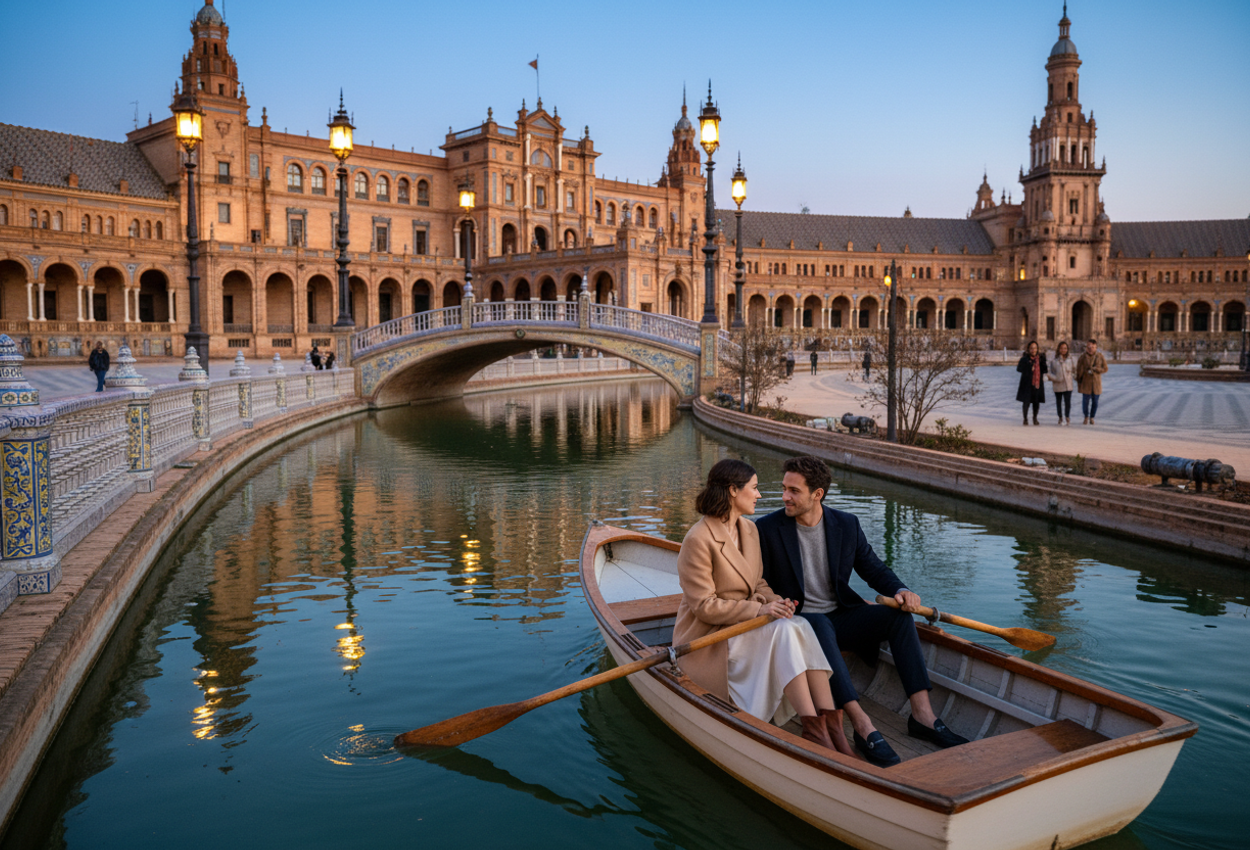
After the final heel-stamp fades, step out into the soft night air and drift towards Plaza de España. Built for the 1929 Ibero-American Exposition, its sweeping semi-circular façade and tiled alcoves can look almost theatrical by daylight, but at twilight it becomes something gentler. The last of the day’s rowboats slide across the canal that arcs in front of the plaza, their oars barely disturbing the water’s glassy surface. Rent a small boat and take to the canal yourself; the gentle resistance of the oar, the echo of your laughter against the arched bridges, and the play of light on the plaza’s extravagant tiles conspire to create a timeless scene, as if the two of you have drifted into a sepia postcard.
Later, trade grandeur for intimacy with a horse-drawn carriage ride. The clip-clop of hooves on cobblestones becomes a soft metronome as you roll past the illuminated bulk of the Seville Cathedral and the soaring Giralda tower. A light breeze lifts the scent of jasmine from hidden courtyards, and the driver, accustomed to lovers in his backseat, knows exactly when to slow down for a lingering view and when to pick up the pace so the city’s rhythm never quite dies away.
As night deepens, make your way to the banks of the Guadalquivir River and stroll along Calle Betis. On one side, pastel facades lean towards the water like old friends swapping secrets; on the other, the river reflects a wavering twin city of lights. Here, romance is delightfully unscripted: couples share plates of fried fish on terraces, the strains of yet another guitar drift from a nearby bar, and the scent of grilled prawns mingles with river air. Pause on the low stone wall, legs dangling over the water, to watch the sun disappear behind the silhouette of the Torre del Oro. As the sky bruises into shades of indigo and rose, you understand that in Seville, love is less about perfection and more about being carried away by the city’s untidy, glorious passion.
Hidden Gem: For a truly local experience, follow the late-night crowd away from the main plazas to a tiny flamenco bar in the backstreets of Santa Cruz, where shows start close to midnight and performers dance not for applause, but for each other. With barely a dozen tables and walls stained with decades of cigarette smoke and song, it is here that Seville’s fiery embrace feels most personal.
Prague's Fairytale Charm
Prague has the uncanny ability to make you feel as though you have wandered into a storybook written specifically for two. Spires pierce the clouds in every direction, cobbled streets twist into improbable spirals, and the Vltava River slips under arched bridges like a ribbon of mercury. Yet beyond the usual postcards of Charles Bridge at dawn and red roofs sparkling in the sun, the city’s romance lies in quieter, more unexpected corners where the fairy tale becomes something you can actually touch.
Start in Old Town Square, where the Astronomical Clock ticks away centuries on the façade of the Old Town Hall. Here, among the steeples and baroque facades, a horse-drawn carriage waits, all polished leather and brass. As you climb inside and the driver snaps the reins, the bustle of cafes and buskers recedes to a gentle hum. Moving at this old-fashioned pace, Prague reveals its details: saints carved into cornices, flickers of candlelight from within Gothic chapels, the rhythm of your partner’s shoulder rising and falling against yours beneath a shared blanket. The carriage clatters across the cobbles of Celetná and Karlova streets, then onto the Charles Bridge itself, where stone saints peer down at you like benevolent witnesses to your stolen glances.
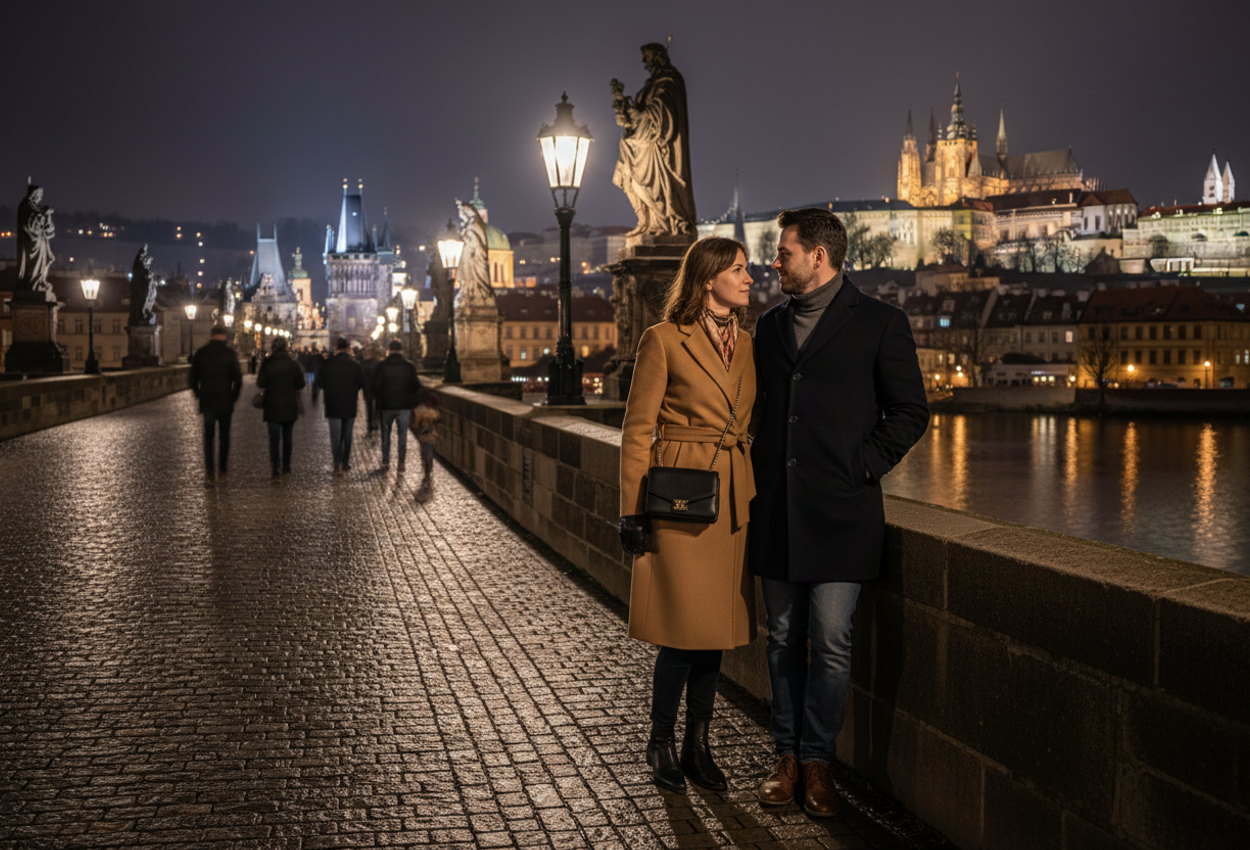
By day, the bridge is a lively procession of artists, musicians, and visitors. At night, especially in the cooler months, it softens into something far more intimate. Lanterns cast small circles of honeyed light, and the city’s famed skyline reflects in the dark water below. Walk slowly, pausing at the midpoint to lean against the balustrade. Church bells echo faintly across the river; somewhere a violinist is playing a melody that blends with the shush of the current. In winter, your breath appears in small clouds between you; in summer, the air carries the faint aroma of riverweed and roasting chestnuts from nearby stalls.
When daylight returns, trade spires for greenery with a climb to Petřín Hill. As you wander through Petřín Park, gravel paths wind between apple orchards and rose gardens, the sounds of the city dimming beneath a cocoon of leaves. You might detour through the famed mirror maze for a burst of childhood laughter, or ride the funicular together, watching the red roofs of Malá Strana tilt and fall away beneath you. From the top, the lookout tower offers sweeping views, but the most romantic moments are often found on a simple bench, sharing a pastry and watching the city glimmer far below like a promise.
Back down near the castle complex, seek out Kavárna Nový Svět, one of Prague’s most quietly enchanting hideaways. Tucked into the tiny lanes of the Nový Svět quarter, this family-run café feels more like a private living room than a business. A few tables cluster beneath low ceilings; shelves bow under the weight of books and old photographs. Order two thick cups of coffee and perhaps a slice of homemade cake, then take them out to the petite courtyard, where ivy climbs the walls and a single tree casts dappled shade. It is the perfect place to linger after exploring Prague Castle, far from the crowds, where you can talk for hours and lose track of time.
Hidden Gem: For an under-the-radar dose of sweetness, slip into the Chocotopia Chocolate Museum, a playful space where you can learn about the history of chocolate, watch demonstrations, and, most importantly, taste your way through pralines and truffles. Wander the exhibits together, sharing samples and jokes, then emerge with a small box of handpicked chocolates to savor later as the city lights up around you.
Kyoto's Serene Beauty
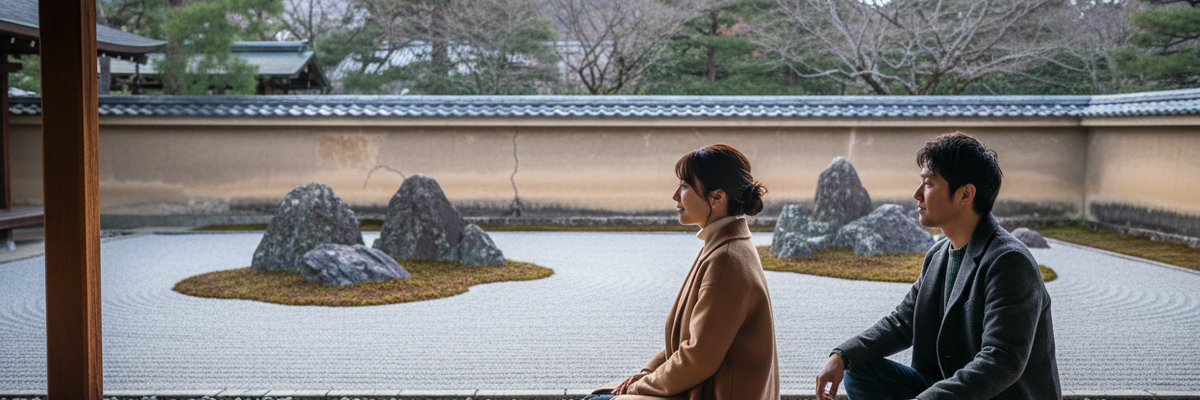
Romance in Kyoto is hushed rather than declared, revealed through the crunch of gravel beneath your feet, the rustle of silk, the sighing of bamboo in the wind. This former imperial capital is a study in restraint, and it rewards couples willing to slow down and listen. Here, affection reveals itself in shared silences, in the way steam curls from a shared cup of matcha, in the careful rituals of shrines and gardens that have outlasted empires.
Begin at Fushimi Inari Taisha, where a seemingly endless procession of vermilion torii gates climbs the forested slopes of Inari mountain. Arrive early or late to avoid crowds and you may find yourselves alone in those tunnels of color, the sunlight filtering through the gaps in warm, wavering bands. Fox statues, guardians of the shrine, appear at intervals along the way, their stone faces softened by moss. As you walk, the world narrows to the rhythm of your footsteps, the brush of your shoulders against one another, and the faint chime of bells carried from distant altars. At a small wayside tea hut, pause for sweet dango skewers lacquered in soy glaze, their smoky-sweet warmth a quiet indulgence shared between you.
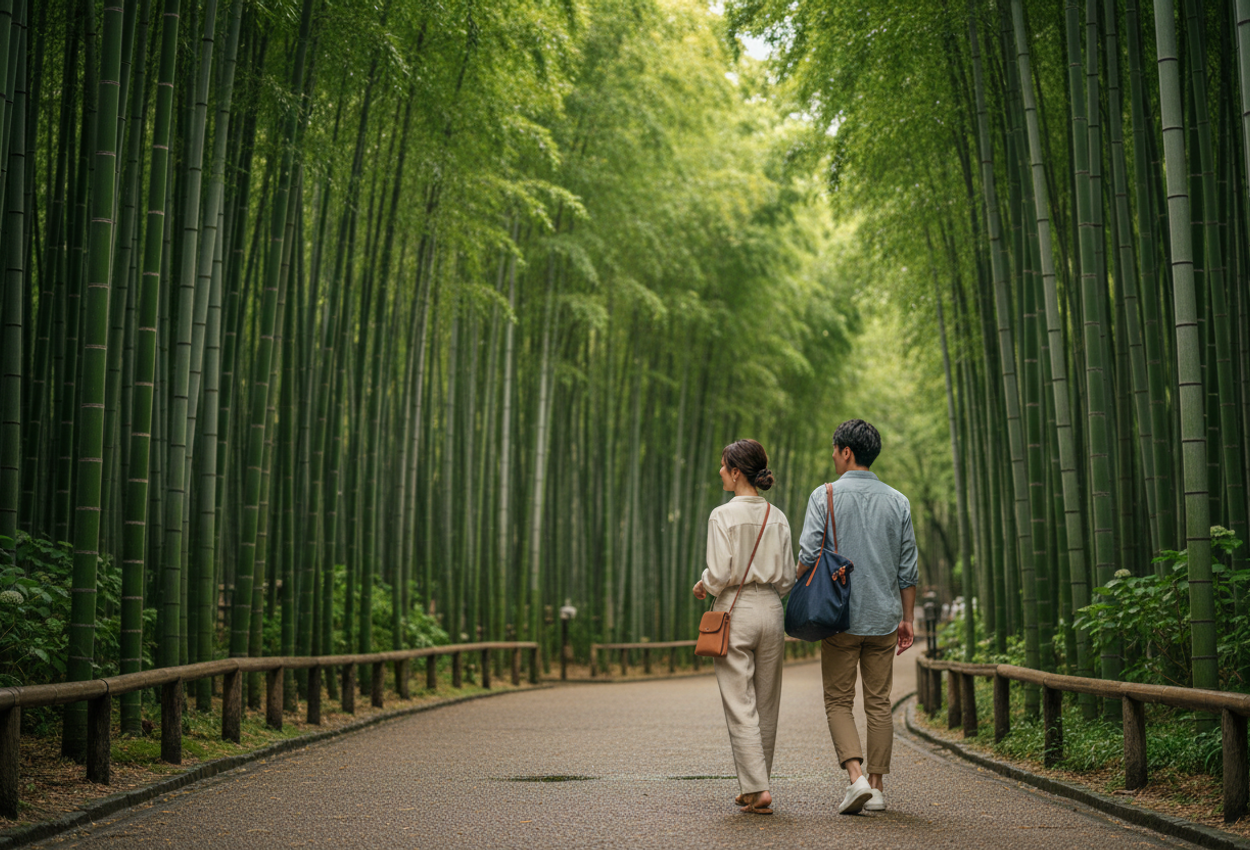
Later, trade red for green in the ethereal Arashiyama Bamboo Grove. Stepping into the grove feels like entering another element entirely. Bamboo stalks rise in shimmering verticals, their leaves catching the light so that it seems to ripple above your heads like water. The air is cooler here, infused with a faint vegetal scent; every sound becomes softer, as if padded by the green walls around you. Walk in single file, one behind the other, fingertips trailing lightly along the smooth trunks. When a breeze passes through, the bamboo sways and creaks softly, a natural music that makes conversation feel unnecessary.
To truly savor Kyoto’s quiet romance, rent bicycles and drift through residential backstreets where wooden machiya townhouses lean close to one another, their latticed windows and noren curtains hinting at life within. Pedal along the Philosopher’s Path when the cherry trees are blooming and petals float down like confetti, or in late autumn when the canal is lined with blazing maples reflected in the water. The movements of cycling together – slowing for a corner, pausing to let a cat cross your path, stopping to photograph a tiny roadside shrine – become their own shared choreography.
For an even deeper immersion into Kyoto’s contemplative side, make time for the moss temple, Saiho-ji. Access is limited and must be arranged in advance, but those who make the effort are rewarded with one of the city’s most transcendent experiences. Within the temple’s grounds, a carpet of vivid green moss spills like velvet over rocks, tree roots, and gentle slopes surrounding a mirror-still pond. You move quietly along the paths, voices lowered instinctively, the air cool and moist with the scent of earth and cedar. There is no overt romantic gesture here, only the overwhelming sense of sharing something profoundly beautiful, of sitting side by side on a simple wooden veranda while the world outside the temple walls fades into insignificance.
As the day sinks towards evening, climb towards the Yasaka Pagoda in the Higashiyama district. From the sloping streets of Ninen-zaka and Sannen-zaka, the five-story pagoda rises like a paper silhouette against the sky. When the sun begins to set, tiled rooftops and wooden facades take on a warm gloss, lanterns flickering to life one by one. Find a vantage point where you can watch the pagoda’s outline sharpen against a wash of pink and gold, then linger as the first stars appear. In Kyoto, love is not shouted from rooftops; it is simply understood, folded into the centuries-old rituals that surround you.
Bruges' Canal-Side Whispers
Bruges is the kind of city that makes you question whether reality has been subtly edited. Its gabled facades lean crookedly over cobbled lanes, swans patrol glassy canals like feathered sentries, and belfries chime on the hour as they have done for centuries. Yet for all its fairy-tale beauty, the romance of Bruges lies not only in what you see, but in the quiet, conspiratorial feeling that you and your partner have stumbled into a world that moves at a gentler pace.
As afternoon slides towards evening, make your way to one of the boat docks that fringe the city’s web of canals. Slip into a low-slung vessel for a sunset canal cruise, blankets folded neatly across the seats. As the engine hums to life, Bruges rearranges itself around you: houses that seemed modest from the street blossom into secret gardens at canal level, their ivy-covered walls broken by archways and hidden courtyards. Above, arched stone bridges pass overhead like frames in an old film reel. The water catches every color – the russet hue of brick, the pale blue of a laundry line, the blush of the evening sky – and smears them into painterly streaks.
Back on dry land, stroll to Markt Square, the city’s historic heart, where medieval guild houses line up shoulder to shoulder in shades of butter yellow, brick red, and soft green. The air smells of waffles and melted chocolate, and the square’s cobbles echo with the clatter of passing bicycles. Climb the Belfry of Bruges together if you wish – the 366-step ascent may leave you breathless, but the panoramic reward of the city unfurling beneath you, its canals glinting like threads of silver, is worth every pause along the way.
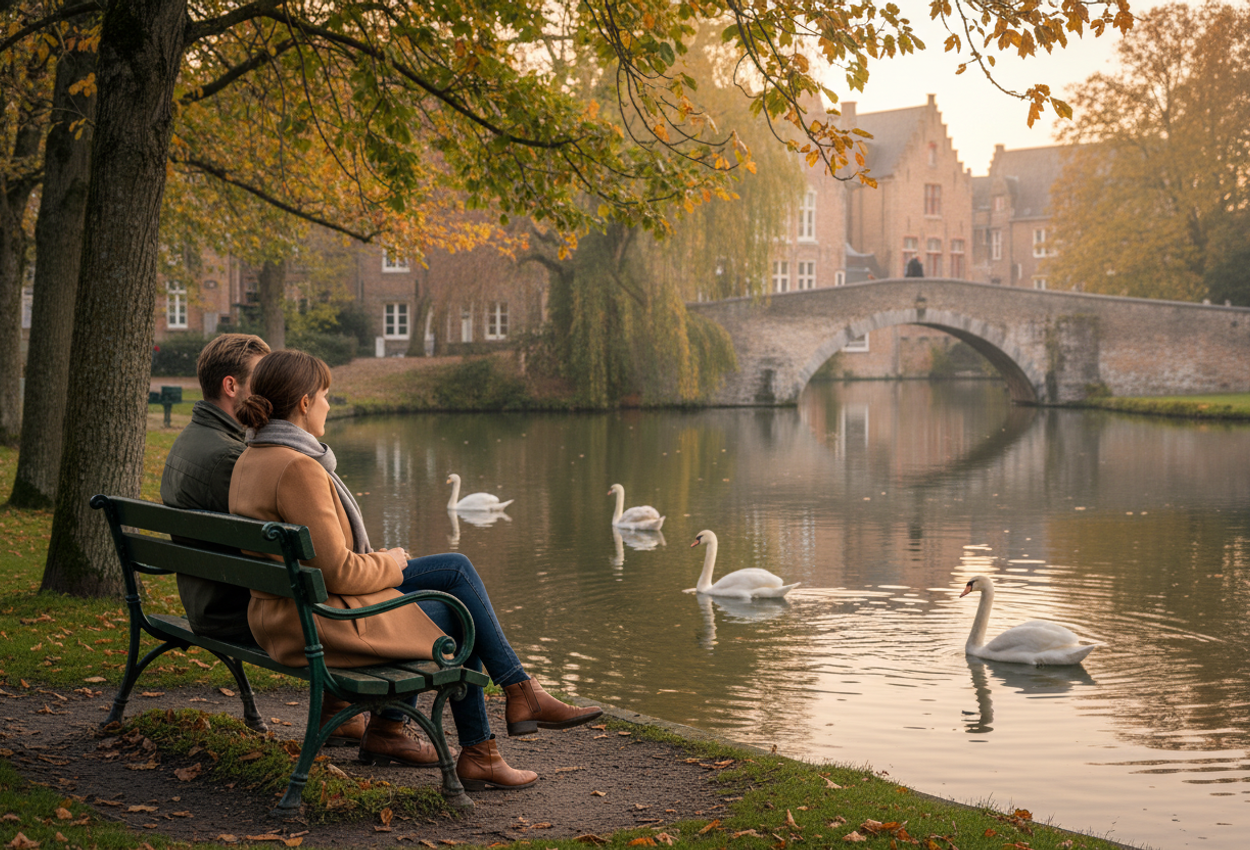
It is a short walk from the bustling square to the dreamlike stillness of Minnewater Lake, known as the Lake of Love. Here, the city lowers its voice. Trees lean towards the water, their branches brushing the surface; swans glide along, unhurried and impossibly elegant. Legend holds that couples who cross the stone bridge together will remain in love forever, and while such promises cannot be guaranteed, the setting certainly tilts the odds in your favor. Sit on a bench, watch the changing patterns of light on the water, and let time slip for a while.
For a deeper, more intimate layer of Bruges, wander into the Sint-Anna district and seek out the Adornes Domein. This family estate, largely unchanged since the 15th century, feels worlds away from the souvenir shops and chocolatiers of the center. The centerpiece is the atmospheric Jeruzalemkapel – the Jerusalem Church – a private chapel with dark wood, stone effigies, and a sense of time slowed almost to a standstill. In the estate’s small Scottish lounge, a nod to the Adornes family’s connections to Scotland, you can sit in deep armchairs surrounded by tartan touches and ancestral portraits, feeling less like a visitor and more like a guest of the family. Outside, the courtyard and small garden provide a quiet spot to sit together in the filtered light, the muffled sounds of the city drifting over the walls like a distant tide.
As night falls, Bruges’ canals transform again, reflecting the warm glow of street lamps and the occasional passing cyclist’s headlight. The streets grow quieter, and your footsteps on the cobbles seem to echo just a little more. It is then that Bruges feels at its most romantic: not as a backdrop for cinematic gestures, but as a cocoon where whispered conversations and shared silences are all the more precious.
Budapest's Thermal Embrace
In Budapest, romance is written in steam and stone. The city stretches along both sides of the Danube, its bridge-lit skyline a string of jewels reflected in the river, but it is beneath the surface – in natural hot springs and hidden caves – that its most intimate experiences are found. Here, evenings are for soaking in mineral-rich pools, lingering on rooftops, and drifting through parks where history and hedonism coexist in harmonious balance.
Begin your exploration on Margaret Island, a green ribbon in the middle of the Danube. Cars are banished here, leaving behind a realm of whispering trees, crumbling medieval ruins, and pathways perfect for aimless strolling. Rent a tandem bicycle or a small electric cart and circle the island together, pausing at the musical fountain where jets of water leap in time to classical music. In spring and summer, the air is heavy with the scent of roses and freshly cut grass; in autumn, carpets of leaves crackle beneath your feet as you wander hand in hand towards the ruins of a 13th-century convent, its broken stone walls softened by ivy.
Back in Buda, slip beneath the city’s surface into the atmospheric Buda Castle Caves. These interconnected tunnels and cellars, formed naturally over millennia and shaped by human hands, once sheltered everything from wartime hospitals to wine cellars. Today, guided tours lead you through cool, slightly damp corridors where echoes carry and the drip of water marks time. Holding a small lantern between you, you move through chambers carved into limestone, listening to stories of kings, sieges, and secret cellars. It is unexpectedly romantic: the pale pool of light, the way your footsteps sync in the semi-darkness, the sense of sharing a secret world beneath the city.
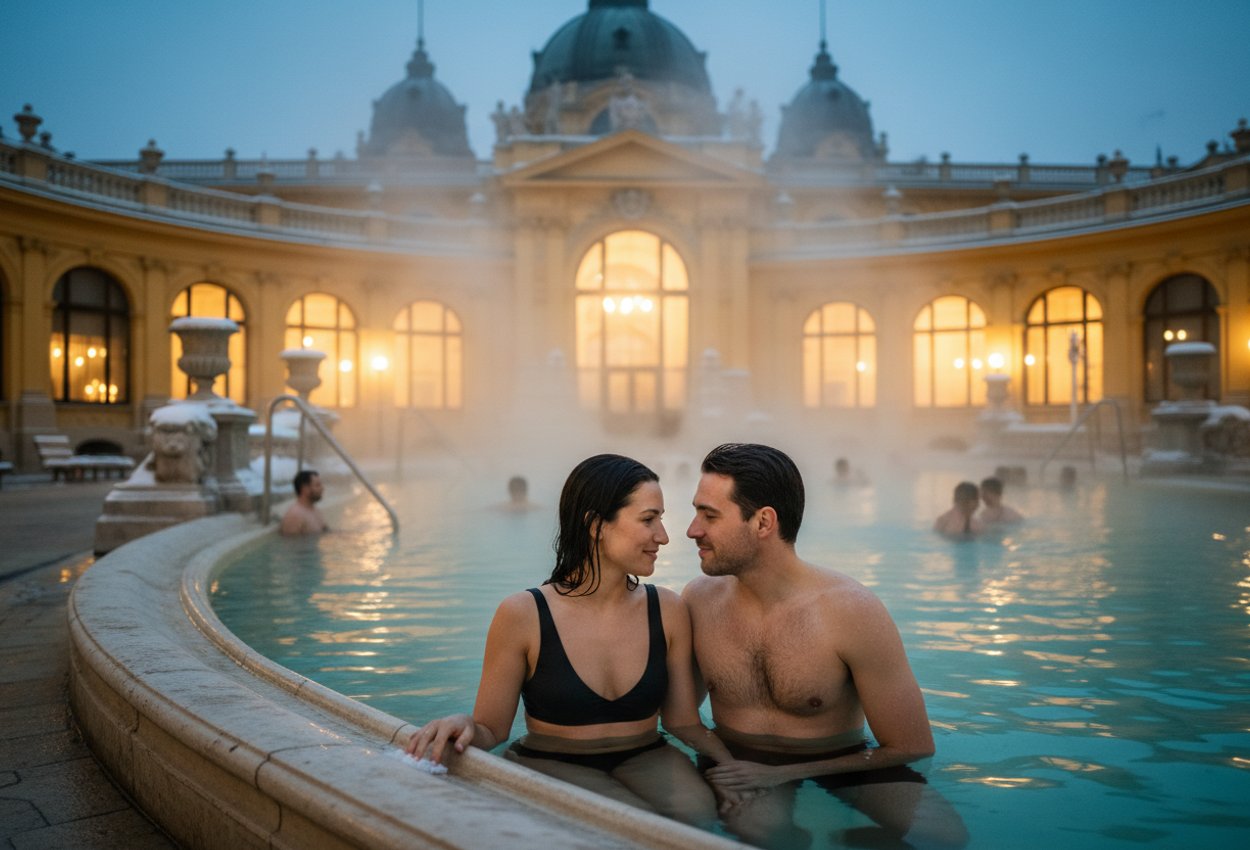
Later, step back into the night and head for one of Budapest’s famed thermal baths. The art nouveau elegance of Gellért Thermal Bath or the neo-baroque splendor of Széchenyi Thermal Bath offer different but equally alluring backdrops. Slip into the outdoor pools as clouds of steam rise around you, turning the illuminated façades into hazy mirages. At Széchenyi, locals play chess at floating boards while couples lean against stone ledges, talking softly as hot water relaxes every muscle. On winter evenings, when the air is icy and your hair prickles with condensation while your body is submerged in warmth, the sensation borders on the surreal.
Budapest’s romance also lives in places less often associated with couples: its ruin bars. In the former Jewish Quarter, crumbling tenement buildings have been transformed into whimsical nightspots filled with mismatched furniture, potted plants, and flickering fairy lights. Seek out a lesser-known bar tucked down a quiet side street rather than the famous addresses. Climb crickety staircases to candlelit mezzanines, slide into a corner bench beneath a wall of old movie posters, and share a bottle of local wine or a pair of pálinka shots. Around you, the murmur of conversation in multiple languages blends with the soft thud of bass from a back room; above you, the night sky is visible through a partial roof, the stars framed by rusting beams.
By the time you wander back towards the river, hand in hand and pleasantly drowsy from hot water and convivial bars, the city feels entirely your own. The Chain Bridge glows softly, its stone lions keeping watch as reflections shudder on the black water below. On the Pest side, the Hungarian Parliament Building looms like a gilded palace, its spires and domes lit up against the night. Budapest’s embrace is equal parts heat and history, pleasure and poignancy – and it is in that alchemy that romance quietly takes hold.
Québec City's Old-World Romance
Within the fortified walls of Québec City, North America momentarily dissolves. Stone houses with dormer windows press close along serpentine streets, church bells toll from slate-grey spires, and the salt-scented breeze from the Saint Lawrence River carries the faintest echo of old-world France. This is a city built for lingering: over long lunches, on snowy promenades, beneath the turreted silhouette of Fairmont Le Château Frontenac.
Begin your romantic journey with a horse-drawn carriage ride through the cobblestone arteries of Old Québec. Climb into the carriage as twilight falls, when gas lamps flicker to life and the stone façades blush under their glow. The carriage wheels clatter gently as you pass Place Royale, one of the oldest squares in North America, and wind your way up towards Haute-Ville. Wrapped in a shared blanket, you watch as snowflakes – in winter – or drifting maple leaves – in autumn – tumble past the carriage lanterns, each season lending its own particular enchantment.
Afterwards, take to the city walls on foot. The Fortifications of Québec encircle the old town in an almost uninterrupted loop, a unique reminder of the city’s strategic past. From the ramparts, you look down over slate rooftops and narrow alleys, then out toward the river where ice floes drift in winter or cruise ships gleam in summer. Walking the walls at an unhurried pace gives you the peculiar thrill of seeing the city from above while still being enveloped by its history; it feels as though you are meandering along the border between centuries.
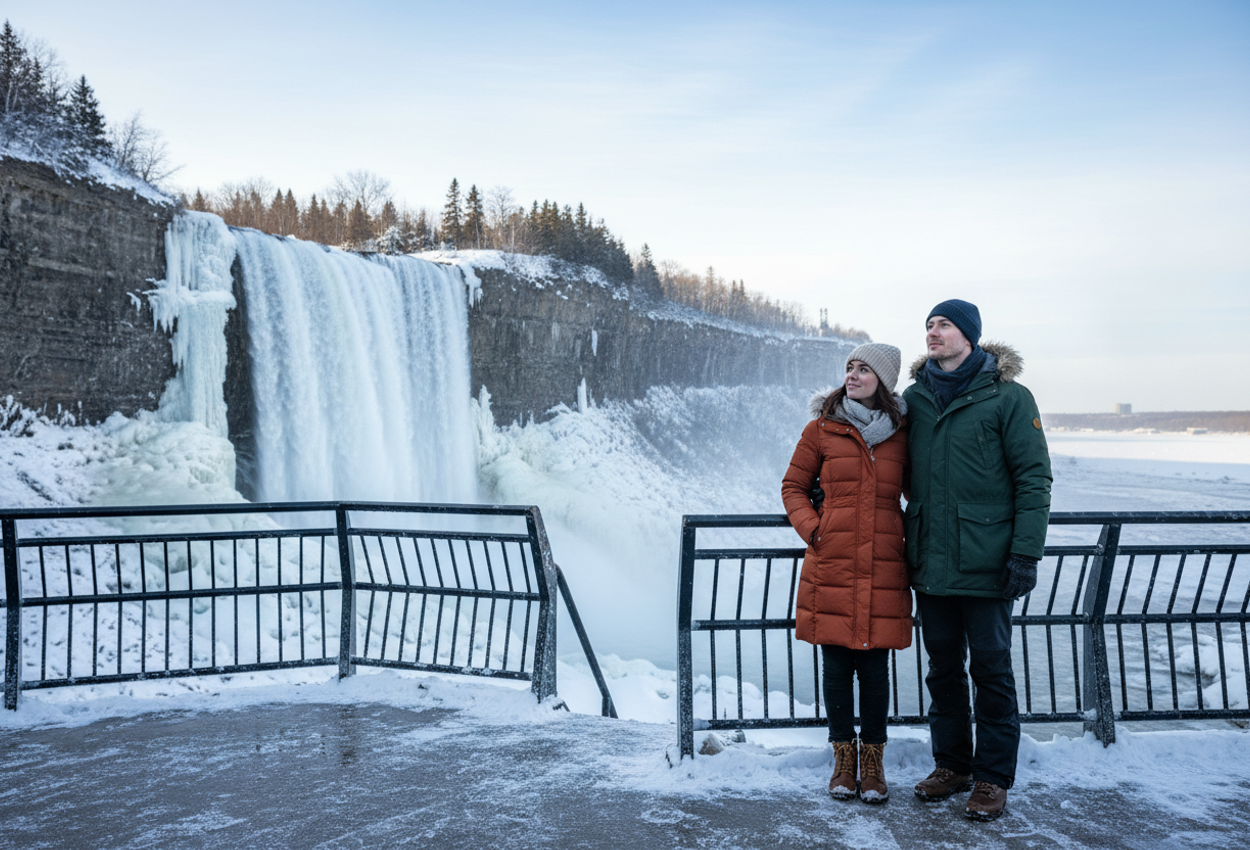
When you crave a gust of raw nature, make the short journey to Montmorency Falls, where the Montmorency River plunges dramatically over a cliff higher than Niagara. In winter, mist freezes into delicate lace on the nearby trees and the base of the falls forms a mound of ice known locally as the Sugarloaf. In summer, rainbows arc through the spray as the sun catches the descending water. Stroll hand in hand across the suspension bridge that spans the top of the falls, the thunder of water vibrating up through your feet, then descend via stairs or cable car to gaze up at the full force of the cascade. There is something undeniably bonding about feeling this much elemental power together.
Back in the city, seek out a quieter, more bucolic slice of romance on Île d'Orléans, just a short drive away yet a world apart. This pastoral island is a patchwork of orchards, vineyards, and traditional farmhouses, where roadside stands offer strawberries in early summer, apples and cider in autumn, and maple products whenever the sap is running. Pick a small family-run cidery or farm shop, settle at a picnic table overlooking the river, and share a tasting flight of ciders or ice wines as the late afternoon light gilds the fields. The pace here is deliciously slow; conversations linger, glasses clink lazily, and the horizon feels pleasantly far away.
As night falls, return to the Petit Champlain district, often cited as one of the most charming neighborhoods on the continent. Narrow lanes are strung with fairy lights, boutiques display locally made art and textiles, and intimate bistros spill warm light onto the cobbles. Choose a table in a stone-walled restaurant, order a bottle of Québec wine and a generous portion of poutine or game stew, and let the evening stretch. When you finally step back outside, the combination of crisp air, historic streets, and a contented fullness feels like being wrapped in the city’s own embrace.
Buenos Aires' Tango Rhythms
In Buenos Aires, romance moves to a syncopated beat. The city hums with tango – in music pouring from open windows, in couples practicing steps in quiet plazas, in the understated elegance of old cafés where time seems to both rush and stand still. This is a metropolis built on passion and melancholy, where love stories unfold as much on the dance floor as they do at candlelit tables.
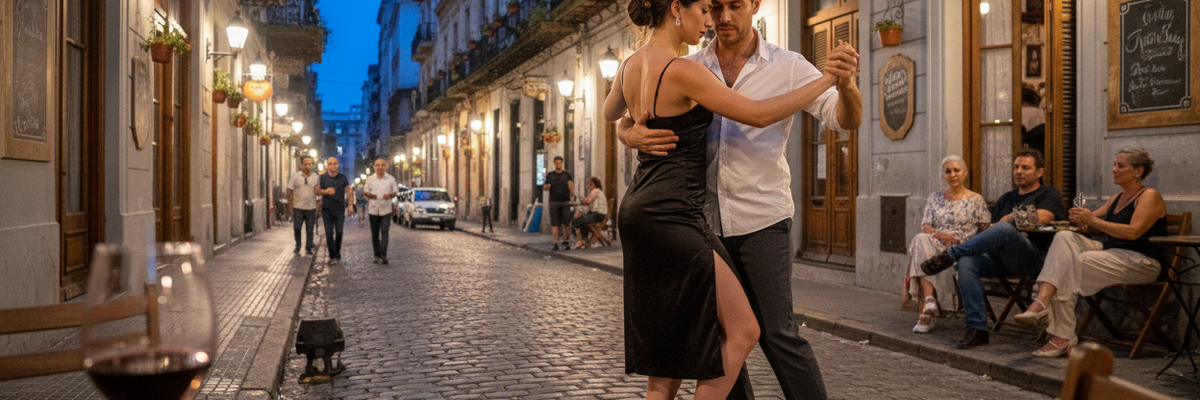
Begin in San Telmo, one of the city’s oldest neighborhoods, where cobblestone streets are lined with crumbling mansions, antique shops, and bars that have hosted generations of night owls. As evening gathers, slip into a tango house tucked behind an unassuming doorway. Inside, velvet curtains, small round tables, and low lighting create a theatrical intimacy. The show begins with a plaintive bandoneón lament, followed by dancers who seem to converse with their bodies: a raised eyebrow, a sudden pivot, a lingering pause before a dramatic sweep. Watching from your table, sharing a bottle of Malbec and perhaps a plate of empanadas, you feel the tension and tenderness in each step; it is impossible not to inch just a little closer to your own partner.
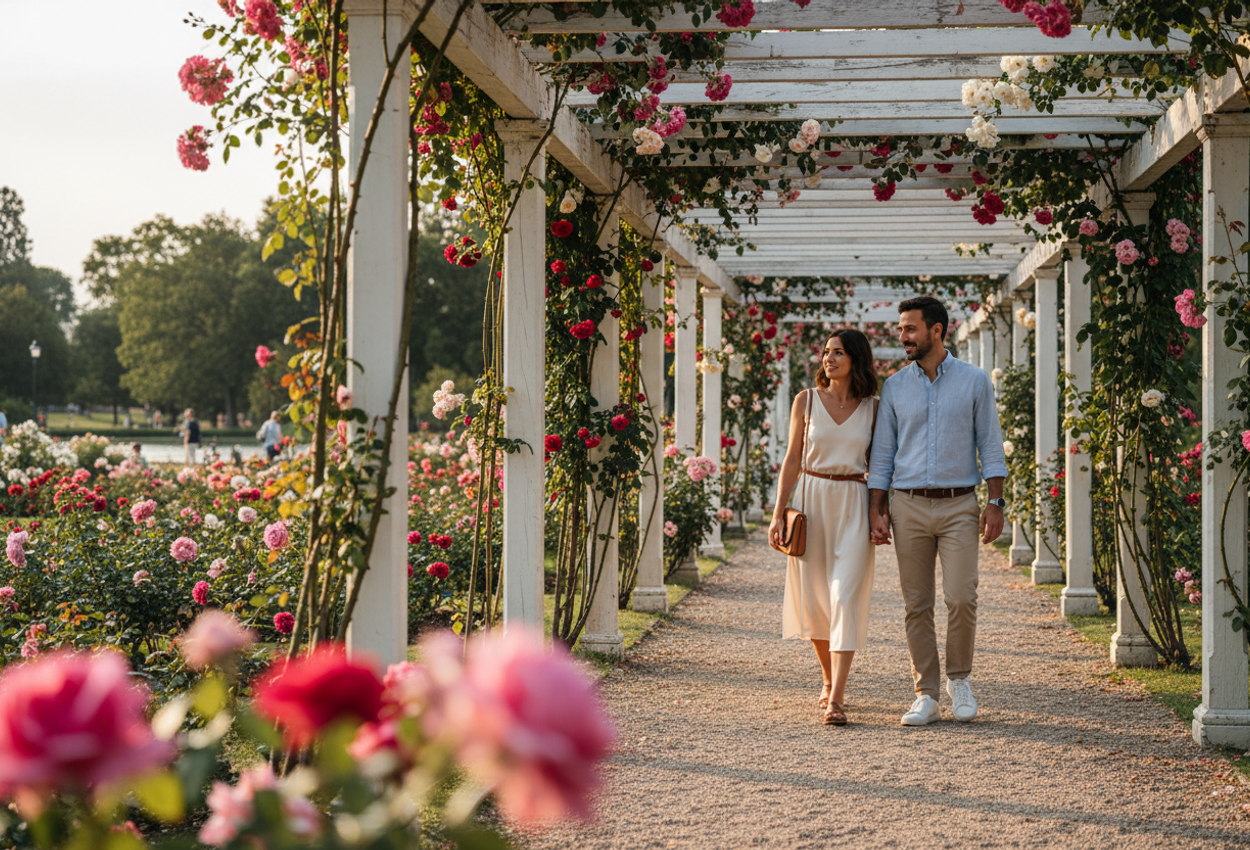
The next day, seek a softer kind of romance amid the greenery of El Rosedal, the rose garden in Bosques de Palermo. Here, over 18,000 rose bushes burst into bloom between October and May, painting the air with fragrance. White pergolas draped in climbing roses cast dappled light onto paths; swan-shaped pedal boats drift lazily across the central lake. Find a bench beneath one of the pergolas, close your eyes, and inhale the mixture of earth, flowers, and freshly cut grass. Even in the height of the city’s buzzing social calendar, this corner of Palermo feels like a private retreat carved out for two.
As night falls again, it is time for another kind of ritual: dinner at a traditional parrilla. Choose a neighborhood spot where locals linger at outdoor tables and the grill is piled high with cuts of beef, sausages, and provoleta, the gloriously melty grilled cheese that arrives at your table sizzling in cast iron. Here, romance lies in sharing: splitting a bottle of deep, velvety Malbec, discussing the merits of different cuts of steak, tearing pieces of warm bread to mop up the last of the chimichurri. Conversations stretch for hours in Buenos Aires, aided by the local habit of dining late and refusing to hurry.
Yet the true heart of porteño romance is found not in polished shows but in the city’s milongas – social dance halls where locals gather to dance into the small hours. Seek out a neighborhood milonga in Almagro or Villa Crespo, where there is no stage, only a polished wooden floor, a DJ or live orchestra, and a code of glances and nods that govern who dances with whom. Even if you are not ready to attempt the steps yourselves, simply watching the couples is spellbinding. Some are young, others have been dancing together for decades, their movements so attuned that a raised finger or shift of weight is enough to communicate the next figure. The air is warm, carrying notes of cologne, hairspray, and the sweet bitterness of Fernet. When the music slows for a tanda of romantic tangos, you will feel the urge to sway in your seats, your hands instinctively finding each other’s.
On your way back to your hotel in the blue-grey hours before dawn, the streets are quieter but not asleep. A dog trots past, a lone taxi glides by, someone laughs from a distant balcony. Buenos Aires has a way of stretching time, of wrapping late nights and slow mornings into one continuous, intoxicating rhythm – and at its center, inevitably, is the dance of two people learning, step by step, how to move together.
Charleston's Southern Charm
Romance in Charleston, South Carolina, comes with a Southern drawl. It lives in weathered piazzas shaded by live oaks, in the briny scent of nearby marshes, in the pastel facades that blush under the coastal sun. This is a city that whispers rather than shouts, inviting you to slow down, sip something cold on a veranda, and let the air grow soft around you.
Begin with a carriage ride through the Historic District, where 18th- and 19th-century houses line narrow streets paved in worn cobblestones. As your horse clops along beneath canopies of live oaks hung with Spanish moss, your guide points out intricate fanlights, wrought-iron gates, and secret gardens hidden behind high brick walls. You pass grand mansions along The Battery, their porches facing the harbor breeze, and colorful clapboard homes where window boxes overflow with petunias and ivy. This unhurried perspective allows the city’s details – a pineapple finial here, a hand-painted tile there – to surface, each one a tiny love letter from the past.
From there, wander to Waterfront Park, where the iconic Pineapple Fountain spills tiers of water into a shallow basin and couples sit on benches facing Charleston Harbor. Children splash in the fountain’s lower pool, but further along, under the shade of palmettos, you can find a quieter spot to watch sailboats slip past Fort Sumter in the distance. The air carries a mix of salt and jasmine; in the humid summer months, even the breezes feel languid, as if they have all the time in the world.
Just a few blocks inland, the fabled row of pastel Georgian houses known as Rainbow Row offers an irresistible backdrop for a romantic stroll. Each house is painted a different sherbet shade – peach, pistachio, lemon, sky blue – and their shuttered windows and wrought-iron balconies seem almost too pretty to be real. Walk slowly along East Bay Street, pausing to peer through garden gates where azaleas and camellias explode in color in spring. The juxtaposition of salt-weathered brick and bright paint, of formal symmetry and lush greenery, creates a visual sweetness that is difficult to leave behind.
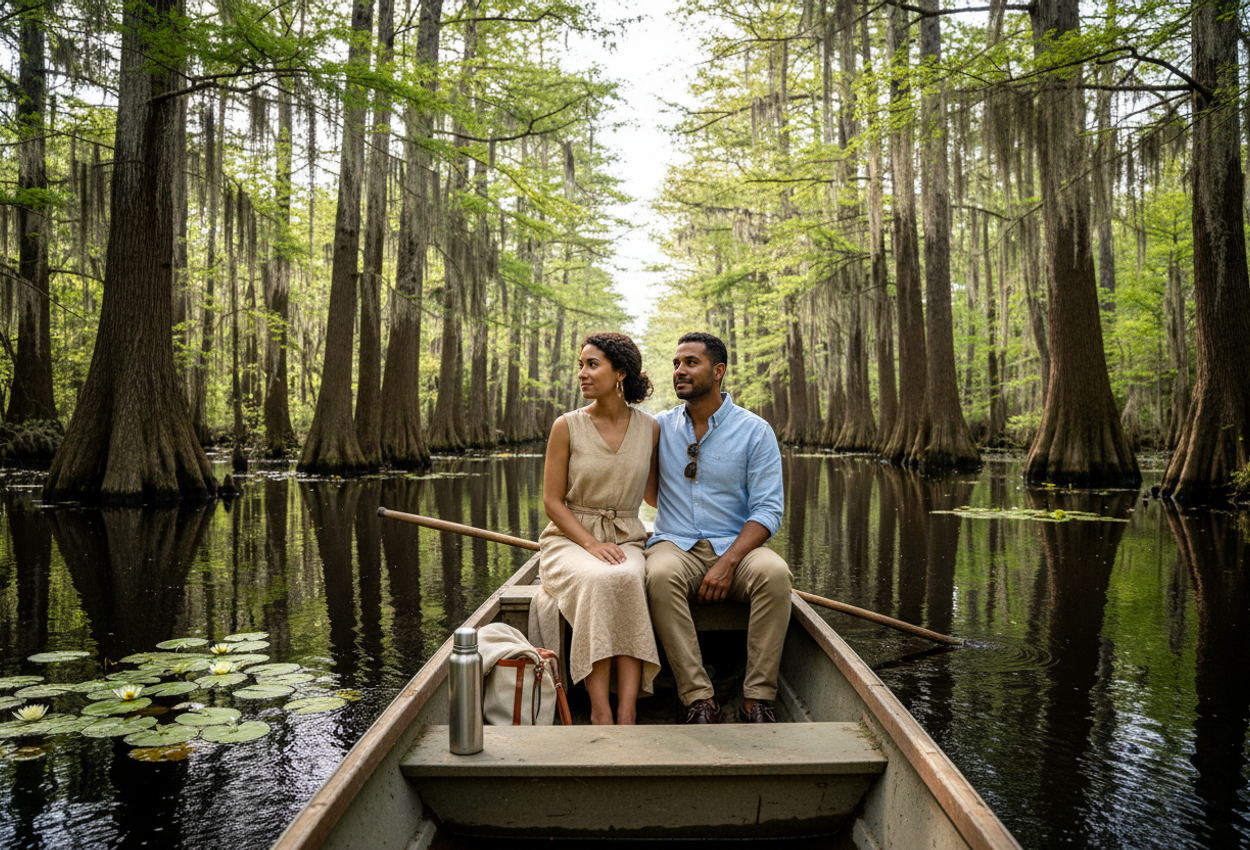
Yet some of Charleston’s most beguiling romance lies beyond the city center. Just a drive away in Moncks Corner, Cypress Gardens offers a completely different but equally stirring landscape. Here, an 80-acre blackwater cypress and tupelo swamp folds you into its stillness. Climb into a flat-bottomed boat – either self-guided or with a quiet-spoken guide – and push off into a maze of mirror-dark water dappled with water lilies. Bald cypress trunks rise straight from the swamp, their knees forming knobbly sculptures; Spanish moss drapes from branches like tattered silk. The only sounds are the dip of your oar, the occasional plop of a turtle dropping into the water, and the echoing call of a heron. Light sifts through the canopy in shafts, painting bright patches onto the surface where dragonflies skim and the reflections of trees shimmer.
Sharing this slow, drifting journey through the swamp is one of the Lowcountry’s most unexpectedly romantic experiences. You sit side by side on the narrow bench, shoulders just touching, your movements unconsciously coordinated as you steer through the marked channels. Occasionally, you glide under a wooden footbridge or past a clearing where wildflowers splash the banks with color. Knowing that scenes from beloved films have been shot here adds a whisper of cinematic magic, but the reality – the smell of tannic water, the coolness beneath the canopy, the sudden rush of wings as a bird takes flight – is richer than any screen.
Return to Charleston at golden hour, when the sun slants low across the harbor and the city’s church steeples glow. Perhaps there is time to walk one more time down a side street you have not yet explored, past hidden courtyards and tucked-away wine bars. In Charleston, romance is not a single marquee moment; it is an accumulation of small, sensual impressions – the touch of worn brick under your fingertips, the taste of fresh shrimp and grits shared on a candlelit patio, the creak of an old house settling as the night draws in.
Lisbon's Fado Soul
Lisbon is a city of hills and heartache, of tiled facades and music that seems to rise from the very cobblestones. Romance here is tinged with saudade – the untranslatable Portuguese notion of longing – and it pervades everything from the way sunlight glints off the Tagus River to the minor chords of a Fado ballad spilling out of a doorway in Alfama.
Begin your evening in that very neighborhood, the oldest in Lisbon, where streets twist into tight switchbacks and laundry flutters overhead like flags. As darkness gathers, lanterns flicker on, their light softened by centuries of grime and salt air. Follow the strains of guitar and the low, velvet voice of a singer to a tiny Fado house where wooden chairs are packed closely together and walls are lined with black-and-white photographs. Between songs, waiters pad silently between tables, setting down plates of grilled sardines, caldo verde soup, and carafes of vinho verde. When the music begins again, conversation stops by custom; you sit in silence, fingers entwined under the table, as the singer pours entire lifetimes of love and loss into each note.
The next day, see the city from its iconic yellow trams. Climb aboard Tram 28, where polished wooden benches and brass fittings speak of another era, and rattle through a cross-section of Lisbon’s most historic districts. The tram lurches uphill past Graça, squeezes between tightly packed buildings in Alfama, and clanks downhill toward Bairro Alto. From the open windows, the smell of baking pastéis de nata wafts in from nearby bakeries, mingling with diesel and sea air. Sharing a bench, you lean together on sharp corners, laughing as the tram negotiates improbably tight turns.
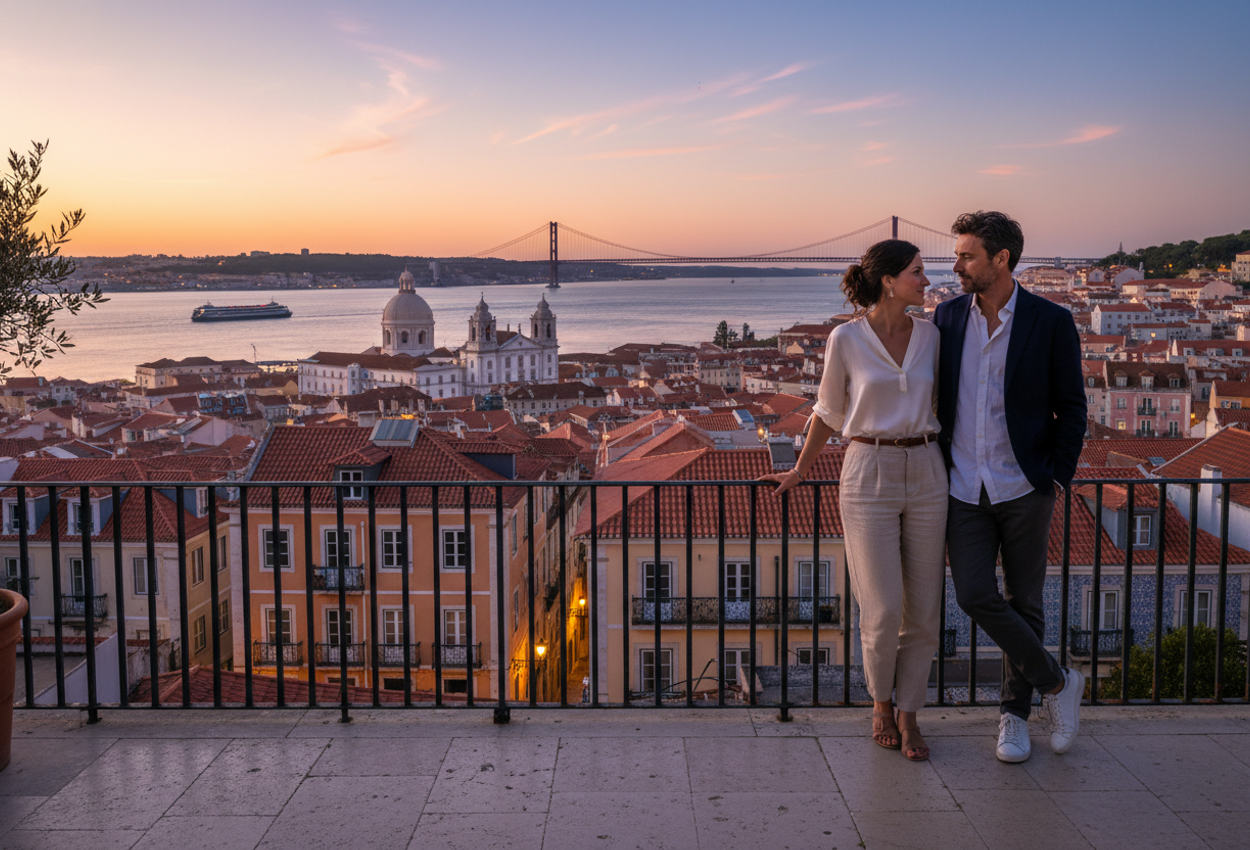
For a more panoramic perspective, climb to Castelo de São Jorge, the Moorish castle that crowns one of Lisbon’s highest hills. Its ramparts offer sweeping views over terracotta rooftops and the broad expanse of the river, where the 25 de Abril Bridge stretches red and delicate against the sky. Find a quiet stretch of wall as late afternoon edges into evening and watch the city change color: whites and creams deepen to honey and amber, shadows lengthen, church bells echo from multiple directions. Street musicians sometimes play in the courtyards below; peacocks strut along the battlements as if they own the place.
Amid these grand vistas, Lisbon’s most romantic experiences are often the simplest ones. Seek out a tiny tasca, a traditional tavern-style restaurant favored by locals rather than guidebooks. Look for hand-lettered menus, paper tablecloths, and the aroma of garlic and olive oil seeping out under the door. Inside, you may find just a handful of tables arranged around a counter where the owner chats with regulars. Order whatever is fresh that day – perhaps clams in white wine and cilantro, salt cod baked with potatoes, or a stew of beans and sausage – and share a carafe of house wine. As you eat, the television murmurs quietly in the corner, the owner’s grandchildren dart in and out of the kitchen, and the couple at the next table leans in close over their own shared plate. This intimacy, this gentle folding of strangers into each other’s evenings, is Lisbon’s quiet gift.
Later, wander back through Alfama’s tangle of lanes, stopping at a miradouro – one of the city’s scenic viewpoints – to look out over a sea of tiled roofs at night. The river is a dark ribbon catch-lighted by passing ferries; behind you, the faint echo of yet another Fado melody drifts from somewhere unseen. In Lisbon, love is always accompanied by a note of longing, an understanding that every perfect moment is fleeting – which only makes it more precious.
San Sebastián's Coastal Allure
On the north coast of Spain, wrapped around a shell-shaped bay, San Sebastián manages to feel both glamorous and deeply relaxed. This Basque seaside city is a place where romance wears salt crystals on its skin and butter on its lips, where long walks are punctuated by tiny, exquisite bites and views that seem almost too perfectly composed to be accidental.
Begin with a stroll along La Concha Beach, its golden arc curving gently between two headlands. The sand here is fine and pale, cool in the morning and warm by afternoon, and the shallow waters of the bay shimmer in shifting shades of turquoise and navy. Couples walk barefoot at the water’s edge, shoes dangling from their fingers, while children chase waves and locals in swim caps slice industriously through the calm surface. The elegant white balustrade of the promenade frames every photograph like an ornate picture frame, and the island of Santa Clara sits in the bay like a small, forested jewel.
As your appetite builds, turn inland to the narrow streets of the Parte Vieja, the Old Town, where pintxos bars stand shoulder to shoulder. Inside, countertops are crowded with neat rows of tiny culinary artworks: anchovies marinated in vinegar, skewers of olives and peppers, slices of tortilla, slivers of jamón balanced on crusty bread. Step from bar to bar, choosing one or two pintxos at each and pairing them with small glasses of txakoli, the lightly sparkling local white wine poured theatrically from a height to aerate it. Standing shoulder to shoulder, passing plates back and forth, you build a shared meal out of bites and sips, out of little discoveries and preferences.
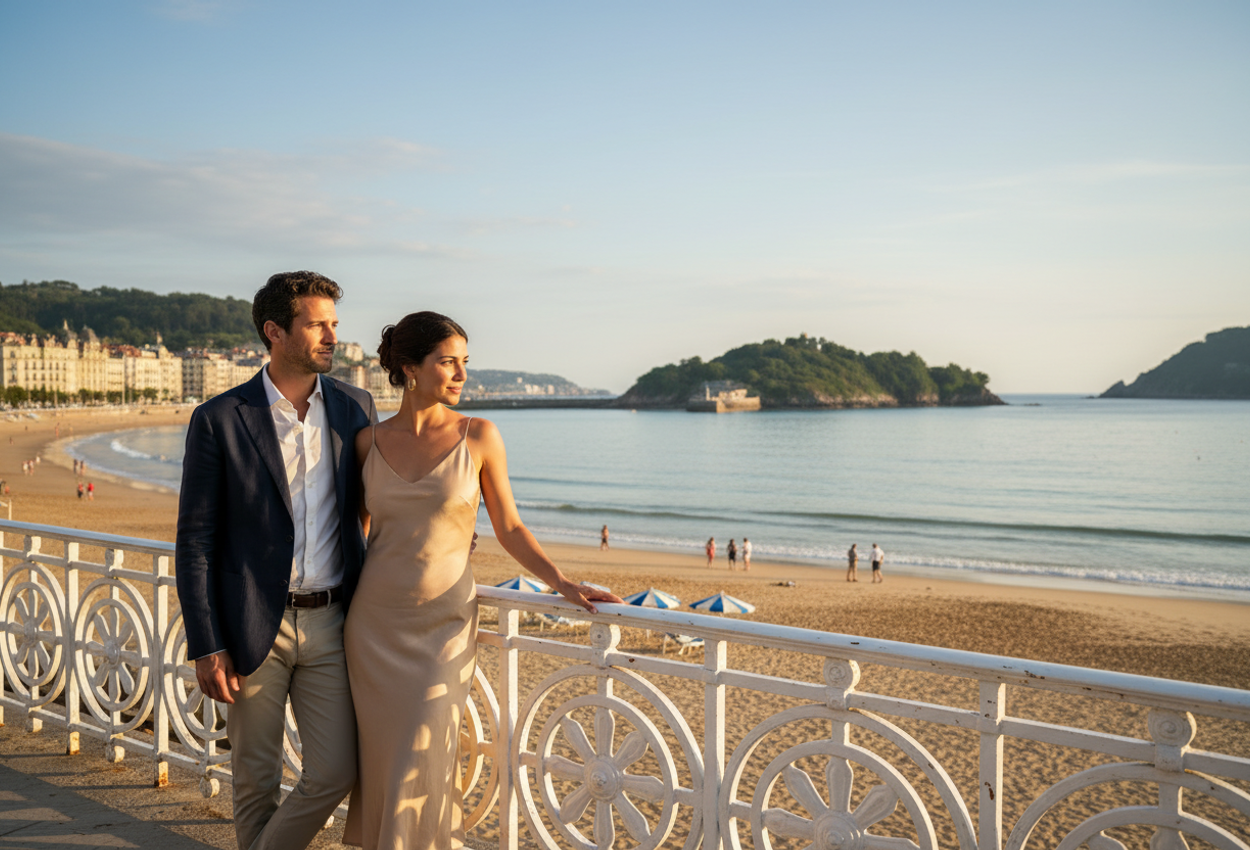
For a broader view – and a touch of retro amusement – ride the funicular up to Monte Igueldo. At the summit, a vintage amusement park clings briefly to the past with its carousel, wooden roller coaster, and slightly faded signage. But it is the outlook that steals the show: from here, the entire sweep of La Concha Bay unfolds below you, framed by the city’s elegant architecture and the deeper blues of the open Bay of Biscay beyond. Lean against the stone wall, feel the Atlantic breeze lift your hair, and watch as the sunlight traces pathways across the waves.
San Sebastián’s romance thrives in quieter, less photographed corners as well. Just beyond the main beaches lie smaller coves where locals escape on sunny days, wedges of sand backed by rugged cliffs and accessed via steep paths. Seek out one of these less obvious spots on a calm day, pack a simple picnic of cheese, local cider, and crusty bread, and settle into the natural amphitheater of rock and sea. The sound of waves breaking against stone becomes your soundtrack; the salt tang in the air sharpens every bite, every kiss.
For dinner, skip the Michelin-star headlines – or save them for another night – in favor of a family-run restaurant tucked down a quieter street. Inside, tables are covered with white cloths; the menu is handwritten or chalked on a board. Order traditional Basque dishes: perhaps a hake stew in green sauce, or grilled turbot presented simply with olive oil and lemon. The fish here tastes of the sea in the best possible way: sweet, delicate, and impossibly fresh. As you eat, the proprietor may come by to ask about your day, to recommend a particular bottle of txakoli, to share a story about the morning’s fish market. In these exchanges, you feel folded into the city’s life, not just passing through but briefly belonging.
When night finally falls, return once more to the promenade. Streetlights cast soft halos on the pavement; the sound of distant laughter trickles across the water from beachside terraces. The bay, now dark except for scattered reflections, feels like a vast, breathing presence. You walk slowly, letting the day’s flavors and images blur into a single, lingering impression. In San Sebastián, as in all of these unexpectedly romantic cities, love is not something to be staged – it is simply what happens when place and person, light and moment, meet in just the right way.