There is a particular kind of romance that only exists between carriage and track: the soft lilt of wheels on rails, landscapes unspooling slowly beyond the window, and the sense that time itself has agreed to loosen its grip.To step aboard a great train is to enter a moving world apart, where conversations linger over silverware, where mountains appear like stage sets beyond your table, and where nights are spent not in anonymous hotel rooms but in softly lit cabins that sway you gently to sleep. These five journeys, scattered across Europe and the Americas, celebrate the art of slow travel: days measured in river bends and mountain passes, in shared glances over candlelit dinners, in the rare luxury of having nowhere to be except exactly where you are.
From the polished marquetry of the Venice Simplon-Orient-Express to the glass domes of the Rocky Mountaineer, from moonlit Andean plateaus to Scotland’s mist-swathed moors and the sun-baked olive groves of Andalusia, each of these trains offers more than a way to get from one city to another. They are destinations in themselves, crafted for couples who want the journey to be the love story.
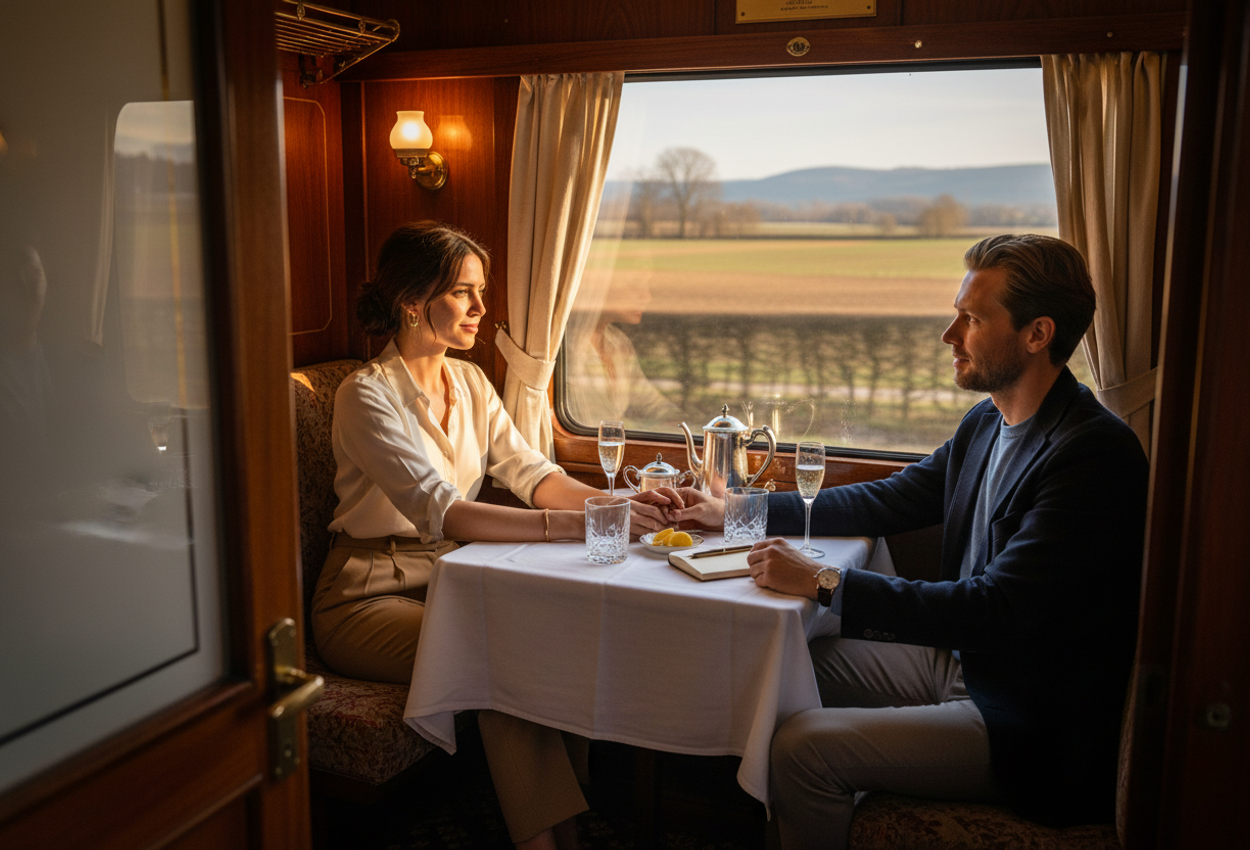
On board, time stretches: mornings begin with coffee delivered to your cabin as a new landscape appears outside; afternoons lengthen into languid lunches and unhurried conversations with fellow travelers; evenings become a theatre of clinking crystal, rich regional cuisine, and the hush of night descending beyond the glass. What follows is your invitation to step on board.
Venice Simplon-Orient-Express: A Whistle-Stop Through Time
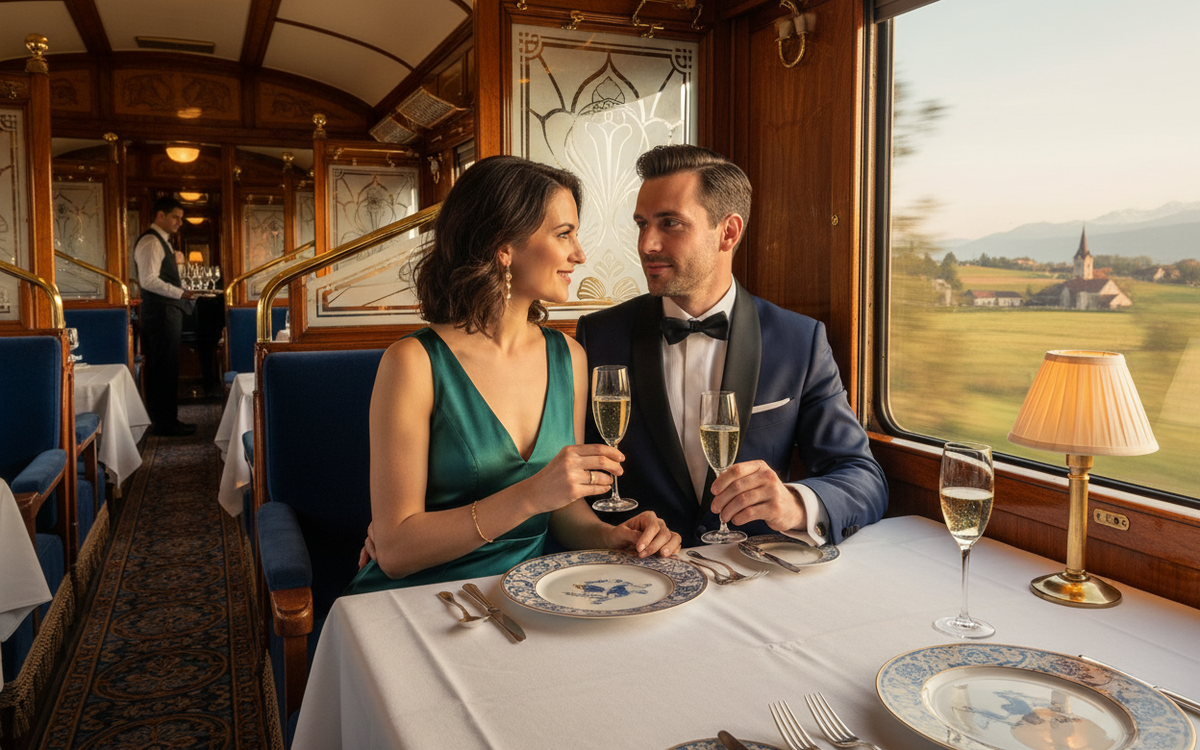
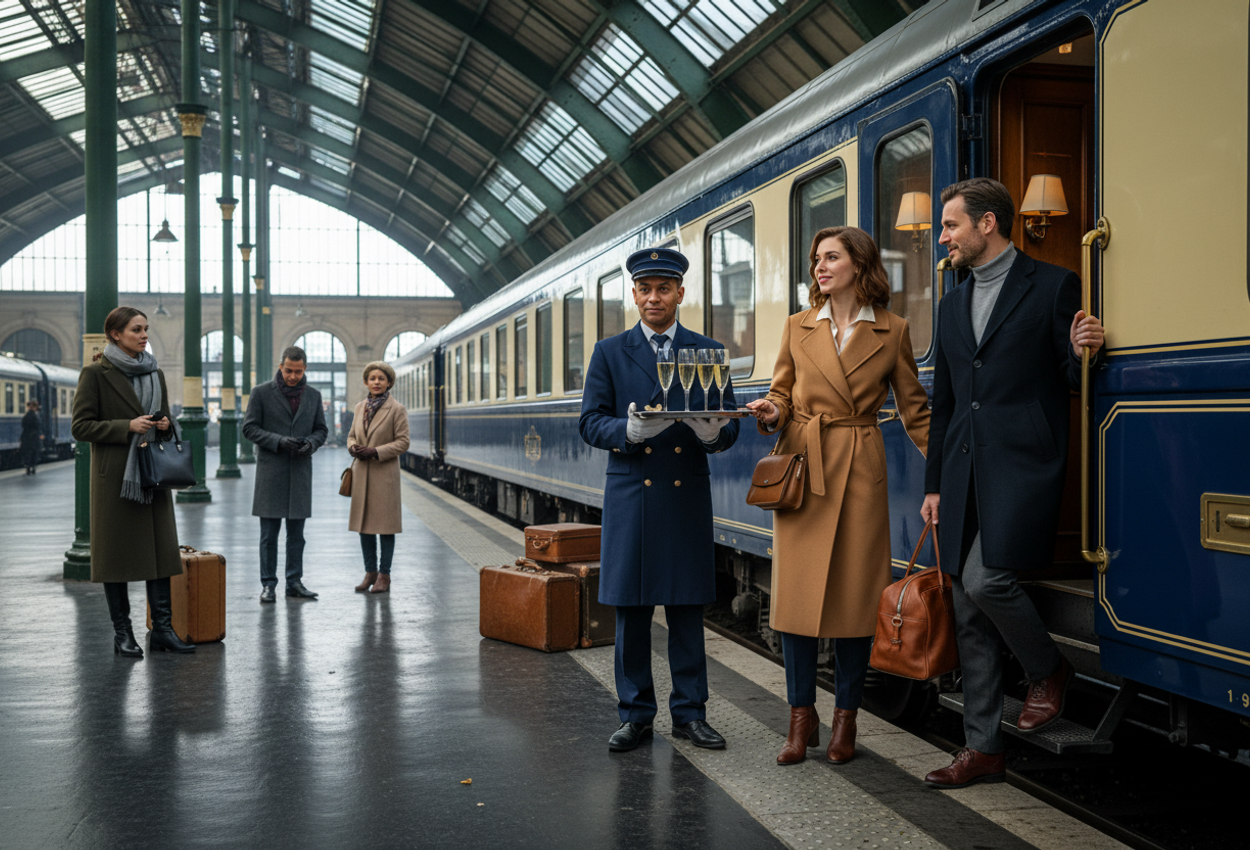
Paris always feels like a beginning, but rarely as much as when you step through the discreet entrance at Gare de l’Est and see the deep blue and cream carriages of the Venice Simplon-Orient-Express waiting under the iron-and-glass canopy. Porters in pillbox hats guide you along the polished brass railings, the clatter of the station softening as you approach the iconic logo on each door. Then comes one of travel’s great rituals: the champagne greeting. A flute of chilled bubbly is pressed into your hand as you step up from the platform, and with that first sip you feel yourself crossing a threshold into another era.
Inside, the restored 1920s and 1930s Wagons-Lits carriages glow with inlaid marquetry, Lalique glass panels, and buttery lamplight. Your cabin is a cocoon of nostalgia: wood-panelled walls gleaming like old honey, velvet banquettes that will later transform into plush bunk beds, crisp monogrammed linens, and a small washbasin hidden behind a mirrored door. The air carries a faint blend of linen, polished wood, and the citrus whisper of someone’s cologne along the corridor. As the whistle sounds and Paris begins to glide away, there is a subtle, collective intake of breath: the city of light recedes and the adventure begins.
By afternoon, the train is threading its way through eastern France, past farmhouse roofs and church spires. In the bar car, a pianist coaxes standards from a baby grand as couples sink into sapphire-blue armchairs. The rhythm of the rails underpins the music, a soft percussion that makes the crystal in your French 75 tremble just so. This is the kind of place where it feels entirely natural to dress for tea; you notice tuxedos and silk gowns emerging long before the dinner gong sounds, as if the very woodwork has conspired to restore the lost art of elegance.
Night brings the Alps. After a multi-course dinner in the restaurant cars – think lobster served on heavy white china, tournedos of beef in a velvety jus, and desserts appearing beneath silver cloches – you return to your cabin to find it transformed. Where there was once a sofa, there are now two bunk beds dressed in pristine white, ladder gleaming, curtains drawn against the chilly mountain darkness beyond. Outside, the train begins its ascent through the Swiss Alps, the world reduced to tiny clusters of lights and the faint outline of peaks etched against a star-pricked sky. Wrapped in your duvet, you feel the subtle sway of the carriage and the comforting rattle as the train weaves through tunnels and over viaducts, carrying you ever closer to Italy.
Dawn arrives with a knock on the door and the soft clink of a silver tray setting down: coffee, fresh orange juice, still-warm pastries perfumed with butter. You pull back the curtain to find the landscape transformed. The harsh drama of the Alps has softened into the gentle foothills of northern Italy; vineyards stitch the slopes in neat rows, red-tiled farmhouses bask in early light, and church bells toll faintly as you glide past. Somewhere ahead lies Venice, but there is no urgency here – only the pleasure of watching the world slowly become more Mediterranean with every mile.
The exclusivity of the experience is as palpable as the scenery. This is not a train you stumble upon by accident; it is an object of desire that has been coaxed back to life with obsessive attention to detail. Staff remember your names and your preferred drink by the second evening. There is a shared sense among passengers that they are participating in something almost theatrical – a revival of the golden age of rail travel, complete with white-jacketed waiters, brass luggage racks, and the quiet thrill of arriving in Venice by rail rather than plane.
As you cross the causeway into the Venetian Lagoon, the city appears like a mirage: domes, campaniles, and palazzi floating above the shimmer of water. The train slows, as if reluctant to relinquish you. You step down onto the platform at Venezia Santa Lucia hand in hand, a little dazed, as if you have slipped through a crack in time and returned with a private memory no one else will quite understand.
Rocky Mountaineer: Rockies to Red Rocks
Where the Venice Simplon-Orient-Express is all about interior glamour, the Rocky Mountaineer draws its romance from what lies beyond the glass. On the Rockies to Red Rocks route, you board in Denver, the mile-high city, where dawn paints the Front Range in bruised purples and soft golds. The train’s signature glass-domed coaches rise above the platform like shimmering conservatories, inviting you into a world where the walls seem to disappear and the landscape takes centre stage.
Inside, the atmosphere is relaxed yet polished. In the upper level of the bi-level coaches, panoramic windows curve overhead, so that even when you lean back in your softly upholstered seat you can see the sky in all directions. The light has a particular clarity here, the sun catching on the river below and turning it into a ribbon of hammered silver as the train curves out of Denver Union Station. The air smells faintly of freshly brewed coffee and maple-glazed bacon drifting up from the galley.
The first day is a slow metamorphosis from city to wilderness. You follow the Colorado River as it slices through the foothills, the track threading into canyons that grow narrower and wilder with each passing hour. Red rock walls rise sheer on either side; aspens quiver in bands of green along the water’s edge. In the distance, the snow-dusted peaks of the Continental Divide shoulder against the sky, a reminder of how recently this route would have been considered impossible. Guides move quietly through the carriage, offering a running commentary that turns the journey into a kind of rolling geological field trip – pointing out layers of rock that mark millions of years, explaining the process that carved these canyons, recounting how surveyors and laborers battled climate and altitude to push the rails this far west.
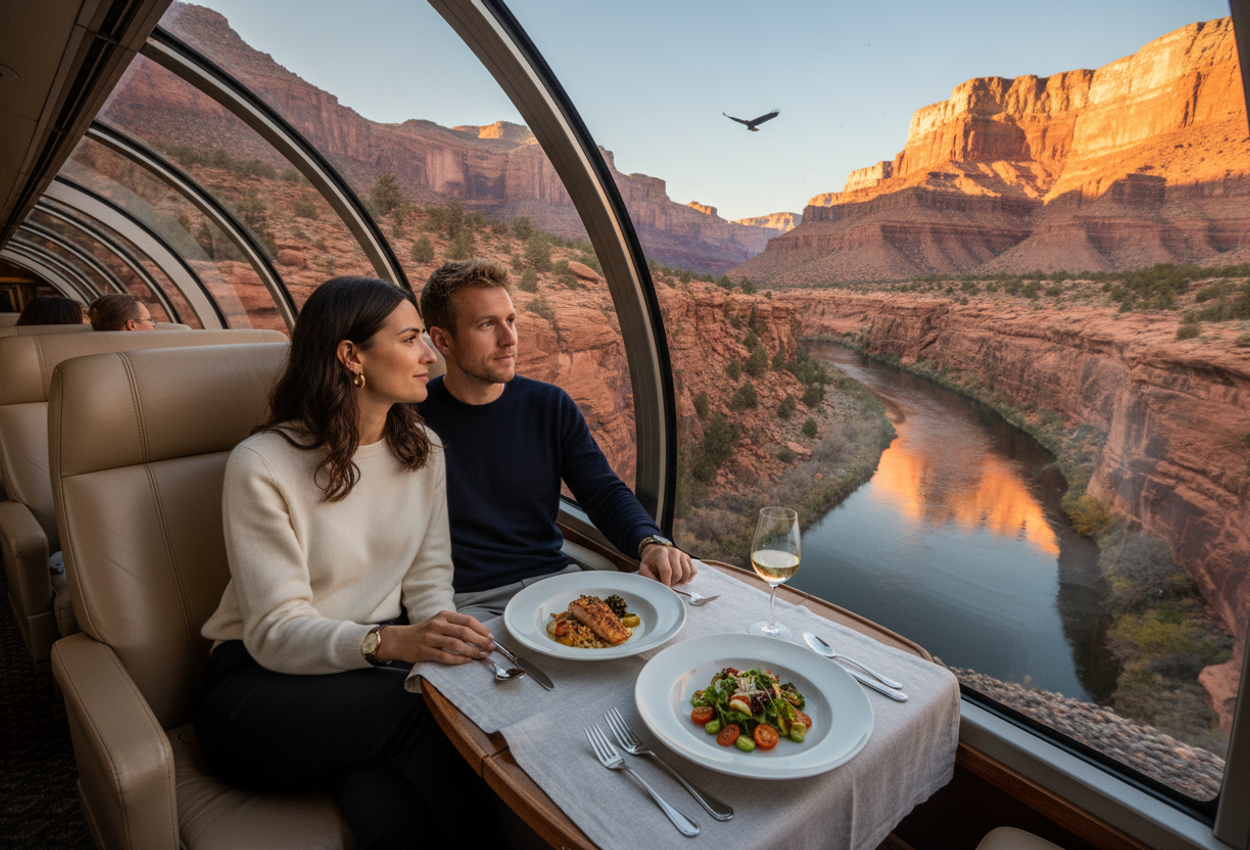
Meals are served at your seat on linen-topped tables: wild salmon with lemon-dill sauce, Colorado beef short ribs that fall apart at the touch of a fork, local wines selected to echo the surrounding landscape – a bright white from the high desert vineyards, a robust red as you enter canyons of deeper, rustier hues. Between courses you lean back into each other’s shoulders and simply watch. Some of the most romantic moments here are silent ones: spotting a bald eagle tracing lazy circles above the river, glimpsing the flash of a mule deer on the bank, or the sudden, thrilling sight of a moose standing half-submerged in a beaver pond, unbothered by the passing train.
By the time you reach the ochre cliffs of Ruby Canyon, the sun is dipping low, and the rocks seem to burn from within. This is a stretch of river accessible only by train or raft, giving it a dreamlike, private quality. Couples cluster near the windows, hands pressed to the glass as shadows deepen and the canyon walls close in, glowing in saturated reds and oranges. You overnight in a hotel off the train – part of Rocky Mountaineer’s leisurely rhythm – before rejoining your carriage the next morning as the landscape shifts again, trading alpine drama for Utah’s cinematic desert.
Heading toward Moab, the scenery unfurls in ever-broader gestures. Hoodoos and sandstone fins punctuate the horizon; buttes rise solitary and regal from the plains. The sky expands, a vast bowl of blue where clouds move in great, slow herds. With the extension to Salt Lake City, the narrative of the journey lengthens: from the old rail yards of Denver through the heart of the Rockies and down into the red rock country that has inspired filmmakers and photographers for generations. Somewhere near the border, the guide shares a lesser-known story about the construction of the original line – of immigrant workers who carved ledges into sheer rock walls, hanging from ropes to set dynamite charges, shaping a route many deemed too ambitious to ever succeed. It adds an undercurrent of awe to the comfort of your seat; every curve you glide around was once a gamble.
As you finally roll into Moab – gateway to Arches and Canyonlands National Parks – or onward toward the calm, Mormon-spired skyline of Salt Lake City, you realise the greatest luxury of all has been perspective. Here, romance is written not in candlelight but in canyon walls, in rivers and rail lines that seem to conspire to slow you down long enough to really see each other, framed by some of North America’s most spectacular scenery.
Belmond Andean Explorer: A Peruvian Dream
In Cusco, the former capital of the Inca Empire, dusk settles quickly, pooling in the cobbled streets and around the carved stone walls of ancient palaces. At the station, lanterns bathe the platform in amber light as you approach the Belmond Andean Explorer, Peru’s first luxury sleeper train and one of the highest in the world. Its navy-and-cream exterior gleams against the darkening sky, while inside, a different world awaits: a fusion of classic rail romance and contemporary Andean design.
Step into the lounge car and the chill of the Andean evening is replaced by the warmth of polished hardwood floors, soft alpaca throws, and deep armchairs upholstered in rich, jewel-toned fabrics. The decor plays on traditional Peruvian textiles – indigo, crimson, and gold patterns echoing the weavings of Lake Titicaca communities – yet the lines are clean, the lighting subtle and modern. Staff greet you with a cool towel and, almost inevitably, an invitation to taste your first Pisco Sour of the journey, the foam dusted with a delicate spiral of bitters.
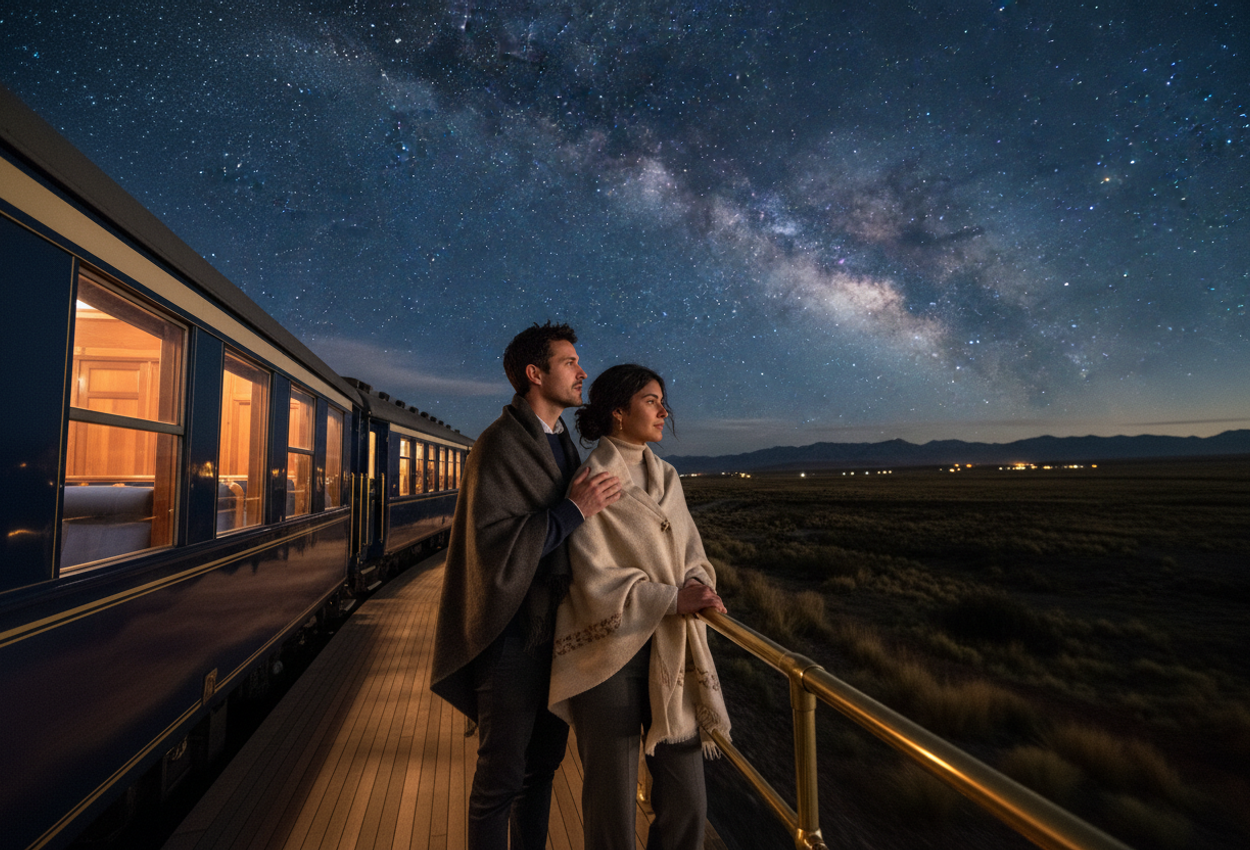
As the train eases out of Cusco, climbing slowly into the Andean altiplano, you walk hand in hand toward the open-air viewing platform at the rear. The air is crisp, thin with altitude but startlingly pure. Stars ignite above you with almost startling intensity, and the scent of burning eucalyptus from distant farmhouses drifts faintly on the wind. Out here, with rails humming beneath your feet and the darkness of the Andean night unfolding in every direction, you feel wonderfully small – reduced to silhouettes against a sky thick with constellations that guided Andean farmers long before railways existed.
By morning, the world has become a vast, tawny ocean of grassland broken by scattered adobe villages and flocks of grazing alpaca. The train is now more than 14,000 feet above sea level, one of the loftiest rail journeys on earth, yet inside everything feels cocooned and serene. Breakfast is a five-star affair: freshly baked breads, tropical fruits from the lower valleys, and creamy quinoa porridge scented lightly with cinnamon. Through the windows, you glimpse women in bright polleras and wide-brimmed hats walking along dirt paths, their skirts flashing crimson and fuchsia against the muted palette of the plains.
The suites are unexpectedly spacious, with king or twin beds dressed in high-thread-count linens, lambswool blankets, and cushions woven in vivid Andean motifs. Sunlight filters through curtains the colour of desert sand, warming the hand-carved wooden headboards. En-suite bathrooms, a rare luxury on such a high-altitude train, offer hot, high-pressure showers and organic botanically scented amenities – notes of muña and coca, herbs long used by local communities to ease the effects of altitude. It feels not simply like a cabin, but like a boutique hotel room that happens to carry you across mountaintops.
Midway through the journey, the Andean Explorer makes its unhurried approach to Lake Titicaca, the highest navigable lake in the world. The water appears first as a band of improbable cobalt on the horizon, gradually widening until it occupies the entire frame of your carriage window. On shore excursions, you step into a different rhythm of life altogether: visiting floating reed islands where Uros families maintain centuries-old traditions, or standing in the quiet courtyards of Taquile Island, where stone archways frame views of distant peaks like painted backdrops. Here, community leaders explain – through your guide – how weaving patterns encode stories of marriage, harvest, and weather, each textile a living archive of memory.
Back on board, the bar car fills with a soft, anticipatory murmur as evening draws in. This is the heart of the train, a place where strangers become traveling companions and, often, friends. Couples gather beneath brass sconces, the light catching in glasses of ruby-red Peruvian wine or in the frosted curves of yet another round of Pisco Sours. A small band may appear, guitars and panpipes weaving melancholic Andean melodies through the clinking of ice and conversation. The effect is intoxicating: you are at once deeply cocooned and profoundly connected to the landscape sliding by outside.
The onward route toward Arequipa leads through increasingly volcanic terrain: fields give way to ash-grey plains studded with cacti, and distant volcanoes – Misti, Chachani, Pichu Pichu – rise like slumbering gods on the horizon. The sense of descent is subtle but perceptible; you feel your breath come easier as the train drops from its dizzying heights toward the White City’s baroque facades and pale sillar stone. By the time you roll past the outskirts of Arequipa, lights beginning to flicker in the twilight, the journey has taken on the cadence of a dream – one in which altitude, culture, and comfort have combined to create a romance that is as much about the soul of Peru as it is about the person seated beside you.
The Caledonian Sleeper: Highlands Under the Stars
In London, the romance of the Caledonian Sleeper begins inconspicuously, tucked along a platform at London Euston as commuters stream past with the weary haste of city life. Step aboard, however, and the mood changes at once. The air is faintly scented with beeswax and whisky, the lights are gentler, and the bustle of the concourse recedes behind a closed door. It feels almost conspiratorial, this decision to leave the metropolis behind while everyone else is still finishing their last emails of the day.
Your cabin is compact yet cleverly designed, with soft Scottish textiles – heather-grey upholstery, a tartan throw folded at the foot of the bed – and a window that frames the platform like a proscenium arch. As departure time approaches, there is a subtle frisson in the corridor: the soft thud of cases being stowed, a murmur of conversation, the hiss of the train’s systems waking fully. Then, almost imperceptibly, you’re in motion. The city lights smear into lines, the tall office blocks fall away, and London’s sprawl begins to loosen its grip.
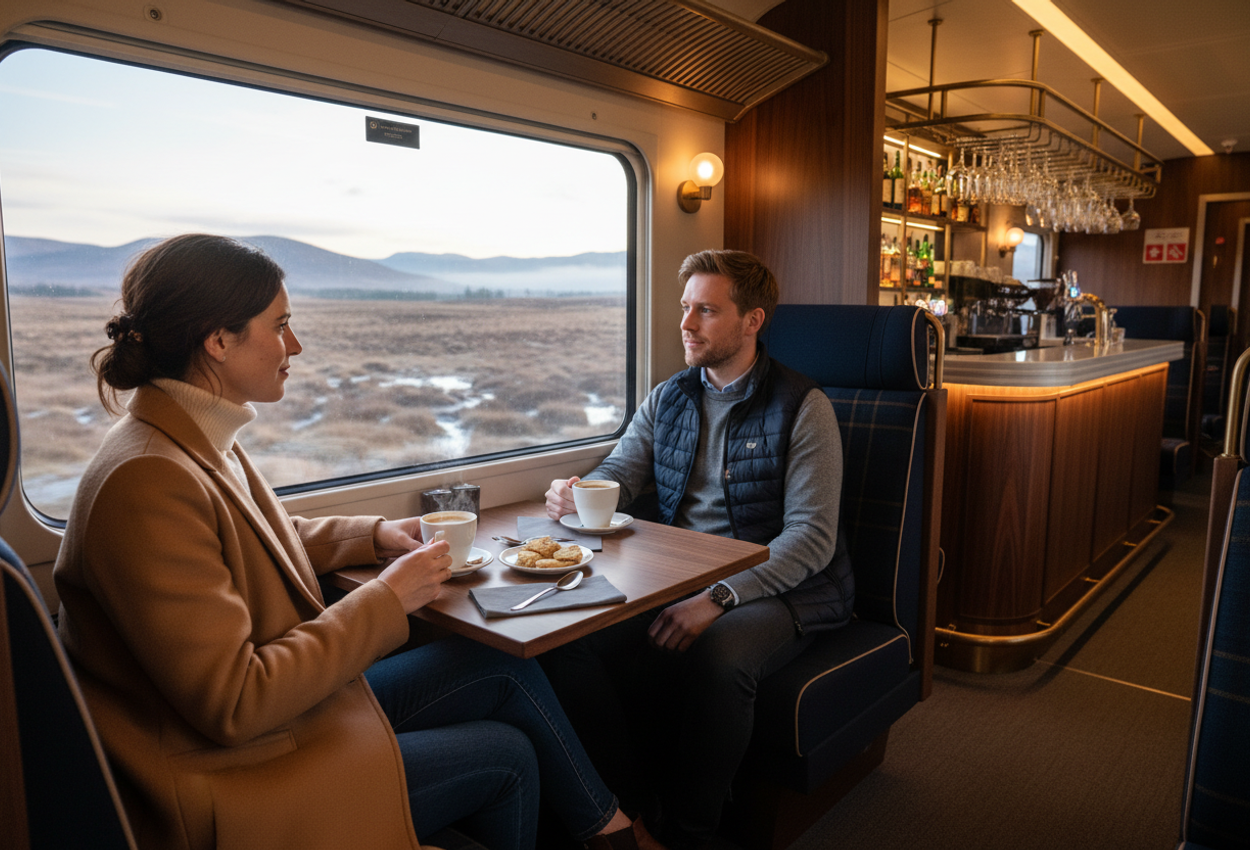
The lounge car is where the sleeper’s particular magic reveals itself. Dark blue banquettes line the windows; the bar gleams with an array of single malts and craft gins; small tables bear menus that read like a love letter to Scottish producers: Shetland salmon, venison from the Highlands, farmhouse cheeses from Aberdeenshire. You order something comforting – perhaps haggis, neeps, and tatties reimagined with refined presentation – and a dram of peaty Islay whisky that smells of sea spray and bonfires. Around you, conversations strike up naturally, the shared intimacy of overnight travel dissolving British reserve. Train staff offer gentle guidance on the whisky list, steering you toward a bottle with a story: a distillery perched at the edge of an Atlantic bay, or an expression once reserved for local casks only.
By the time plates have been cleared and last orders called, the train has long since left the city behind. You return to your cabin to find the bed made up, crisp white sheets tucked tightly, reading light glowing warmly. Outside, darkness presses against the glass, punctuated now and then by the distant glimmer of a village or the pale shimmer of a river catching starlight. There is something unmistakably intimate about falling asleep together in a narrow berth while the world slides unseen past your window, the rhythm of the rails like a very old lullaby.
Dawn in the Highlands arrives quietly. You wake to a different light, the grey softness of a northern morning seeping around the edges of the blind. When you lift it, the transformation is almost shocking. Gone are the suburbs and industrial estates; in their place stretch miles of moorland, tufted with russet heather and silvered grasses. Craggy peaks rise in the distance, their shoulders streaked with the last of winter’s snow or lost in tattered veils of low cloud. Lochs appear suddenly and vanish just as quickly, mirrors of pewter under a pale sky.
Somewhere along the way, you cross the haunting expanse of Rannoch Moor, one of the last great wildernesses of Scotland. Here, the track seems to float above a tapestry of bogs, lochans, and peat pools, with no road in sight. Mist clings low over the water; twisted pines stand solitary against the wind. Red deer sometimes graze at the margins, their silhouettes perfectly still as the train slides by. It feels less like passing through a landscape and more like gliding across the surface of some ancient myth.
Local tales cling to this terrain like fog. In the lounge car, over morning coffee or a second, cheeky nip of whisky, a crew member might share a story of ghostly lights seen over the moor, or of clans driven across these desolate miles during darker chapters of Highland history. The effect is to layer your journey with a sense of deep time; the rails may be a 20th-century addition, but the land they traverse has been shaping destinies for centuries.
Insider tip: If you’re unsure which whisky to sample on board, ask for an Islay single malt such as a Lagavulin or Laphroaig. Their smoky, maritime character seems to distill the essence of the Scottish landscape itself – peat bogs, sea spray, and distant woodsmoke – and sipped slowly as the train winds past lochs and bens, it becomes part of the scenery rather than merely a drink.
By the time you reach the terminus – perhaps Fort William, framed by Ben Nevis, or the pastel harbourfront of Inverness – you feel as though you have passed not just northward on a map, but into another state of being. The pace of life has decelerated; conversations lengthened; the distance between you and your companion gently, almost imperceptibly, closed. To step down onto the platform here is to emerge into a Scotland that feels earned – not glimpsed hurriedly through a rain-streaked car window, but arrived at under the stars.
Al Andalus: Seville to Madrid – A Spanish Rhapsody
In Seville, romance hangs in the air like orange blossom. The late afternoon sun slants across tiled plazas; guitarists strum in the shade of palm trees; the distant staccato of flamenco heels echoes down narrow streets. It is from this sensuous city that the Al Andalus begins its slow, looping rhapsody through the cultural heartland of Spain, an opulent Belle Époque palace on rails connecting Seville and Madrid over seven lingering days.
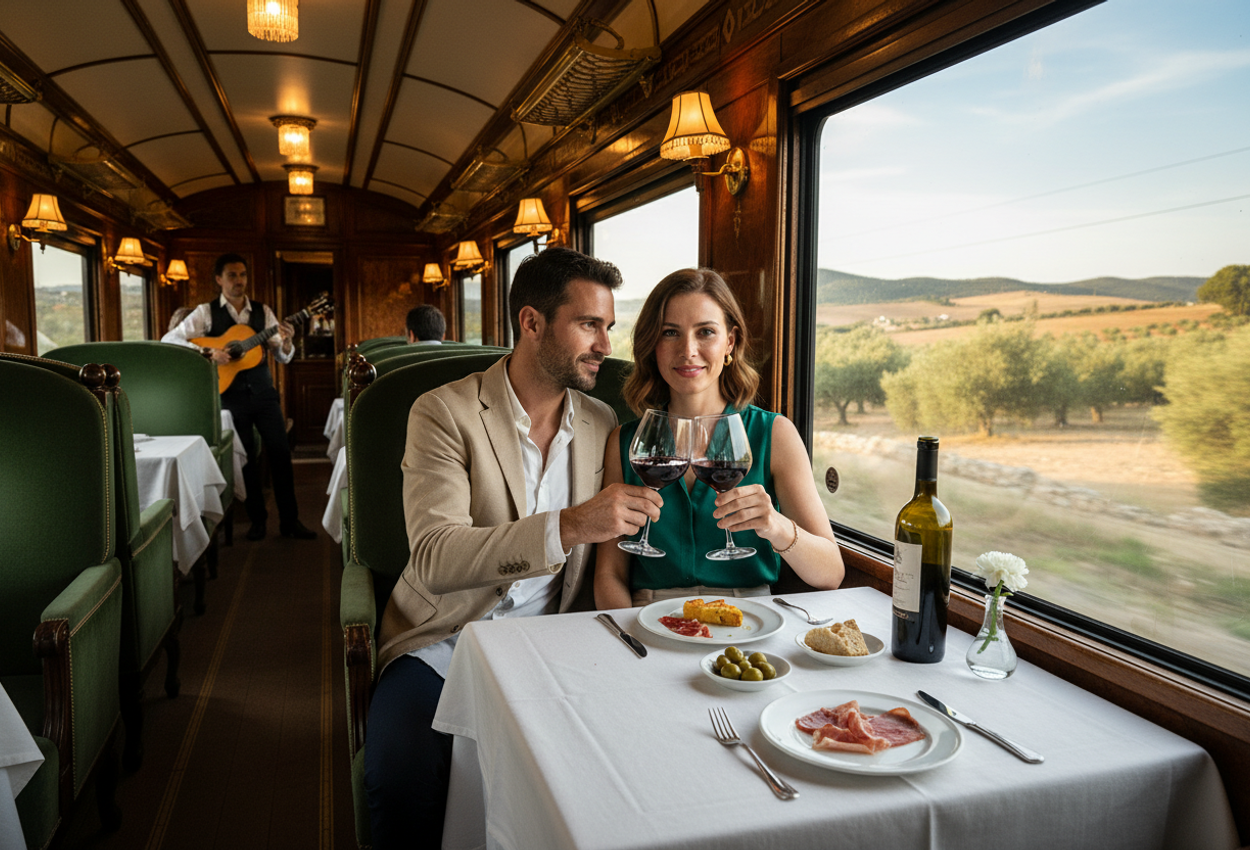
On the platform, the train’s burgundy and cream carriages gleam, their windows curtained in ivory, brass fittings polished to a soft glow. Step inside and you are transported to the late 1920s: many of the lounge and restaurant cars were originally built by the same legendary firm that supplied Europe’s great expresses. Carved wood panelling, fringed lamps, and plush armchairs upholstered in deep greens and golds create an atmosphere halfway between royal salon and intimate salon de thé. It feels like the kind of place where poets might once have scribbled lines on linen napkins, and where dancers could, at any moment, clear a space for one last sevillanas before midnight.
Your suite is a study in old-world elegance softened for modern comfort. In Grand Class rooms, twin beds convert to a generous sofa by day, while Deluxe Suites offer a proper double bed, wardrobe, and a compact but beautifully tiled bathroom with a hydromassage shower. Embroidered pillows hint at Andalusian motifs – stylised pomegranates, Moorish arches – and small vases of fresh flowers bring in the scent of jasmine from the station gardens. When the train glides out of Sevilla Santa Justa, heading first toward Córdoba, you feel the centuries compress into the span of a single journey.
The rhythm of Al Andalus is deliberately unhurried; the train does not race between cities so much as drift, a moving hotel whose true purpose lies in what unfolds when you step down onto each platform. In Córdoba, you might begin the morning walking hand in hand through the forest of columns inside the Mezquita-Catedral, shafts of light piercing the darkness to illuminate alternating red and white arches that speak of Al-Andalus’s layered religious history. Emerging into the flower-laden patios of the Jewish Quarter, you have time to linger beneath wrought-iron balconies and tiled fountains before rejoining the train and a lunch that showcases the region’s flavours – salmorejo so thick your spoon almost stands upright, slow-braised oxtail scented with sherry.
Further along the route, in Jerez de la Frontera and Cádiz, romance finds a different tempo. A shore of Atlantic light and salt air replaces the inland heat. One day you tour a sherry bodega, wandering cool chalky cellars as guides explain how flor forms like a protective veil over the aging wine. Another, you watch an equestrian performance where Andalusian horses seem to dance in perfect time to classical music, their riders’ jackets flashing silver braid. By late afternoon, you are strolling through Cádiz, one of Western Europe’s oldest cities, its pastel facades peeling charmingly in the sea air, waves slapping against stone bastions first raised against pirates and privateers.
As evenings fall, the train becomes a stage for Spanish conviviality. Dinner in the restaurant cars is an exercise in culinary storytelling: gazpachos bright with tomato and green pepper, hake in saffron sauce, Iberian pork so tender it yields to the gentlest pressure of a fork. Wines from Ribera del Duero, Rioja, and local Andalusian bodegas flow freely. Afterward, you drift into the lounge car where musicians may appear, guitars and cajón weaving flamenco rhythms as couples sway between the tables or simply sit back, hands entwined, watching the reflections of passing stations flicker briefly in the windows.
Heading north, the journey traces a richly historical path through Extremadura and Castilla-La Mancha. In Mérida, Roman theatres and temples rise unexpectedly from everyday streets, their stone arches blushing pink in the late afternoon light. In Cáceres, the medieval old town feels like a preserved film set: honey-coloured towers and palaces arranged around cobbled squares, swallows looping in the sky overhead. Walking these streets with your partner in the soft evening glow, it is easy to imagine silk-clad merchants and armoured knights once treading the same stones.
Perhaps the most romantic surprise arrives in La Mancha, land of windmills and literary ghosts. Near Campo de Criptana or Alcázar de San Juan, you may find yourself standing beneath whitewashed windmills whose sails turn slowly against a cobalt sky, their silhouettes familiar from the pages of Don Quixote. The air smells of dry earth and olive trees; in the distance, the train waits, its carriages glowing softly in the declining sun. This is slow travel at its purest: not just seeing, but inhabiting each landscape long enough for stories – both old and new – to take root.
Hidden gem: In some itineraries, a visit to Toledo is included before the final stretch to Madrid. If so, slip away from the main cathedral square for a quiet moment on the Mirador del Valle, a viewpoint across the river. At sunset, the city seems to hover above the Tagus in shades of gold and slate, its spires and ramparts reflected in the dark water. It is one of those views that feels designed for two people standing shoulder to shoulder, saying very little.
The finale, fittingly, is Madrid. As the train curves into the capital, you catch glimpses of rooftops, grand boulevards, and the green sweep of Retiro Park. Stepping down at Atocha Station, the Belle Époque world of Al Andalus recedes behind you, yet its cadence lingers. You have eaten and danced, walked and watched, crossed regions whose names you once read only in guidebooks. More importantly, you have done so at a pace that allowed romance – with place, with history, with each other – to flower slowly, like the late-blooming jasmine that perfumes Andalusian nights.
Across these five journeys, one truth remains constant: romance thrives when time stretches, when views change slowly enough to notice, when the journey itself becomes the destination. On rails that thread through mountains, deserts, moors, and ancient cities, love finds room to breathe – and to travel, always, at its own unhurried speed.