Anniversaries ask for more than dinner reservations and a bouquet of flowers; they call for places where the world briefly falls away, where time slows, and where you remember why you chose each other in the first place.Some destinations seem almost purpose built for this kind of celebration. They wrap you in beauty and ease, but they also offer moments of quiet awe, of shared discovery, of laughter that feels like the early days all over again. From the glow of Paris at dusk to the mirror-still waters of Lake Pichola, from barefoot mornings in the Maldives to hot air balloon sunrises above the Serengeti, these six journeys are crafted not just as trips, but as love stories with boarding passes.
What follows is not a list of places to rush through, but intimate stages on which to mark a milestone together. Think private terraces where you can clink flutes in your bathrobes, markets and gardens where you can get lost side by side, and tables for two that seem to hover above cityscapes or seas. In each destination, you will find not only where to stay, but how to spend your days so that by the time you fly home, your anniversary feels less like a date on a calendar and more like a chapter you have written together.
Parisian Passion Rekindled
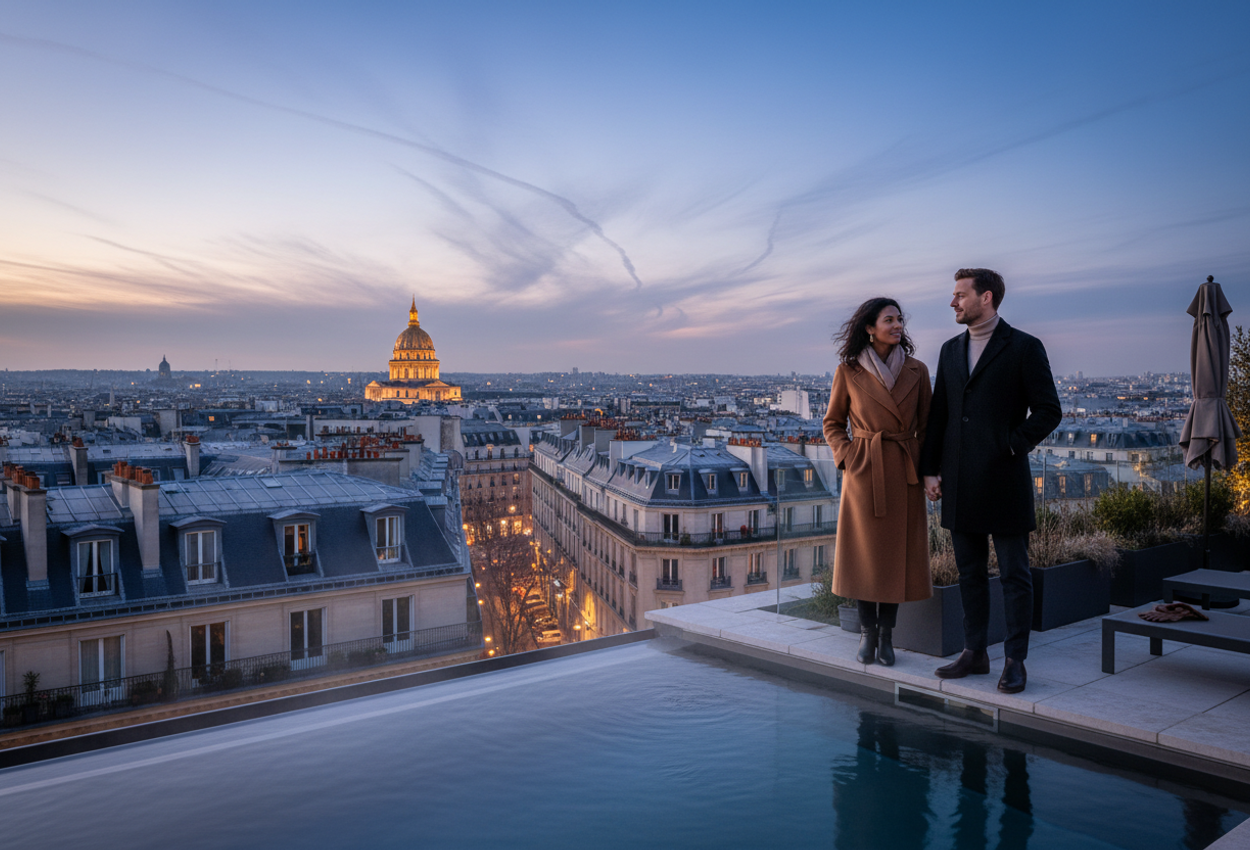
There is a particular hour in Paris when the city seems to inhale. The working day ebbs, shutters lift, and the façades along Rue du Faubourg Saint-Honoré blush with the last light of the sun. On the rooftop of Le Bristol Paris, steam curls above the glass-walled pool like a mirage, and beyond it, the rooftops of the Right Bank stack up in painterly layers. Slipping into the warm water with your partner, you float eye-level with chimneys, mansard roofs, and church spires, while the sky deepens from pale apricot to violet.
Le Bristol has the particular quiet confidence of a grand Parisian palace that has seen nearly a century of love stories unfold. Thick carpets soften every footstep along its corridors, and in your room, heavy drapes frame the city like a private cinema screen. Throw them open in the morning and watch sunlight find its way over slate rooftops, dusting wrought-iron balconies with gold. There is a faint perfume of polished wood and fresh flowers, and from the courtyard below, the muted clink of china as breakfast is served on linen-draped tables.
Step out together and the city greets you in sensory layers. In Montmartre, the cobblestones are polished smooth by decades of footsteps; a street accordion unspools a familiar melody that seems to rise with the scent of roasting chestnuts. The air carries the sugary whisper of crêpes sizzled on hot plates, folded over Nutella or salted caramel as steam ghosts up into the cool evening. You wander hand in hand past ivy climbing old stone walls, past small bistros where chalkboards promise confit de canard and carafes of red, past artists dabbing at canvases in Place du Tertre.
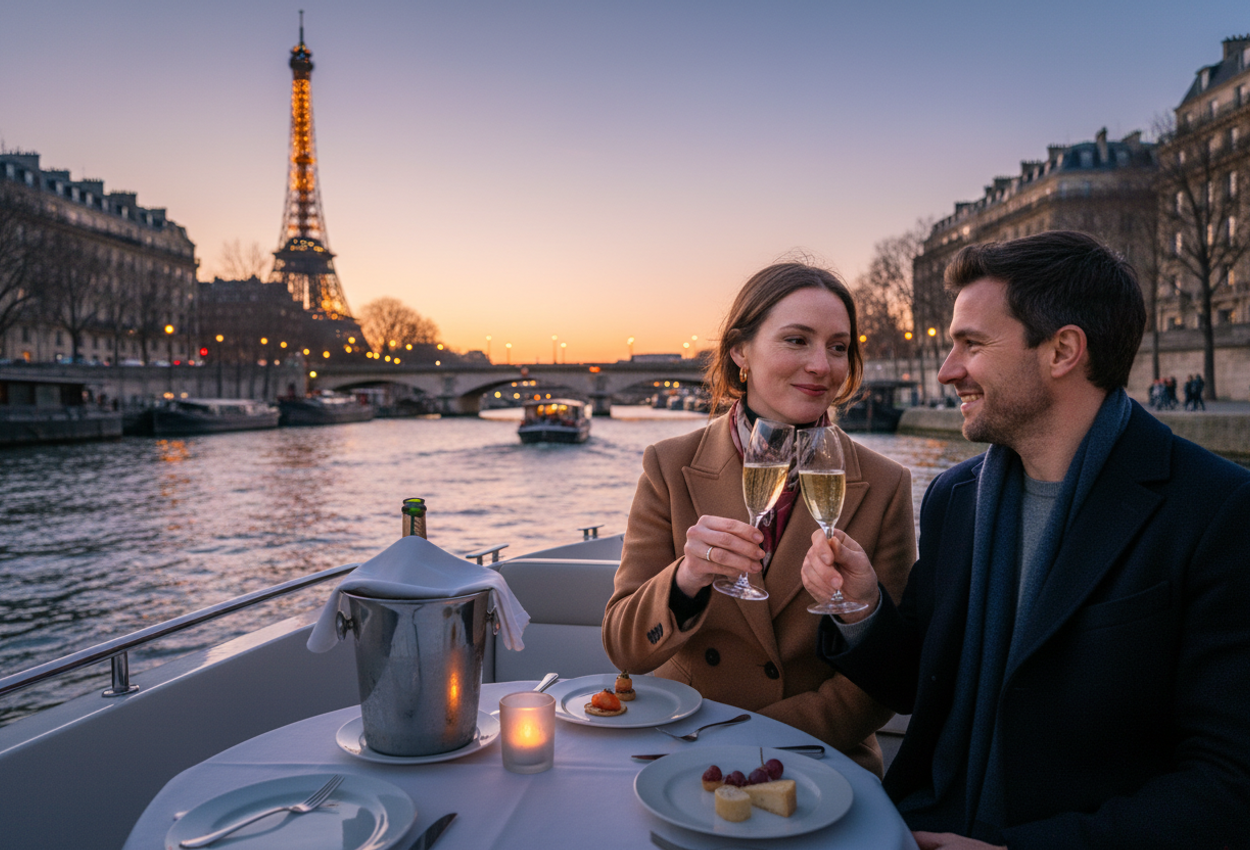
As the afternoon melts toward evening, a private boat awaits on the Seine. The river smells faintly mineral and mossy, like wet stone after summer rain. You sink into cushioned seats as the electric motor hums softly to life, hardly louder than the murmur of the current. The city’s bridges glide overhead like chapters in a story: Pont Neuf with its rounded arches, Pont des Arts with its filigree ironwork. Candles flicker on the table between you, their reflection ruffled by the wake, while the late sun throws copper light against the stone of Île de la Cité. When night gathers, the silhouettes of Notre-Dame and the Louvre become cut-paper shapes against an inky sky.
Your boat gently delivers you to the iron lattice that has watched over more proposals than perhaps any other structure on earth: the Eiffel Tower. The elevator hums upwards, and as you ascend, Paris unfurls beneath you in a glittering map. At Le Jules Verne, the dining room seems to hover within the tower’s steel bones. Through the windows, an ocean of lights stretches in every direction, streets glimmering like necklaces thrown over the dark. Plates arrive as small works of art: a scallop so silky it almost dissolves, a sauce that tastes of the sea and of butter and of something indefinably French. Each bite is an interplay of textures and temperatures, of crunch and silk, of warmth and coolness, while sommelier-selected wines open slowly in the glass, each swirl releasing notes of cherry, tobacco, or sun-warmed stone.
The magic of Paris, though, is often most intense in its quieter corners. On a languid afternoon, gather a paper bag of still-warm croissants, a soft wedge of brie that grows almost runny at the edges, and a bottle of chilled Sancerre, then slip into the Tuileries Garden. Gravel crunches softly under your shoes as you find a bench facing the ornamental ponds. Children’s laughter lifts from the carousel; chairs scrape gently across stone; a fountain sends its silvery spray just high enough to catch the light. You peel tangerines, their oil misting the air with citrus, and share flaky pastries that leave a halo of crumbs on your lap. Time here has the pleasant elasticity of a Sunday afternoon, stretching just enough for long conversations and companionable silences.
When the mood for something sweet and slightly clandestine strikes, wander across the river into the Marais. Away from the main arteries, down a narrow side street lined with galleries and vintage boutiques, you duck into a lesser-known patisserie with fogged windows and a glass case that glows with caramel, chocolate, and fruit glazes. The air inside is sugared and warm, laced with butter and toasted almonds. Perhaps you order a glossy vanilla mille-feuille whose layers shatter delicately under your fork, or tiny raspberry tarts crowned with jeweled berries. Standing at a marble-topped counter, your coffee dark and strong, your pastries exquisite and fleeting, you might feel that romance in Paris is less about grand gestures, and more about how decadently present every small moment can feel.
Maldivian Blissful Seclusion
Morning in the Maldives arrives with a soft rush of color. From your overwater bungalow at Four Seasons Resort Maldives at Landaa Giraavaru, the horizon is a line of palest lavender that slowly blooms into rose and then brightens to a clear, impossible blue. You step barefoot onto the timber deck; it is already warm under your soles, kissed by equatorial sun. The lagoon below is a mosaic of turquoise and aquamarine, so transparent you can count the pale ridges of rippled sand and watch parrotfish flash by in electric blues and yellows.
Your bungalow feels less like a room and more like a private floating world. High thatched ceilings hold the faint scent of palm and salt; wide glass doors slide open to invite in the ocean’s breath. You hear the gentle slosh of water under the stilts, the soft thunk of a boat in the distance, the occasional splash as a ray skims the surface. Slip into your plunge pool and you hover between two blues, sky above and sea below, warmed by the sun but cooled by the breeze. Here, the only dress code is bare feet and linen that flutters softly against sun-bronzed skin.
After breakfast—perhaps tropical fruit so ripe it might have fallen from the tree moments ago, mango yielding at the touch, papaya perfumed with flowers—you wander down to the jetty, masks and fins in hand. A dhoni waits, its wooden hull smelling faintly of coconut oil and sea. As you skim over the water toward the house reef, flying fish erupt briefly from the waves, shards of silver catching the sun before they vanish again. When you slide into the Indian Ocean, the first sensation is of warmth embracing you, almost body temperature, and then a faint fizz of tiny bubbles as you exhale.
Beneath the surface, the world changes scale and color. Coral bommies rise like miniature mountain ranges coated in every texture imaginable: branching staghorn coral where tiny chromis flicker like mint-green confetti, boulder coral pocked with the hiding places of shy cleaner shrimp, soft corals that sway lazily in the current like underwater gardens. A turtle glides past with unhurried dignity, its shell a map of intricate whorls, while schools of orange anthias hover above the reef in shimmering clouds. Sound is muffled to the steady rhythm of your own breath and the distant crackle of shrimp, a hypnotic backdrop that makes time stretch and blur.
Back at the resort, the spa beckons from a pavilion that seems to float amid palm trees and frangipani. For your couples massage, you lie side by side on low beds draped in crisp white cotton. The air is cool with the whisper of fans and scented with coconut, jasmine, and a faint underlying spice from Ayurvedic oils. Skilled hands work warmed oil across tired muscles, kneading the knots that city life leaves in shoulders and spines. Outside, the sea provides a constant, soporific soundtrack—waves sliding against the shore in a gentle, unending lullaby. You emerge loose-limbed and drowsy, skin glowing with oil and sun, the world beyond the island reduced to an abstract concept you are in no hurry to revisit.
As afternoon eases into evening, a small boat carries you to a sandbank in the middle of the atoll, no larger than a generous living room, circled by clear water that fades from pale celadon at the edge to a deep sapphire beyond the reef. Here, your table for two is the only furniture, set with linen that flutters in the breeze, lanterns that will soon cast honeyed light, and plates awaiting a progression of grilled lobster, coconut-scented curries, and desserts that taste of tropical fruit and black vanilla. The sand is cool silk under your bare feet, harboring a faint stored warmth that releases as you move.
The sun dissolves into the sea in slow motion, trailing streaks of gold and magenta across the sky. As twilight thickens, the first stars appear, sharp and bright in the absence of city lights. The air cools slightly, still humid but touched by the whisper of night. Waves lap in a slow, hypnotic rhythm, circling the sandbank like a heartbeat. A discreet waiter appears and disappears, refilling glasses with chilled champagne, leaving you mostly alone with the soft murmur of your own voices and the occasional laughter that tumbles out more freely in such a secluded, unreal setting.
On another evening, you trade cultivated romance for something that feels startlingly pure: joining the resort’s marine team to release rehabilitated baby sea turtles into the ocean. In your hands, the hatchling is improbably light, its tiny flippers whirring anxiously, its shell still faintly pliable. Up close, it smells of clean salt and sand. At the water’s edge, under a sky smeared with the last streaks of sunset, you lower it gently onto the wet sand and watch as instinct pulls it forward. The creature leaves a delicate, miniature track before a small wave washes over it; for a second you lose sight of its mottled shell, and then it is swimming, flippers now powerful and certain, vanishing into the teal. In that moment, surrounded by the immense quiet of the atoll, your own journey together may feel both humblingly small and beautifully intertwined with the wider rhythms of the natural world.

Tuscan Dreaming Under the Italian Sun
The road into Tuscany seems to wind not just through landscape but through time. Cypress trees stand like sentinels along the ridgelines, dark green spires against a sky so blue it looks freshly washed. Fields roll up and down in waves of wheat and vines, their colors shifting from silver-green leaves to rust-colored soil to the soft gold of farmhouses baked by centuries of sun. As you approach Florence, the dome of the cathedral swells above the city, terracotta against stone, while bells echo faintly across the Arno.
Just beyond the city center, nestled in a park scented with roses and old stone, Villa Cora rises from the surrounding greenery like something from a 19th-century romance. The villa’s pale façade is traced with ornament, balconies trimmed with wrought iron, high windows reflecting the canopy of old trees. Inside, frescoed ceilings soar above thick carpets and velvet-upholstered chairs; chandeliers send a warm, flattering glow across marble floors. Your room might feature silk drapes that puddle on parquet floors, a carved headboard, perhaps even a balcony where you can lean on the rail with a glass of wine and watch the sun paint the Duomo in shades of coral and bronze.
Mornings here feel unhurried, almost ceremonial. On the terrace, breakfast arrives as a spread of crusty pane toscano still warm from the oven, jars of honey infused with chestnut or wildflower, and slices of prosciutto so thin they drape like silk over the plate. Espresso comes short and dark, with a crema the color of hazelnuts, its aroma curling into the cool air. Pop a cherry tomato into your mouth and it bursts with sweetness and acid, tasting of sun and soil in equal measure. The scent of basil, torn over omelets or tucked in between mozzarella and tomato slices, anchors you firmly in this corner of Italy where food is less fuel and more love language.
Later, you join a private cooking class in a sunlit kitchen, perhaps on the villa’s grounds or in a nearby farmhouse framed by olive groves. The room smells of garlic just hitting olive oil, that unmistakable sizzle where sharpness softens into something richer. Hands dusted with flour, you and your partner work side by side to knead dough for pappardelle, the heel of your palms pushing and folding, pushing and folding, until the surface grows smooth and elastic. A local chef laughs softly as you attempt to match their fluid motions, the room punctuated by the clatter of knives on cutting boards and the soft thud of dough on wood.
You roll the pasta out into long, golden sheets, feeling the change in texture as it thins, and then slice it into ribbons that curl into loose nests. The sauce is simple: tomatoes that collapse in a pan until they melt into a glossy red pool, basil leaves torn at the last moment to preserve their scent, a generous pour of peppery Tuscan olive oil that glows green in the bottle. When you finally sit down to eat what you have made, the flavors are startlingly vivid: the bite of al dente pasta, the sweetness of slow-cooked tomatoes, the assertive fruitiness of the oil, and the subtle mineral edge of a finishing sprinkle of sea salt.
The afternoon carries you into the Chianti hills, where vineyards stripe the slopes like notes on a staff. At a family-run winery, the air is cool and damp inside the cellar, thick with the scent of aging oak barrels, fermenting grapes, and stone. You curl your fingers around the stem of a glass, swirling deep ruby liquid and watching it cling to the sides in languid legs. On the nose: cherries, blackberries, perhaps a trace of leather or dried herbs. On the palate: a dance of tannins and acidity, first assertive and then yielding, leaving a faintly dusty sensation reminiscent of the roads that wind past those same vines.
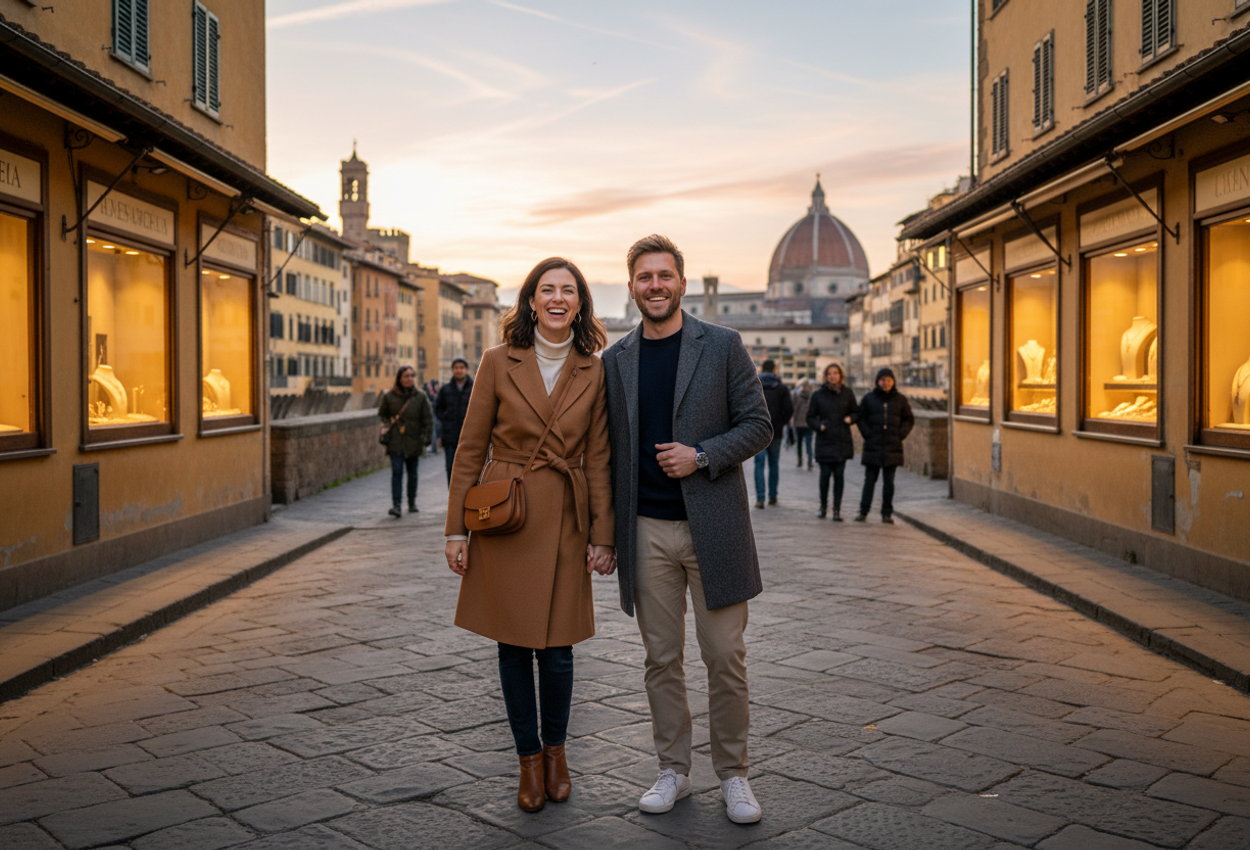
After a day steeped in flavors, Florence calls you back for a more ethereal kind of beauty. As the sun begins to dip, you walk across the Ponte Vecchio, its little jewelry shops glowing like treasure chests in the golden light. The Arno slides lazily beneath you, the water taking on a metallic sheen that mirrors the sky. Street musicians send soft notes into the air—an acoustic guitar, a violin—mixing with the murmur of footsteps and the occasional clink of glass from nearby bars. You lean on the ancient stone balustrade, shoulders touching, and watch the city’s façades catch fire in the last light before cooling into dusk.
For a hidden adventure that pulls you away from the city’s celebrated canvases and domes, head into the woods with a local truffle hunter. Dawn finds you in a forest that smells of damp earth and leaves, your boots brushing aside fallen branches as a dog trots eagerly ahead, nose to the ground. The air is cold enough that your breath ghosts in front of you, but rays of early sun break through the canopy in pale shafts, illuminating patches of moss like tiny emerald carpets. When the dog starts to dig, the truffle hunter kneels, coaxing the prized fungi from the soil like a secret. Held in your hand, it is knobbly and unassuming, but bring it to your nose and the aroma is heady: earthy, musky, and faintly garlicky, the scent of autumn distilled.
Back in a rustic kitchen, the truffle is shaved over scrambled eggs so soft they border on custard, over tagliolini tossed in butter until each strand gleams. The thin slices of truffle curl and soften with the heat, releasing their perfume so powerfully that it seems to inhabit the entire room. Eating such a dish with your partner, you may both fall into an appreciative silence, punctuated only by clinking cutlery and the occasional satisfied sigh—the kind of moment where language falls away and shared pleasure says everything that needs to be said.
Kyoto's Serene Embrace
In Kyoto, romance is quiet. It drifts in on the steam from a cup of matcha, lingers in the shadows of wooden machiya townhouses, and hides in the spaces between bamboo stalks that sway silently in the wind. At The Ritz-Carlton, Kyoto, the riverfront location folds all of this softness into a single, gracious refuge. Floor-to-ceiling windows frame the Kamo River as it ribbons past, its surface burnished by morning light or misted into silver on rainy days. Inside, tatami mats faintly perfume the air with their grassy scent, while sliding shoji screens cast a soft, diffused glow over low-slung furniture and carefully chosen ceramics.
Check in and you are welcomed not with fanfare, but with ritual. Perhaps you are offered a cup of pale green tea, its surface framed by a delicate ring of froth. Holding the warm bowl between your palms feels grounding, a reminder to slow your breath and arrive fully. The lobby hush is broken only by the burble of an indoor water feature and the discreet murmur of staff. Your room is a study in restraint: clean lines, natural wood, a deep soaking tub of smooth stone where you can sink until the water laps at your shoulders, turning your skin pink as the day’s journey dissolves.
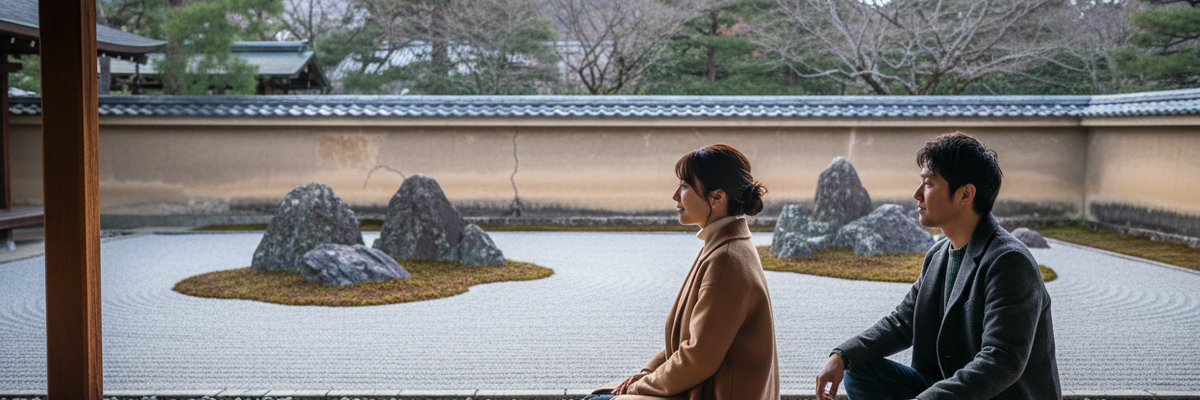
One morning, dressed in soft slippers, you and your partner make your way to a private tea ceremony in a tatami room. The space is spare, with a scroll hanging in the alcove and a single ikebana arrangement—maybe a branch of plum blossom just beginning to show buds—rising from a slim vase. You kneel on the tatami, feeling its woven texture through your clothing, and listen as the tea master works with precise, graceful movements. The soundscape is an exercise in mindfulness: the rasp of bamboo whisk against ceramic, the gentle rush of water poured from kettle to bowl, the rustle of silk as sleeves are smoothed and folded.
When the bowl is passed to you, its rim warm against your fingertips, you turn it slowly, as tradition dictates, before raising it to your lips. The matcha is thick and velvety, coating your tongue with a delicate bitterness that quickly rounds into something sweet and vegetal. The aroma is fresh-cut grass and rain, the taste lingering long after you have swallowed. Sharing this moment—this intentionally slow, quiet ritual—feels like an act of mutual reverence, not just for the tea, but for the time you have carved out together.
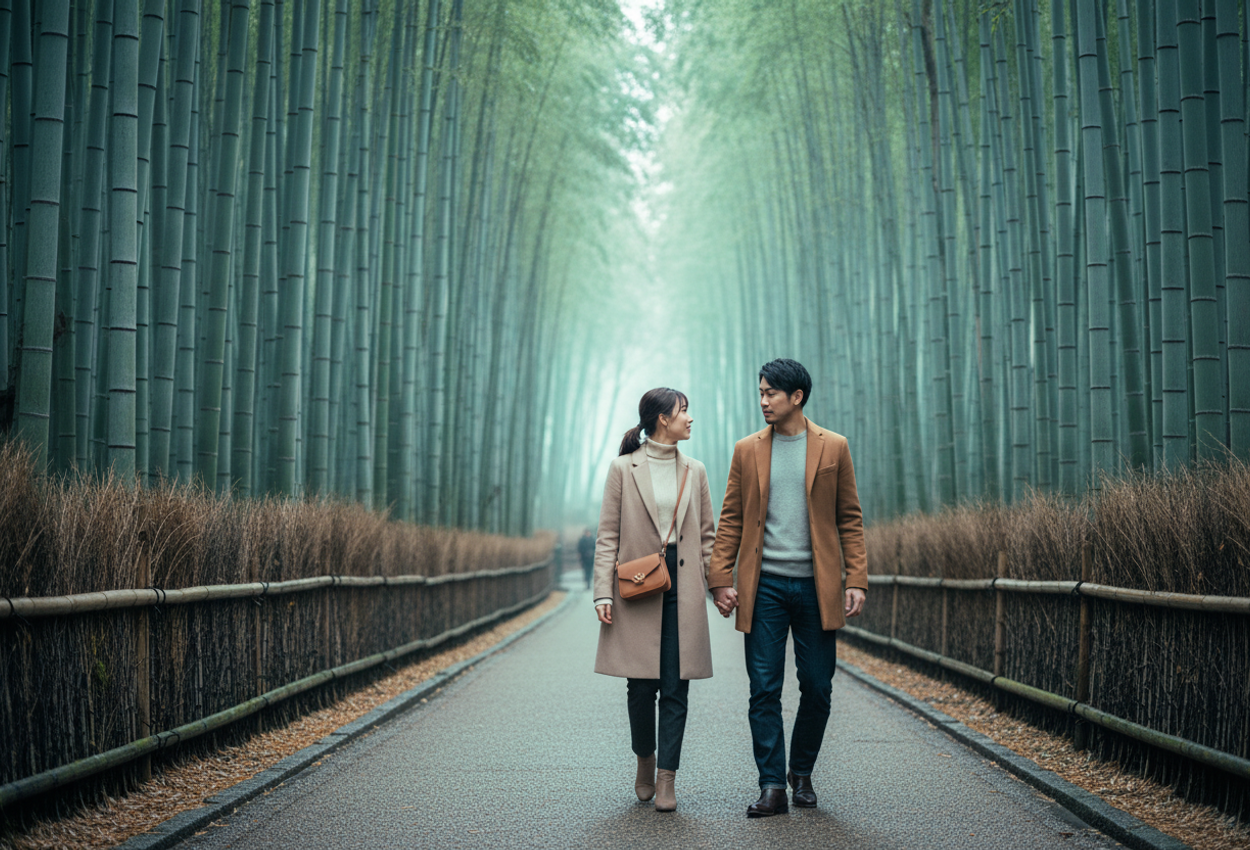
Later, you ride a train out to Arashiyama, where the famous bamboo grove waits. The path into the grove transitions almost imperceptibly from sunlight to green shade. As the stalks rise higher around you, the temperature seems to drop a degree or two, and the light thins into something almost underwater. Bamboo trunks ringed with subtle scars soar upward, their surfaces cool and faintly waxy to the touch. When a breeze threads its way through, the leaves far above you rustle in a layered whisper, a sound like the turning of countless pages. Every so often a shaft of light spears down, catching dust motes that spin slowly in the air; couples ahead of you become silhouettes framed by infinite vertical lines of green.
On your way back toward the city, you stroll along the Kamo River, its shallow shallows splashing softly over stones, herons and egrets standing motionless in the current. By evening, you find yourselves in Gion, Kyoto’s historic geisha district. Here, the streets are narrow and paved in stone, lined with ochre and dark wooden buildings whose paper lanterns begin to glow as dusk bleeds in. The sound of your steps echoes differently here, absorbed by centuries-old wood. A faint perfume of incense and grilled yakitori hangs in the air, threaded with the fragrance of blooming seasonal flowers—perhaps camellias in winter, fresh wisteria in spring.
Every now and then, a figure in a resplendent kimono appears at the end of the alley, obi tied in a complex bow, white tabi socks peeking above lacquered geta sandals. The colors of the fabric—indigo, persimmon, gold—catch the lantern light, patterns of cranes or blossoms seeming to move as the wearer slips swiftly from one teahouse to another. You and your partner walk more slowly, fingers brushing, listening to the wooden clack of distant sandals and the muted laughter that leaks from behind sliding doors. The romance here is less about public displays and more about sharing the attentive gaze it takes to notice such fleeting moments.
For a more tangible memento of your time, you might arrange a private calligraphy lesson with a local teacher. Seated at a low table, the world shrinks to brush, ink, and paper. You grind the ink stick against the stone, the faint scratchy sound increasing as black liquid pools and thickens. There is a faint, resinous scent from the ink, grounding and meditative. Holding the brush, heavy with ink, you hover briefly above the rice paper before pressing down. The bristles fan and then pull together again as you draw each stroke, some bold and straight, others tapering delicately like the end of a sigh.
Your partner sits beside you, equally focused, and the room fills with a shared, companionable silence broken only by the occasional soft exclamation when a character turns out more beautifully than expected—or more crooked. When you lift the finished sheet, the black characters gleam slightly before drying to a velvety matte. Perhaps you have written words that hold meaning for you both: the kanji for love, for river, for eternity. Whatever the translation, the artwork becomes an artifact of an afternoon spent fully present with one another, every stroke a small act of intention.
Safari Romance in Tanzania
The Serengeti wakes before the sun. From the deck of your suite at Four Seasons Safari Lodge Serengeti, you step into air that is cool and dry, edged with the faint, metallic scent of dew on dust. In the half-light, the plains stretch away in soft gradients of grey and blue, the acacia trees rendered as delicate ink drawings against the horizon. Somewhere nearby, a dove calls its low, repetitive note; further off, a hyena whoops once, the sound rising and falling like an eerie question.
Coffee steams in your cup, rich and dark, its aroma cutting cleanly through the earthy morning air. As you sip, movement begins to resolve out of the landscape: a line of wildebeest, their heads down and tails switching; a small herd of zebras with stripes that seem to glow in the dawn; perhaps even an elephant family ambling toward a watering hole, their heavy footfalls somehow silent at this distance. The lodge itself feels like a contemporary aerie, all wood and stone, decks and walkways raised on stilts to respect the paths of the animals below.
Before the sun has fully shrugged off the night, you are whisked to a field where a hot air balloon lies sprawled on its side, a giant, sleeping creature of fabric. The smell of propane and canvas fills the chill air as burners roar to life, heat blooming across your cheeks even as your breath still puffs white. Climb into the wicker basket beside your partner; your hands brush as you grip the rim, a shared, anticipatory squeeze. As the balloon lifts, the ground falls away in slow, almost imperceptible increments, the voices from below dimming until you can hear nothing but the gentle sigh of the burner and the vast, soft hush of the sky.
The landscape unfurls beneath you in astonishing clarity. Herds become patterns—dots and dashes of brown and black moving across the golden grass, like notes on a sheet of music. The sinuous line of a river carves darker green through the plains; crocodiles sun themselves along its banks like living logs. The smell up here is clean and thin, tinged with a faint smokiness from the balloon; the air is cool against your face, hands tucked into your partner’s for warmth. When the sun finally crests the horizon, it floods everything in molten gold, transforming dust into glitter and turning each animal into a small, moving sculpture.
After landing and a celebratory breakfast in the bush—flaky pastries, tropical fruits, maybe even a glass of sparkling wine served at a linen-covered table under a solitary acacia—you climb into a safari vehicle for a private game drive. The vehicle’s seats are warm from the early sun, its canvas sides rolled up to invite in the breeze. The smell of the savanna is layered and complex: dry grass and warm dust, faintly sweet acacia blossoms and occasionally the sharp, musky tang of animal spoor.
Your guide’s eyes miss nothing. They point out the subtle twitch of an ear in the tall grass that gives away a lion’s resting spot, the dark comma shape of a cheetah draped along a fallen tree trunk. Close encounters engage all your senses: the heavy, haylike breath of an elephant passing close by, the low, resonant rumble you can almost feel more than hear when a lioness calls to her cubs, the sudden crack of branches as a giraffe moves through the brush. Dust settles on your skin, mixing with sunscreen and the faint coconut of your partner’s lotion, leaving a tactile reminder of the day on your forearms and collarbones.
By late afternoon, the sun softens and lengthens shadows. Back at the lodge, you might slip into the infinity pool that seems to pour directly into the savanna, its cool water a vivid, blue contrast to the tawny plains beyond. Sometimes, elephants wander down to the nearby watering hole, slurping and spraying water, their rough hides catching the light in surprising shades of slate and silver. Floating side by side in the pool, your ears underwater, the world compresses into muted splashes and your own heartbeat, punctuated by the occasional trumpeting call above the surface.
When night claims the sky, the savanna’s chorus shifts. Cicadas buzz insistently; distant lions trade deep, guttural roars across the darkness; a jackal barks staccato from somewhere unseen. Tonight, a private bush dinner has been prepared a short drive from the lodge. Lanterns hang from tree branches, casting puddles of light on the red earth, and a fire sends embers spiraling up toward the Milky Way, which stretches overhead in astonishing clarity—so bright it seems like a gauzy path you could almost walk.
Your table is set with white linens and gleaming cutlery, yet you sit on simple wooden chairs that rock slightly on the uneven ground, a pleasant reminder that even in luxury, you are guests in a wild space. The air smells of woodsmoke and grilled meat, of spices toasting in oil for a fragrant stew. Perhaps you taste ugali and sukuma wiki, or a dessert infused with local honey that clings lusciously to your spoon. Each course arrives with quiet efficiency, then leaves you once more in the comforting embrace of the star-pierced African night.
During the day, when the sun is high and the animals move into shade, you might visit a nearby Maasai village. As you arrive, the rhythmic thump of feet on dry earth carries the sound of welcome dances to your ears before you even see their source. The Maasai’s shukas—vivid cloth wraps in reds, blues, and purples—flare against the neutral tones of the landscape. Beaded collars and earrings catch the light with each movement, sending tiny pricks of color flickering into the air.
You step into a circle of song, the voices layered and powerful, rising in call-and-response that vibrates gently in your chest. Someone places a beaded bracelet on your wrist; up close, you can see the minute variations in each bead, feel the faint texture of hand-twisted wire. Inside a traditional boma hut, the air is cool and smells of smoke and earth, filtered through small openings in the walls. Listening to stories about cattle, rites of passage, and ancestral lands, you gain a different sense of time—measured not in hours or days, but in seasons, migrations, and the long arc of tradition.
Enchanting Udaipur, India
Some cities look romantic in photographs; Udaipur feels romantic the moment you inhale. The air is soft with the scent of marigold garlands and incense curling from temple doorways, threaded with the distant clang of bells and the melodic call of vendors. Whitewashed buildings tumble down to the edge of Lake Pichola, their façades mirrored in the water so perfectly that it is sometimes hard to tell where reality ends and reflection begins.
In the midst of this, floating like a mirage of marble and light, stands the Taj Lake Palace. Accessible only by boat, it appears to hover on the surface of the lake, its arches and domes glowing ivory against the surrounding hills. As your small launch glides across the water, the city’s noise falls away, replaced by the slap of waves against the hull and the rhythmic chug of the engine. The palace draws closer: delicate jharokha balconies overhanging the lake, latticed windows hinting at candlelit rooms within, courtyards where fountains toss water into the warm air.
Stepping onto the palace’s marble landing feels like entering a story. Rose petals may scatter softly under your feet; a garland, fragrant and faintly damp against your neck, might be placed over your shoulders. The lobby is cool and scented with a mix of polished stone, sandalwood, and fresh flowers. Light pours in from inner courtyards where bougainvillea spills fuchsia over white walls and the plash of fountains provides a constant, liquid heartbeat. Your room looks out over the lake, its windows framing the city’s ghats and distant palaces as if painted.
As late afternoon unfurls, you board a traditional boat for a sunset ride on Lake Pichola. The water is calm, shifting from pale blue to molten silver as the sun drops. The boat’s wooden benches are smooth from years of passengers; when you trail your fingers over the side, the lake is warm and silky, swirling around your skin before streaming away. The breeze carries faint hints of spice and smoke from cooking fires along the shore, mingling with the floral sweetness of nearby temple gardens.
The city transforms minute by minute. The sprawling City Palace, etched with balconies and cupolas, blazes in golden light before slowly deepening into amber and then a rich, burnished bronze. The sky behind it cycles through apricot, pink, and violet, each color bleeding gently into the next. Lamps flicker to life along the ghats, their flames reflected in the water as long, trembling strands. Bells ring out from various temples, overlapping in a shimmering soundscape punctuated by the occasional burst of laughter or snatch of devotional song drifting across the water.
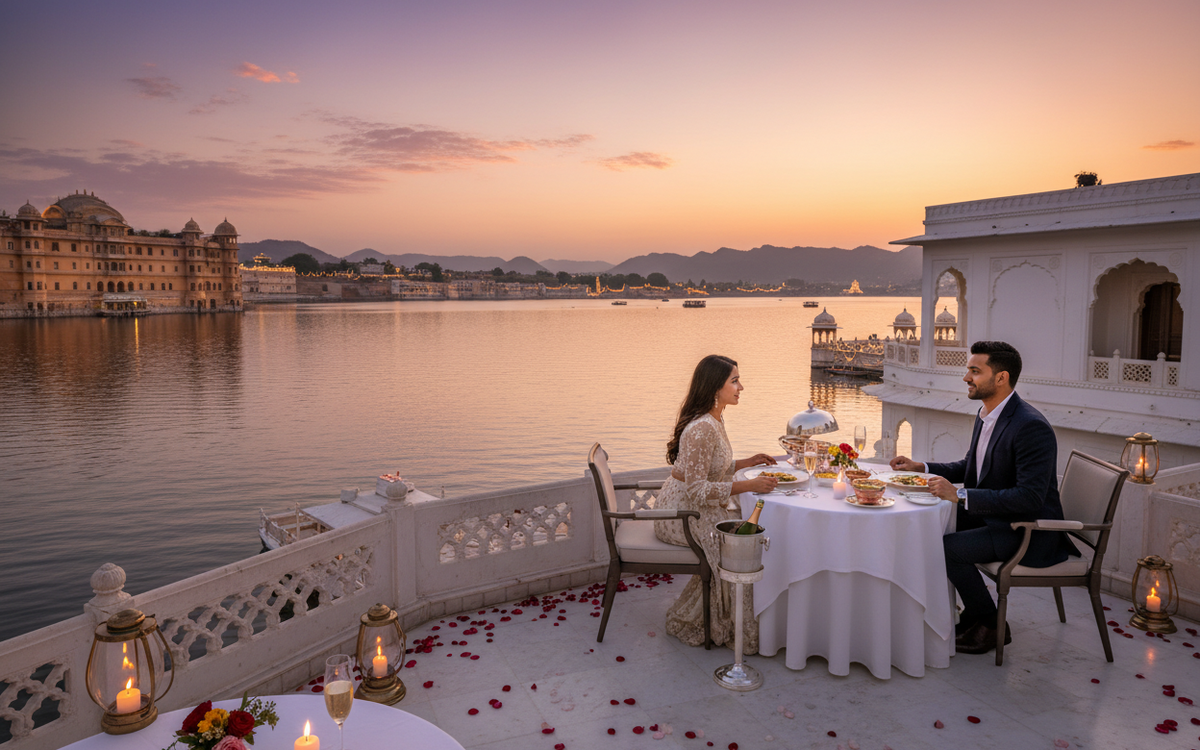
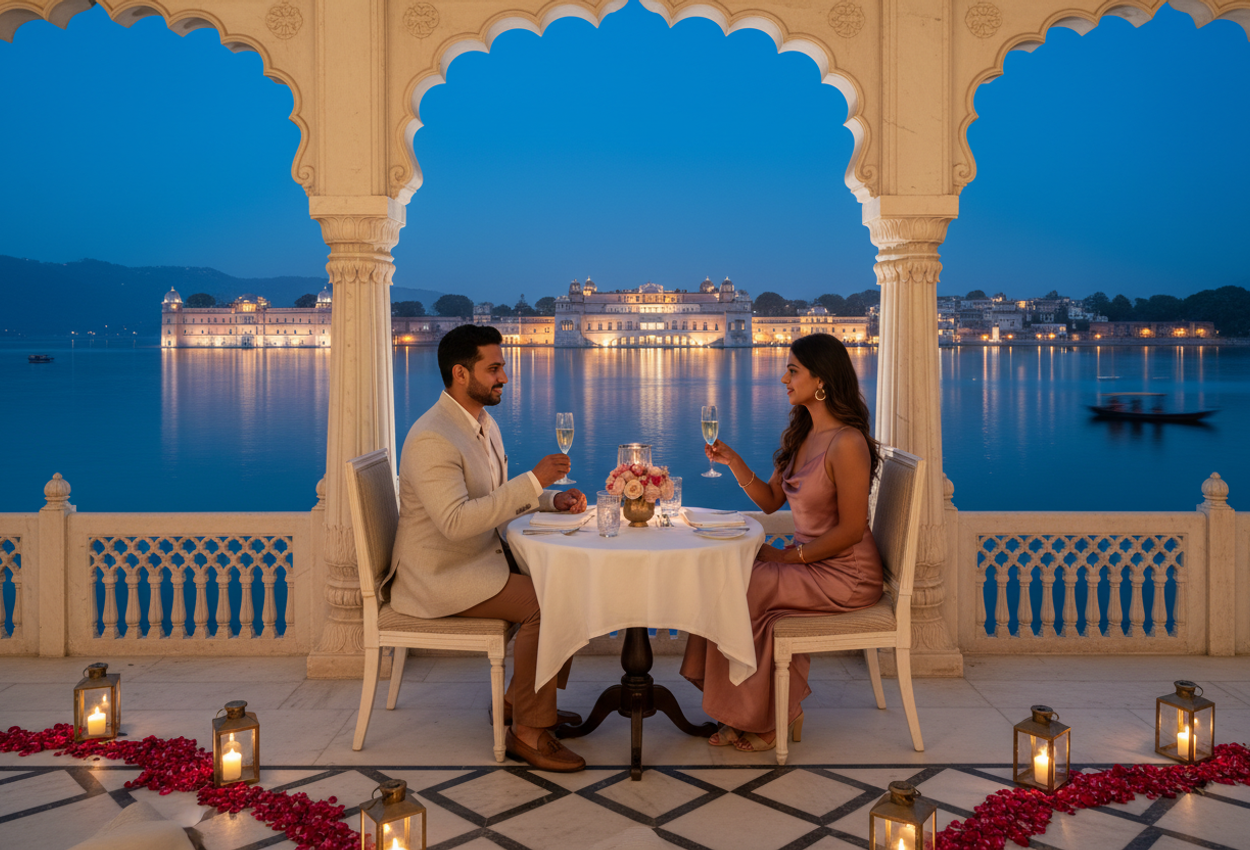
Back at Taj Lake Palace, evening is welcomed with an almost theatrical flourish. Courtyards glow with lantern light; musicians play the sitar and tabla, their notes looping in intricate patterns that seem to swirl up into the starlit sky. For your anniversary night, reserve a table on the Mewar Terrace, an elevated perch that seems to float above the lake. Underfoot, the marble is cool and smooth; above, the sky stretches like dark velvet pricked with stars. A gentle breeze off the water carries the faint scent of roses from arrangements on each table.
Dinner unfolds as a series of sensory revelations. Crystal glasses catch the candlelight as you toast—perhaps with sparkling wine, perhaps with a local gin infused with botanicals that echo the surrounding hills. A silver cloche lifts to reveal a thali of Rajasthani specialties: laal maas rich with smoky chili and tender lamb; gatte ki sabzi where gram flour dumplings bathe in a tangy yogurt gravy; bowls of saffron-scented rice that release a sweet, floral aroma with each spoonful. Warm naan arrives with a faint char, the exterior blistered and crisp, the interior soft and chewy, perfect for scooping up gravies that leave a mild heat blooming on your tongue.
On another day, you wander through the City Palace complex itself, climbing staircases whose stone has been smoothed by centuries of feet. Inside, rooms blossom with mirrored mosaics that catch the light in a thousand points, stained glass windows that cast jewel-toned pools across the floor, and cooling courtyards where the sound of trickling water provides relief from the afternoon heat. When you step out onto one of the terraces, the view steals your breath for a moment: Lake Pichola spread below like liquid metal, the Taj Lake Palace gleaming at its center, distant hills forming a protective ring beyond.
As the sun climbs high, retreat to the palace spa for a traditional Indian treatment designed for couples. The spa’s corridors are hushed; light is filtered through intricate screens, dappling the floors in lace-like patterns. In your private room, copper vessels gleam softly in the low light, and the air is heavy with the aroma of jasmine, rose, and warm oils. Perhaps you choose an Abhyanga massage, where synchronized movements of two therapists work in unison over your bodies, or a ritual that begins with a fragrant rose petal foot bath and ends with your foreheads anointed with cooling sandalwood paste.
Warm oil is poured in slow streams across your back, spreading in a comforting wave before hands begin to knead and smooth, following the contours of muscles that have tensed through months of daily life. You hear only the murmur of water somewhere beyond, the muted chiming of temple bells in the distance, and your partner’s breathing syncing rhythmically with your own. Emerging afterward, skin humming and perfumed, limbs loose, you may find that your internal pace has shifted closer to the city’s: unhurried, rich, attuned to beauty in small details.
Back on the palace’s lake-facing terraces, night blooms with a particular lushness. Lanterns float on the surface of the water, each a small, flickering universe drifting slowly away. Musicians’ fingers blur across strings and drumheads, their music both ancient and unmistakably alive. Somewhere nearby, roses perfume the air so insistently that you can almost taste their sweetness. Standing together at the balustrade, arms brushing, eyes tracing the city’s sparkling outline on the water, you might feel that if anniversaries are about honoring the journey so far, then Udaipur offers the perfect reflection—shimmering, layered, and filled with a sense of timeless, enveloping romance.