In Berlin, love is rarely candlelit and predictable. It is spray paint under the fingernails, clay on your sleeves, color dripping from a shared canvas, and two irises glowing side by side on a gallery wall. This is a city that does not ask couples to simply watch art; it invites them to make it together.Stroll Through the East Side Gallery's Open-Air Canvas
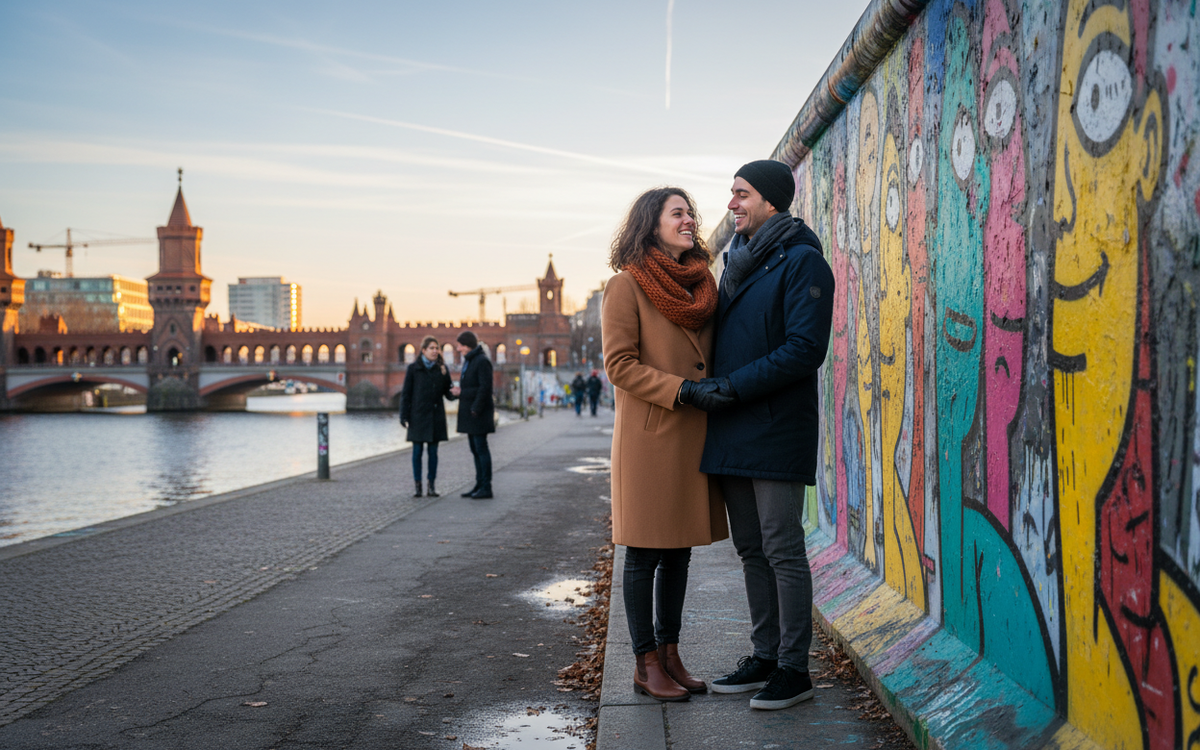
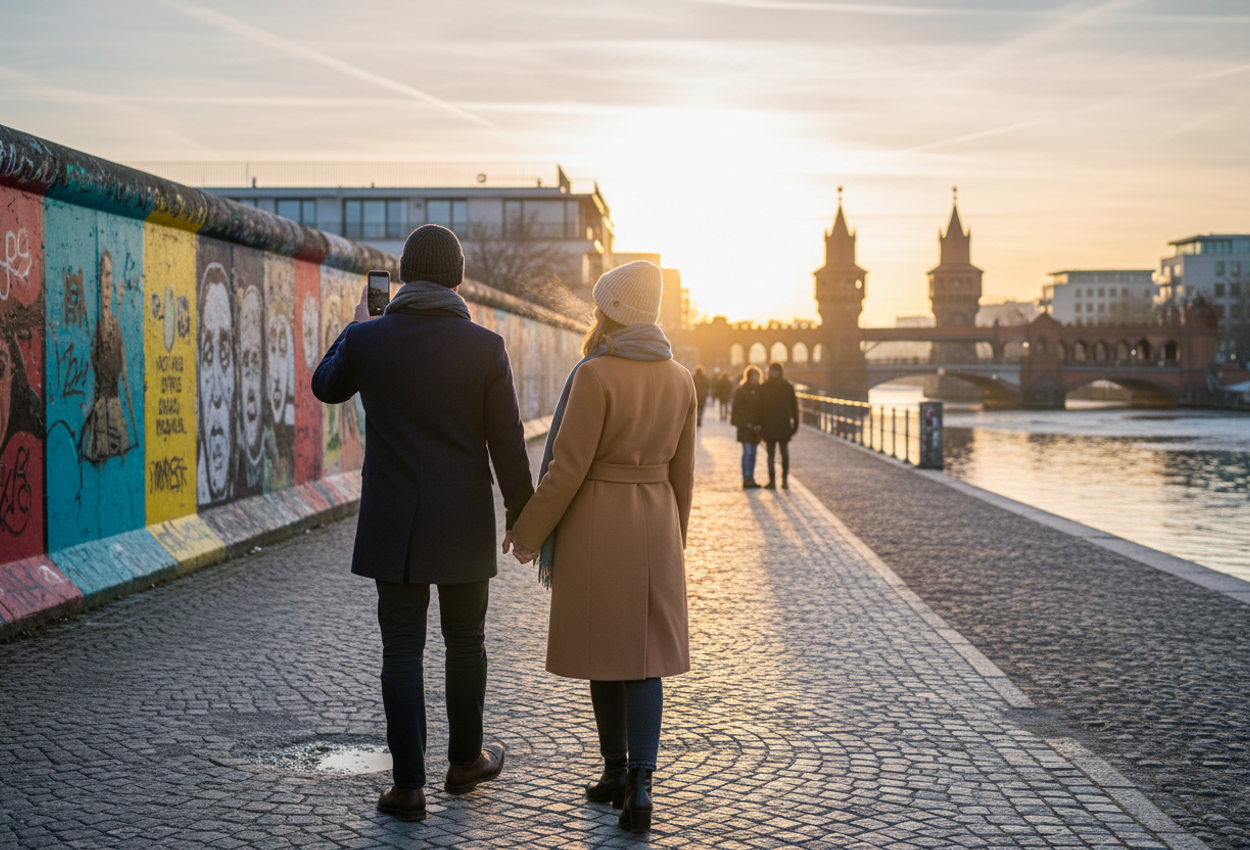
The first hint that Berlin does romance differently appears along Mühlenstraße, where a jagged ribbon of concrete runs parallel to the River Spree. Here, the East Side Gallery stretches for more than a kilometer, its rough grey skin transformed into a blaze of color. This is not a pristine white cube but an open-air palimpsest of hope and resistance, where couples drift slowly along the pavement like readers turning the pages of a living, painted novel.
On a winter afternoon, the air carries the faint metallic tang of the river and the distant rhythm of S-Bahn trains sliding across the tracks near Ostbahnhof. The concrete beneath your palms feels cold and faintly porous, mottled with decades of paint and Berlin weather. As you and your partner walk side by side, you begin to recognize the icons that have leapt from guidebooks into reality: the blue Trabant bursting through the wall, a cartoon of liberation that seems frozen mid-crash; the bright, elongated heads of Thierry Noir, their colors almost humming against the flat winter sky. Every few meters, the city feels different, its history redrawn by new hands.
Near the stretch overlooking the Mercedes-Benz Arena, a small crowd tends to form, phones raised. They are here for Dmitri Vrubel’s mural, the one the world knows as the brotherly kiss. On the wall, Soviet leader Leonid Brezhnev and East German leader Erich Honecker lock in a socialist embrace, the folds of their skin and the shine of their suits rendered with almost uncomfortable intimacy. Stand a moment longer and the noise of the city drops away; what remains is the raw symbolism of power, alliance, and a love that is not quite love. This is where couples step into the frame, leaning in for their own carefully staged kiss under the painted one, laughing as a stranger offers to take the photo.
It would be easy to treat the East Side Gallery as a checklist of famous murals, but its romance lies in the quieter moments between them. Walk further along, fingers threaded together, and start looking not only for the images you recognize but for the ones that seem to speak directly to your story. Perhaps it is an abstract flurry of blues and golds that mirrors the way you once moved across countries to be together. Perhaps it is a simple line of text about freedom, or a lone figure stepping through a doorway. Stop when something catches your breath, and take a photograph not just of the wall but of the two of you standing in front of it, your silhouettes flanked by color.
Across the road, the Spree glints between gaps in the buildings, a sheet of steel-grey water that softens the hard angles of concrete and brick. Slip down one of the small paths to the riverbank and you find a different tempo: joggers with steady footfalls, a couple sharing a paper cup of coffee, a cyclist pausing to watch the last smear of daylight fade behind the arches of the Oberbaumbrücke. In winter, your breath hangs in front of your face; in summer, the air smells faintly of sunscreen, river algae, and grilled meat drifting over from impromptu barbecues on nearby lawns.
As the afternoon tilts into evening, the wall seems to drink in the changing light. Colors that felt flat under the midday sky suddenly deepen; oranges grow warmer, blues more mysterious. Streetlamps flicker on, pooling honey-colored light on the pavement. This is the moment when couples linger longest near the murals they love, watching as each brushstroke takes on a new mood. It is also when the tour groups begin to thin, leaving pockets of quiet where you can stand with your backs against the painted concrete, feeling the texture press through your coat, and talk about what freedom has meant in your own lives.
Hidden gem: Visit the East Side Gallery in the hour before sunset. The crowds soften, the golden light skims across the river, and the murals seem to glow from within. Walk from Oberbaumbrücke towards Ostbahnhof with the sun at your back, and finish your stroll with a detour along the water’s edge, where the reflections of bridges and cranes stretch like brushstrokes across the surface of the Spree.
Unleash Your Inner Artist: A Pottery Workshop in Neukölln
Leave the river behind and take the U-Bahn south into Neukölln, where romance hides not in grand gestures but behind unassuming courtyard doors. Here, former industrial spaces and old apartments have turned into studios, each one flickering with kiln heat and late-night creativity. In a cozy home studio tucked off a leafy side street, ceramic artist Keegan welcomes couples into a world of clay-splattered aprons, hand-thrown cups, and shelves lined with earthy glazes.
The moment you step inside, the city outside loosens its grip. You smell damp clay and hot tea, hear the muffled thump of a kiln slowly cooling in the corner, and feel the soft drag of a wool rug under your shoes as you cross to the worktable. Keegan’s studio is intimate rather than intimidating: wooden shelves sag slightly with stacks of bowls and delicate vases, a strand of warm fairy lights snakes around the window, and a portable speaker hums low with jazz or mellow electronic beats. It feels less like a classroom and more like a friend’s living room that happens to have a pottery wheel in it.
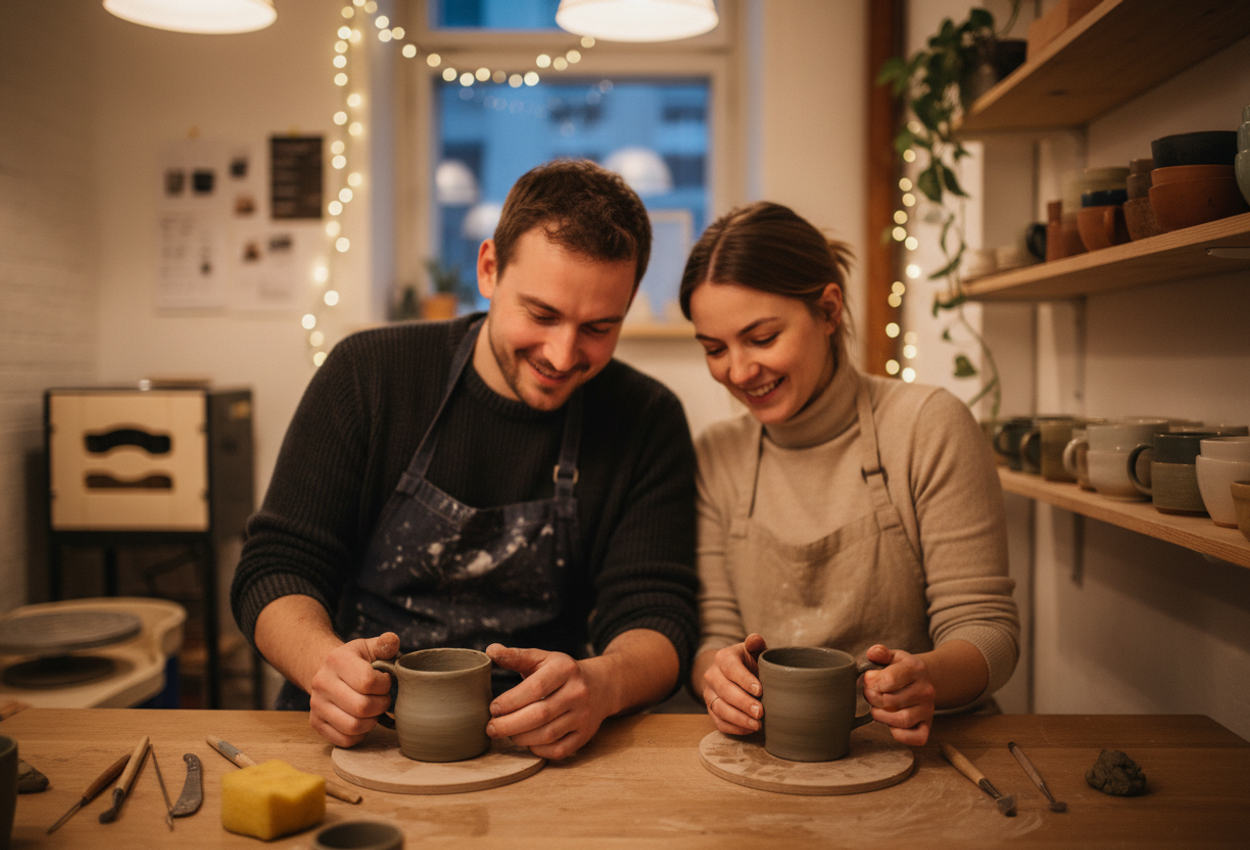
For couples, a hand-building ceramics workshop becomes a kind of gentle choreography. You sit side by side at a low table, each with a cool, solid lump of stoneware clay in front of you. Under Keegan’s patient guidance, your hands begin the slow work of transforming it. First comes pinch pottery: thumbs pressing deep into the center, fingers rotating and coaxing a simple bowl into existence. The clay resists at first, dense and unyielding, but as your palms warm it, it gives way. You glance at your partner’s progress, laughing when one bowl slumps dramatically while the other stands proud and smooth.
From pinch pots you move to coil building, rolling long, snake-like strands of clay that you spiral one atop another to form the walls of a cup or vase. The movement is hypnotic; each coil must be pressed just so to avoid leaving gaps, each join smoothed with a fingertip dipped in water. This is where the collaboration deepens. One of you may shape the base while the other steadies and blends the coils, your hands overlapping on the same piece, the rhythm of your breathing unconsciously aligning. Clay clings to your wrists, cool and satin-slick; your shared laughter, when a wall buckles or a handle snaps, feels like part of the creative process rather than a failure.
Because this is Berlin, perfection is not the goal. Keegan encourages couples to lean into wobble and asymmetry, to think of each mug or pot as a snapshot of a particular evening in their relationship. Make matching coffee cups, he suggests, but let each one carry a secret detail: a thumbprint on the handle, a small carved symbol hidden inside the base, a phrase impressed lightly into the clay with a letter stamp. While one of you shapes, the other might carve patterns with a loop tool or press the edge of a leaf into the clay to leave a delicate fossil of your walk here through Neukölln’s park-lined streets.
Outside, the neighborhood hums with the layered life that has made Neukölln a magnet for artists and dreamers. On your way to or from the studio, you pass Turkish bakeries perfuming the air with sesame and warm bread, small bars serving natural wines, and storefront galleries where experimental installations glow blue behind steamed-up glass. Graffiti flowers across metal shutters and courtyard walls; overhead, the orange blink of U-Bahn trains crossing the canal reflects on the water like a line of marching lanterns. Creatives from around the world have planted their lives here, and you feel that energy in the studio as you lean close over a shared project, speaking more softly than usual, as if not to disturb whatever alchemy is at work.
By the end of the session, the table is dotted with your combined efforts: a slightly crooked espresso cup with a heart-shaped thumbprint, two bowls that seem to lean towards each other, a small planter whose rim undulates like a gentle wave. Keegan labels each piece with your names and a date, explaining how they will dry, be bisque-fired, glazed, and fired again. There is a delicious delay built into ceramics; weeks later, perhaps back home in another country, a parcel will arrive containing the solid, weighty evidence of this night. Every morning when you wrap your hands around those mugs, you will feel the memory of clay slick under your fingers, of your partner’s hands steadying yours, of Neukölln’s lamplit streets waiting outside.
Hidden gem: If your workshop falls on a Tuesday or Friday, arrive early to wander the nearby Türkischer Markt along the Maybachufer. The air fills with the sizzle of gözleme on hot griddles, the perfume of piled mint and flat-leaf parsley, and the chatter of vendors calling out prices in Turkish and German. Pick up a still-warm simit and share it on a bench by the canal before heading to Keegan’s studio; the sesame-scented crumbs on your fingers will mingle with the earthiness of clay, a sensory prelude to an evening of making.
Dive into Colors: Intuitive Painting for Two
Not all creativity in Berlin requires technique. In a bright, plant-filled loft just beyond a quiet courtyard, an intuitive painting workshop invites couples to pick up a brush without any expectation of realism or skill. This is art as language, color as confession, a chance to say what is difficult to speak aloud using only pigment and shape.
The studio is a balm from the moment you step in. Large windows frame a sliver of city rooftops and winter sky; in the late afternoon, the room is washed in a pale, silvery light that softens every edge. Long tables have been pushed aside so that easels can stand in gentle pairs, each draped with a sheet of canvas primed and ready. Jars of water catch the light like tiny ponds; an entire wall is lined with shelves of paint in every imaginable hue, from storm-cloud greys to jubilant magentas. The faint smell of linseed oil mingles with that of freshly ground coffee from the kitchenette in the corner.
Your facilitator, perhaps an artist who splits time between gallery shows and teaching, begins not with instructions but with questions. How do you want to feel during the next two hours. What colors do you think of when you remember your first trip together. Instead of offering rules about composition, she encourages you to close your eyes and picture an emotion. The goal is not to paint what you see but to give that feeling a body on the canvas.
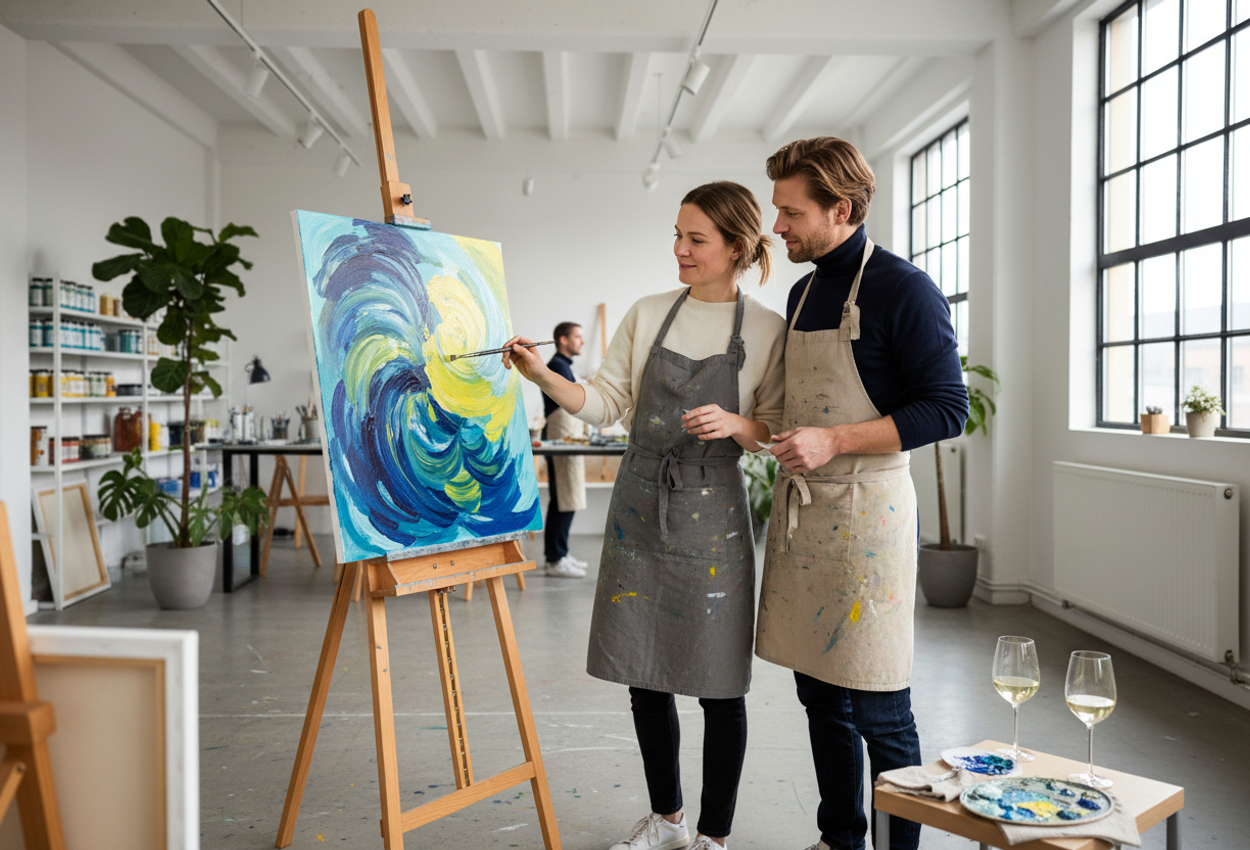
For couples, the possibilities unfold in several directions. You might choose to stand at separate easels, back to back, each working on your own interpretation of the same theme. Later, when you turn the canvases around, you discover how differently you remember that night in Kreuzberg or that train journey from Paris, and yet how the colors you chose echo each other. Alternatively, you can work on a single, large canvas, meeting in the middle like two rivers merging. One of you may start with sweeping arcs of cobalt and teal, while the other adds small, deliberate dots of gold that cluster around the curves like constellations.
There is a moment, inevitable in any painting session, when hesitation creeps in. You hesitate, brush hovering, unsure if another layer will ruin what you have already made. Here, the beauty of painting together reveals itself. Your partner may gently take your wrist, adding a quick streak of bright orange that shocks the composition back to life. You might hand them a sponge or a palette knife, inviting them to scrape through a stubborn patch of color to reveal what lies beneath. The canvas becomes a record of negotiation, compromise, and sudden bursts of courage.
Because the workshop is framed explicitly for couples, the facilitator will often weave in small prompts designed to deepen connection. You might be asked to paint with your non-dominant hand while your partner offers verbal encouragement, or to close your eyes while they guide your hand across the canvas, trusting their voice to steer you. At one point, she may ask you to trade places entirely, stepping up to each other’s canvases to add a final, defining gesture without overthinking. The result is not two perfect paintings but two artifacts of an afternoon spent listening, trusting, and sometimes disagreeing in the most constructive way.
As the session unfolds, the atmosphere loosens. Brushes clink against jar rims; someone puts on a playlist that drifts from neo-soul to ambient electronica. Couples at other easels laugh softly, swap colors, or pause to sip from their glasses. You notice how your body relaxes, shoulders dropping, breath slowing with each broad brushstroke. Bits of city life filter in through the windows the hum of a tram, the distant bark of a dog but inside, time seems to stretch to accommodate every layer of paint you want to add.
When you finally step back from your canvases, fingers smudged with ochres and blues, you are looking not only at color and line but at the story of your afternoon. Perhaps a sweeping band of midnight blue anchors the bottom of the canvas, representing the years you weathered apart; above it, a rising column of yellow for your decision to move together to a new city. Perhaps recurring dots of crimson stand in for the sharp, surprising joys you did not plan for. You might not be able to explain it in words, but when you look at the finished piece, something in your chest loosens, and your partner, standing beside you, nods in quiet recognition.
Hidden gem: For couples who prefer a looser, more social setting, seek out one of Berlin’s Sip and Paint evenings. Hosted in stylish studios or candlelit wine bars, these sessions pair canvases and guided prompts with glasses of Riesling or craft beer. You can paint side by side at a shared table, pausing between brushstrokes to clink glasses and trade stories with the couples around you. It is less about introspection and more about the laughter that bubbles up when someone attempts an ambitious skyline or accidentally paints their sleeve.
Street Art Safari: Kreuzberg's Hidden Masterpieces
If the East Side Gallery is Berlin’s open-air museum, then Kreuzberg is its restless, ever-changing sketchbook. Here, street art is not preserved behind plaques; it is born in the middle of the night, layered, scratched away, and reborn by morning. A guided street art tour through these streets becomes, for couples, a shared treasure hunt a chance to learn the city’s visual language together, decoding symbols and tags like secret love notes written in spray paint.
You meet your guide near Görlitzer Park or at a corner café on Oranienstraße, where the smell of espresso mingles with the faint acrid tang of aerosol. They might be an artist themselves, paint flecks still crusted around their fingernails, or a long-time resident whose memories map onto particular murals. As the small group gathers, your guide explains that what you are about to see will likely be gone in a few weeks or months, painted over or transformed. The very ephemerality of the work makes the walk feel intimate; what you witness together this afternoon is uniquely yours.
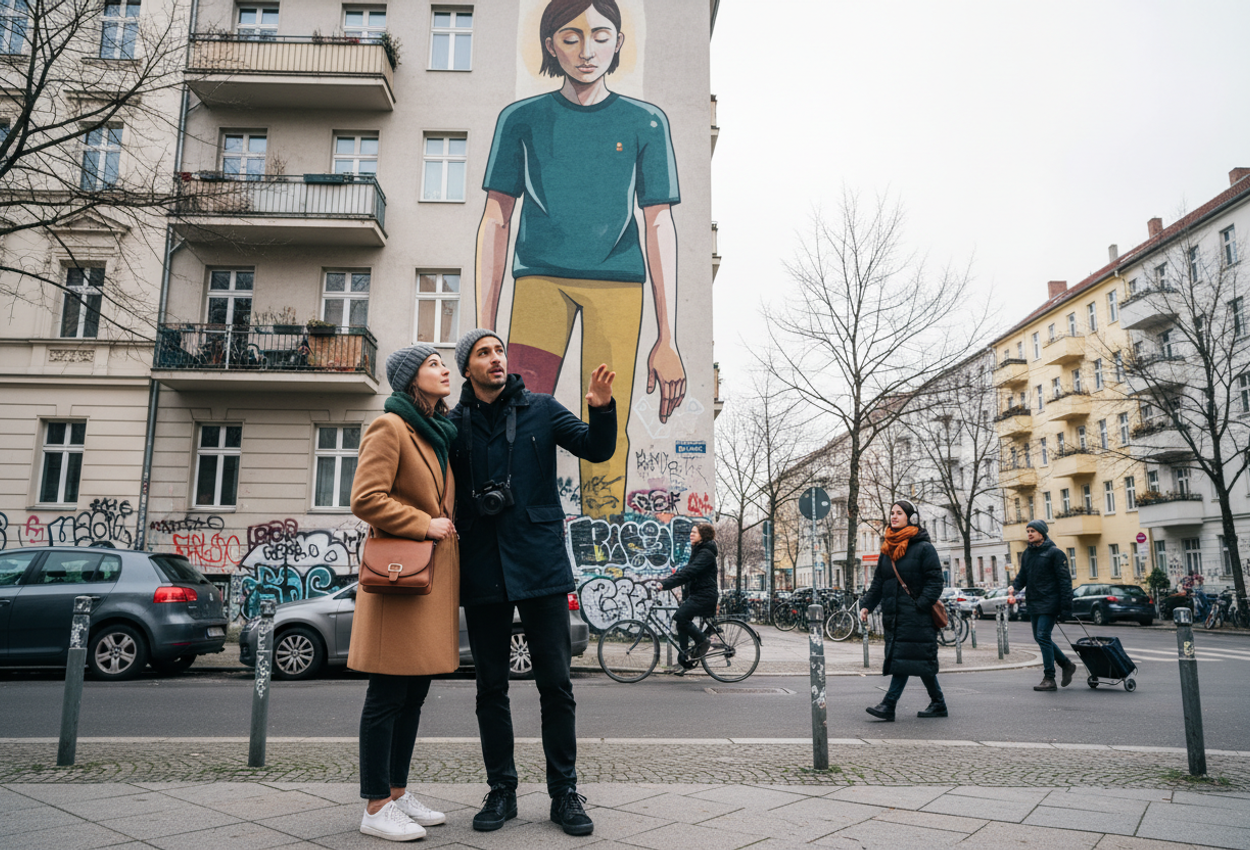
Moving through Kreuzberg, your gaze shifts upward. Tower-block facades carry massive, building-high murals: a figure in grayscale whose body appears to be stitched from hundreds of tiny symbols, a pair of hands breaking free from painted shackles, a surreal creature peering around the corner of a pre-war building. Your guide stops periodically, drawing your attention to the small details you might otherwise overlook. Letters hidden in negative space. A particular shade of pink that signals the work of a famous Berlin crew. The faint ghost of an older piece peeking from beneath a fresh layer of paint.
Between these monumental works, smaller interventions hide in plain sight. Stencils of dancing figures leap along the baseboards of an alleyway, stickers cluster thick as barnacles on a metal doorframe, and paste-up posters add new faces and slogans to the walls overnight. For couples, this layered environment becomes a playful field of discovery. Your guide may challenge you to spot recurring motifs a certain animal, a stylized eye, a repeated phrase and once you see them, you cannot unsee them. You and your partner nudge each other excitedly whenever you catch another, building a shared catalog of favorites as you go.
Along the way, you learn that much of Berlin’s street art functions as a kind of public conversation about politics, identity, and power. A mural critiquing surveillance culture might face a wall tagged with slogans about housing rights; a delicate wheat-pasted portrait could be surrounded by aggressive, angular tags. Your guide decodes these juxtapositions, explaining how certain color choices, stylistic flourishes, or locations communicate subtle messages within the street art community. Listening together, you and your partner begin to see the city’s facades not as static surfaces but as a constantly updated group chat: funny, furious, grieving, hopeful.
The romance of this safari lies as much in the back streets as in the big squares. Your group might duck into a narrow passage that smells faintly of damp stone and spilled beer, the walls closing in on either side, only to emerge into a courtyard exploding with color. Here, laundry lines crisscross overhead and a bicycle leans lazily against a mural of a woman whose hair dissolves into a swarm of birds. The guide pauses, giving you space to wander at your own pace. You and your partner might fall back from the group, tracing the curve of a painted wing with your eyes, whispering theories about what the artist intended.
Hidden gem: Ask your guide to point you towards Haus Schwarzenberg, a narrow, easily missed alleyway in Mitte just beyond the polished courtyards of the Hackesche Höfe. While not technically in Kreuzberg, it feels like the district’s spiritual cousin: a tunnel of walls layered with tags, stencils, and collages that seem to shift every week. Slip into the courtyard and you find studios, a tiny cinema, and bohemian bars where candles flicker in old beer bottles. It is one of the rare places where street art is allowed to accumulate and evolve, and wandering it as a couple feels like eavesdropping on Berlin’s creative subconscious.
By the time your tour ends, your pockets might hold a few stickers gifted by the guide or purchased from a small gallery supporting local artists. To commemorate the experience, many tours invite participants to a nearby workshop space at the end, where you can try your hand at stenciling on cardboard or tote bags. Standing side by side at a long table, can of spray paint in hand, you take turns pressing your chosen stencil onto the fabric and misting color across it. Perhaps you decide on a shared motif a tiny rocket ship, a heart hidden inside a lightning bolt that will become your shared emblem from this trip, appearing later on a notebook or jacket back home, a secret code only the two of you recognize.
Capture Your Connection: Iris Photography as Art
After days spent roaming street corners and studio tables, consider a different canvas altogether the one inside your own eyes. In a sleek, softly lit space near Kurfürstendamm or along a fashionable side street, Iris Galerie transforms the colored rings of your irises into luminous works of art. It is an experience that feels part science, part portrait session, and wholly intimate for couples seeking a new way to see each other.
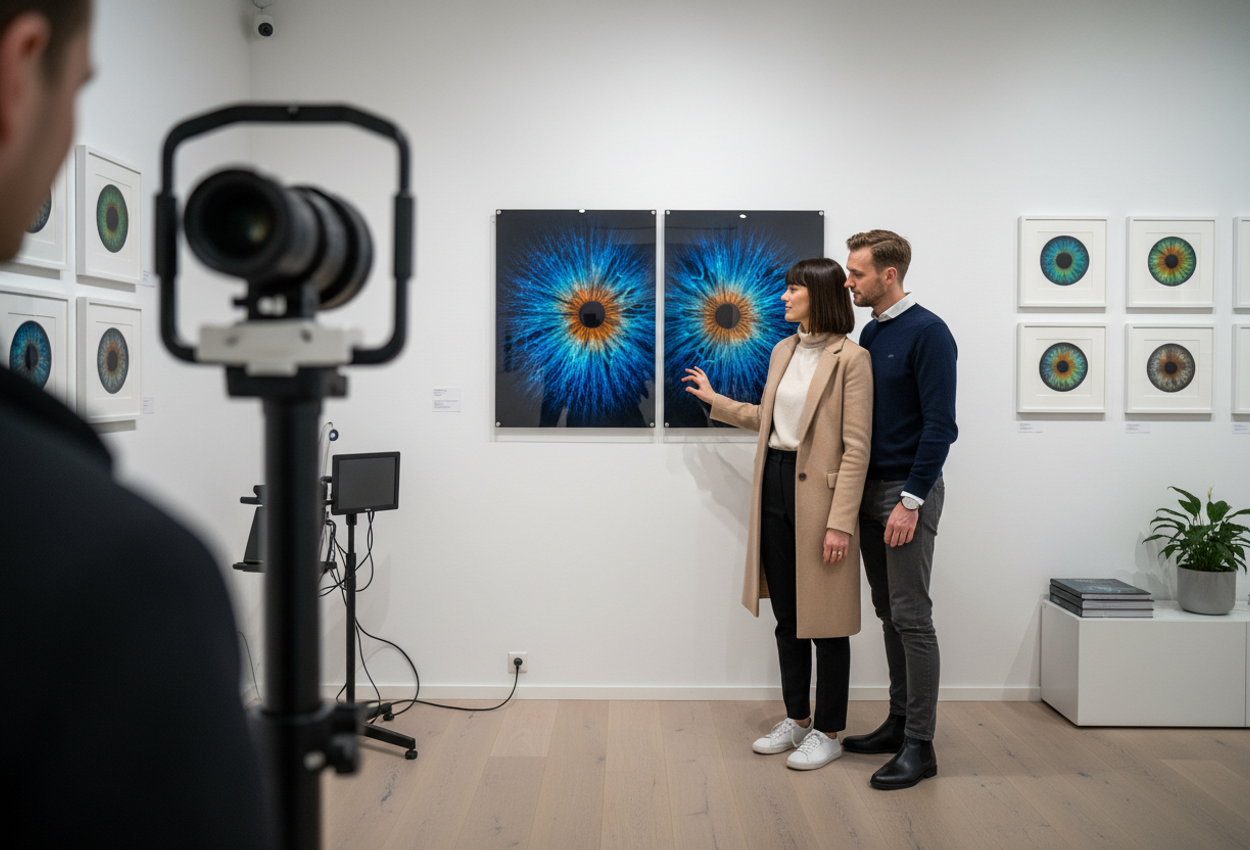
The gallery’s interior is a quiet contrast to Berlin’s graffiti-kissed streets. White walls, pale oak floors, and carefully placed plants create a sense of calm; the only strong color here comes from the glowing examples of finished iris portraits displayed like nebulae in a private cosmos. Each image is a close-up of an eye’s center, magnified until the textures resemble lava flows, storm systems, or the surface of a distant planet. It is hard to believe these universes live, unnoticed, behind the flick of an eyelid.
Staff guide you and your partner through the process with the ease of people who have watched hundreds of couples walk nervously through the door. First comes the reassurance: there is no uncomfortable brightness, no invasive touch. You will rest your chin on a padded support, lean forward, and look directly into a specialized camera that uses gentle light and high-resolution sensors to capture every ridge and fleck of your iris. One of you goes first, the other watching on a nearby monitor as your eye fills the frame a ring of ocean blue, perhaps, ringed with bronze, or a rich brown limned with flashes of green.
There is a strange tenderness in this act of being seen so closely. You are used to your partner’s eye color as a broad impression, a wash of blue or hazel; here, you see how many tiny structures and gradients contribute to that overall effect. When it is your turn, you sit as still as you can, feeling the faint puff of your own breath bounce back from the camera housing. The click is soft, almost anticlimactic, but then the image appears on the screen, and your partner leans in with a small gasp. You had not realized your iris contains a ring of unexpected amber, or a starburst of darker pigment radiating from the pupil like sun flares.
The magic unfolds in the next step, when the staff invite you to design the final artwork. Side by side at a digital station, you can choose from different compositions. Do you want both irises captured individually, framed as a diptych that hangs side by side like two celestial bodies in close orbit. Or would you prefer a fusion, where the images overlap slightly, blending colors at their edges to suggest the way your lives have intertwined. Backgrounds shift from deep black to smoky grey to luminous white; subtle color grading can enhance the blues, warm the browns, or draw out small veins of unexpected green.
For couples, each decision becomes a quiet act of storytelling. Perhaps you opt to keep the images separate but equal, honoring the individuality you each bring to the relationship. Or maybe you choose a bold, overlapping composition, the point of contact between the two irises forming a bright, shared center. The staff can add minimal text below the print names, a date, a phrase that means something to only the two of you but most couples find that the image speaks loudest on its own. Enlarged and printed on glossy paper, metal, or acrylic, the iris portraits become less about biology and more about a visual metaphor for how intimately two people can know each other while still remaining whole worlds apart.
Hidden gem: If your budget allows, consider choosing an acrylic or metal finish for your iris artwork. These materials interact with light in a way that makes the colors seem almost backlit; the golds shimmer, the blues deepen, and the intricate fibers of the iris cast subtle shadows. Hung near a window or under a carefully positioned spotlight at home, the piece glows softly as the day shifts, a daily reminder of your trip to Berlin and the ways you learned to look at each other more closely.
As you leave the gallery, stepping back out into the clatter and hum of the city, you may find yourselves studying each other’s eyes anew in the harsh brightness of a U-Bahn carriage or the cozy half-light of a bar. You have seen the miniature galaxies that live inside them; now, every glance feels a fraction more resonant. In a city that prizes creativity, your very bodies have become art, and the souvenir you carry home is not just something to hang above the sofa but a reminder that intimacy, like art, lies in learning to pay attention.
Berlin's Creative Pulse, Shared
Across all these experiences, what emerges is a portrait of Berlin not only as a capital of art, but as a city that uses creativity to braid people together. Walking the East Side Gallery, you and your partner trace the scars of division made bright with paint; in a Neukölln pottery studio, you learn the patience and mess of shaping something new from raw material. Intuitive painting workshops turn unspoken feelings into color, while street art safaris through Kreuzberg and alleys like Haus Schwarzenberg teach you to read the city’s walls as if they were love letters in a secret code. At Iris Galerie, the art is literally inside you, waiting only for the right lens to reveal it.
For couples, these collaborative projects offer more than just unusual date ideas. They are rehearsals in communication and trust, opportunities to negotiate aesthetics, share risks, and laugh at imperfections. In clay that collapses, in drips of paint that fall where they should not, in the slightly blurred edge of an iris print, you find proof that beauty rarely arrives in flawless form. It is the process the reaching across a spinning wheel, the exchange of a loaded brush, the decision to book a workshop in an unfamiliar part of town that makes these experiences unforgettable.
As night falls on Berlin and you step back onto the streets, your hands perhaps dusty with clay, stained with paint, or still tingling from having gripped the edges of a camera support, you will notice that the city’s creative heartbeat follows you. Neon signs and café windows flash like small canvases; the low thrum of trains and distant club bass becomes a soundtrack. You have not just observed Berlin’s artistic heart you have helped it beat, if only for a few days. And somewhere back home, long after your flight has landed, a crooked mug, a riotous canvas, a spray-painted tote bag, or a glowing iris print will wait to remind you of the trip when love meant making something, together, in the most creative city in Europe.