Romance is not only found in rose petals scattered on hotel sheets or sunset dinners scripted months in advance; it lives in whispered alleyways, in shared silences, in the surprise of tasting something new at the exact same moment. In Kyoto, Buenos Aires, and Zanzibar, love takes on unexpected shapes – meditative, wild, and salt‑kissed – inviting couples to step beyond the familiar bouquet and into something far more enduring.Kyoto's Whispers of Ancient Romance
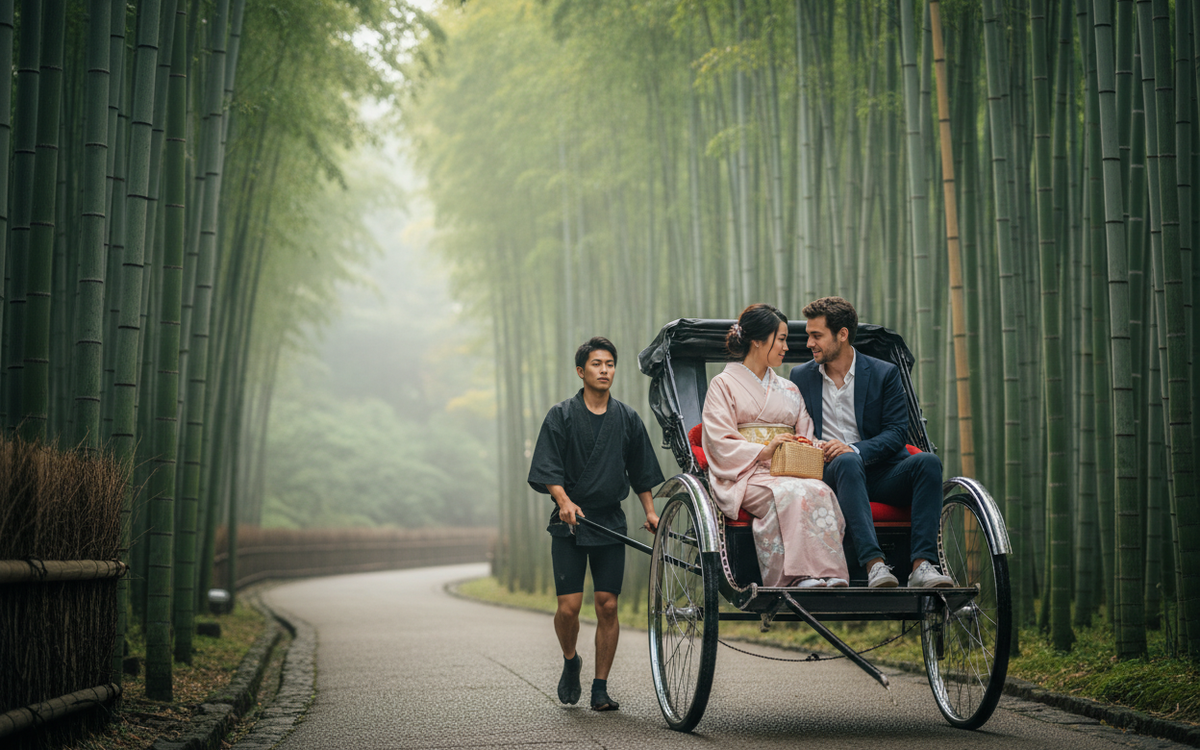
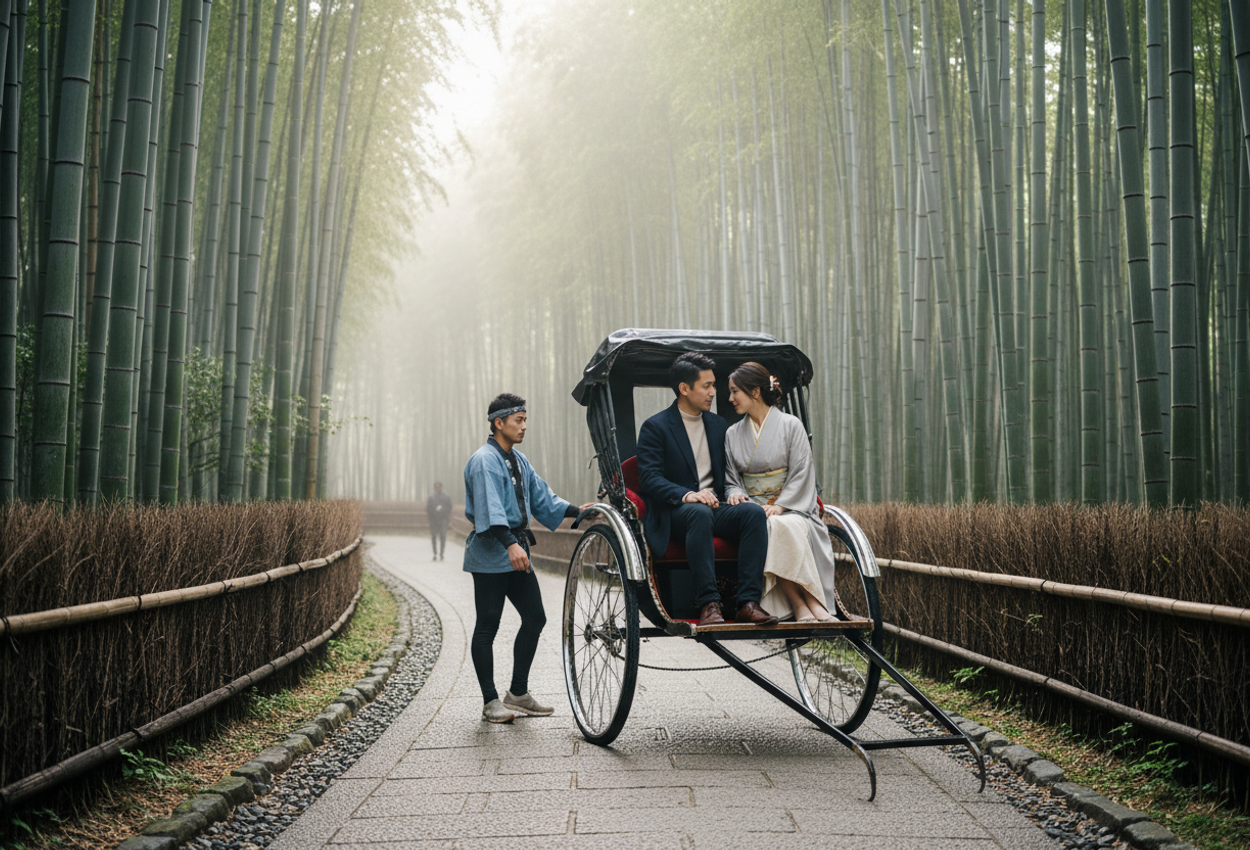
In the half-light of early morning, when mist still clings to the hills of Arashiyama and the crowds have yet to arrive, the famed Arashiyama Bamboo Grove feels less like a tourist sight and more like a secret whispered between two people. A rickshaw wheel hums softly over the stone path, the gentle rhythm in time with your heartbeat as you lean back against the padded seat. Above you, stalks of bamboo rise in pale green columns, impossibly tall, swaying with a sound like distant rain. Sunlight filters through in slender shafts, catching in your partner’s hair, turning each breath into something visible and almost sacred.
Your rickshaw puller – a young local with an easy laugh and a runner’s stride – guides you off the main path to a quieter lane flanking the Katsura River. The water glides past in shades of pewter and jade, wooden boats rocking softly against their moorings. The cool air smells faintly of river stones and damp earth, laced with the faint sweetness of incense drifting down from hidden temples. As you pause on a small bridge, he offers to take a photograph; instead, you slip the phone back into your pocket, choosing to remember the moment only in the reflection of your faces side by side in the still water below.
Later, you climb toward Kiyomizu-dera Temple, the city stretching out like a sea of tiled roofs and narrow streets beneath its famed wooden terrace. At the top, the view is a panorama of modern and ancient Kyoto woven together: sleek glass buildings rising discreetly behind pagoda roofs, alleyways that snake away into pockets of shadow, distant mountains circling the horizon in muted blues. Wind brushes against the sleeves of your yukata, carrying with it the resinous scent of cedar and the faint clang of temple bells. Couples linger at the railing, the silence between them not empty but full – of shared memories, unspoken questions, and the quiet understanding that they are standing in a place where people have come to pray for love for centuries.
As you wander the temple grounds, you pass by Jishu Shrine, dedicated to love and matchmaking. Two stones stand several meters apart, and you watch as a local couple attempts to walk from one to the other with their eyes closed, guided only by the whispered directions of friends. When they reach their goal, laughter erupts, light and unguarded. You and your partner trade a look; perhaps you skip the game, or perhaps one of you closes your eyes and trusts the other’s hand to guide you – a playful, almost childlike test of faith wrapped in an ancient ritual.
Down in the city, the Philosopher's Path traces a quiet canal lined with cherry trees. In early spring, when the sakura petals are in bloom, the air is frosted with pale pink and white; they cling to stone walls, swirl lazily on the water’s surface, and catch in your hair like confetti from some secret celebration. Even outside of the blossom season, the path feels contemplative. Small cafes and galleries tuck themselves behind low wooden gates, their signs handwritten, their interiors glowing softly with amber light. Your footsteps are cushioned by moss and fallen leaves, and from an open window you hear the soft pluck of a shamisen, each note hanging in the air between you.
It is here that you meet Aya and Kenji, a Kyoto-born couple in their thirties sitting on a bench, fingers loosely intertwined as they share a thermos of green tea. They tell you that this path was once their daily commute to university, a place they rushed through, headphones on, exams looming. Now, years later, they return each anniversary to walk it slowly. For them, romance is not grand gestures but returning to a familiar path and noticing how it has changed – and how it has not. As you part ways, their story lingers like the aftertaste of strong tea, a reminder that love thrives in repetition as much as in novelty.
The most intimate moment of the day, however, unfolds in near silence. In a small residential neighborhood far from the main tourist routes, a sliding wooden door reveals a private garden and a tea room used by a family that has practiced the art of tea for generations. You and your partner kneel on tatami mats, toes curled under, as the tea master prepares bowls of matcha with movements so deliberate they resemble a choreography. The chasen whisk brushes against ceramic with a delicate rasp, frothing the tea into a vivid green capped with fine bubbles.
The room smells of straw tatami, roasted tea leaves, and the faintest whisper of sandalwood. Light slips through shoji screens, drawing delicate rectangles on the floor. When you raise the bowl to your lips, its rough clay warms your fingers; the matcha itself is velvety and bitter, with a sweetness that blooms only on the second sip. Across from you, your partner cradles their own bowl, eyes lowered in concentration, present in the same ritual yet experiencing it entirely through their own senses. There is no need to talk. The moment stretches – a shared stillness, anchored in the simple act of drinking tea together – and you realize that in Kyoto, romance is sometimes nothing more and nothing less than two people learning to be quiet in the same room.
Buenos Aires: Tango, Roses, and Hidden Passions
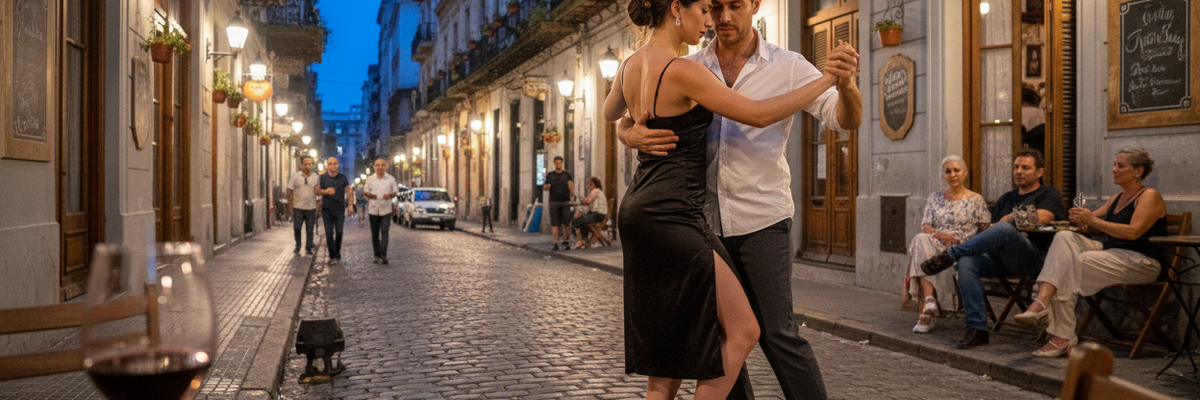
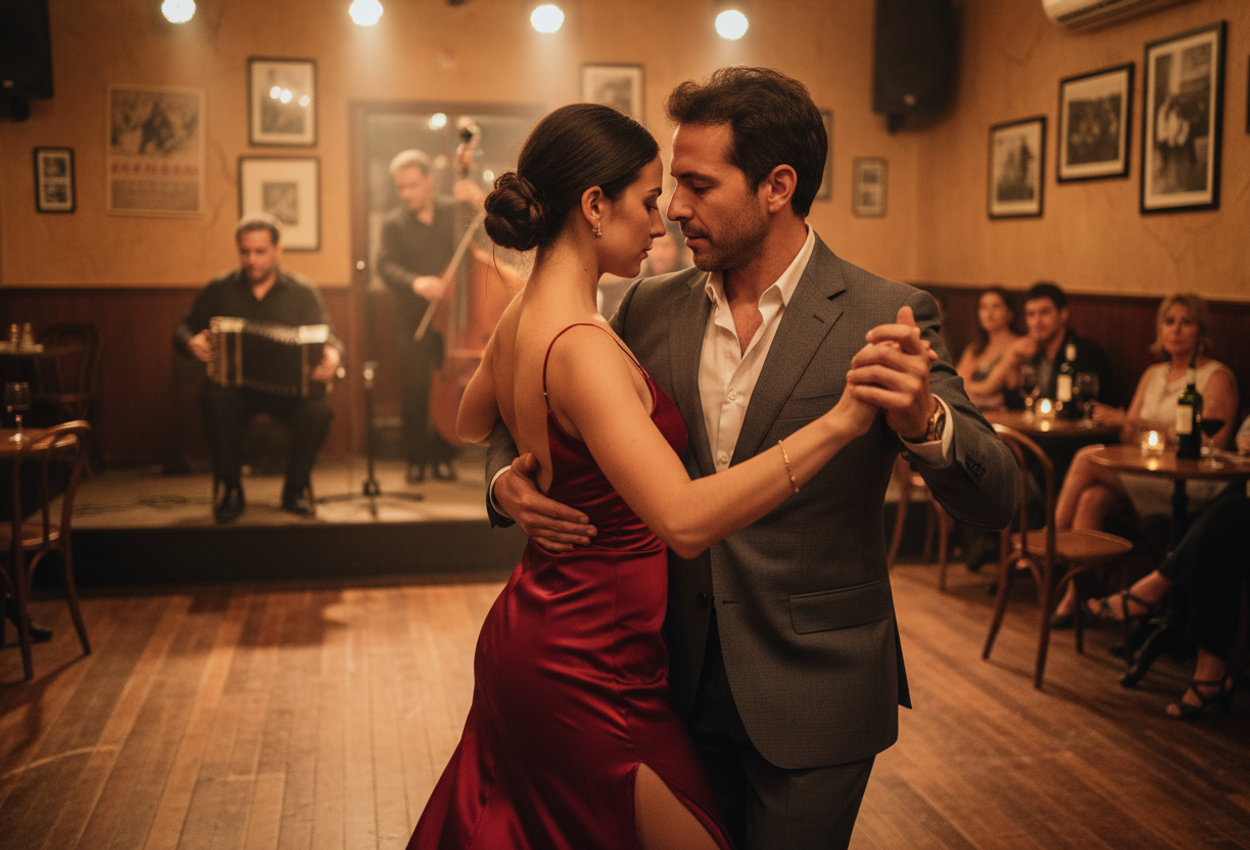
Night in Buenos Aires does not fall so much as it unfurls, slowly and dramatically, like a dancer’s skirt. In San Telmo, cobblestone streets shine faintly under wrought-iron lamps, and the air smells of grilled meat, red wine, and the faintest trace of old tobacco curling out of narrow doorways. Inside a restored colonial building, your tango evening begins. The salon’s wooden floors glow with decades of polish; old posters of tango legends line the walls, their monochrome gazes intense even after all these years. A live band tunes up at the back – bandoneón sighing, violin streaking through the warm air, bass thrumming like a heartbeat.
You and your partner sit at a small round table, a candle flickering between you, as dancers take to the floor. A woman in a crimson dress steps forward with her partner; the first notes of the tango spill out, syrupy and urgent. They move as if tied to invisible strings, her heel carving precise arcs against the floor, his hand a steady anchor at the small of her back. There is heat, yes, but also restraint – the tension of almost touching, of almost stepping too far. Each pause is loaded, a breath held, a promise not yet fulfilled. As you watch, you realize that tango is less about perfection and more about listening: to the music, to your partner, to the space in between.
During a break, you meet Lucía and Martín, a couple from the city who tell you how tango brought them back together after a difficult year. They describe the frustration of stepping on each other’s toes, of missed leads and misread signals, and how, over time, the dance taught them to communicate without words. Listening to them, you begin to understand why tango is often called a conversation of bodies. When you finally gather the courage to take a beginners’ class in the back room, your first steps are tentative, hesitant. But as you learn to follow and to lead, cheeks flushed, you feel something subtle falling into place: trust, in motion.
The following afternoon, El Rosedal, the famed rose garden in Palermo, offers an entirely different kind of romance. Spread over rolling lawns within Parque Tres de Febrero, the garden is a meticulously tended sea of color – deep crimson, coral, buttery yellow, blush pink, petals unfurling like silk. Sunlight shimmers on the lake that curls around its edges, small rowboats skimming the surface, oars dipping in perfect rhythm. As you cross the Greek-style white bridge, the scent of thousands upon thousands of roses wraps around you: sweet, peppery, citrusy, sometimes almost smoky, each variety offering a different note in an invisible perfume.
You stroll past pergolas draped with climbing roses and through the Andalusian patio, its tiled benches still cool even in the afternoon warmth. The murmur of Spanish, French, English, and Portuguese mingles with birdsong; couples lean in over shared ice creams, families pose for pictures under the trellises. You and your partner find a bench in a quiet corner near the poets’ garden, where busts of writers watch over the paths. Reading the engraved names, you imagine what verses of love might have been inspired in this very spot a century ago. A breeze stirs the petals at your feet, and for a moment the entire garden seems to exhale.
But the heartbeat of modern romance in Buenos Aires often lies underground – quite literally. That evening, you descend a narrow staircase in Palermo into a small, brick-lined wine cellar lit by wall sconces and the occasional flicker of a candle trapped inside a green bottle. Wooden tables are worn smooth by elbows and laughter; oak barrels rest in shadowed corners. You have come for a private tasting of Argentine wines, and the room already hums with quiet anticipation.
Your sommelier, Andrés, speaks about Malbec the way some people speak about first love – with reverence and an almost painful specificity. As he pours the first glass, the garnet liquid catching the light, he explains how high-altitude vineyards in Mendoza give the wine its characteristic intensity. You lift the glass, inhaling notes of black plum, violet, and a hint of cocoa; the first sip is plush and generous, tannins wrapping around your tongue like a slow embrace. Later, a crisp Torrontés surprises you with its aromatic burst of orange blossom and peach, while a Patagonian Pinot Noir glides across your palate, all red berries and spice.
Throughout the tasting, you and your partner trade impressions – one tastes cherries, the other tobacco; one loves the bold Malbec, the other is drawn to something softer, more elusive. The conversation becomes a portrait of your differing sensibilities, revealing as much about your relationship as it does about the wines. Andrés smiles, saying that he has watched many couples fall a little more in love down here, not because of the alcohol but because of the careful attention they learn to pay to what they are experiencing together. As you climb the stairs back to street level, cheeks warm, you feel buoyed by the knowledge that romance can be as simple – and as complex – as sharing a glass and really listening to each other’s reactions.
Zanzibar: Spice-Scented Shores and Azure Dreams
On the waters off the northern coast of Zanzibar, the traditional dhow is more silhouette than vessel at first, a sharp triangle of canvas cut out against the molten gold of the setting sun. You and your partner step barefoot onto its wooden deck, the planks smooth with age and salt. The late afternoon heat is softening; a breeze blows in from the open Indian Ocean, carrying with it the mineral tang of salt, the faint smell of seaweed drying on distant rocks, and a hint of clove from plantations inland. As the sail billows and fills, the boat leans into the wind, creaking reassuringly, and the shoreline begins to drift away.
Sky and sea conspire in a spectacle of color. The horizon melts from sapphire to indigo; overhead, streaks of tangerine and rose bleed into lavender. The dhow cuts through gentle swells, and small sprays of seawater dust your skin, drying almost instantly in the warm air. Fishermen in other boats raise hands in greeting as they pass, their laughter carried across the water. You rest your head on your partner’s shoulder, listening to the flap of the canvas, the low murmur of Swahili between crew members, the soft slap of waves against the hull: a lullaby equal parts wild and serene.

As twilight deepens, the lights of Stone Town begin to glimmer along the shore, a scatter of amber beads against the darkening land. Earlier that day, you had wandered through its maze of alleys, narrow as secrets, where carved wooden doors rise taller than the people who pass them. The scent of history there is a physical thing: sun-warmed limestone, cardamom drifting from open doorways, charcoal smoke curling up from streetside braziers. Each turn reveals another vignette – a child playing by a heavy brass-studded door, a man in a crisp kofia hat pouring spiced coffee, cats dozing beneath mango trees.
On a rooftop café near the harbor, you had watched life below unfold like a tapestry. Call to prayer floated up from the mosques, a melodic thread weaving through the evening; below, women in brightly patterned kangas chatted as they walked, and the ocean shone silver beyond the low, flat roofs. Sharing a plate of grilled calamari and coconut rice, you and your partner found yourselves speaking not about to-do lists back home but about dreams: the skills you still wanted to learn, the corners of the world you hoped to see. Perhaps it is the height, or the salt in the air, but rooftops have a way of making conversations feel both intimate and unbounded, and here in Stone Town that feeling is amplified by the weight of centuries vibrating beneath your feet.
Later, guided by the distant sounds of sizzling oil and laughter, you arrive at Forodhani Gardens as the night food market comes to life. Lanterns swing from makeshift stalls, their light falling on skewers of lobster, octopus, and kingfish, on pyramids of samosas and bowls of pillowy chapati. Smoke rises in fragrant clouds: charcoal, chili, garlic, and the unmistakable sweetness of sugar cane being pressed into juice. You and your partner share a Zanzibar pizza – a thin, stretchy dough folded around egg, diced vegetables, perhaps a bit of minced beef and cheese – crisp at the edges, gooey at the center. Oil drips onto the paper it is served on, and you lick your fingers unabashedly, laughing when a morsel escapes.
But it is away from the markets and the town’s hum that Zanzibar offers one of its most unforgettable romantic gestures: a private dinner on the beach, set far enough from your lodge that the rest of the world might as well not exist. As darkness settles, the tide withdraws, leaving the sand cool underfoot and dusted with fragments of shell like scattered stars. A low table is laid directly on the beach, surrounded by cushions in deep blue and locally woven mats. Lanterns and candles, protected from the breeze by glass, cast a golden halo around your small world; beyond it, the ocean whispers in silver and black.
The menu is a love letter to the island: coconut-crusted prawns with a squeeze of lime; grilled reef fish fragrant with coriander, chili, and garlic; rice steamed in coconut milk, its grains perfumed and subtly sweet. There is fresh mango, sticky and sun-sweet, and passionfruit whose tartness cuts through the richness of everything else. As you eat, the only sounds are the quiet clink of cutlery, the hush of waves, and the soft rustle of palm fronds overhead. Your bare feet find each other beneath the table, toes tangled in the sand. In the vast darkness of the ocean night, this small pool of light feels like a promise: that in making space for moments like this, you are making space for each other.
Serenity Found: A Kyoto Garden Retreat
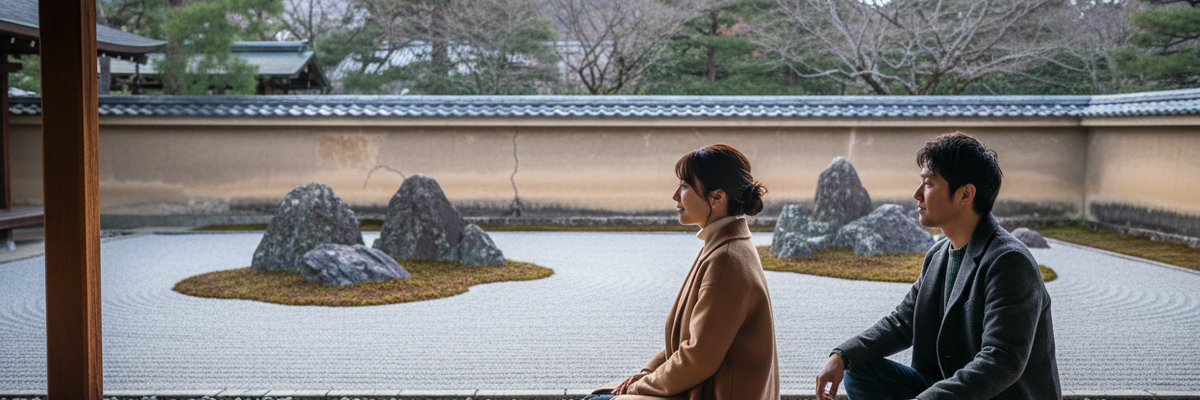
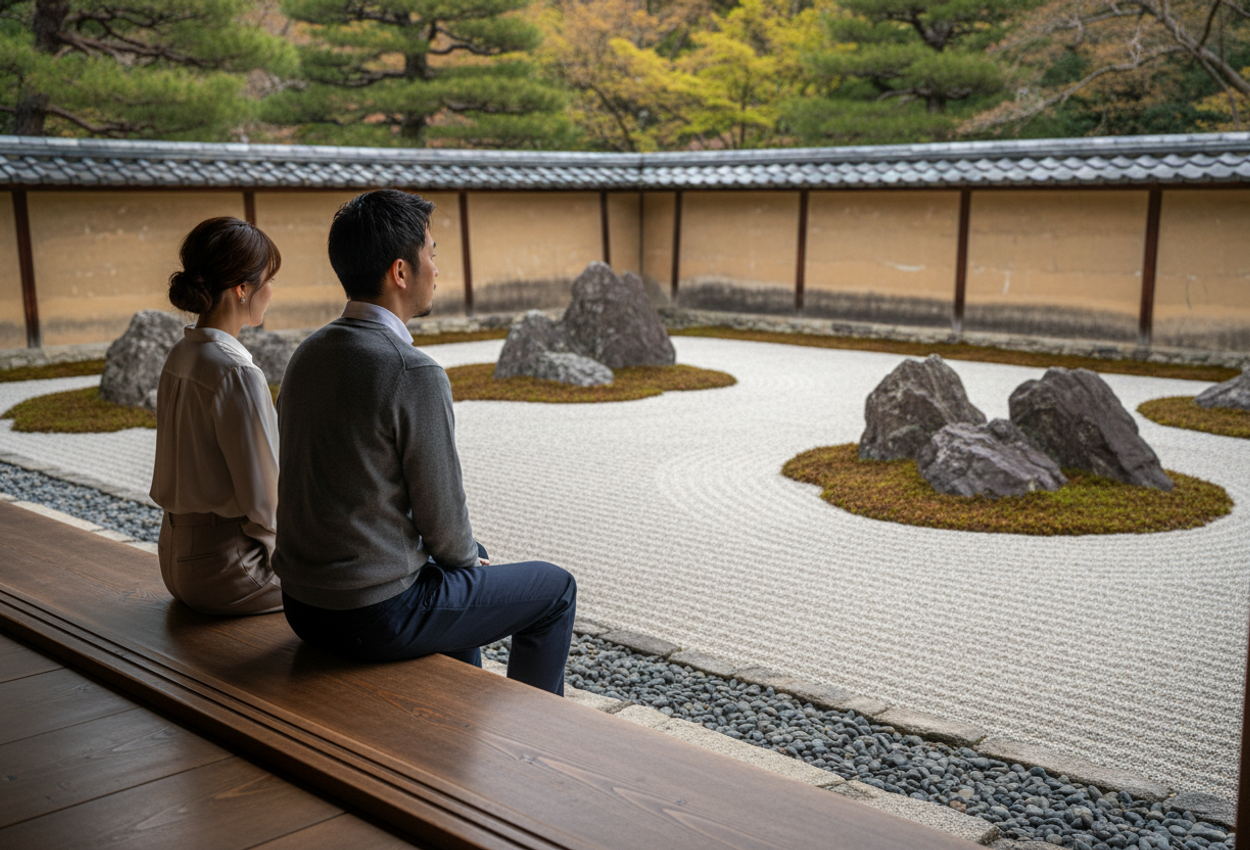
Back in Kyoto, the romance shifts from sea breeze to stillness. At Ryoan-ji Temple, home to one of Japan’s most famous Zen rock gardens, the city feels impossibly distant, as if someone has turned down the volume on the world. You and your partner slip off your shoes and join a handful of visitors seated along the wooden veranda, facing a rectangle of raked white gravel punctuated by fifteen moss-fringed stones. There are no flowers here, no fountains, no elaborate ornaments – just a pattern so simple it appears, at first glance, almost austere.
Yet as you sit, breathing syncing naturally with the slow rhythm of the place, the garden begins to reveal itself. The gravel’s perfectly parallel lines evoke waves or perhaps ripples of thought; the stones, clustered in small groups, suggest islands, mountains, or even moments in a life. No matter where you sit, tradition says, you can see only fourteen of the fifteen stones at once; one is always hidden, hinting gently at the impossibility of total understanding. You glance at your partner, wondering which stone you each might be missing, what parts of each other remain just out of view – not as a failing, but as an invitation to keep looking.
The afternoon sun warms the veranda’s wooden planks, and the air carries the faint scent of pine and temple incense. A breeze brushes against your cheek, stirring the leaves beyond the temple wall. Around you, camera shutters occasionally click, but even those sounds seem softened here. There is an odd, calming intimacy in simply sitting together and saying nothing, letting your thoughts rise and fall without needing to be shared. In a world that celebrates constant conversation, this shared silence feels radically, beautifully romantic.
Later, you trade the earth tones of Ryoan-ji for the lush greens of the mountains north of the city, traveling to Kifune Shrine in the village of Kibune. The approach is lined with red lanterns that march up the stone stairway, their color vivid against moss-covered rocks and towering cedars. A cold stream races beside you, its chatter a constant counterpoint to the quiet murmur of visitors. At the shrine, you and your partner each take a slender wooden ema plaque. You write your wish carefully – perhaps for a new beginning, for resilience, or simply for many more journeys together – and hang it among hundreds of others, the wood gently clacking as the wind moves through.
Just downriver, the true hidden treasure of Kibune awaits: kawadoko dining, where wooden platforms are built directly over the rushing water. In the summer months, low tables and straw mats turn the river into an open-air dining room. You settle cross-legged with your partner on a platform barely a meter above the water, cool mist kissing your ankles. Lanterns sway overhead, casting a soft glow that reflects in the moving surface below, so that it appears as though you are floating on ribbons of light.
A multi-course kaiseki meal arrives in delicate, artful waves: river fish grilled until their skin blisters and crackles, tofu as silky as custard set in a light dashi, mountain vegetables dressed with sesame, rice delicately scented with herbs. Each dish arrives like a small poem, arranged in seasonal colors and shapes, inviting you to eat with your eyes before your chopsticks ever touch the plate. The sound of the river below hushes conversation into murmurs; you lean in, voices low, sharing impressions, stories, quiet jokes. Wrapped in cool air, lantern light, and the music of water, the rest of the world feels impossibly far away.
Buenos Aires's Artistic Heart: La Boca's Colorful Embrace
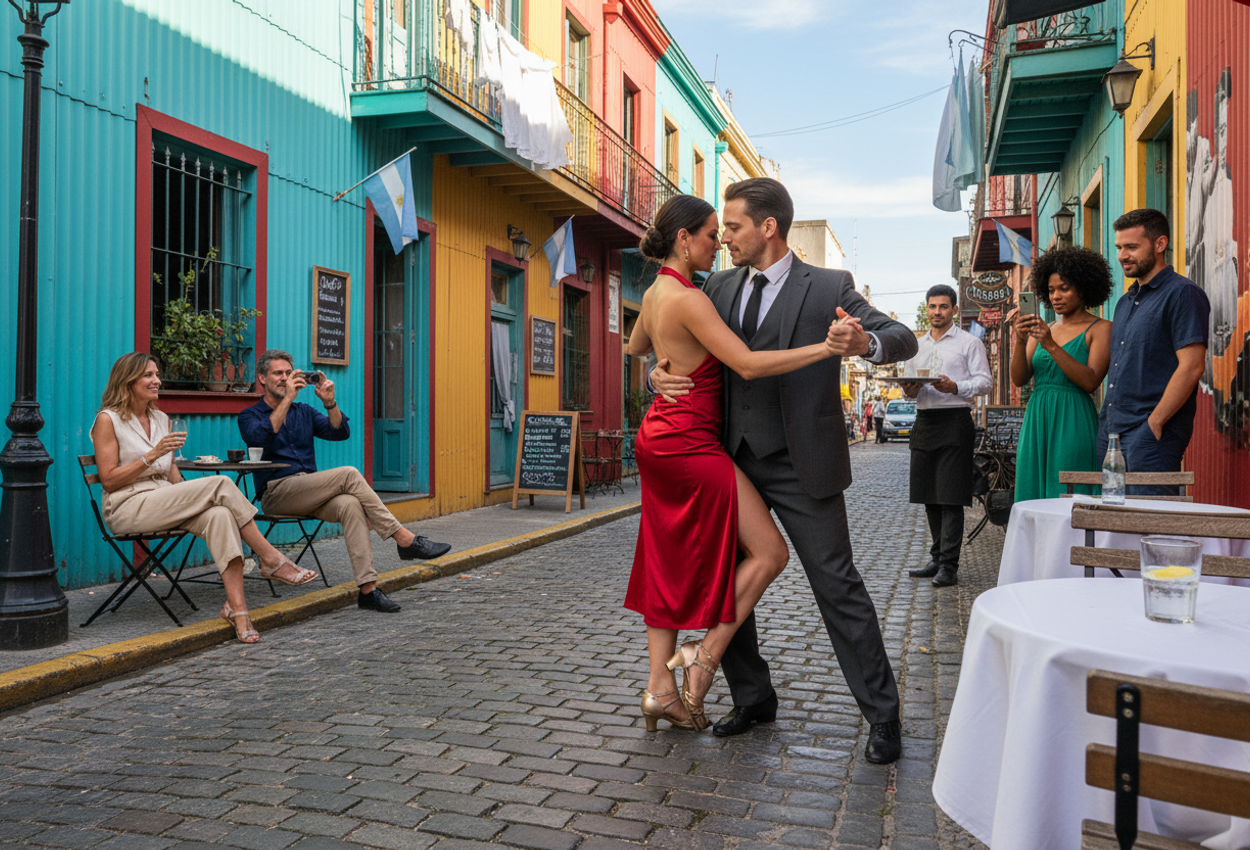
If San Telmo is where Buenos Aires broods and remembers, La Boca is where it shouts its joy in every possible color. Walking along Caminito, the famous alley turned open-air museum, you and your partner find yourselves framed by corrugated metal houses painted in electric shades of turquoise, sunflower yellow, and fire-engine red. Laundry flaps overhead between balconies; street artists prop their canvases outside, wet paint catching the light. The air vibrates with music – snatches of tango, cumbia, and the occasional busker’s guitar – blending with the sizzle of empanadas frying in small food stands.
On a small corner stage, a tango duo claims a square of pavement. The woman’s dress, emerald green, flashes as she turns; the man’s fedora casts a mysterious shadow over his eyes. Though this performance is for tourists, there is nothing mechanical about the way they move. Each step is sharp and precise; her legs slice the air in quick, controlled flicks, his embrace firm but respectful. As they dance, they pull volunteers from the crowd; when your partner is chosen, you watch them stumble, then laugh, then slowly begin to mirror the rhythm. Something in your chest squeezes – not jealousy, but a strange mix of tenderness and awe at seeing them through the eyes of strangers, brave and open on a makeshift stage.
A short walk away, the bright chaos of Caminito gives way to the refined quiet of Fundación PROA, a contemporary art center facing the old port. Its sleek façade of glass and pale stone stands in deliberate contrast to the rustic neighborhood around it. Inside, white-walled galleries host rotating exhibitions of Latin American and international artists; the crisp lines and controlled light create a perfect counterpoint to the riot of color outside. You and your partner wander through installations and photographs that grapple with identity, memory, and change, pausing to discuss the pieces that resonate or confound you.
Art, like travel, can be a mirror. In front of a particularly striking photograph – perhaps an image of the Riachuelo river in all its industrial, melancholy beauty – you find yourselves talking about your own pasts: the neighborhoods you grew up in, the things you hope to leave behind, the parts of yourselves you still carry. On the rooftop terrace café, mate gourds and coffee cups clink softly as you look out over the colorful houses of La Boca and the quiet sweep of the water. A breeze off the river tugs at napkins and at strands of hair, and the late afternoon sun gives everything a honeyed glow that makes the scene feel almost cinematic.
As dusk falls, you follow a local friend’s recommendation to a nearby milonga, one of the city’s social tango clubs. From the outside, the building is unremarkable – a nondescript door, a small sign – but as soon as you climb the stairs and push it open, another world spills out. The room is hazy with warm light, strings of bulbs casting halos over a simple wooden floor. Locals of all ages occupy small tables at the edges, nursing beers or tumblers of soda water, shoes placed carefully beside them. Here, tango is not a performance but a language spoken between those who know each other well, and those who have only just met.
You watch as dancers take to the floor during each tanda, or set of songs. Invitations are exchanged with the briefest of nods, or with the traditional cabeceo – a meeting of eyes across the room that carries enough electricity to feel like a secret. Couples glide in close embrace, steps smaller and more introspective than in the stage shows. There is an unhurried sensuality in the way they move, improvising within shared rules, adjusting to each nuance in the music. When you are finally pulled onto the floor by a new acquaintance or by each other, nerves give way to a feeling of being gently carried along by something larger than you both. The milonga hums around you: the scrape of shoes, the sigh of bandoneón, the murmur of conversation. In this dim, crowded room, romance is not a spectacle but an atmosphere, thick and enveloping.
Zanzibar's Underwater Eden: Mnemba Atoll's Secrets
At first light, off the northeast coast of Unguja, the main island of Zanzibar, the sea is so clear it seems as if the boats are floating in mid-air. You and your partner climb aboard a small dhow bound for Mnemba Atoll, a famed marine reserve that circles a tiny private island like a jeweled collar. As the boat cuts through increasingly vivid shades of turquoise and cobalt, the sun rises higher, turning the water’s surface into a spill of shimmering silver. Flying fish occasionally leap at the bow; seabirds trace lazy arcs overhead.
When you reach the protected reef, the captain drops anchor in water so transparent you can see straight to the sandy bottom, ten or more meters below. Slipping into the sea, mask snug against your face, you feel the cool embrace of another world. Sounds from above fade into a distant muffled thrum, replaced by the soft crackle of shrimp in the coral, the whoosh of your own breath through the snorkel. All around you, the reef blooms: branching corals like frozen lightning, brain coral folded into intricate labyrinths, fans swaying in the current like underwater banners.

Fish appear in impossible colors and patterns – electric blue tangs, striped sergeant majors, parrotfish with scales painted in brushstrokes of teal and magenta. A cloud of tiny silver fish darts in unison, fracturing and reforming as a shadow passes overhead. You spot a moray eel peering from its rocky crevice, its jaw gently opening and closing, and a languid sea cucumber resting like a forgotten relic on the sand. Reaching out, you feel your partner’s hand find yours, fingers tightening briefly as the two of you float above this alien, radiant city. It is a strange comfort to know that such beauty exists whether humans witness it or not, and that for a brief moment, you are tolerated guests in its midst.
Back on the boat, warmed by the sun and wrapped in towels, you sip sweet, spiced tea and nibble on fresh pineapple, its juice sticky on your fingers. On the way back toward shore, the captain steers you to a spot where green turtles are known to feed. Soon enough, a smooth, dark shell materializes below, then another. The guide explains quietly how conservation efforts in the area protect nesting sites and regulate boat traffic, so that these ancient mariners can continue their quiet patrols. Slipping back into the water with respectful distance, you watch as a turtle glides past, its movements unhurried, almost regal. For a few suspended seconds, its eye meets yours, deep and unblinking, before it dips down again into bluer shadow.
Later that day, on land again, you travel inland to a spice farm where the island’s nickname – the Spice Island – comes alive. Walking between neat rows of plants and trees, you crush leaves between your fingers, releasing the scent of clove, cinnamon, lemongrass, and nutmeg. Your guide plucks pods and seeds straight from branches and invites you to taste: ginger fiery against your tongue, vanilla sweet and floral, turmeric earthy and bitter. The air is heavy with fragrance; it clings to your clothes and your hair. As you and your partner test each other, trying to guess the spice by smell alone, laughter erupts with every wrong answer. You pocket small packets to take home, already imagining how, months from now, one of you will toss a pinch of clove into a pot and the kitchen will suddenly smell like Zanzibar.
In the late afternoon, as shadows lengthen, you arrive at a sheltered cove where turtles sometimes surface near volcanic rocks. Here, if conditions allow and guides deem it safe, you may slip into the water again, this time in a quiet, more intimate encounter. The sea is cooler here, darker, the sandy bottom giving way to rocks and sea grass where turtles graze. You float on your stomach, heart slowing, as a turtle rises gracefully from the depths to breathe, its beak breaking the surface with the softest of sounds. Beside you, your partner’s eyes are wide behind their mask, mirroring your own sense of wonder. The guide’s gentle reminders about distance and respect fold into the experience itself, making the moment not just magical but meaningful. In sharing this fragile space with such ancient creatures, you feel your own timeline, and the timeline of your relationship, slip humbly into perspective.
Kyoto's Culinary Charms: A Nishiki Market Adventure
If Zen gardens invite quiet contemplation and kawadoko dining lifts you above the river, then Nishiki Market throws you into the beating heart of everyday Kyoto. Known as Kyoto’s kitchen, this narrow, covered arcade hums from morning till late afternoon with vendors calling out their wares, locals navigating the crush with practiced ease, and visitors stopping every few steps to point, sniff, and taste. Lanterns and awnings in shades of red, green, and white hang overhead; the floor beneath your feet is a mosaic of stone worn smooth by centuries of footsteps.
Stalls line both sides in endless variety. There are barrels brimming with pickles – crunchy cucumbers stained fuchsia with shiso, pale daikon radishes infused with yuzu, eggplants so glossy they look lacquered. Their briny perfume cuts through the richer aromas of grilled eel lacquered with sweet soy, skewers of yakitori sizzling over charcoal, and the deep, nutty scent of sesame oil. Elderly shopkeepers in aprons stand ready with toothpicks, offering samples and watching with amusement as your partner’s face sharpens in surprise at the intensity of a particularly pungent tsukemono.
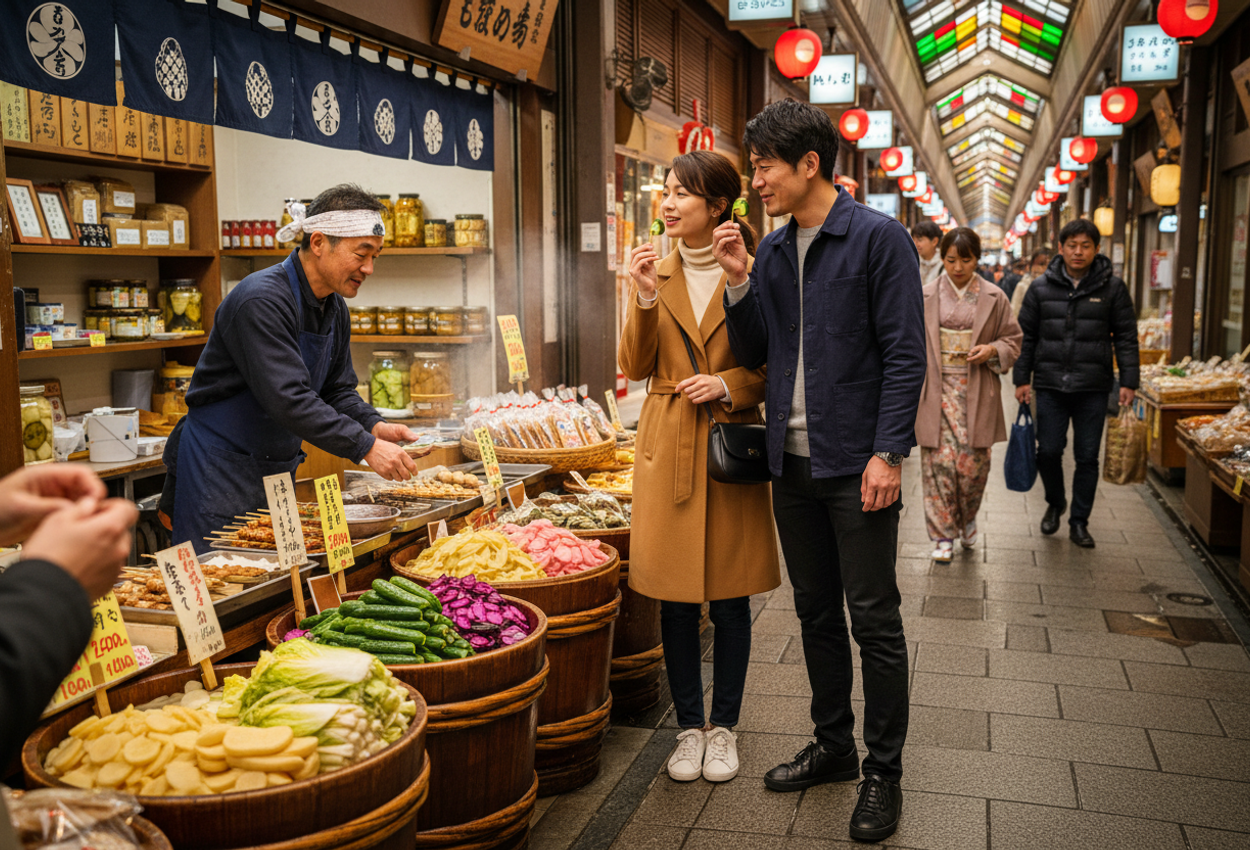
You pause at a stand selling fresh mochi, still warm from being pounded. The vendor tucks a strawberry and a dollop of sweet red bean paste inside a soft rice cake, handing it to you in a paper wrapper. The mochi yields under your teeth with a slight chew before giving way to the juicy burst of fruit, the sweetness balanced by the earthy beans. Nearby, skewers of konnyaku are brushed with miso and grilled until the sauce caramelizes at the edges, lending smoky depth to the otherwise neutral jelly. Everything is bite-sized, designed for grazing; every few meters, you and your partner exchange morsels, discovering that one of you loves the chewy texture of yuba while the other is transfixed by the crunch of senbei rice crackers hot off the griddle.
At a small counter tucked between stalls, you sit for an impromptu sake tasting. Behind the counter, a neatly dressed attendant lines up tiny glasses, each filled with a different variety from Kyoto and beyond – a crisp junmai ginjo with floral notes, a robust junmai with hints of rice and earth, perhaps a cloudy nigori that tastes surprisingly like dessert. As you sniff, sip, and compare, the clink of glass and the gentle burn down your throat become part of the market’s sensory tapestry. You discover that your partner prefers the delicate, aromatic styles, while you gravitate toward something richer and more umami-driven. The attendant smiles and, with a conspiratorial wink, recommends a bottle that she says will make an excellent souvenir – not just for drinking, but for remembering this moment.
The market’s true hidden gem, however, lies just beyond its hustle, in a small studio kitchen where a local chef offers intimate cooking classes in traditional Kyoto cuisine. Together with two other couples, you tie on aprons and gather at low wooden tables. The chef, a woman named Yuki with a soothing voice and a mischievous sense of humor, explains the philosophy of Kyoto cooking: restraint, seasonality, and respect for ingredients. She has you smell kombu and katsuobushi before they are simmered into dashi, the stock that will underpin much of the meal. The aroma that rises from the pot is subtle yet profound – smoky, savory, marine.
You learn to shape tamagoyaki, the layered omelet rolled into a perfect rectangle, your first attempts comically uneven before they slowly become more confident. You slice tofu with almost reverent precision, its delicate wobble teaching you patience. Under Yuki’s guidance, you and your partner fold gyoza-like dumplings filled with seasonal vegetables, pinching the edges together like sealing a tiny envelope of flavor. There are mistakes, of course – a burnt edge here, an overly generous pinch of salt there – but each one becomes a point of shared laughter. When at last you sit down to eat the dishes you have created together, the flavors feel amplified not only by umami but by the work of four hands. Cooking, you realize, may be one of the most intimate forms of collaboration: a shared project whose reward is immediate, tangible, and delicious.
Buenos Aires's Literary Soul: El Ateneo's Grandeur
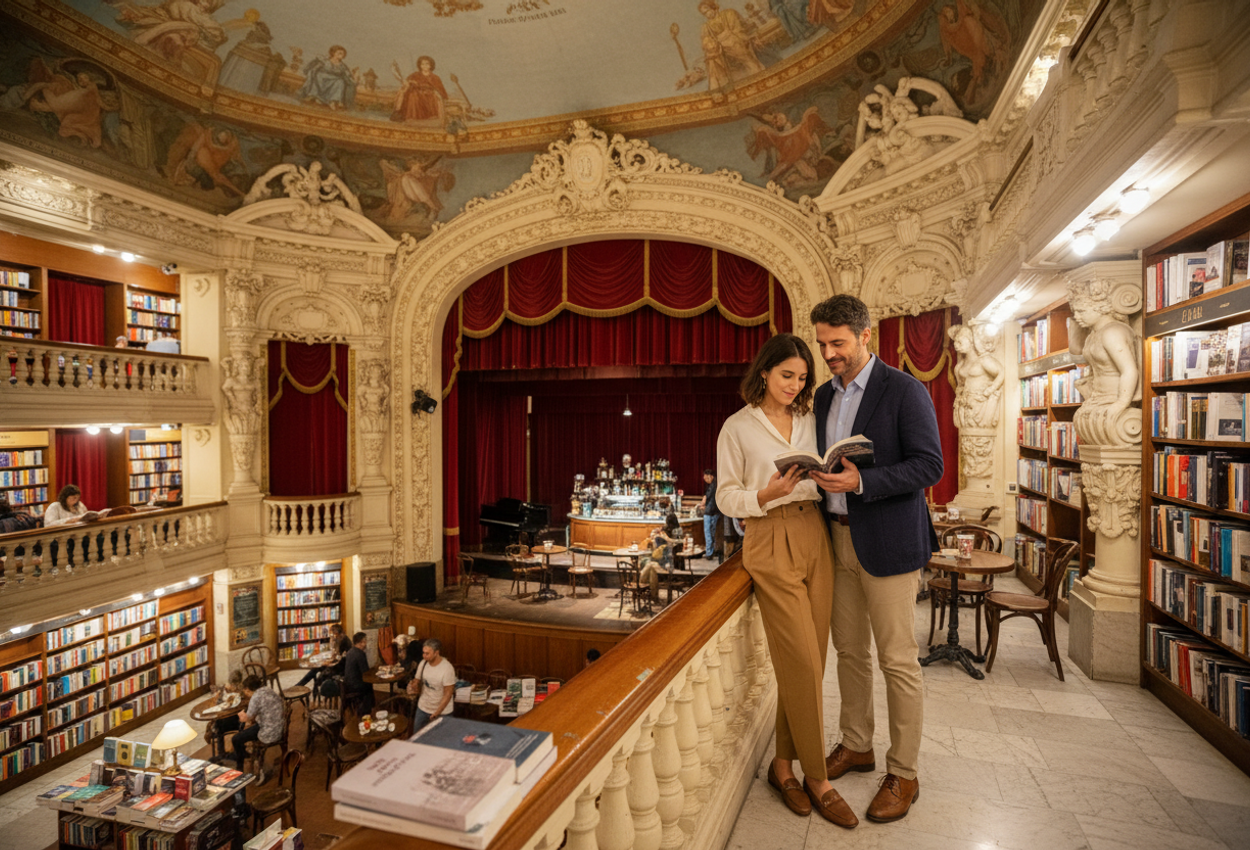
In the bustle of Recoleta, where elegant avenues are lined with jacaranda trees and Belle Époque facades, El Ateneo Grand Splendid stands as a temple not of religion but of reading. Once a grand theater, the building now houses one of the world’s most beautiful bookstores, and stepping inside with your partner feels a little like entering a shared dream. The domed ceiling soars above, its frescoes still intact, while the original balconies now overflow with books instead of patrons. Soft lighting bathes the shelves in a golden glow; the hush inside is reverent but not stiff, punctuated by the occasional joyous exclamation when someone finds exactly what they were hoping for.
You wander the aisles that curve around where the theater seats once were, fingers trailing over spines in Spanish and English, poetry and philosophy, cookbooks and graphic novels. On the former stage, now a café, couples sit at small tables, the murmur of conversation like a distant soundtrack. You and your partner take turns plucking out volumes that have meant something to you – a dog-eared novel from adolescence, a poetry collection discovered during a difficult year – and sharing the stories behind them. There is something disarming about revealing your inner landscape in this way, about laying old obsessions and vulnerabilities bare among strangers in a bookstore. Yet, surrounded by so many lives and voices bound in paper, your own narrative feels at once singular and part of a much vaster story.
Outside, the city’s tempo quickens as you walk toward Plaza de Mayo, the political heart of Buenos Aires. The square, framed by the Casa Rosada, the Metropolitan Cathedral, and the Cabildo, is a palimpsest of Argentine history – site of revolutions, protests, and celebrations. Couples stroll hand in hand past the white headscarf symbols painted on the ground, reminders of the Mothers of Plaza de Mayo who marched here for decades in search of their disappeared children. The air smells faintly of exhaust, jacaranda blossoms, and roasted peanuts from street vendors.
Here, romance takes on a reflective hue. Standing together at the edge of the plaza, you and your partner talk about the weight of history in relationships – the personal and collective pasts we carry, the causes we care about, the ways in which love can be both private sanctuary and public act. A nearby musician strums a guitar, his melody weaving through the chatter of tour groups and the flapping of flags overhead. In a corner of the square, a couple in their seventies sits on a bench sharing a newspaper and a thermos of mate, their silver heads bending toward each other in quiet conversation. Love, you realize, is not untouched by politics and history; it exists within them, shaped and tested by them.
As afternoon leans toward evening, you head back to Recoleta for one of the city’s more old-world romantic rituals: afternoon tea at the Alvear Palace Hotel. Its lobby is a study in opulence – chandeliers casting prismatic light across marble floors, gilded mirrors reflecting bouquets of fresh flowers, upholstered chairs that invite lingering. In the lounge, you are seated at a table laid with crisp white linen and silverware polished to a mirror sheen. A tiered stand arrives, laden with finger sandwiches, warm scones, and delicate pastries glazed to a perfect shine.
You and your partner share everything, trading bites of dulce de leche tart and lemon tartlet, of smoked salmon on brioche and fluffy medialunas. The tea itself is fragrant – perhaps a blend infused with rose petals or citrus peel – and the clink of porcelain and spoon becomes a kind of gentle music. Around you, conversations murmur in multiple languages, but the overall effect is cocooning rather than overwhelming. This is romance in a minor key: not showy or dramatic, but measured, elegant, and thoroughly indulgent. In the mirror behind your table, you catch a glimpse of the two of you reflected together in this gilded frame, and you tuck the image away like a favorite line from a book.
Zanzibar's Stone Town Echoes: A Cultural Tapestry
Back in Stone Town, morning light slants through the narrow streets in bright, angled ribbons. The whitewashed walls of old houses glow softly, their once-brilliant paint weathered by years of sun and sea air. Heavy wooden doors studded with brass – some carved in swirling floral patterns, others geometric and severe – stand guard over courtyards perfumed with jasmine and frangipani. You and your partner wander without a map, allowing curiosity to dictate your turns. Cats nap in splashes of sunlight; boys kick a worn football against a wall; the call of a vendor selling mandazi doughnuts rises and falls like a refrain.
At every turn, there is a story written in architecture: Omani arches, Indian chhatris, European balconies, Swahili coral stone. Your guide, a soft-spoken local with a knack for weaving history into anecdote, explains how Stone Town has always been a crossroads – of spices and slaves, of traders and travelers, of cultures that met and mingled and sometimes clashed. As he talks, you and your partner exchange quiet glances, feeling the weight and complexity of this place, the way beauty and pain coexist in its sunlit streets.

By late afternoon, you find yourselves back at Forodhani Gardens, now a tranquil seaside park waiting to transform into the bustling night market you visited before. Couples sit on the low sea wall, watching dhows drift across the horizon; children lick melting ice creams, sticky hands waving at passing friends. The air smells of salt and grilling fish in anticipation. You take a seat under a tree and simply watch the scene unfold, savoring that precious travel luxury: time to do absolutely nothing together.
As dusk falls and the lanterns are lit, the stalls return with their colorful chorus of vendors and customers. This time, rather than just tasting, you head to a nearby home-style cooking class recommended by your guide. In a simple, open-sided kitchen not far from the gardens, a local woman named Saida welcomes you with a warm smile and a bowl of freshly grated coconut. Alongside a few other travelers, you and your partner roll up your sleeves and set about learning the basics of Zanzibari cuisine.
The menu is generous: a fragrant pilau rice spiced with cinnamon, cardamom, and cumin; a rich, tomato-based octopus curry; fried plantains drizzled with lime. You pound garlic and ginger in a mortar and pestle until their aroma fills the room, add handfuls of chopped coriander to simmering pots, and learn the subtle art of balancing heat with sweetness using chili and coconut milk. Saida moves between you all, correcting knife holds, adjusting flame levels, telling stories about her grandmother’s recipes and the festivals where certain dishes must always make an appearance.
As you and your partner stir the same pot, shoulders bumping occasionally, you fall into an easy rhythm. Cooking side by side, sharing the small triumph of perfecting the seasoning, you feel a different kind of intimacy unfold – one built on collaboration, patience, and trust in each other’s senses. When at last you carry the platters to a low communal table and dig in with your hands, scooping rice and curry with pieces of chapati, the flavors seem somehow more vivid. Outside, the sounds of the night market drift in – laughter, bargaining, the clatter of metal on metal – but inside this humble kitchen, the world has narrowed to a circle of warm light and spice-laden steam.
Later, walking back through the dim alleys of Stone Town, stomachs full and fingers still smelling faintly of garlic and cardamom, you and your partner talk about what you will carry home from this journey. Not just the photographs of bamboo forests and tango floors, of coral reefs and carved doors, but the textures of the experiences themselves: the grain of a wooden ema plaque under your pen, the press of a partner’s palm in a dance hall, the cool slip of a turtle’s shell through water, the sting of chili on your tongue. Beyond the bouquet – beyond the scripted romance of roses and set menus – you have found something messier and more profound: the joy of learning, together, how vast and varied love can be.