Candlelit tables and grand hotel lobbies have their charms, but in Tuscany, romance simmers in enamel pots, dusts your fingers with flour, and lingers like good olive oil on the tongue.Savoring San Gimignano: A Taste of Togetherness
From a distance, the stone towers of San Gimignano rise like an ancient skyline against the Tuscan sky, their silhouettes etched in soft winter light. As you and your partner walk the cobbled streets hand in hand, the air smells of espresso, baking bread and a faint whisper of wood smoke from hidden kitchens. In February, the usual crowds thin, and the town feels almost conspiratorial, as if it has decided to keep its secrets just for the two of you.
The day begins at the Mercato Settimanale di San Gimignano, the weekly market that spills across the piazza in a cheerful disorder of colors and voices. Stalls are piled high with winter vegetables: deep green cavolo nero curled like dragon scales, plump carrots still dusted with earth, creamy cannellini beans, and squat onions with papery skins that rustle in the breeze. A cheesemonger offers wedges of sharp pecorino, its rind stamped with the mark of a nearby farm, while a butcher lifts a length of Tuscan sausage, scented with fennel seeds, for you to examine.
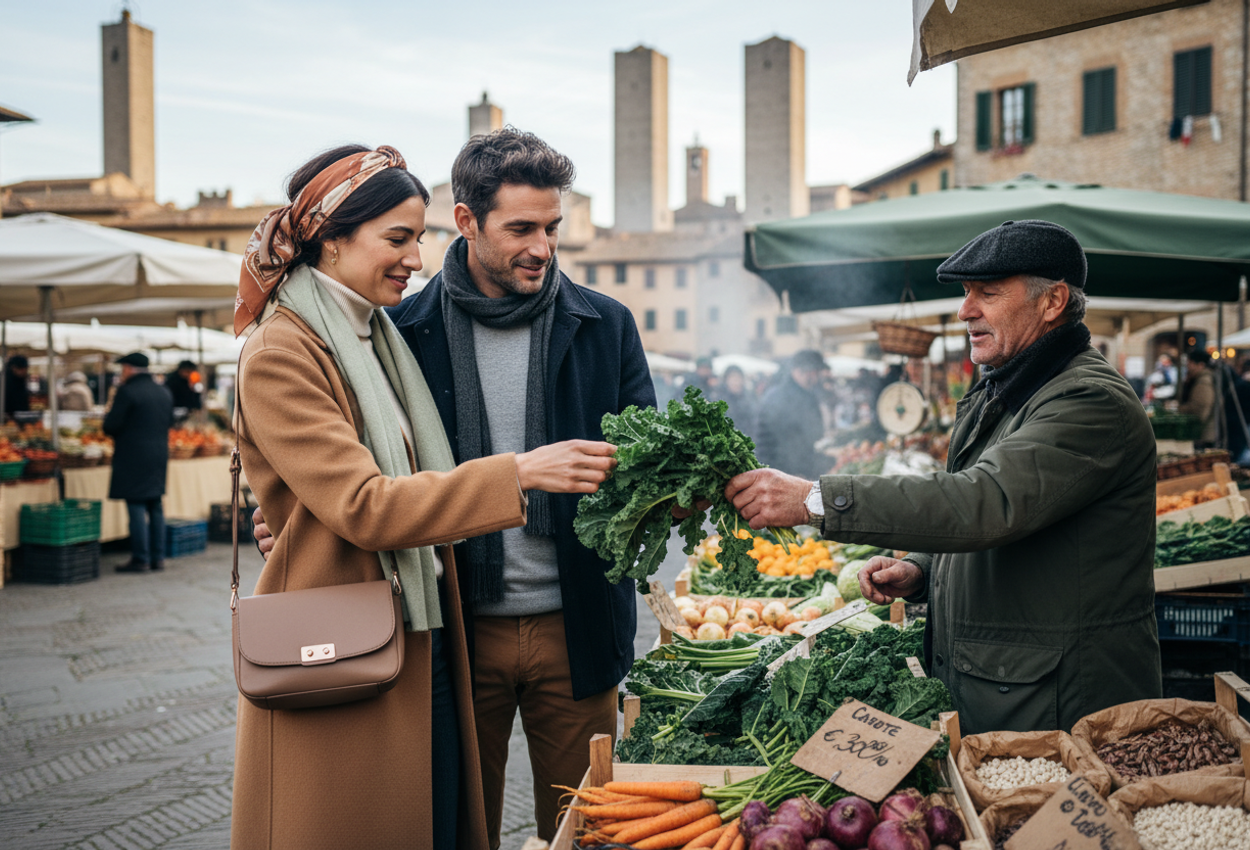
Your cooking instructor, a local signora whose family has lived in the hills around San Gimignano for generations, moves through the market with easy authority. She presses a tomato into your palm to show you how it should yield just slightly under your fingers, lifts a bunch of parsley to your nose so you can memorize its bright, peppery scent, and insists that you taste three different olive oils before choosing the one to carry back to the kitchen. Around you, the music of Tuscan dialect rises and falls, punctuated by the clatter of crates and the squeak of market trolleys.
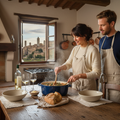
Back at a rustic farmhouse just outside the town walls, the kitchen is warm and fragrant, windows clouded by the steam of simmering broth. Copper pots hang from beams darkened by time, and a long wooden table is laid with simple tools: heavy knives, a worn cutting board, a terracotta pot, a loaf of country bread already going stale. Today’s lesson is devoted to the art of making something humble and miraculous from almost nothing: ribollita, the thick Tuscan vegetable and bread soup whose name means reboiled.
Chopping becomes a kind of meditation you share as a couple. One of you slices onions into thin crescents, their sweetness released as they hit the olive oil with a soft hiss, while the other strips the cavolo nero from its stems, fingers growing glossy and green. Carrots fall in cheerful orange coins, celery adds its bright, clean perfume, and the kitchen fills with the gentle, reassuring sounds of a meal coming together: the scrape of spoon against pot, the soft gurgle of beans breaking down into creaminess, the occasional pop from the logs in the fireplace.
Your teacher insists that the secret to real ribollita is time and togetherness. First, a rich vegetable and bean soup is slowly cooked, then cooled, then reheated the next day with layers of stale bread stirred in until it becomes thick enough that your spoon can almost stand upright. For travelers, she adapts tradition into a version that can be enjoyed the same evening, but the lesson is clear: the most satisfying flavors, like the deepest relationships, are built slowly, with patience and care.
To recreate a Tuscan-style ribollita at home together, begin with a base of finely chopped onion, carrot and celery, sautéed gently in good extra virgin olive oil until soft and translucent. Add a spoonful of tomato paste and let it darken slightly before stirring in diced seasonal vegetables: potatoes, savoy cabbage, and especially cavolo nero if you can find it. Cover with vegetable stock and add cooked cannellini beans, some left whole for texture, some mashed to thicken the broth. Season with salt, pepper and a sprig of rosemary. Let the soup simmer until the vegetables yield easily. Then remove the rosemary, and layer slices of day-old rustic bread into the pot, pressing them down so they drink in the broth. Simmer again until the bread dissolves into a lush, spoon-coating stew. Finish with a generous drizzle of your best olive oil and, if you wish, a scattering of grated pecorino.
As the pot sputters gently and the kitchen fogs with fragrance, you set the table together, your movements unconsciously synchronized: one of you laying out thick ceramic bowls, the other uncorking a bottle of pale straw-colored Vernaccia di San Gimignano. Outside the window, the towers glow amber in the low afternoon sun, and the world beyond the farmhouse seems to fade away. When you finally sit, knees touching under the table, and taste the soup you have coaxed into being, it feels less like a dish and more like a shared accomplishment.
Later, your instructor leads you down a narrow lane lined with stone walls furred in moss to a tiny family-run olive oil mill tucked just beyond the town. The machinery is compact, almost improvised, but gleamingly clean, and the air is heavy with the scent of crushed olives: grassy, fruity, almost spicy in the back of your throat. The miller explains the harvest rhythm of the hills, the difference between early and late pressing, the way temperature and timing can mean the difference between a lifeless oil and one that sings. You dip torn bread into tiny white cups, comparing flavors: one bright and green, another buttery and soft, a third almost peppery enough to make you cough.
Standing shoulder to shoulder at a worn wooden counter, you begin to understand why Tuscans talk about olive oil the way others talk about wine or perfume. You choose a bottle together, already imagining it on your kitchen counter back home, a liquid memory of this afternoon in San Gimignano. It will become the finishing touch on your future soups and salads, but also a sensory time machine, transporting you back to the hill town where you learned that cooking as a couple is as much about the journey as it is about the meal.
Chianti Charm: Rolling Hills and Ravioli Romance
The next chapter of your Tuscan culinary love story unfolds on the winding roads of the Chianti countryside, where vineyards ripple over hills like green corduroy even in winter’s muted palette. Cypress trees stand sentinel along gravel driveways, and stone farmhouses crouch among the vines as if they have been there forever. As you drive toward a family-owned winery for your cooking class, the landscape feels almost cinematic, the kind of countryside that has launched a thousand daydreams.
At the winery, rows of leafless vines still trace perfect parallel lines down the slopes, their knotted branches promising new life come spring. The air carries the cool scent of damp earth and resting vines, mixed with the deeper notes of oak barrels and fermenting grapes wafting from the cellar. You are welcomed with a glass of Chianti Classico, its ruby color catching the soft afternoon light. On the palate, it tastes like the landscape around you: red cherries, a hint of dried herbs, a lick of Tuscan dust.
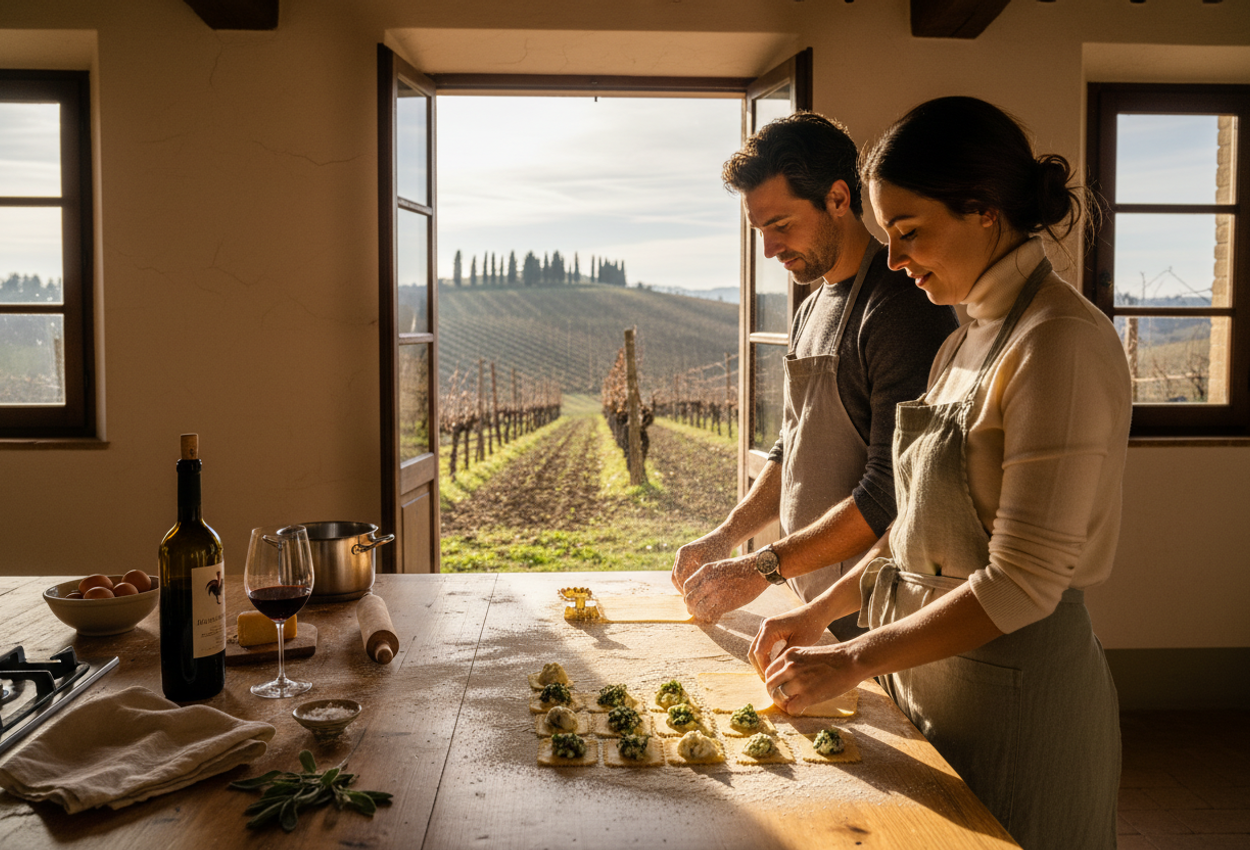
Today’s lesson is all about touch. In a sun-warmed kitchen overlooking the vineyards, a long worktable is dusted with flour, and a mound of fine Italian 00 flour waits at the center like fresh snow. Your instructor demonstrates the ritual of pasta making, creating a well in the flour, cracking golden-yolked eggs into the crater, and slowly drawing flour inward with a fork until a shaggy dough begins to form. Then it is your turn. One of you steadies the flour well while the other whisk the eggs, both laughing as a rivulet threatens to escape over the edge.
Making ravishing ravioli together is a quiet dance. Once the dough comes together, you knead side by side, pushing the heel of your hand into the dough, folding it over, turning it, feeling it gradually transform from sticky and resistant to smooth and elastic. The instructor encourages you to pay attention not to the clock but to the feel: the dough should be soft yet firm, like an earlobe, supple under your fingers. After resting under a clean cloth, it rolls out into long golden sheets, thin enough that you can almost see the grain of the wood beneath.
For the filling, you wilt spinach in a pan with a little olive oil until its bright green softens, then squeeze it tightly to rid it of excess moisture. Chopped finely and mixed with fresh ricotta, grated pecorino, lemon zest and a whisper of nutmeg, it becomes a creamy, fragrant mixture you and your partner keep sneaking tastes of from the bowl. Together, you dot the filling in neat mounds along one sheet of pasta, cover it carefully with another, and press around each pocket, expelling the air and sealing the edges with a satisfying pinch.
To ensure your ravioli dough at home has the right texture, remember a few simple tips. Use high-quality 00 flour or a mix of 00 and semolina for structure. Start with roughly 100 grams of flour and one large egg per serving, adding an extra egg yolk if you want a richer dough. Resist the temptation to add too much flour while kneading; a slightly tacky dough that smooths with time will yield a tender bite. Let it rest, wrapped, for at least 30 minutes so the gluten relaxes. When rolling, aim for sheets that are almost translucent but still sturdy enough to support the filling. Seal each raviolo carefully, pressing out any trapped air to prevent bursting, and dust lightly with semolina to keep them from sticking.
As the ravioli cook briefly in salted boiling water, a simple sauce of butter and fresh sage leaves sizzles in a pan, filling the kitchen with a nutty, herbal aroma. The first plate you share is a revelation: the pasta yielding gently to your fork, the filling creamy and bright, the browned butter pooling in the bottom of the plate ready to be chased with torn bread. Outside, the hills fade from green to indigo as dusk gathers, and the vineyard lights flicker on like fallen stars.
But your Chianti experience goes beyond the plate. After dinner, you follow your host down into the cool hush of the cantina, where barrels march in neat ranks and the air smells of oak and must. Here, you are invited into the alchemy of a wine blending session, a chance to create your own expression of Chianti Classico together. Small glass carafes of different Sangiovese-based wines are set out, each representing a distinct parcel of vineyard or aging style. Some are brighter and more floral, others deeper and more brooding, with notes of leather and tobacco.
With measuring cylinders and tasting glasses, you begin to experiment like slightly tipsy scientists. Perhaps you prefer a blend that leans toward freshness and red fruit, while your partner gravitates toward structure and spice. Gradually, through discussion and laughter and a few missteps, you arrive at a compromise blend that seems to capture both your palates: generous but grounded, lively yet with enough backbone to age. Bottled and labeled with your names, it becomes a liquid love letter you will uncork on some future anniversary, the scent of Chianti hills rising from the glass even if you are thousands of miles away.
Driving back along the dark, curving roads, the car filled with the faint aroma of flour and wine, you realize that what you have made together in Chianti is more than pasta and a custom bottle. You have practiced listening and adjusting, learned to trust each other’s instincts, and discovered that in the kitchen, as in relationships, the most satisfying results often come from blending two distinct personalities into something new.
Florence Flavors: Market to Table Magic
In Florence, romance comes wrapped in Renaissance grandeur and the heady fragrance of simmering sauces. Here, cooking together begins not in a secluded farmhouse but in the beating heart of the city’s culinary life: the Mercato Centrale. On a crisp February morning, you arrive just as the city is shaking off its sleepiness. The Duomo’s dome glows softly under a pale sky, and the streets gleam from an early-morning mist as you wind your way toward the indoor market hall.
Inside, Mercato Centrale hums with energy. Vendors call out greetings, knives thud rhythmically against wooden blocks, and espresso machines hiss and sigh like contented dragons. The air is thick with smells: sharp aged pecorino, cured meats, roasted coffee, candied orange peel, and the coppery tang of freshly butchered meat. You and your partner follow your guide through aisles of abundance. A produce stall offers citrus fruits stacked like little suns, artichokes tightly furled like fists, and wild mushrooms paper-bagged for curious cooks. Nearby, a salumeria displays rows of prosciutto di Parma and Tuscan salami perfumed with fennel, while the fishmongers lay out gleaming, glass-eyed catches on mounds of crushed ice.
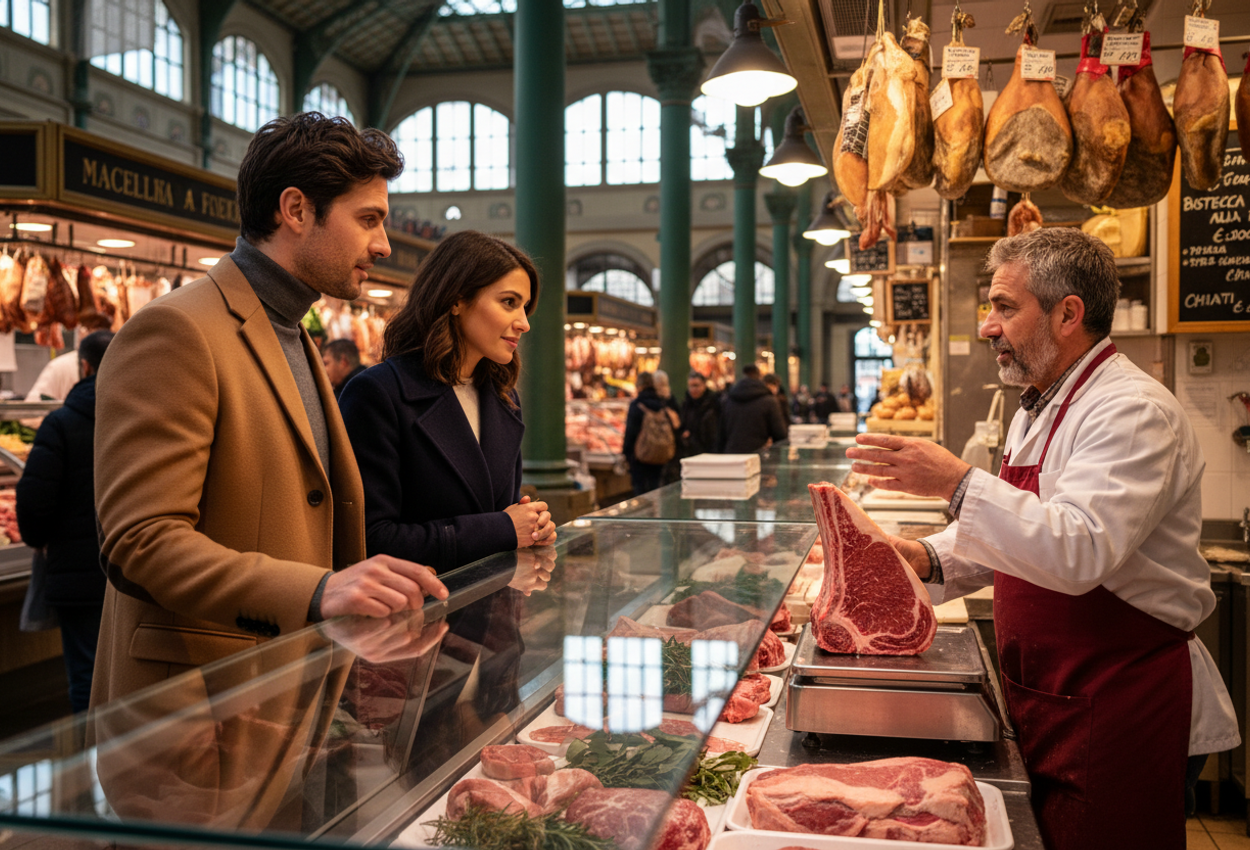
Your instructor pauses at a butcher proudly advertising Carne di Chianina, the prized local cattle whose meat is the soul of the legendary bistecca alla fiorentina. Massive T-bone steaks, thick as a grown man’s hand, rest on the counter, creamy fat threaded through deep ruby flesh. The butcher explains, with the solemnity of a priest, how real Florentine steak must come from Chianina cattle, be cut at least three fingers thick, and cooked over embers, never gas. To spot quality Chianina at home, look for meat that is a deep, even red with a fine marbling of fat, ideally certified by a reputable butcher who can trace its origin. The fat should be firm and ivory rather than chalky white, and the cut should be substantial enough to remain juicy when cooked rare to medium-rare, as tradition insists.
Armed with steak, fragrant herbs, and a few soft tomatoes for a simple pasta sauce, you leave the market and wind through narrow streets lined with stone palazzi to a traditional Florentine kitchen. The space feels like a family home: copper pots hanging over a wide stove, an old wooden table burnished by decades of use, and a window framing a slice of terracotta rooftops and distant hills. Here, the city’s grandeur shrinks down to something intimate and domestic.
While the steak comes to room temperature, sprinkled only with coarse salt, you turn your attention to making fresh pasta. Flour piles into a familiar mound, eggs are cracked into its center, and soon your hands are slick and sticky with dough. In this kitchen, the rhythm you began in Chianti continues but takes on a more urban tempo. One of you rolls sheet after sheet of pasta through a metal hand-cranked machine clamped to the table, laughing when the first attempt emerges thick and crooked. The other guides the sheet back through progressively smaller settings until it falls in silky ribbons ready to be cut into tagliatelle.
The sauce is a study in Tuscan restraint. In a heavy pan, garlic sizzles gently in olive oil until fragrant but not browned. Halved cherry tomatoes tumble in, their skins blistering and splitting as their juices meet the heat. A handful of torn basil leaves, a pinch of salt, and a ladleful of starchy pasta water create a sauce that clings to the noodles without smothering them. You toss the steaming strands together in one swift, confident motion, the motion cooks everywhere know, then shower them with grated pecorino and a last thread of oil.
Meanwhile, the bistecca alla fiorentina takes center stage. It hits the hot grill with a ferocious hiss, the fat spitting and flaring as flames lick the meat. Traditionally, the steak is cooked quickly over high heat, seared deeply on the outside while remaining almost rare at its heart. Your instructor shows you how to judge doneness not with a thermometer but by pressing the meat and feeling its resistance. When it has rested, you and your partner share the ceremonial task of carving, slicing thick strips from the bone and arranging them on a platter, their rosy centers gleaming.
The meal you eat together at a small table in the corner of the kitchen would hold its own in any Florentine trattoria: ribbons of pasta shimmering in light tomato sauce, charred steak slices sprinkled with crunchy salt, a simple salad of bitter leaves dressed in oil and vinegar. Yet it tastes different, more intimate, because each bite carries the memory of your shared labor. Outside, the sounds of the city drift in—the distant tolling of bells, the murmur of voices from the street below—but for now, the world has narrowed to two plates, two glasses, and the quiet exchange of smiles across the table.
After class, your instructor leads you into a different corner of Florentine food culture: a humble lampredotto stand tucked near a busy piazza. The set-up is simple—just a small kiosk, a bubbling pot, a few stools—but the line of locals speaks volumes. Lampredotto, made from the fourth stomach of the cow, is street food born in the markets and beloved by Florentines who appreciate thrift and flavor in equal measure. The vendor lifts tender slices of the slow-cooked offal from the broth, tucks them into a crusty roll, and drenches them with green salsa verde and a little spicy red sauce if you dare.
Sharing a lampredotto panino, perhaps a little hesitantly at first, you taste not just the richness of the meat and the brightness of parsley and capers in the sauce but the long history of a working-class snack that has outlived empires. It is a reminder that Florence’s romance is not only in its marble statues and frescoed chapels but in the way it elevates even the most modest ingredients into something memorable. Back home, you may never find lampredotto, but you will remember the courage it took to try it together, the thrill of stepping just outside your culinary comfort zone side by side.
Lucca's Lusciousness: A Culinary Escape
If Florence seduces with grandeur, Lucca charms with gentleness. Enclosed by perfectly preserved Renaissance walls, the city feels like a secret garden you enter through its gates. On a calm February morning, you meet your guide atop the broad ramparts, where a ring of plane trees stands bare against the pale sky. Bicycles are the preferred way to circle the city, and soon you and your partner are pedaling along the walls, the cool air stinging your cheeks as you glimpse terracotta rooftops, church towers, and quiet courtyards below.
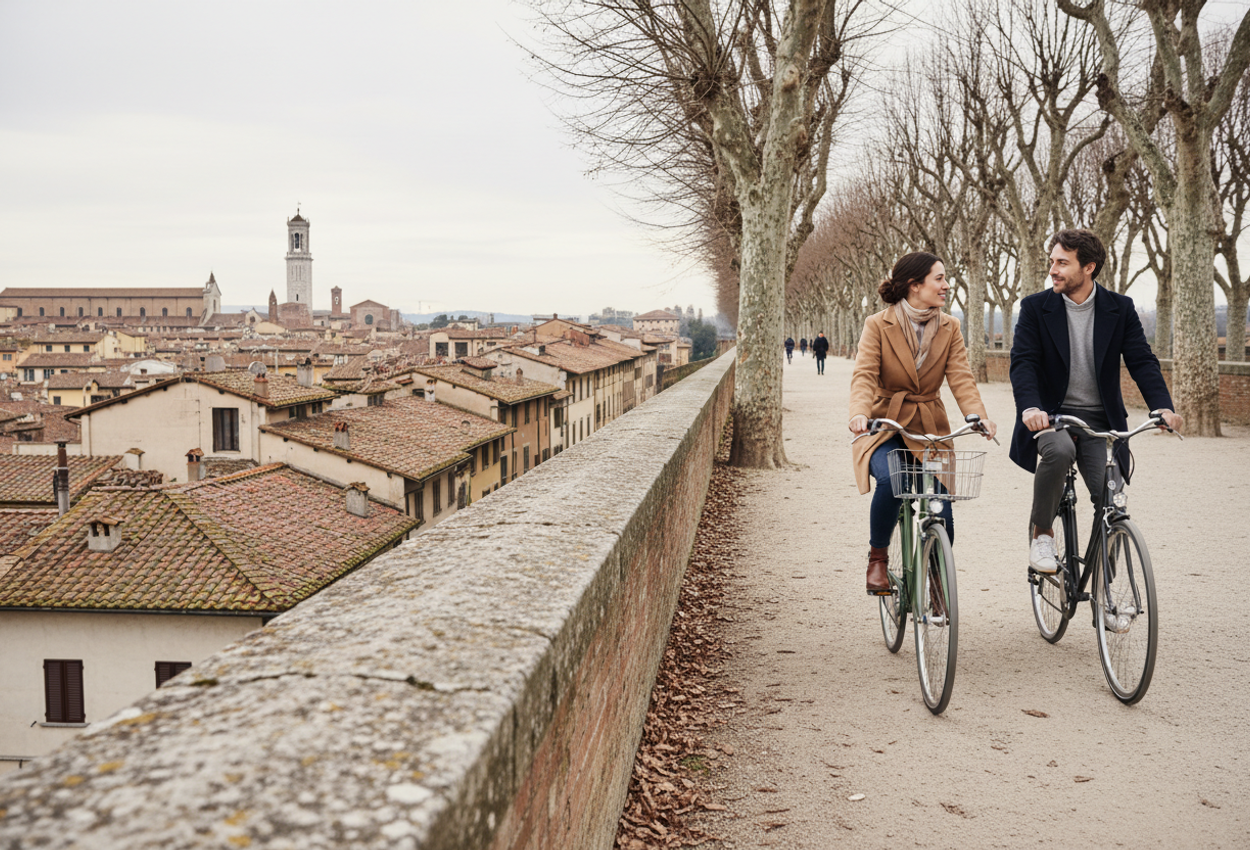
The ride is unhurried, punctuated by stops to peer over the parapets at laundry strung between buildings, children kicking a ball in a cloistered square, and locals walking dogs along the leafy paths. Lucca reveals itself in layers, and by the time you roll back down into the old town, you feel as if you have been gently welcomed rather than overwhelmed. Your destination is a small cooking studio tucked along a cobbled lane, its door framed by climbing ivy and terracotta pots of herbs.
Today’s class focuses on the comforting, lesser-known dishes of Lucchese home cooking. On the menu are torta di verdure, a savory vegetable tart snug in a flaky crust, and garmugia, a delicate spring vegetable soup traditionally eaten to celebrate the season’s first tender produce. Though it is still winter, your instructor has sourced the freshest possible ingredients: peas, young fava beans, tiny artichokes, and sweet carrots, alongside leeks and aromatic herbs.
You begin with the tart, working together to rub cold butter into flour with your fingertips until the mixture resembles coarse sand. There is something deeply sensual about this process, the way the cool fat yields under your touch, the flour puffing lightly into the air. A few spoonfuls of cold water bring the dough together, and after a brief rest, you roll it out into a thin circle, coaxing it into a waiting tin. The filling is a celebration of vegetables: sautéed leeks and greens, chopped artichokes, peas and carrots bound together with eggs and a little grated cheese. Poured into the crust and baked until golden and set, it emerges from the oven smelling of herbs and butter, a simple dish woven with care.
While the tart bakes, you turn to garmugia. The soup begins with pancetta gently rendered in a pot until it releases its fat, followed by onions sliced so thin they almost dissolve. Then come the vegetables in careful order, hardest first and tenderest last, each added at the moment when it will cook just enough to keep its texture and color. The broth is light yet deeply flavorful, a reflection of Lucca itself—understated but quietly confident. Your instructor suggests that at home, you can adapt garmugia to whatever fresh vegetables your market offers in early spring, remembering that the goal is not to overcomplicate but to honor the green sweetness of the season.
To recreate a Lucchese-inspired torta di verdure together, start with a simple shortcrust made from 250 grams of flour, 125 grams of cold butter, a pinch of salt, and just enough cold water to bring it together. Chill, then roll and line a tart tin. For the filling, sauté 2 thinly sliced leeks in olive oil until soft, add chopped spinach or chard, a handful of blanched peas, and diced cooked artichoke hearts. Season with salt, pepper, and chopped parsley. In a bowl, beat 3 eggs with 100 milliliters of milk or cream and 50 grams of grated pecorino. Combine with the vegetables, pour into the crust, and bake at a moderate heat until the filling is set and the top is lightly golden. Serve warm or at room temperature, ideally sliced and shared on a picnic.
No exploration of Lucca’s flavors would be complete without a stop at a local bakery to taste Buccellato di Lucca, the city’s signature sweet bread. In a small shop perfumed with sugar and yeast, loaves of buccellato cool on racks, their glossy brown crusts hinting at the anise seeds and raisins inside. You are encouraged to tear off pieces with your hands, and the texture is a delight—soft, slightly chewy, fragrant with honeyed fruit and licorice-like spice. As you share a slice on the street outside, crumbs falling onto the worn stones at your feet, you understand why locals insist that those who leave Lucca without having tasted buccellato have not truly visited.
The greatest secret of Lucca, however, may be hidden not in its bakeries or trattorias but behind stone walls. Following your instructor’s directions, you slip through a discreet doorway into a small, secluded garden encircled by old brick buildings. Even in late winter, the space is serene: evergreen shrubs whisper in the breeze, a few early blossoms nod in sheltered corners, and a wrought-iron bench waits beneath a climbing rose that will soon explode into color. Here, with a simple blanket spread on the grass, you unpack the fruits of your class—a wedge of still-warm torta di verdure, slices of buccellato, a small bottle of local wine—and create your own private picnic within the city walls.
As you sit together in this quiet, almost secret space, you can hear the muffled life of Lucca continuing just beyond the garden: the faint chime of church bells, the murmur of voices passing in nearby alleys, the distant rattle of a bicycle on cobblestones. Yet here, it feels as if the city has folded itself around you, creating a cocoon of green calm. Breaking off a piece of tart and holding it out for your partner, you realize that what you will carry away from Lucca is not just a recipe but the memory of having paused the world for a few stolen hours of culinary intimacy.
Siena's Sweet Secrets: From Pici to Panforte
Where Lucca is gentle, Siena is dramatic. The city rises from the surrounding Tuscan hills in a swirl of terracotta roofs and Gothic spires, centered around the shell-shaped embrace of Piazza del Campo. Walking its narrow, brick-colored streets with your partner, you can almost hear the echo of horses’ hooves from the famous Palio races that thunder across the square each summer. But today, your race is toward a warm kitchen where Sienese traditions are kept fiercely, almost reverently, alive.
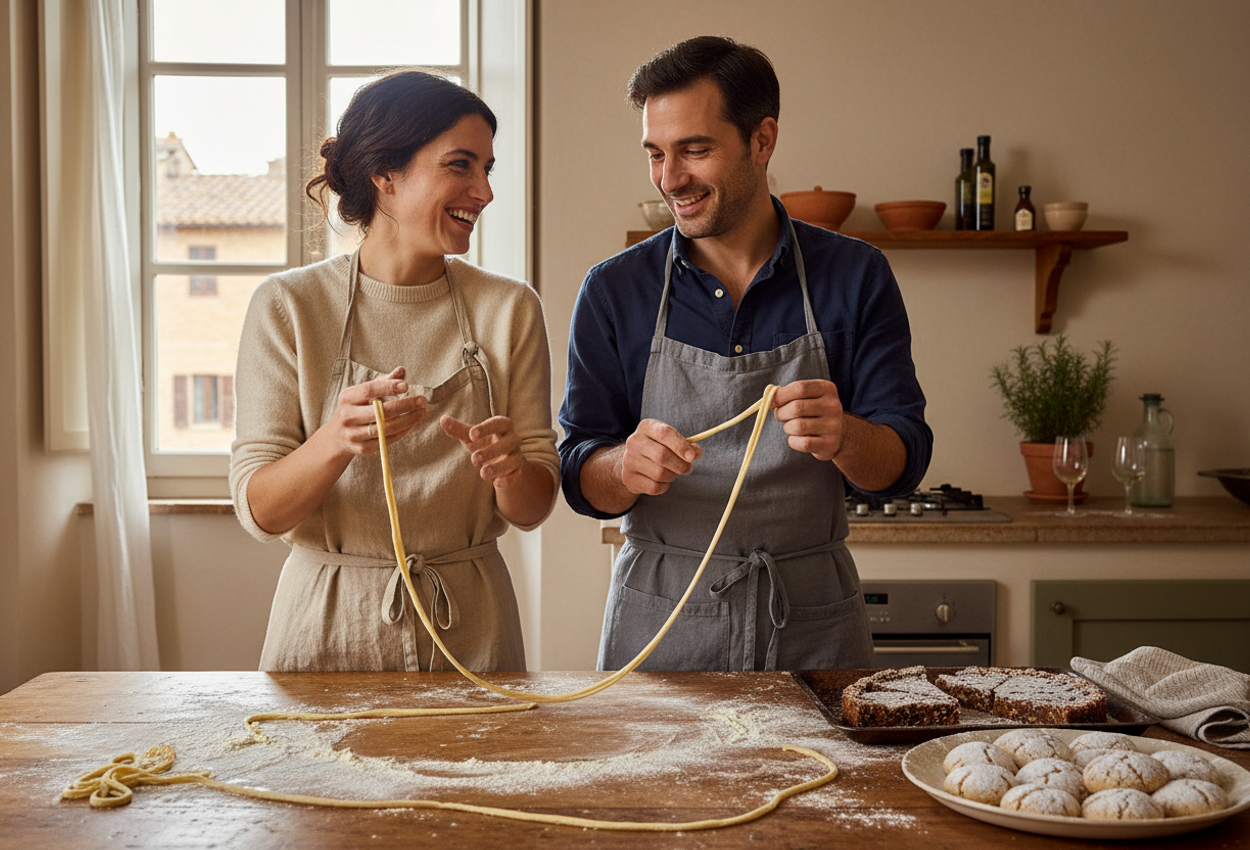
The focus of your class here is twofold: the rustic, hand-rolled pasta called pici and the city’s iconic sweets—panforte and ricciarelli. In a room fragrant with spice and citrus peel, you tie on aprons and are introduced to the simplest of ingredients: flour, water, a little olive oil, and a pinch of salt for the pasta; nuts, candied fruit, sugar, and honey for the confections. It is a reminder that in Siena, as in the rest of Tuscany, culinary magic often begins with modest components transformed through time and touch.
Making pici is like sculpting edible ropes from dough. You mix flour and water with a drizzle of olive oil until a dough forms, then knead it until smooth. Rolled out and cut into strips, the dough is then rolled by hand on the table with your palms, one strand at a time, until it forms thick, irregular noodles that look almost like rustic shoelaces. Working side by side, you and your partner find a shared rhythm, your hands moving in parallel, sometimes competing playfully to see who can roll a strand the longest without breaking it. The slight unevenness of each piece is part of the charm—pici should look hand-made, individual, like the people who shaped it.
While the pasta rests, you turn to panforte, a dense, spiced cake that has been part of Sienese life for centuries. The ingredients—almonds, hazelnuts, candied citrus peel, honey, sugar, and a heady blend of spices like cinnamon, cloves, and nutmeg—are stirred together into a sticky mass that is pressed into a shallow pan. As it bakes, the kitchen fills with a perfume that is at once Christmassy and timeless, the kind of aroma that seems to reach back through generations. Your instructor explains that every family in Siena once guarded its own panforte recipe, each spice mix a closely held secret. By making it together, you step for a moment into that lineage.
Next come ricciarelli, delicate almond cookies dusted in a blizzard of powdered sugar. The dough, made from finely ground almonds, sugar, egg whites, and a hint of bitter almond essence, is shaped into small lozenge forms and left to rest so a light crust develops. When baked, they crack charmingly on top, revealing a chewy, marzipan-like interior. Forming the cookies together, your fingers quickly coated in sugar, you understand how such simple rituals of shaping and sharing can become some of the sweetest memories of a trip.
Before cooking the pici, your instructor leads you on a brief visit to a local pastificio, where extruded and hand-shaped pastas dry on racks in a warm, flour-dusted room. Here, you see every imaginable form: spirals, shells, ribbons, and little twists. Learning how each shape pairs with a specific sauce—ridged ones to catch ragù, hollow ones to hold chunky vegetables—enriches your understanding of pasta as more than just a starch but a thoughtful vehicle for flavor. Back in the kitchen, your own pici is destined for a robust garlicky sauce, aglione, in which slow-cooked garlic melts into tomatoes and olive oil.
As you sit down to eat, twirling the thick noodles around your fork, you admire how their uneven texture clings to the sauce, offering little surprises in each bite. The pasta has a satisfying chew, rustic and bold, perfectly suited to the gutsy flavors of Siena. Dessert is a flight through local history: slender slices of panforte, dense with nuts and candied fruit, and powdery ricciarelli that almost melt on the tongue. A small glass of Vin Santo, amber and honeyed, is poured, and your instructor demonstrates how to sip it slowly, letting its sweetness pull forward the spices in the panforte and the almond notes in the cookies.
Sharing these desserts, you taste the city’s layered past in each mouthful—the Middle Ages, when spices were precious, the Renaissance, when Sienese bakers perfected their craft, and the modern day, where old recipes are still cherished. At home, you can echo Siena by rolling your own pici from a simple dough of 400 grams of flour, 200 milliliters of warm water, 2 tablespoons of olive oil, and a pinch of salt. Knead, rest, roll and cut into strips, then hand-roll each into thick strands. While they boil, gently cook sliced garlic in olive oil with tomato passata and a little water until smooth and mellow, then toss together and serve with a final drizzle of oil. Finish the meal with store-bought biscotti dipped in sweet wine if panforte feels too ambitious; it is the ritual of lingering over something sweet together that matters most.
Val d'Orcia's Vittles: A Pastoral Paradise
Leaving Siena behind, the road unfurls into the open beauty of the Val d'Orcia, where the Tuscan countryside seems to relax into long, slow curves. Here, fields stretch in rolling waves, some planted with winter wheat, others lying fallow in soft shades of brown and gold. Lone cypress trees punctuate hilltops, and stone farmhouses sit snugly amid the folds of land, their tiled roofs weathered by centuries of sun and wind. Even in February’s quieter light, the valley feels almost impossibly serene, a pastoral painting brought to life.
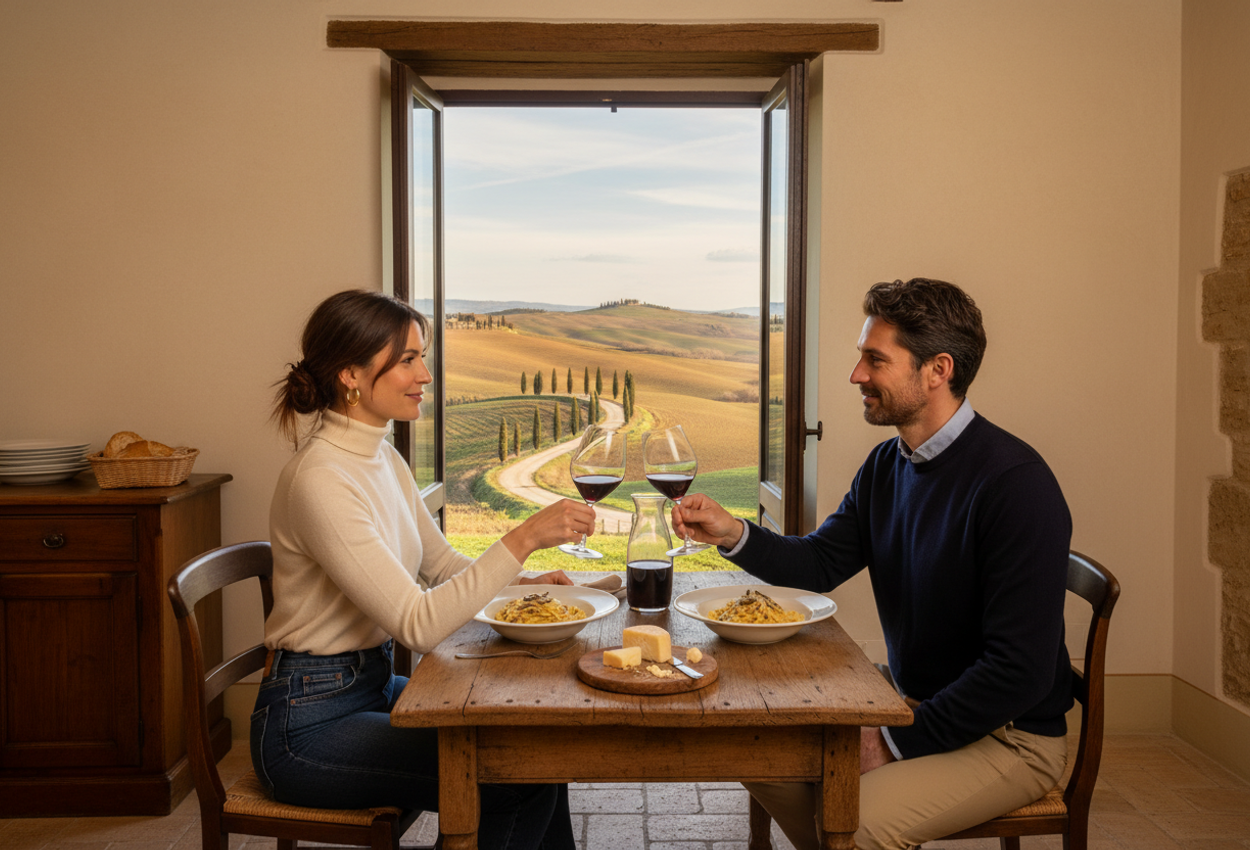
Your destination is a working cheese farm outside Pienza, famed for its Pecorino di Pienza. As you arrive, the gentle bleating of sheep floats across the air, carried with the smell of hay and clean animal warmth. The farmer greets you with a handshake strengthened by years of labor and invites you into a compact dairy where the magic of cheese-making unfolds. Large vats hold fresh sheep’s milk slowly warming, while wheels of pecorino at various stages of aging rest on wooden shelves, their rinds brushed and turned with regular care.
Tasting pecorino here is an education in time. Young, barely aged cheese is pale, moist and mild, with a milky sweetness. Semi-aged wheels are firmer, salt crystals beginning to form, flavors deepening into nuttiness. Fully aged pecorino is dense and crumbly, its taste sharp, almost spicy, with an intensity that lingers. You and your partner exchange slivers across the tasting table, guessing which you might grate over pasta, which to serve with honey, and which to savor alone with a glass of red wine. Each sample is a snapshot of the months of care invested in it.
Today’s cooking class unfolds in a farmhouse kitchen overlooking the fields, where the focus is on celebrating pecorino and another treasure of the valley’s woods: truffles. On the menu is a deceptively simple dish—fresh pasta with pecorino and truffle—that allows the ingredients to shine. Before you cook, however, you join a local truffle hunter and his energetic dog for a short walk into the nearby woods. The ground is soft underfoot, the air cool and damp, rich with the smell of earth and fallen leaves. Watching the dog work, nose pressed to the soil, you sense the quiet thrill of seeking a hidden prize together.
When the dog suddenly begins to dig, tail wagging furiously, your guide kneels to gently extract a small, knobbly truffle, brushing off the dirt to reveal the dark, marbled treasure beneath. It is passed around, its aroma surprisingly intense—a mix of garlic, cheese, and forest floor that seems to demand attention. A few more finds follow, each eliciting smiles and soft exclamations. Back at the farmhouse, you feel a deeper appreciation for the shavings that will soon grace your plates, knowing the patience and keen senses required to unearth them.
In the kitchen, you and your partner work together to prepare the pasta. The dough is familiar now, a rhythm you have internalized during your travels: flour, eggs, a pinch of salt, kneaded until smooth and rolled into fine ribbons. As the water heats, your instructor prepares the sauce base by gently melting grated semi-aged pecorino with a splash of warm pasta water in a large bowl, whisking until it becomes creamy and glossy. The key, you learn, is to keep the heat indirect to prevent the cheese from becoming stringy.
To recreate a Val d’Orcia-inspired pecorino and truffle pasta at home, cook fresh tagliatelle in well-salted boiling water until just al dente. In a warm bowl, combine 100 grams of finely grated semi-aged pecorino with a ladle of hot pasta water, whisking until smooth and velvety. Add a knob of butter if you wish for extra richness. Drain the pasta, reserving more cooking water, and toss it vigorously with the cheese cream, adding splashes of water as needed until every strand is coated in a silky, glossy sauce. Plate in warm bowls and, just before serving, shave over a modest amount of fresh truffle or drizzle with a high-quality truffle-infused oil if fresh truffles are unavailable. The flavors should be balanced, with the cheese forming the backbone and the truffle a fragrant flourish rather than an overpowering note.
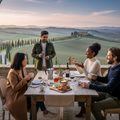
As you sit down at a farmhouse table by the window, a bottle of local red uncorked between you, the landscape unfurls beyond the glass like a living mural. The pasta before you is the color of pale straw, speckled with dark truffle shavings, steam curling upward in fragrant ribbons. The first bite is pure comfort—salty, creamy, earthy in a way that seems to anchor you to this very place. Outside, the light begins to soften into the gold that photographers chase, sliding across the patchwork fields and turning every curve of land into sculpture.
The hidden gem of this experience lies not only in the plate but in the gentle pace of the day. There is time after lunch to wander the fields, to visit the cheese aging room once more, to stand together in companionable silence as you watch sheep grazing on distant slopes. Cooking here feels less like an activity slotted into an itinerary and more like a way of joining the valley’s unhurried rhythm. Later, back at your accommodation, you may find yourselves recreating a simpler version of the dish with supermarket pecorino and bottled truffle oil, but the memory of this afternoon in the Val d’Orcia will season it with something no ingredient list can capture.
Coastal Cooking: Seafood Sensations in the Maremma
For your final culinary chapter, Tuscany leads you to the sea. The Maremma coastline, wild and less trodden than the famous inland hills, stretches along the Tyrrhenian Sea in a succession of sandy beaches, pine forests, and rugged headlands. In early February, the summer crowds are long gone, and the ports feel like working places rather than tourist postcards. Fishing boats rock gently in the harbor, gulls wheel overhead, and the air is sharp with salt and the smell of seaweed drying on rocks.
You meet your host at a small fishing port, perhaps near Castiglione della Pescaia or another Maremma village where the rhythms of the sea dictate daily life. The day’s catch is being unloaded as you arrive: gleaming silver anchovies, pink shrimp, glossy black mussels, and crates of clams that clatter softly as they are set down. Fishermen in rubber boots banter in rapid Italian, their hands moving with efficient ease as they sort, clean and pack the bounty of the morning. Your instructor guides you through selecting seafood for your class, teaching you to look for bright, clear eyes in fish, firmly closed shells in clams and mussels, and a scent that is briny and clean rather than fishy.
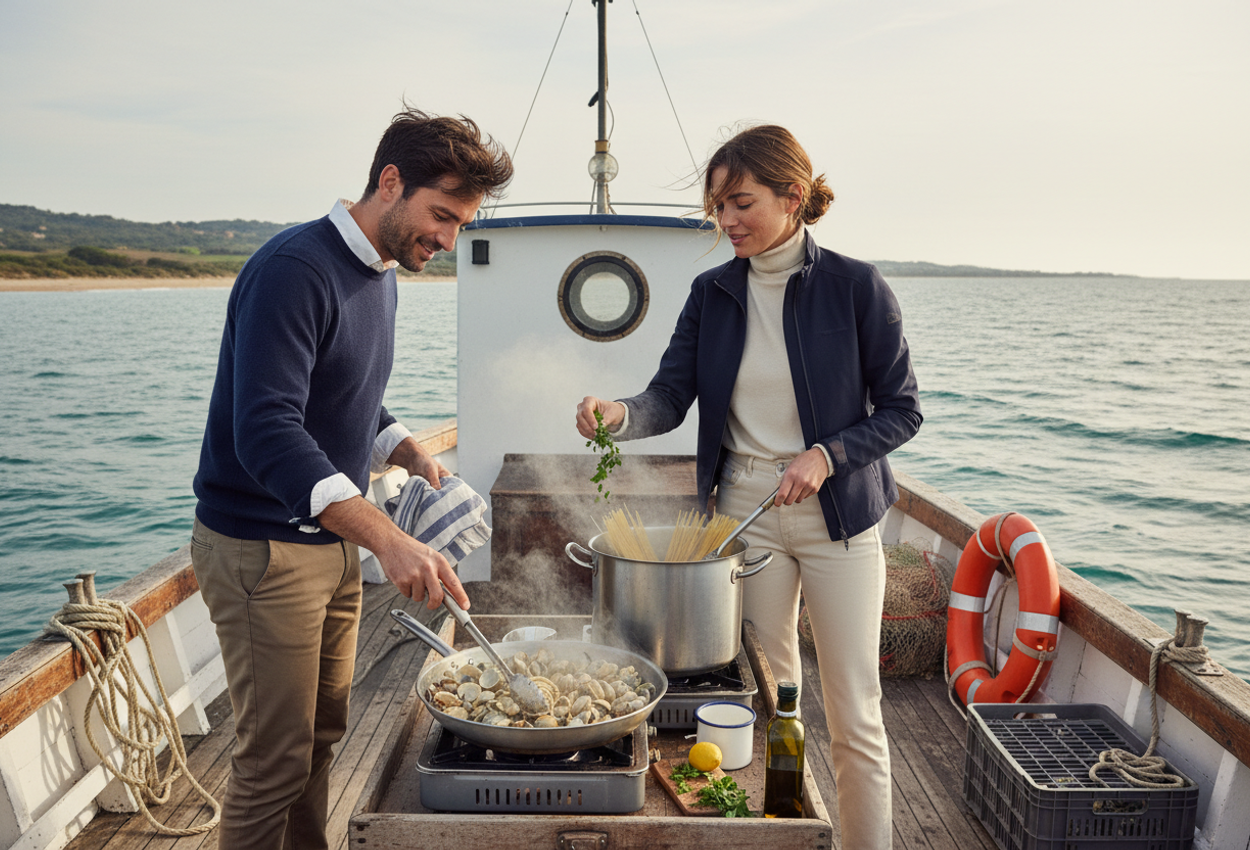
With a basket of clams, small firm fish, and a few other treasures from the market, you walk down the dock to a waiting boat. The cooking class today will take place not in a farmhouse or kitchen studio but on the water itself, the deck transformed into an impromptu galley. As the boat noses out of the harbor, the town recedes, and the coast unspools in rugged cliffs and secret coves. The winter sun hangs low but bright, reflecting off the water in a shimmer that makes you squint and smile. Wrapped in light jackets, you breathe in air that tastes of salt and possibility.
The first dish on the menu is spaghetti alle vongole, a deceptively simple classic that depends entirely on the freshness of its ingredients and the care of its preparation. On a small stove set up on deck, olive oil warms in a pan, followed by slices of garlic and a pinch of chili flakes that bloom in the heat. When the oil is fragrant, the clams tumble in with a satisfying clatter, followed by a splash of white wine that sends up a plume of steam scented with the sea. As the pot is covered, you can hear the clams rattle slightly, then gradually fall silent as they open, releasing their briny juices into the pan.
Meanwhile, you and your partner work together at a narrow counter to cook the spaghetti, conscious of the boat’s gentle rocking. One of you stirs the pot to prevent sticking, while the other sets the table—simple plates, forks, and a carafe of chilled local white wine—on a bench at the stern. When the pasta is just shy of al dente, it is transferred to the pan with the clams, a ladle of cooking water added, and the whole pan tossed until the sauce emulsifies into a glossy coating that clings to each strand. A handful of chopped parsley and a final drizzle of raw olive oil complete the dish.
To choose the freshest seafood for a similar dish at home, remember the lessons of the port. Clams should be tightly closed when you buy them, their shells unbroken and heavy for their size. Discard any that remain open after a firm tap or that float in water. Fish should smell faintly of the ocean, never pungent, with moist, shiny skin and red gills. If you are buying fillets, avoid any that look dried out or have browning edges. Freshness is the soul of seafood; no sauce or seasoning can disguise tired ingredients.
After savoring the spaghetti, eaten in the open air with the wake unfurling behind you, you turn to preparing a simple grilled fish. The instructor seasons the cleaned whole fish with only salt, pepper, lemon and a drizzle of oil, then lays it on a hot grill plate. The skin crackles and chars, crisping into a smoky, salty jacket that hides tender, moist flesh within. You take turns gently turning the fish, learning to judge its readiness by the way the flesh starts to pull away from the backbone. When it is done, you drizzle it with more oil and lemon, then share it directly from the platter, picking the sweet meat from the bones.
As the boat idles near a quiet cove, the afternoon light softens and the sea deepens from bright blue to a more mysterious indigo. The conversations hush, and you find yourselves leaning against the rail together, hands wrapped around warm mugs of coffee offered by the crew. There is a particular kind of intimacy that arises from cooking in close quarters, negotiating limited space, passing knives and bowls back and forth, adjusting to the slight sway of the boat underfoot. It demands trust, cooperation, and the ability to laugh when a splash of sauce goes astray with a sudden wave.
By the time you return to port, the sun is sliding toward the horizon, painting the sky in peach and lavender. The smells of garlic, grilled fish, and sea salt linger on your clothes, and you carry with you new confidence in handling seafood—confidence born not just from instruction, but from shared experience. Back home, you may recreate spaghetti alle vongole in a landlocked kitchen, but the sound of clams opening and the first taste of briny sauce will summon back this day on the Maremma coast, when the sea itself became your dining room.
As your Tuscan journey ends, you realize that the true gift of these couples’ cooking classes is not only the recipes written in notebooks or the jars of olive oil and bags of dried pasta tucked into your suitcase. It is the collection of small, shared moments: flour on your partner’s nose, the warmth of their hand steadying a cutting board, the way you both leaned in to inhale the aroma of a simmering sauce. Tuscany has given you flavors and techniques, yes, but more importantly, it has offered a reminder that the most enduring connections are often forged not in grand gestures but over chopping boards and simmering pots, one shared meal at a time.