In the Scottish Highlands, romance is not staged; it is weathered into stone, whispered across lochs, and carried on the wind that combs the heather. This is a landscape that does not simply host love stories, it shapes them.Ask any Highlander and they will tell you that the north of Scotland rewards those who linger. Lovers who arrive in a rush soon find their pace softening to match the unhurried drift of cloud over the Cairngorms, the slow turning of light on seawashed headlands, the patient aging of whisky in oak. This is a place for long conversations beside peat fires, for wordless hours staring at horizons that seem to tilt into infinity, for journeys where the road, the track, and the footpath become part of the story as much as the destination itself.
This itinerary follows a loop through the heart of the Highlands, moving from tidal castles to turreted hotels, from legendary train journeys to dark-sky coasts and island pools whose waters shine impossible shades of blue. It is designed as a loose, week-long arc, but it can be stretched, compressed, or gently rearranged. What matters is not the timestamps, but the slow accumulation of sensory details: salt on your lips from a coastal breeze, the weight of a wool blanket over tired legs, the taste of single malt on the back of your tongue while snow dusts the hills outside.
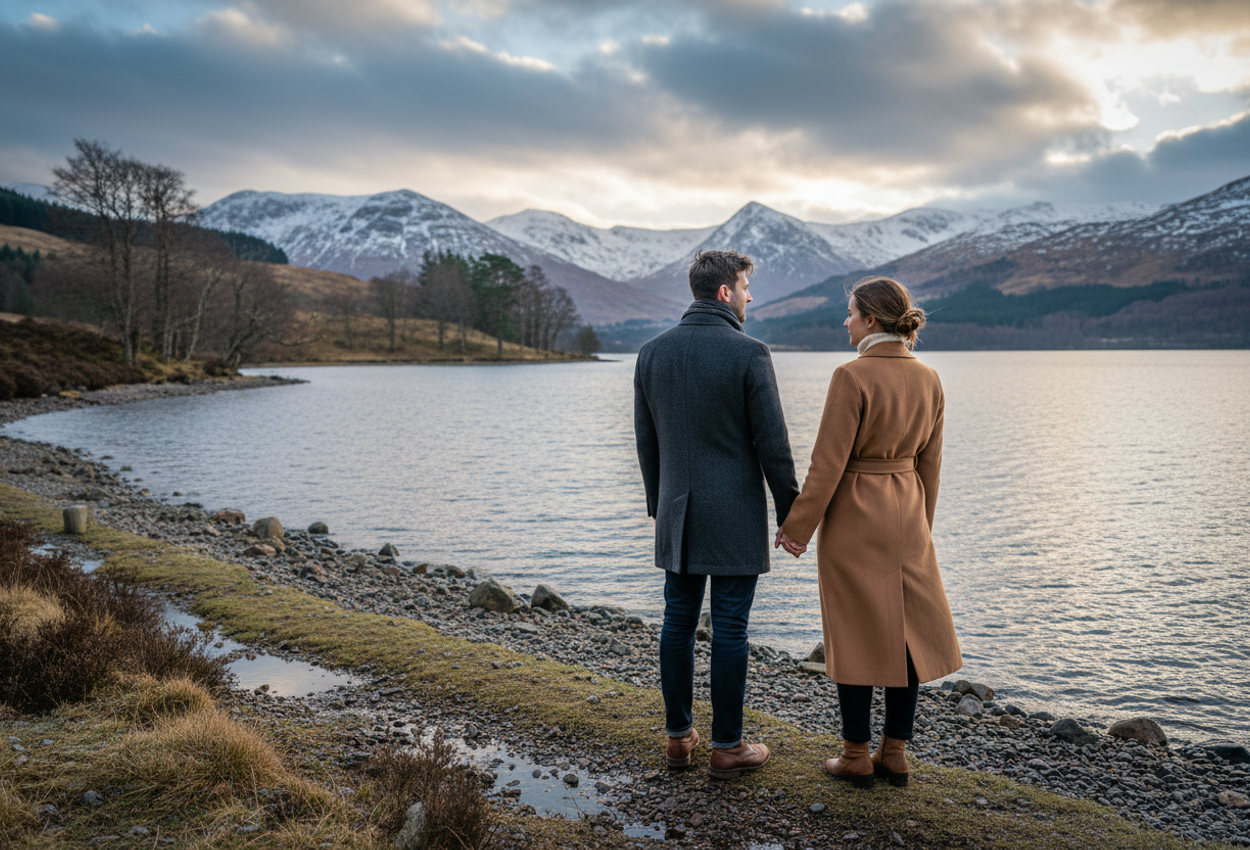
Come in late winter or early spring, when snow still rims the summits but the days are stretching and the sky, on clear nights, is inked deep enough to reveal galaxies. Come ready to share silence as well as speech. The Highlands will take care of the rest.
Whispers of Love at Eilean Donan Castle
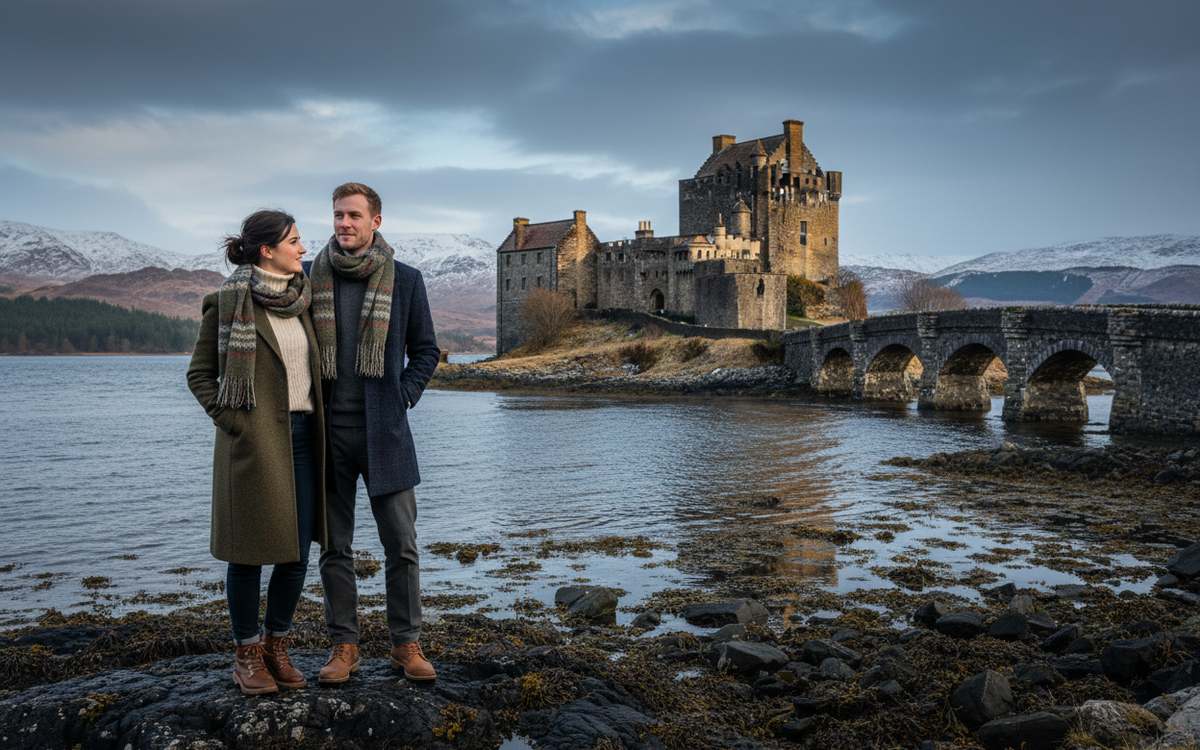
The road to Eilean Donan Castle curves along the shores of Loch Duich, the tarmac often slick with recent rain, the verges furred with moss and tough little wildflowers that cling to stone. As you crest the final bend, the castle appears as if conjured: a cluster of turrets and battlements on a tidal island, joined to the mainland by a narrow stone bridge. Three lochs – Loch Duich, Loch Long, and Loch Alsh – meet here, their waters braiding and folding around the island like dark silk.
In the blue-grey light of a February afternoon, the couple steps out of their car and pauses. The air smells of salt and damp stone, with a faint tang of seaweed drying on the rocks below. A breeze lifts droplets from the loch and throws them softly against their faces, cool and clean. Across the water, the hills are dusted with snow, their flanks streaked with the pale threads of winter burns. Light breaks through the shifting cloud in sudden, theatrical shafts, painting moving corridors of silver on the loch’s surface. Each time the sun pierces the overcast, the castle seems to shift mood – now sombre and battle-worn, now almost golden and tender.
They walk the bridge slowly, their footsteps echoing faintly off the stone arches. Inside the curtain walls, the air changes; it smells older here, infused with centuries of woodsmoke, damp lime, and the faint beeswax polish of more recent restorations. In the great hall, they read of the castle’s early 13th-century origins and of its founder, often associated with Clan Mackenzie and the warriors who sought to secure this crucial meeting point of sea lochs. One tale that lingers is the story of a young chieftain who, according to local lore, returned from exile bearing a precious gift – some say a casket of holy relics, others a sacred relic of St. Donnán himself – offered in thanks for the sanctuary these waters had once provided his kin. Whether fact or embroidery, the idea of a gift tied to protection and home settles warmly between the couple as they move from room to room.
They trace fingers lightly over cold stone window embrasures, imagining the hands that set each block in place. In a small chamber, the scent of old timber rises from floorboards smoothed by countless feet. Through a narrow slit window, the woman watches a skein of geese slice across the sky, their calls a wild, distant music. Her partner leans in behind her, their breath mingling in the chill air as they share the view: water, cloud, and hills layered together in an endless gradation of blues and greys.
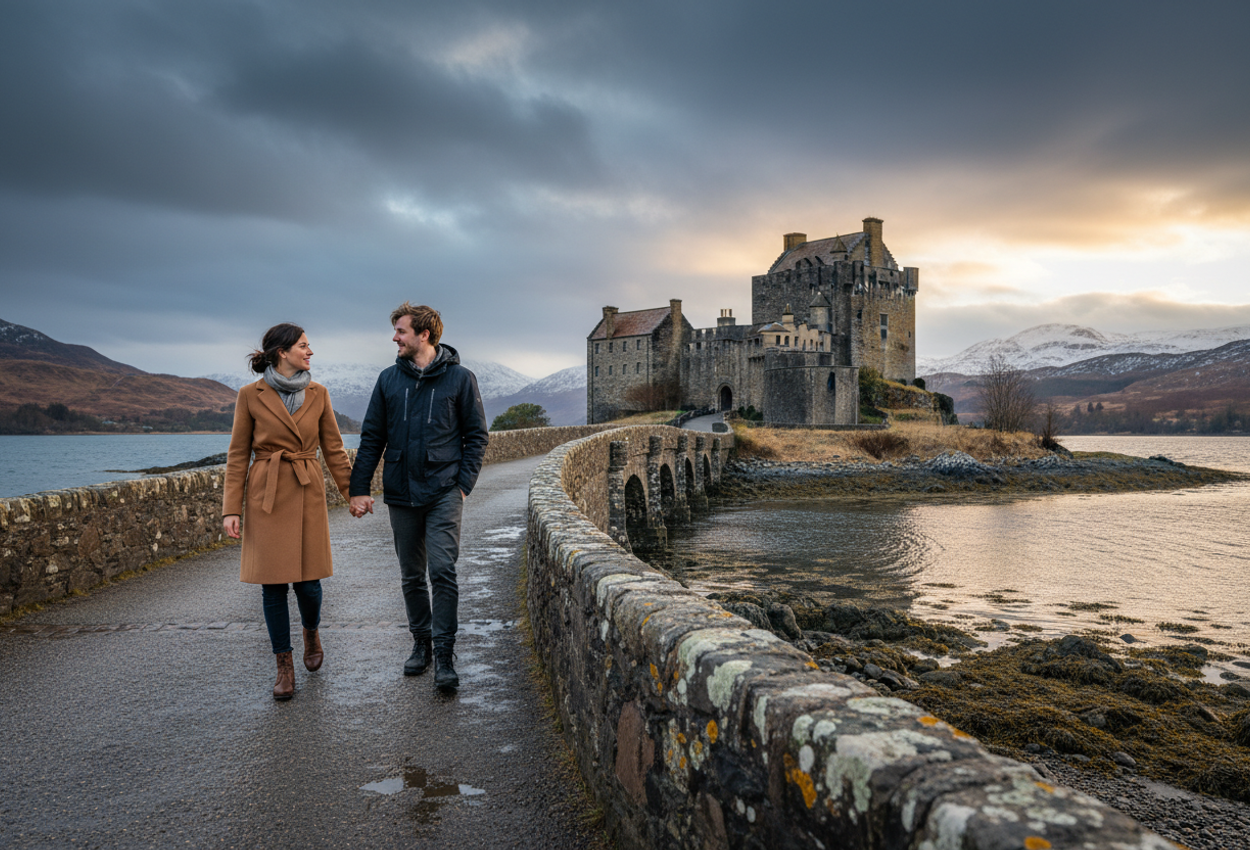
Later, they stand on the battlements just as the low sun begins to seep beneath the cloud, drawing out veins of copper and rose across the lochs. The tide is turning, and the exposed rocks glisten, slick and black, around the castle’s foundations. The soundscape is unexpectedly gentle: the soft slap of water against stone, the rattle of pebbles as waves retreat, the distant hum of a car crossing the nearby bridge, quickly swallowed by the wind. They say nothing for a long time, sharing the thin warmth of a wool scarf looped between them, feeling the subtle vibration of history under their boots.
As they finally turn away, they pass a guide recounting fragments of the castle’s dramatic past – clan feuds, Spanish galleons, cannon fire. But what they carry with them onto the mainland is a different kind of story: that of an island fortress which has survived destruction, abandonment, and the relentless weathering of centuries to stand once again at the meeting point of three lochs. A reminder that love, like stone, acquires its deepest character through storms endured together.
Secluded Luxury at Inverlochy Castle Hotel
The transition from windswept battlements to the cocooned luxury of Inverlochy Castle Hotel feels almost cinematic. Nestled at the foot of Ben Nevis, a few miles outside Fort William, this 19th-century baronial mansion appears through a fringe of ancient trees: ivy-softened stone walls, steep gables, and turrets reflected in a small loch that often holds a perfect, tremoring mirror of the sky.
Inside, the atmosphere is one of hushed, understated opulence. The couple is greeted not at a bustling reception desk but in a wood-panelled hall, where the scent of polished oak mingles with fresh flowers and the faintest ghost of a peat fire. Their luggage disappears as if by magic. A staff member leads them up a sweeping staircase thickly carpeted in tartan, their footsteps sinking almost soundlessly into the wool. The banister is smooth under their hands, worn to satin by generations of guests.
Their room feels like a private chapter in a much longer story. Heavy drapes frame tall windows looking out over lawn and woodland, where winter light filters through bare branches in soft washes. The bed is a cloud of fine linens and down, topped with a cashmere throw so soft it seems hardly to have weight. When she runs her fingertips along the fabric of the armchair, it gives like velvet under her nails. A decanter of sherry glows ruby on a side table; somewhere close by, a clock ticks with the tranquil confidence of an old house that knows precisely who it is.
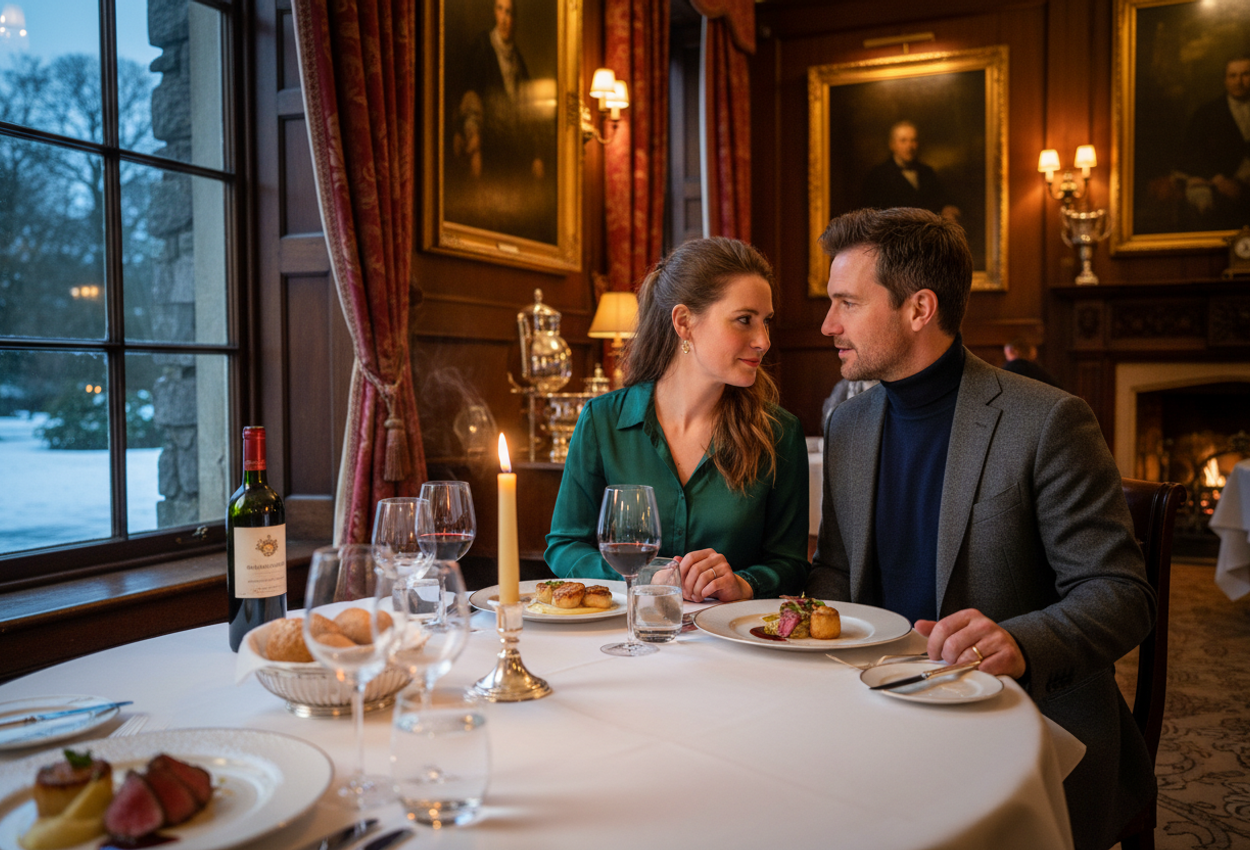
As dusk deepens outside, they dress for dinner. In the small bar, they sample a Highland single malt: honeyed, with a touch of smoke and a hint of heather. It warms its way slowly down, leaving notes of dried fruit and toasted oak lingering on the palate. The man swirls his glass thoughtfully, watching the way the amber liquid catches the lamplight, while his partner leans into the leather sofa, the cushion sighing beneath her. The only sounds are the low murmur of conversation and the distant clink of china from the kitchen.
In the dining room, candlelight pools gently on white linen and gleams off crystal. The menu is an ode to the region: perhaps a starter of hand-dived scallops from the west coast, seared just to the point of caramelisation and paired with a silky celeriac purée; followed by venison from the surrounding hills, pink at the centre and served with a glossy jus infused with juniper and redcurrant. Each bite feels anchored to the landscape outside – the salt tang of the sea, the herbaceous whisper of moorland and pine forest. Dessert might be a deconstructed cranachan, clouds of whisky cream and shards of oat praline tangled with raspberries preserved from last summer’s harvest.
Later, wrapped in their warmest layers, they slip through a side door into the castle’s walled garden. The staff have arranged a private stargazing set-up – a hidden gem the hotel can quietly orchestrate for couples who ask in advance. A discreet telescope waits on the lawn beside two Adirondack chairs draped with thick wool blankets and hot water bottles. The February air is crisp enough to tint their cheeks pink and send their breath streaming white, but the sky above is astonishingly clear, a deep velvet scattered with stars so bright they seem almost close enough to touch.
They settle together under a shared blanket, the earth cold beneath their boots, the smell of damp grass and leaf mould rising as the ground slowly loses the day’s thin warmth. Somewhere beyond the trees, a burn chatters over stones; an owl calls, soft and insistent, from the woods. The guide points out Orion’s belt, the hazy smudge of the Andromeda Galaxy, the thin mist of the Milky Way drawn right across the sky. In this dark pocket of the Highlands, far from urban glare, the universe presents itself in intricate, dazzling detail.
They take turns at the eyepiece, laughing as caps and scarves shift and hands search instinctively for each other in the dark. At one point, a satellite drifts silently overhead, an anonymous silver bead tracking across the stars. For a long breath, everything else drops away: the clink of cutlery inside, the next day’s plans, the world beyond the castle grounds. There is only them, the night, and the vast, cold beauty of the heavens. It feels like being entrusted with a secret.
A Highland Fling on the Jacobite Steam Train
The next morning in Fort William, the romance shifts gears – quite literally – as they step onto the platform to board the Jacobite Steam Train, the famed service that runs along the West Highland Line to Mallaig. Even out of peak season, the sight of the locomotive never fails to quicken the heart: a great black engine breathing clouds of white steam into the cool air, brass and paintwork gleaming, carriages lined up in a proud, crimson row.
The scent hits them first: hot oil, coal smoke, and a metallic tang that speaks of pistons and valves and a different age of travel. As the train exhales against the platform, steam curls around ankles and suit hems, wrapping strangers briefly in the same ghostly veil. They find their seats in a wood-panelled carriage whose windows frame the world like moving postcards. The upholstery has that particular springiness of well-kept vintage seating, with a slightly scratchy fabric that feels somehow reassuringly solid beneath their fingertips.
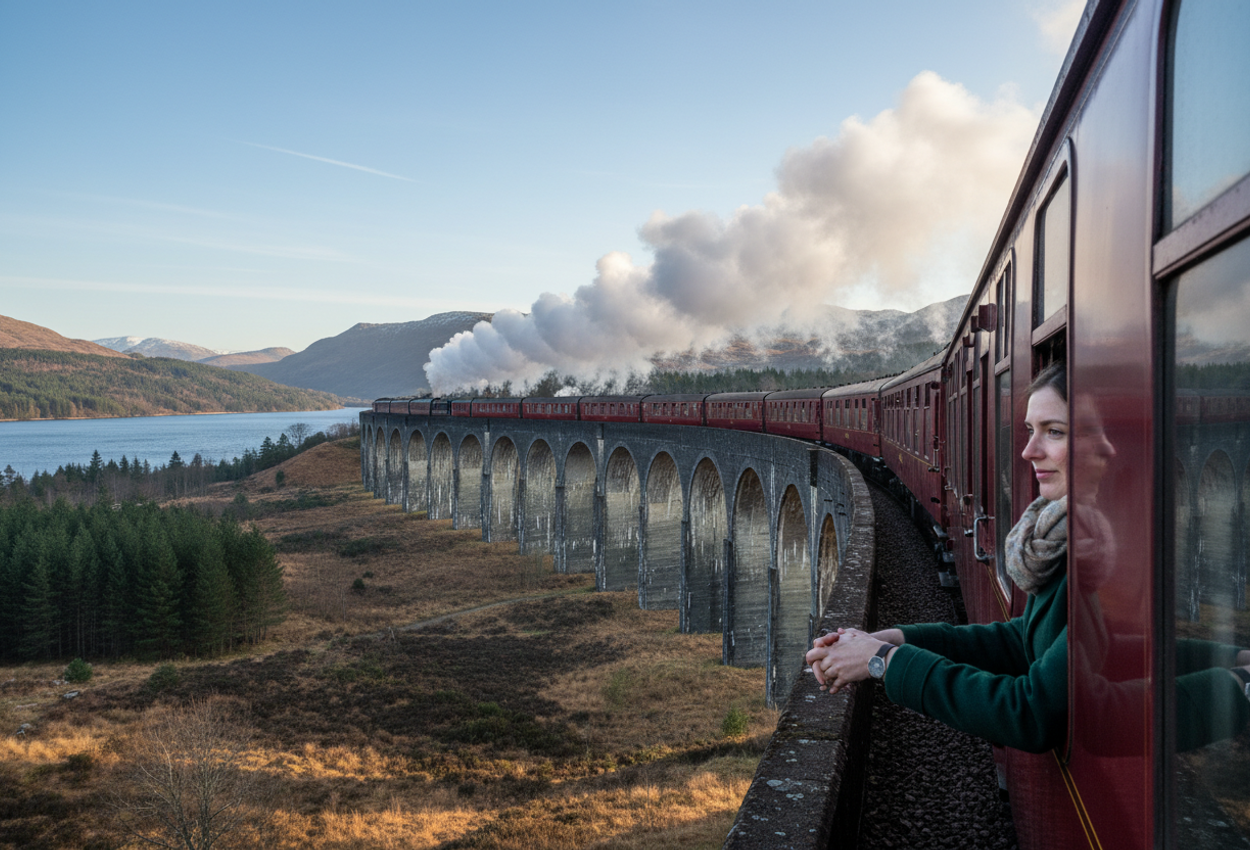
With a shudder and a low, gathering chuff, the Jacobite eases out of the station. The rhythm builds quickly: the initial, tentative tug of motion smoothing into the steady, hypnotic heartbeat of steel on steel. Outside, Ben Nevis rears up behind Fort William, its flanks often streaked with late snow in February, clouds snagged around its summit like torn wool. Soon the town’s edges fall away and the train threads itself into wilder country, curving alongside Loch Linnhe and onto the sweeping moorland beyond.
They have packed a picnic instead of relying on snacks from the trolley – thick-cut sandwiches made with local smoked salmon and cream cheese, oatcakes with wedges of Isle of Mull cheddar, a small flask of cullen skink whose creamy warmth is a comfort against the chill that seeps gently through the carriage windows. As the train climbs, they unwrap waxed paper and share bites, the tang of the sea in the salmon echoed by the salty air seeping in each time the corridor door slides open.
The highlight, of course, is the crossing of the Glenfinnan Viaduct, the great curving bridge that fans of the Harry Potter films know as the route of the Hogwarts Express. As the train slows to make the most of the moment, steam bellows around the carriages, briefly obscuring the view before peeling away to reveal the arc of concrete arches floating above the valley. Below, tiny figures cluster at the viewpoints, cameras lifted; beyond, Loch Shiel stretches into the distance, a silver blade between dark hills. The couple leans close to the window, their reflections superimposed on the landscape, cheeks nearly touching as they watch the curve of the train ahead sliding gracefully along the viaduct.
There is a particular alchemy here: the nostalgia of steam travel, the cinematic overlay of a beloved film franchise, and the raw, unedited grandeur of the West Highlands themselves. The engine whistles – a long, exultant note that ricochets off rock and woodland – and for a second it is easy to imagine themselves as students rattling towards a magical school, lives about to crack open in unexpected ways.
The remainder of the journey to Mallaig is a tapestry of quickly changing scenes: small stations where the train pauses while a single figure waits in the drizzle, waving; sea lochs that flash silver, then pewter, then deep green as the light shifts; pockets of birch woodland, the pale trunks luminous against dark peat. The carriage fills with a low buzz of conversation, the occasional pop of a camera shutter, the steady, undercurrent sigh of wheels over joints in the track.
In Mallaig, they step down onto a platform scented with salt and diesel. The fishing village is compact and easy to wander: seagulls wheel overhead, ropes creak softly against painted hulls in the harbour, and the air tastes faintly of frying batter from chippies doing a brisk lunchtime trade. They walk hand in hand along the waterfront, collars turned up against the wind, before ducking into a café for hot tea and a shared slice of clootie dumpling, dense with dried fruit and spice.
On the return journey, the rhythm of the engine becomes a lullaby. The couple leans together, watching the afternoon light leach slowly from the hillsides, the lochs darkening to ink. Warming fingers around their flask, they talk lazily about nothing much at all – future trips, favourite films, who in their family would have been most delighted by the Hogwarts connection. Outside, the Highlands slide by in a cinematic blur; inside, the carriage is filled with that particular intimacy that comes when you are journeying side by side, nowhere to be but here, now, together.
Romance Among the Ruins of Urquhart Castle
The next chapter of their Highland romance unfolds on the shores of legendary Loch Ness, where the ruins of Urquhart Castle sprawl across a promontory like a broken crown. Approaching along the A82, they catch tantalising glimpses of grey stone towers between trees, the loch itself a long, dark mirror stretching away into mist at either end.
From the visitor centre, they follow a gently sloping path that descends towards the ruins. The wind carries up a mixture of scents – wet grass, cold stone, a faint smoke note from a distant chimney in Drumnadrochit. Loch Ness, even on a calm day, has a particular texture to its surface: restless, almost oily, light skimming across it in subtle, shifting patterns. Standing at the first viewpoint, the couple takes in the full sweep of the site: the shattered keep of Grant Tower, roofless chambers open to the sky, fragments of curtain wall braced against the water’s edge.
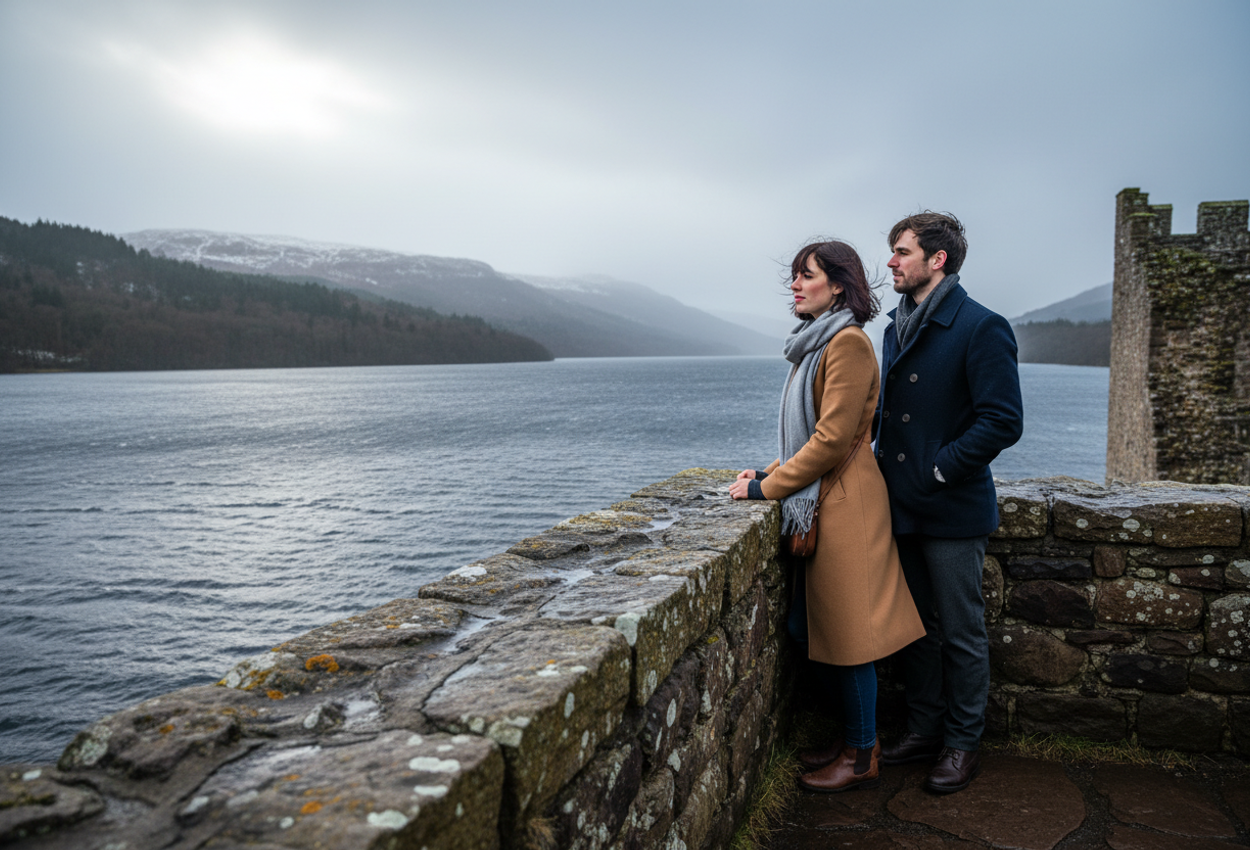
They wander down into the heart of the castle, palms brushing over lichen-flecked stone. The masonry is cool and slightly damp, the uneven surfaces softened here and there by cushions of moss. In what was once the great hall, they pause to imagine fires roaring in the enormous hearth, banners hanging from beams, the smell of roasting meat and beeswax candles. Now, the ceiling is the sky, and their footsteps echo hollowly on the worn flagstones. A raven lands on a nearby wall, tilts its head, and croaks once before launching itself back into the wind.
Climbing the tight spiral staircase of Grant Tower, the woman trails her hand along the central spine, feeling the shallow grooves carved by centuries of other hands. The air grows colder and thinner with each turn, until, emerging at the top, it opens out into a breath-stealing panorama. Loch Ness runs north-south like a great, dark artery, flanked by wooded slopes and distant, snow-dusted peaks. The wind up here is a living thing, tugging at hats and scarves, roaring softly in their ears; it smells clean and sharp, with an undernote of peat and pine from the surrounding hills.
They stand side by side at the parapet, fingers interlaced on the rough stone, and let their minds drift back through time. To Pictish fortifications. Medieval feasts. Raids and sieges and the deliberate slighting of the castle to deny it to Jacobite forces. The romance here is not delicate or decorative; it is rugged, marked by absence as much as presence, by what has been lost as much as what remains. In the shifting play of light on the loch’s surface, they catch the illusion of movement – shadowy shapes beneath the waves, tricks of sun and cloud that have fuelled centuries of stories about what might lurk in its depths.
Later, curiosity carries them back into Drumnadrochit itself and to the Drumnadrochit Hotel, which has long leaned into the Nessie mythos with cheerful gusto. Here the mood shifts from windswept melancholy to something more playful. In a small exhibition space dedicated to the monster’s legend, they wander among displays of grainy photographs and evocative eyewitness accounts. Models of long-necked creatures glide silently through carefully lit dioramas of the loch’s inky depths. A guide recounts tales of inexplicable sonar readings, of quiet nights when the water has shivered in odd, concentric ripples under a clear, windless sky.
They pose – somewhat sheepishly but unable to resist – beside a fibreglass Nessie emerging from an artificial pool, their laughter ringing off the painted walls. Over coffee in the hotel lounge, where tartan upholstery and framed watercolours create a cozier ambience than any cryptid could demand, they debate the likelihood of something vast and unknown moving silently through the lake’s deep, peat-stained waters. It is, they decide, beside the point. The magic lies not in proof, but in possibility – in the space that this landscape leaves open for stories and shared imaginings.
Outside, the loch lies as inscrutable as ever, catching the late light in long, pewter strokes. As they drive away, the ruins of Urquhart recede in the rear-view mirror, but the feeling of standing on those ancient stones, exposed to wind and history and the uneasy stillness of the water, stays with them. Love, like legends, thrives in spaces where certainty loosens its grip.
Whisky and Wool: Cozying Up in a Highland Inn
By the time they reach Aviemore, in the heart of the Cairngorms National Park, the light has folded in completely. The village’s main street glows softly with lamplight, the occasional window bright with ski gear or outdoor clothing. But the couple’s destination lies just off the centre, where a low, stone building crouches beside the dark ribbon of the River Spey: The Old Bridge Inn.
Pushing open the heavy door, they step into a fug of warmth and welcome. The air is thick with comforting scents: woodsmoke from the stove, a savoury hint of venison or slow-braised beef from the kitchen, the malty sweetness of beer and the more austere perfume of whisky. Conversations murmur and braid together, punctuated by occasional bursts of laughter. Dogs doze under tables, tails thudding lazily against the flagstones whenever someone passes.
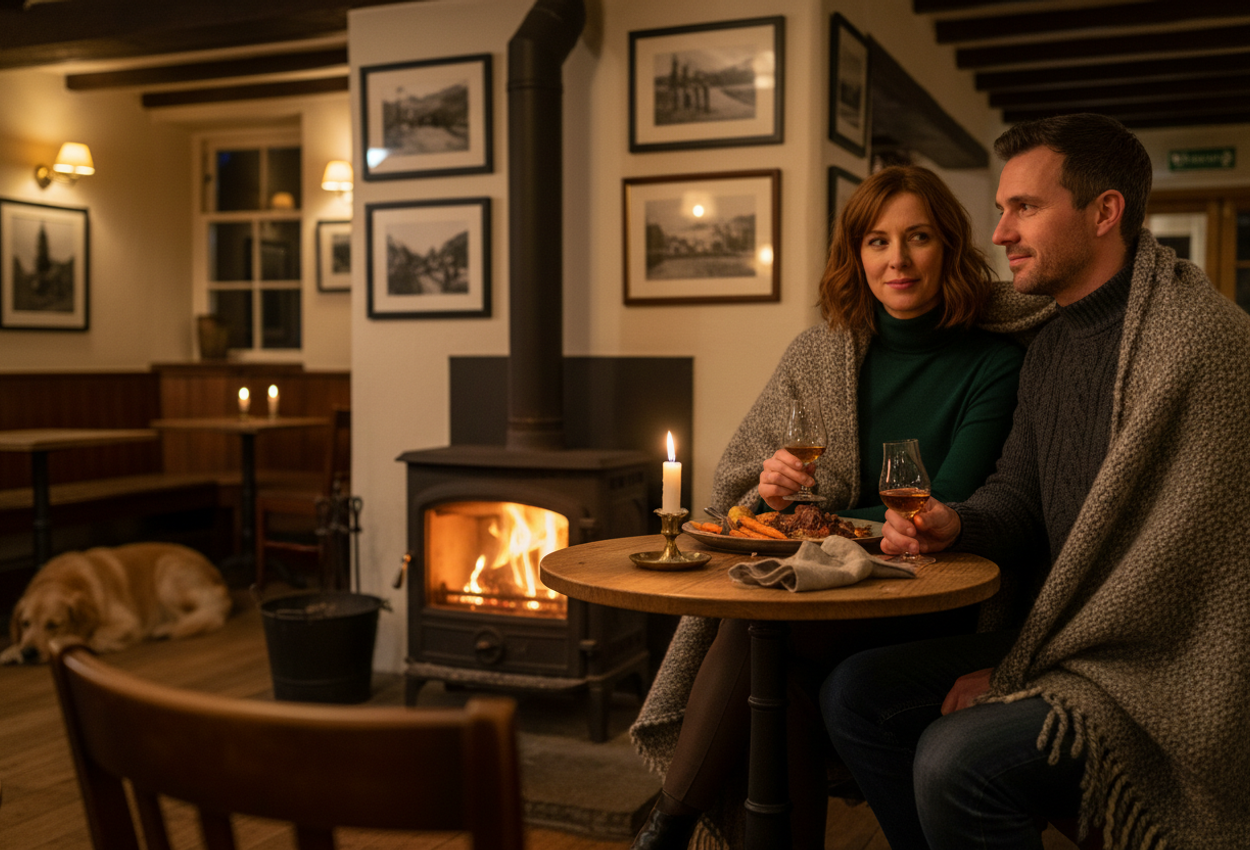
They are shown to a corner table near the fire, where a cast-iron stove glows a deep, contented orange behind its glass door. Above them, beams darkened by centuries of smoke and time intersect; on the walls, local artwork and antique odds and ends – an old gamekeeper’s satchel, a framed fly-fishing lure, a slightly foxed mirror – tell of lives lived close to this river and these hills. The wooden table bears the subtle scars of long use, grooves smoothed by generations of plates and elbows.
They begin with whisky, because it feels only right. The barman guides them through the options with a storyteller’s flair: a Speyside with notes of orchard fruit and vanilla; an Islay whose peat reek rolls into the nose like sea fog over machair; a Highland dram shimmering with heather, honey, and spice. They choose a local single malt, served neat in tulip glasses that focus the aroma. The first sip is almost shocking in its intensity – a prickle of alcohol heat, then a slow unfolding of flavours: toffee, toasted barley, a fleeting suggestion of citrus zest. As it opens in the glass, the whisky softens, revealing subtler notes that seem to echo the landscape outside: resinous pine, a whisper of smoke, the earthiness of wet leaves.
Dinner is hearty, seasonal, and deeply satisfying. Perhaps a starter of cullen skink – a thick, creamy soup of smoked haddock, potatoes, and onions – whose steam fogs their glasses as they bend over their bowls. The fish flakes into tender shards at the touch of a spoon, the broth rich and gently smoky, with a background sweetness from long-sweated onions. For a main, venison haunch from the surrounding estates, seared and served pink atop a bed of buttery neeps and tatties, with a glossy red wine and juniper sauce pooling invitingly at the edges of the plate. Each bite is both rustic and refined, anchored in place and season.
Afterwards, full and content, they migrate to a pair of chairs closer to the fire. The staff produce thick wool blankets – dense, slightly scratchy in the best possible way, smelling faintly of lanolin and peat smoke – and drape them over the couple’s knees. As the crackle from the stove deepens and the fire’s heat seeps through leather and fabric into their bones, a hush falls over the room. The last plates are cleared; pints and drams take their place. Someone near the bar produces a fiddle, another a small, well-worn book.
This is the inn’s unofficial hidden gem: an impromptu storytelling and music session that surfaces on certain winter evenings when there is a willing audience and enough locals present to steer the tone. The fiddler warms up with a slow air, notes hanging in the thick air like breath in frost. Then the storyteller begins, his voice low and rhythmic, reciting tales of shape-shifting selkies, doomed lovers on lonely moors, and the capricious, often mischievous sidhe who haunt remote corries and hidden glens.
The couple leans in, sharing a blanket, glasses cradled in their palms. The stories weave around them, the cadences of Scots and English interlacing like threads in a tartan. Each tale seems to root itself in these very hills and rivers – in boulders you might otherwise walk past without noticing, in pools that look no different from any others until the right light or the right wind reveals their deeper character. Every so often, the storyteller pauses, the fiddler picks up the thread with a reel or a jig, and the room comes briefly, gently alive with tapping feet and nodding heads.
When they finally step back out into the night, cheeks flushed and fingers tingling from the heat they have left behind, the air feels almost startlingly cold and clean. The river runs dark beside them, its low, constant rush a counterpoint to the warmth and words of the inn. They pull the wool blankets tighter around their shoulders as they cross the nearby bridge, the wooden planks hollow beneath their boots, and feel entirely, deliciously cocooned – by the inn, by the village, by the Highlands themselves.
Stargazing Under Sutherland's Dark Skies
North again, and the Highlands grow wilder. In Sutherland, the land opens out into vast, sparsely populated tracts where sea and sky seem to share an unspoken agreement to dominate every horizon. Here, scattered crofts and tight-knit villages hunker against Atlantic weather, and after dark, the stars reclaim the night with a brilliance that feels almost shocking to eyes used to urban glow.
The couple chooses a base near the north-west coast – perhaps close to Durness or along the emptying curve of Loch Eriboll – where small guesthouses and converted crofts offer simple but comfortable accommodation. In February, the air has a sharp edge even in late afternoon; by early evening, frost is already delicately scalloping the verges and turning puddles to black glass. They dress in layers, pulling on thermal leggings, thick socks, and insulated jackets, then step out towards the coastline with a thermos of hot chocolate and a shared sense of anticipation.
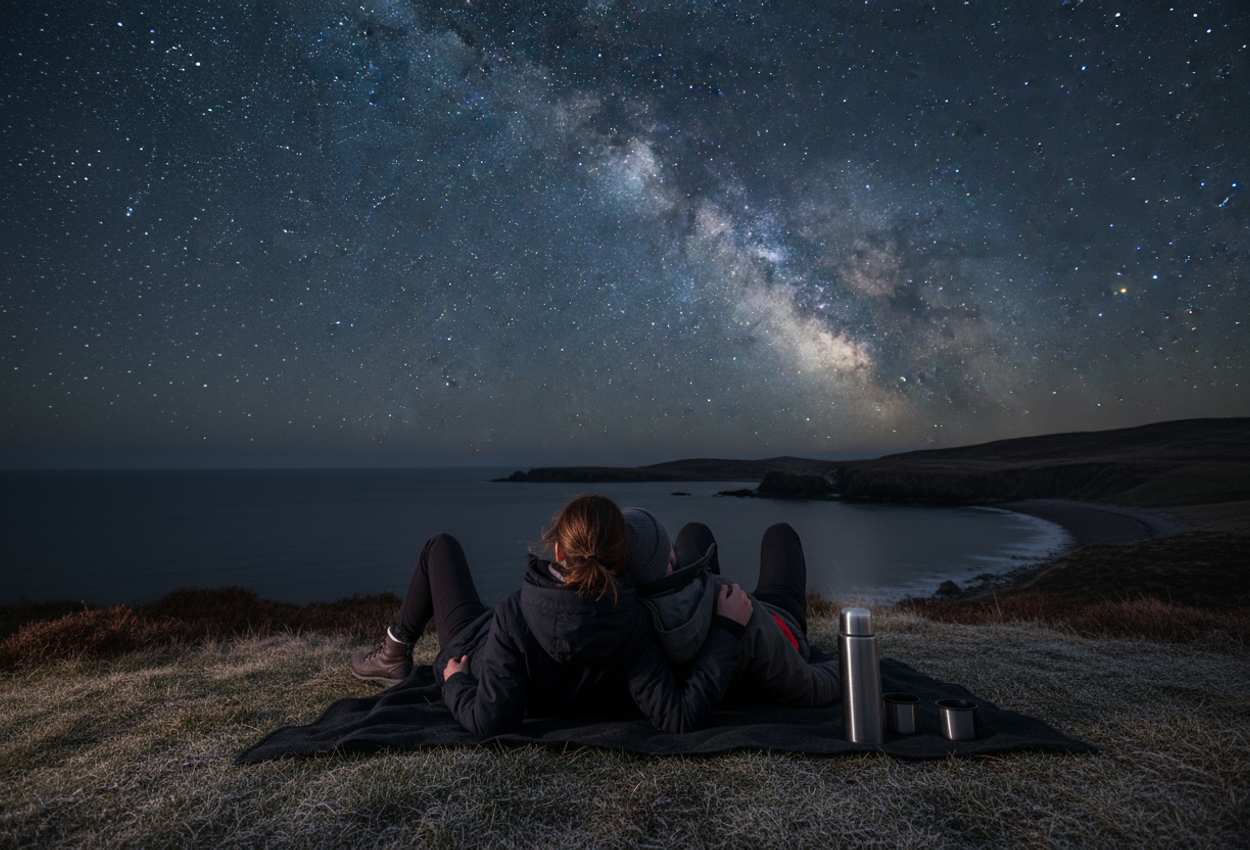
Their chosen stargazing spot is a low grassy knoll above a small, quiet bay. The tide is out, leaving ridged sand and scattered rocks exposed; beyond, the Atlantic breathes in long, low swells that slide in and out with a susurrus rather than a crash. The smell of salt and seaweed is clean and bracing, threaded with the faint mineral tang of cold rock and distant peat smoke from a cottage somewhere inland. No streetlights intrude here, only the pale swing of a lighthouse beam far along the coast and the soft glow of a single farmhouse window, quickly swallowed by distance.
They spread out a groundsheet and sit back-to-back at first, each looking towards a different quadrant of the sky. As their eyes adjust, the heavens slowly reveal their detail: first a scattering of bright anchors, then fainter stars emerging in their thousands, then the pale, powdery wash of the Milky Way stretching from horizon to horizon. The night is so clear it almost seems to ring with it, the air so dry and cold that sound carries in odd, precise ways – the clink of a pebble dislodged far down on the beach, the brief hiss of a wave meeting sand, the distant bark of a dog in a village they cannot see.
They trade sips from the thermos, the hot chocolate thick and slightly grainy, flavoured with a ribbon of whisky that warms throat and belly. The mug’s metal lip is almost painfully cold against their fingers between sips. Overhead, constellations wheel slowly. They trace familiar shapes – the Plough, Cassiopeia, Orion – and try to learn new ones from a stargazing app downloaded before they left their guesthouse’s Wi-Fi. From time to time, a meteor scratches a brief, brilliant arc across the darkness, eliciting a soft exclamation that evaporates instantly into the great hush.
On some winter nights, Sutherland offers an even rarer gift: the flicker of the Northern Lights, drawn south by a particularly active sun. Tonight, they are lucky. It begins as a faint blanching of the northern horizon, a subtle, vertical smudge of greenish light that could almost be dismissed as imagination. Slowly, tentatively, it strengthens, smearing upwards in translucent curtains that ripple and sway as if plucked by invisible fingers. The colour deepens to a clear, almost electric green in places, with fleeting hints of purple at the edges.
The couple falls instinctively silent, eyes fixed on the display. The aurora moves with both grace and unpredictability: here a sudden burst that flares and fades like breath on glass, there a long, sinuous arc that hangs above the sea and is perfectly mirrored in the black water below. The only sound is the ocean, the soft rustle of their jackets as they shift to lean into one another for warmth, and the quiet, involuntary sighs that escape when a particularly vivid ribbon of light twists across the stars.
After an hour – or perhaps two; time feels strange under such a sky – they lie back fully, shoulder to shoulder, hats touching. The ground is hard and cold beneath their backs, but the sensation only sharpens the contrast with the vast, luminous dome above. Here, on the edge of Europe, the usual scales of life fall away. Their worries, their plans, even their memories seem to shrink to manageable proportions, anchored in the simple, animal contentment of being warm, being together, and being dwarfed, healthily and humbly, by the universe.
A Coastal Drive to Applecross and the Bealach na Bà
From Sutherland, they swing south-west again towards Wester Ross, drawn by stories of a road that feels more pilgrimage than passage: the Bealach na Bà, the Pass of the Cattle, a single-track ribbon of tarmac that climbs steeply over the Applecross peninsula from Tornapress to the tiny settlement of Applecross itself.
On the morning they choose to drive it, the forecast is clear but cold – essential for undertaking this road in winter, when ice and sudden weather can turn its hairpin bends treacherous. They set off late enough for the low sun to have burned some of the frost from the tarmac, but early enough that traffic is sparse. Signs at the junction, recently checked after a spate of vandalism, warn bluntly that the route is unsuitable for large vehicles and inexperienced drivers, particularly in poor conditions. They read them carefully, measure their confidence against the sky’s current benign mood, and proceed with respectful caution.
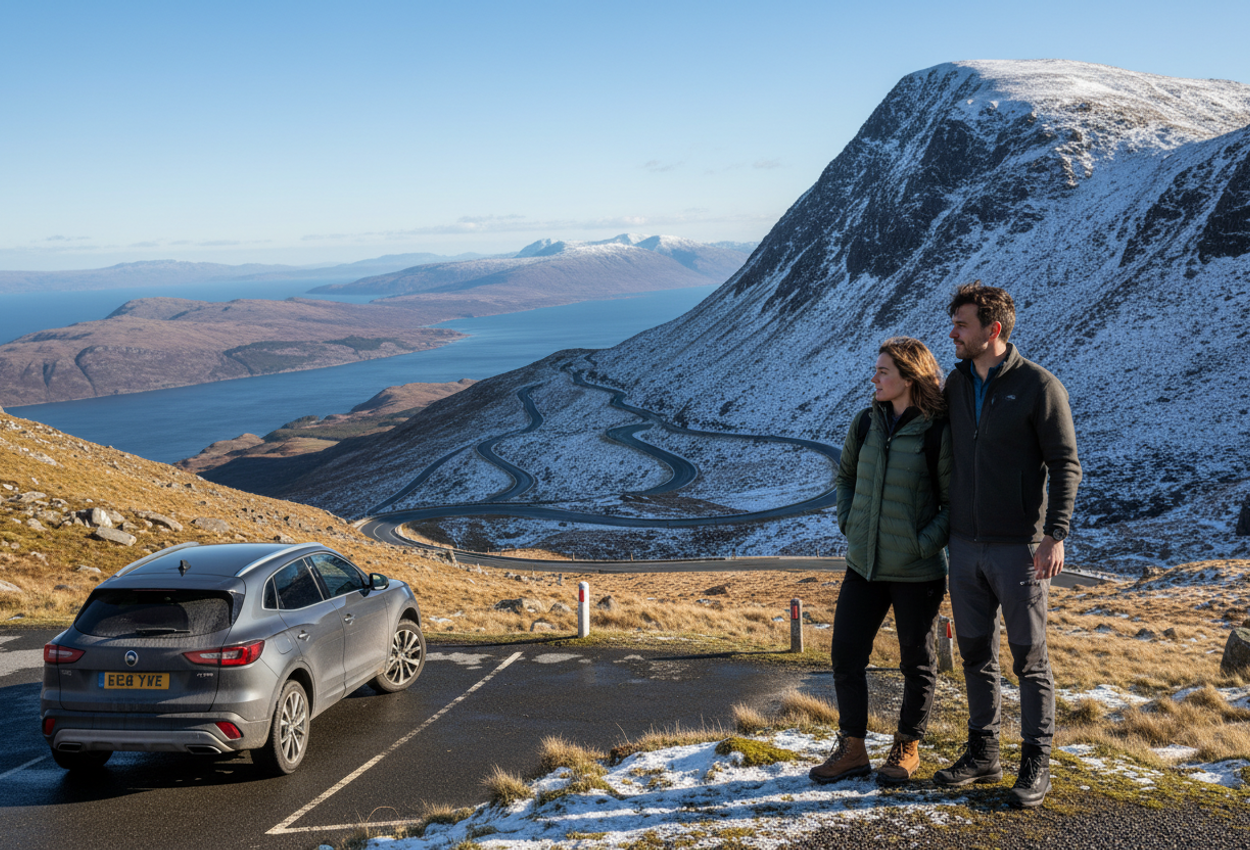
The Bealach announces itself almost at once, rearing up from sea level in a series of dramatic, tightly stacked switchbacks. As they climb, the landscape shifts from low, croft-dotted pastures to open, rock-strewn moorland. The air through the car’s vents smells thinner, cooler, kissed by snow lying in streaks along drainage ditches and tucked into gullies. They drive slowly, pulling into passing places well in advance to let descending vehicles by, offering and receiving the customary Highland wave.
With each ascent, the views expand. Behind them, Loch Kishorn lies like a shard of glass at the foot of the pass; beyond it, the serried peaks of Torridon rise in layers of russet and grey, their upper slopes still snow-capped in February. The couple pauses at a lay-by near the summit and steps out into air so crisp it almost rings, the silence broken only by the faint sigh of wind and the distant, incredulous bleat of a sheep somewhere below. The smell here is clean rock and cold metal, with a hint of engine heat ticking down as their car cools.
From the top, the road begins its own dramatic descent towards Applecross, curling along the contours of a corrie whose cliffs fall steeply away beneath the verge. The sea appears ahead, suddenly and gloriously: a broad, shining plane stretching towards the hazed shapes of the Isle of Skye and the distant Outer Hebrides. The winter sun, still low even at midday, flings long, golden pathways across the water, flecked with the white triangles of gulls and the darker blurs of cormorants skimming the surface.
Down in Applecross, the world shrinks again to human scale. The settlement is little more than a ribbon of houses along a curve of shore, backed by low hills and facing directly across to Skye. The smell of seaweed and salt hangs in the air; the pebbled beach crunches underfoot as they walk, their breath steaming in the chill. At the heart of it all sits the Applecross Inn, its whitewashed walls bright against the muted winter palette.
Inside, the inn offers a welcome as warm as any Highland hearth. The couple secures a table by a window smudged delicately with salt spray. The menu is a love letter to the surrounding waters: langoustines landed that morning from local boats, their shells a vivid coral; plump mussels steamed in white wine and garlic until they open with soft, seawet sighs; perhaps a simple fillet of haddock fried in a thin, shattering batter and served with chips as crisp as the air outside. They opt for a seafood platter to share, a still life of the sea arranged on blue-rimmed china. Each bite tastes intensely, unmistakably of place – the sweetness of the langoustines, the briny chew of the mussels, a squeeze of lemon releasing a brief, sunny brightness that feels almost shocking in this cool, north-west light.
The inn’s interior hums gently: cutlery against crockery, the low rise and fall of voices, a dog sighing in its sleep under a neighbouring table. Through the window, the tide continues its slow, inexorable work, rippling in around anchored boats and over dark rocks. They linger over coffee and perhaps a dram, reluctant to trade this snug harbour for the stark drama of the pass again. But when they finally step back outside, the air feels like a bracing plunge after a hot bath – sharp, invigorating, rich with the smell of kelp drying on the shoreline.
For all its romance, the Bealach na Bà is not a road to be taken lightly. They descend, or loop out along the gentler coastal alternative, acutely aware of its demands: narrow, steep, unforgiving of inattention. It is precisely this combination of beauty and seriousness that gives the day its charge. Love here is not the soft-focus kind; it is practical and attentive, made of careful navigation, mutual reassurance, and the shared thrill of emerging, safely and together, on the far side of a mountain pass that has tested drivers for generations.
Island Hopping to Skye's Fairy Pools
No romantic circuit of the Highlands feels complete without stepping, at least for a day, onto the storied shores of the Isle of Skye. From the mainland, the couple crosses the Skye Bridge at Kyle of Lochalsh, watching the water of Loch Alsh ripple far below in broad, pewter sweeps. Beyond the causeway, Skye rises in a tumble of hills and the serrated silhouettes of the Cuillin, their winter crowns still streaked with snow.
The road to the Fairy Pools threads through Glen Brittle, a valley that feels at once intimate and vast. Blackface sheep dot the rough fields, their fleece muddied and wind-tousled; occasional stands of woodland gather in sheltered folds. As they leave the car at the car park, a gust of wind sweeps down from the Cuillin, bringing with it the sharp, metallic smell of snow and wet rock. The path towards the pools is clear but uneven, crossing small burns on stepping stones that sit just proud of the water, slick with spray.
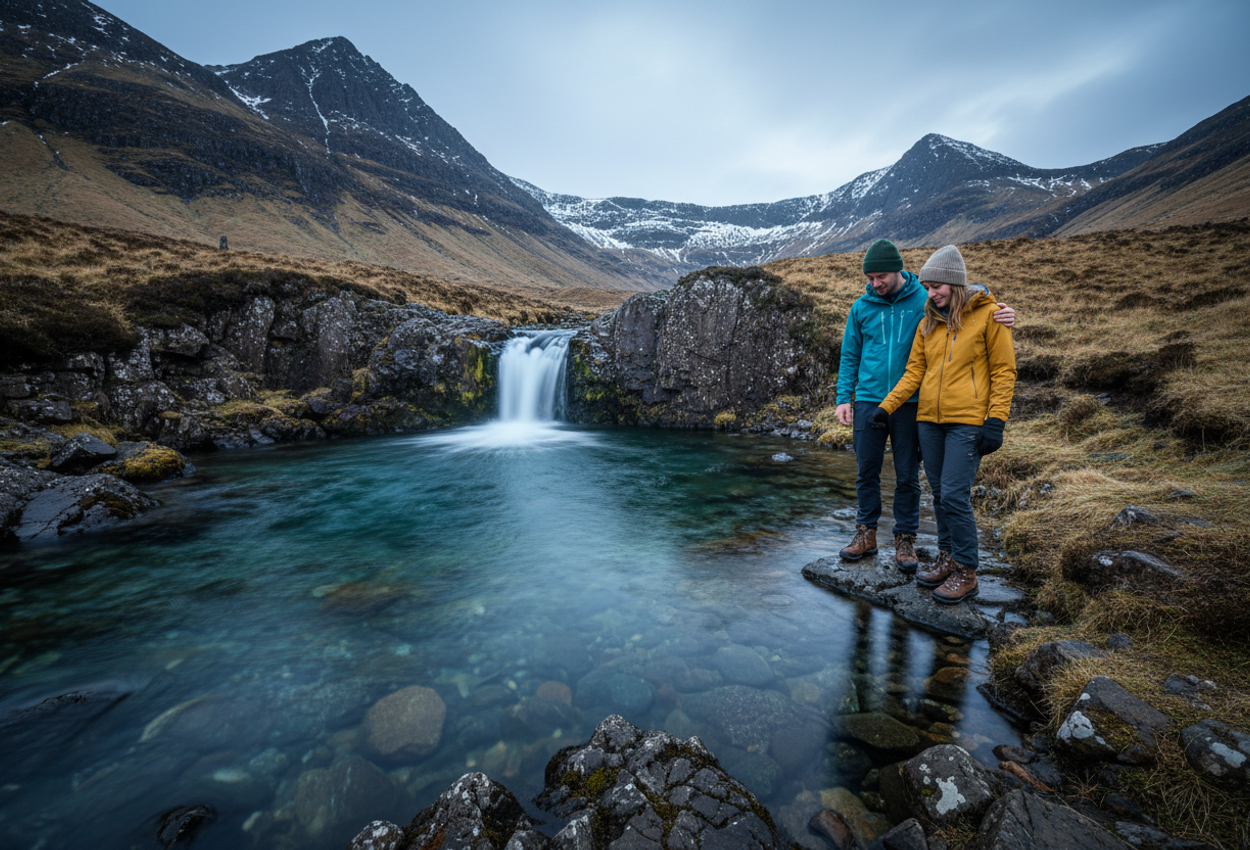
From the first moment they glimpse the water, the couple understands why the Fairy Pools have captured so many imaginations. Even under a winter sky, the series of cascades and rock-rimmed basins glows with an otherworldly clarity: blues that range from deep teal to almost Caribbean turquoise, filtered through water so transparent that every pebble and grain of sand on the riverbed stands in sharp relief. The soundscape here is layered and soothing – the constant hiss and splash of falling water, the rush of the main burn, the occasional bleat of a sheep or distant call of a raven riding an updraft higher on the slopes.
They follow the path upstream, the ground springy underfoot where patches of heather cling to the soil, treacherously slick where the mud has been kneaded by many boots. The air is chilled and moist, with a faint, wild sweetness from the vegetation: bog myrtle, heather, moss. When the wind drops, they can hear the more delicate notes in the water’s song – the tinkling over small stones, the deeper gurgle in hidden hollows. As they approach one of the larger pools, the woman reaches out to touch the water’s surface; her fingertips burn instantly with cold, the chill so intense it elicits a burst of startled laughter.
In warmer months, hardy souls plunge into these pools, their shouts echoing off the slopes as they surface, gasping, from the near-icy depths. In February, a full swim would be an act of masochism rather than romance, but the couple does slip off gloves to trail hands through a calmer eddy, feeling the paradoxical combination of pain and exhilaration that cold water always brings. They watch as a shaft of sun pierces the passing clouds and drops like a physical thing into the pool, lighting it from within; the rocks below jump into even sharper focus, every groove and swirl thrown into high relief beneath the shimmering surface.
Most visitors turn back after the main series of pools, satisfied with the standard postcards. The couple, however, follows a faint side path that climbs a little higher onto a knoll overlooking the glen – a local photographer’s tip picked up over breakfast. From here, the Fairy Pools are revealed in their fuller context: a silver chain of water threaded through the valley floor, dwarfed by the dark, looming ramparts of the Cuillin. The mountains’ ridges cut knife-sharp against the sky, their snowfields catching the low sun in bruised purples and cold golds.
This hidden viewpoint offers space and quiet. The wind is stronger here, tugging at coats and hair, tasting of snow and distant sea. They sit close, backs braced against a rock warmed just slightly by a brief flirtation with sunlight, and let their gaze travel over the landscape: down to the glinting pools, across to the burn’s white ribbons of foam, and up again to the shredded banners of cloud snagged on the peaks. The Isle of Skye unfolds around them in all its winter austerity – stark, elemental, magnificent.
By the time they return to the car, their cheeks are windburned and their legs pleasantly heavy. They drive back towards the bridge in a contemplative hush, stopping briefly at a lay-by that offers one last, sweeping view over sea and mountains. The romance here is not the soft-focus fantasy of fairy-tale islands, though the name might suggest it; it is a more bracing, invigorating kind, grounded in weather and rock and the shock of cold water on warm skin. It is the feeling of standing very small and very alive in a landscape that will remain, implacable and beautiful, long after they have gone.
As their Highland journey draws to a close, the couple realises that what they will remember most is not any single castle, road, or pool, but the way this region has tuned them to a different frequency. The Highlands reward those who pay attention – to the grain of stone under fingertips, to the tonal shifts in a dram of whisky, to the thousand subtle dialogues between light and water and sky. In learning to attend together, they have discovered not only the romance of the land, but new, quieter currents within their own story. And that, ultimately, is the greatest Highland gift of all.