In Kyoto, love does not shout; it sighs softly through moss and maple, drifts on steam from a lacquered tea bowl, and shimmers in the pale reflection of cherry blossoms on still water.Whispers of the Zen Masters at Ryoan-ji
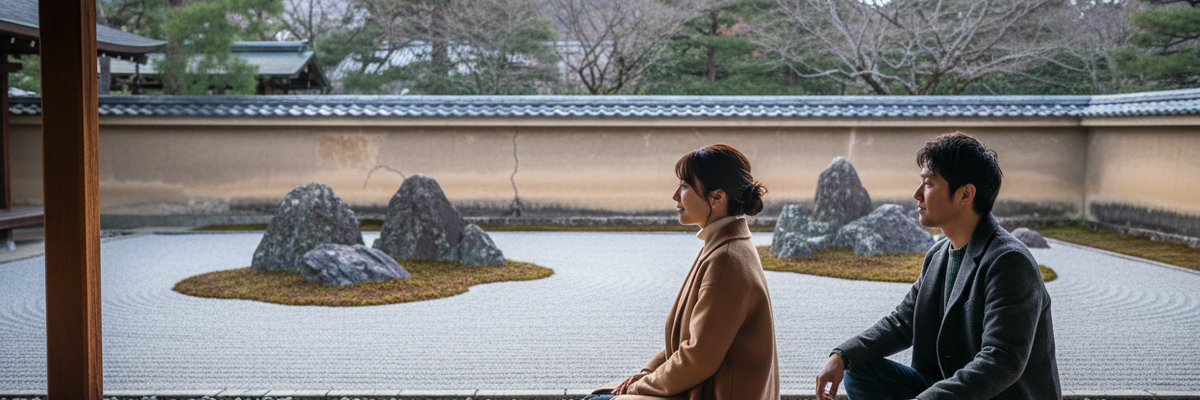
You approach the heart of Ryoan-ji along a path scented with damp cedar and incense, shoes tucked into your hand, the hush of the temple grounds drawing you inward like a tide. Inside the hojo, the former abbot’s residence, tatami mats exhale the faint aroma of straw and time. You and your partner settle side by side on the wooden veranda, shoulders just brushing, and there it is before you: a rectangle of white gravel and stone that has puzzled, soothed, and stirred visitors for centuries.
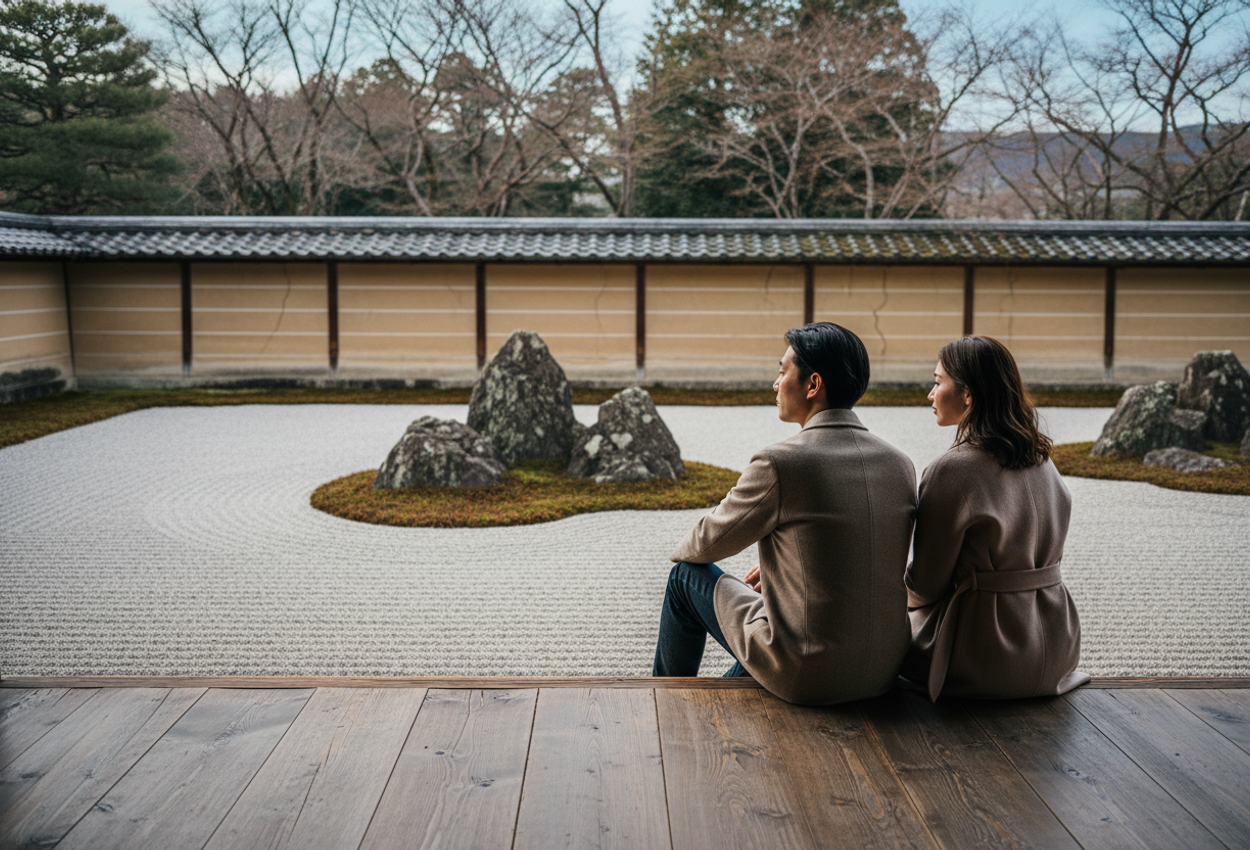
The famed karesansui, or dry landscape garden, stretches long and low, a measured 25 by 10 meters of meticulously raked white gravel. Each grain seems to contain a story. The surface is combed into precise, rippling lines that suggest the slow movement of water, though nothing here ever truly moves except light and the drift of seasons. Fifteen weathered rocks rise from this pale sea in five clusters, each stone cradled by soft halos of moss the color of dark jade. The contrast is almost startling; the gravel is cool and bright, while the moss seems to breathe with an ancient, earthy warmth.
From any one vantage point, tradition insists, you can see only fourteen of the fifteen stones. One is always hidden, eclipsed by others, no matter how you lean or shift. You and your companion unconsciously test the legend, tilting your heads, trading the slightest of smiles as you silently count. Fourteen. Always fourteen. The missing stone becomes an invitation, a gentle reminder that in love, as in life, wholeness is often felt more than seen, understood more in absence than in presence.
Sitting on the veranda of the hojo, the garden framed by the rough earthen wall and the straight line of polished wood beneath your knees, you enter into a quiet dialogue with emptiness. Here, the void is not empty but alive. The eye moves between rock groupings the way a mind paces through questions. One cluster suggests islands on a boundless sea, another drifting clouds, another perhaps a mother animal with her young. Interpretations have ranged from tigers crossing a river to mountain peaks lost in fog, but the garden resists any single reading. It becomes a mirror, reflecting whatever inner landscape you bring to it: longing, gratitude, uncertainty, the tremor of a new commitment.
Close your eyes for a moment and the sensory impressions sharpen. You feel the grain of the veranda’s wood against your palms, burnished smooth by uncountable pilgrims. The winter air, crisp on this early February day, slips under the eaves and cools your cheeks. Somewhere behind you, a floorboard yields with the softest creak; ahead, unseen, a crow calls from the grove encircling the temple. When you open your eyes again, the white of the gravel seems almost luminous, holding the pale sky, while the clumps of moss huddle like miniature forests, each one an intimate world.
As you and your partner sit in silence, time loosens. Words feel suddenly clumsy, unnecessary. Instead you share a small gesture – your knees touch, hands almost graze, a breath rises and falls in unison. Here, romance is not grand or theatrical. It is the feeling of discovering that another person can sit with you in stillness, content to contemplate the same mysterious composition, to accept that not everything must be solved or named. The one stone that can never be seen becomes a quiet metaphor for all that remains unknowable in the person beside you, and for the lifelong, tender work of learning to see a little more clearly, together.
Before you leave, you walk slowly along the outer path skirting the pond that gave Ryoan-ji its name, the scent of wet earth mingling with the faint smoke of temple incense. The ripples on the water echo the raked patterns of the gravel, and the garden’s quiet logic follows you out through the wooden gate. Even when you return to the city streets, some part of you remains seated on that veranda, watching rocks and gravel and moss hold their perfect, inscrutable pose.
Strolling Hand-in-Hand Through Murin-an's Cascade
Across town, in the gentle embrace of Higashiyama, lies a different kind of solitude. At Murin-an, the masterpiece of landscape gardener Ogawa Jihei, you enter into a strolling garden where everything appears effortlessly natural, yet every stone and stream has been considered with obsessive care. From the gate, the murmur of water calls you forward, a liquid counterpoint to the distant hum of the city. You and your partner step onto a narrow path, shoes whispering over fine gravel, and the world opens into a series of unfolding scenes.
Here, the Higashiyama mountain range does not simply sit on the horizon; it is drawn into the garden itself through the principle of shakkei, or borrowed scenery. Beyond the mossy slopes and sculpted shrubs, the blue-grey ridgeline rises like a painted screen, its contours echoing those of the garden’s gently undulating mounds. The effect is that the boundary between cultivated space and wild landscape dissolves. You feel at once enclosed and limitless, as if the garden were an intimate room with walls made of distant hills.
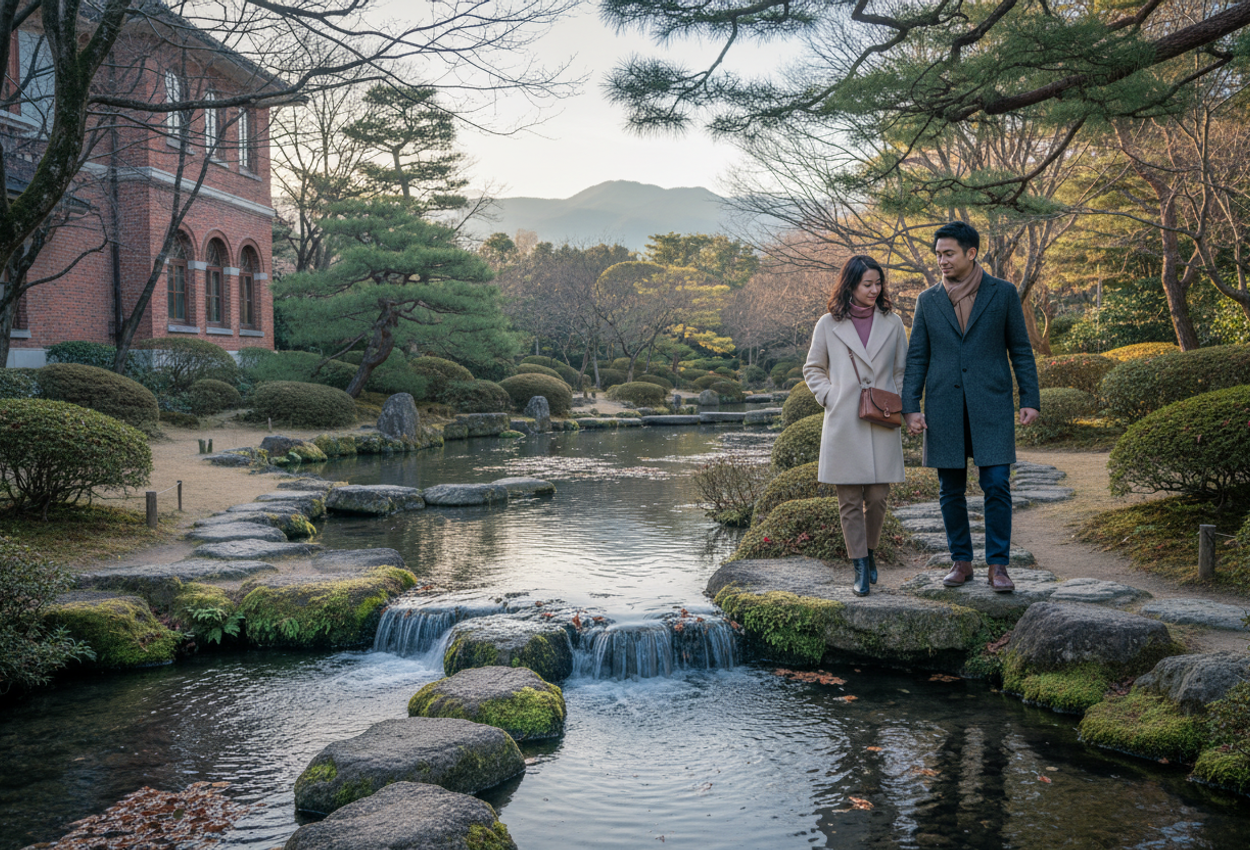
The sound you have been hearing grows louder as you descend towards it: a delicate cascade tumbling over stones, feeding a narrow stream that curls through the grounds. This waterfall, carefully orchestrated by Ogawa Jihei, is the pulsing heart of Murin-an. Its clear water catches the winter light, breaking it into bright shards that dance on the moss. You pause on a stepping stone, your partner’s fingers laced in yours, watching the current slip around rounded rocks slick with wetness. The air is cool and carries the faint metallic tang of fresh water, the earthy perfume of damp soil, and the resinous whisper of pine.
The cascade pours into a pond that appears more like a calm fragment of river than a static pool. Wild ducks sometimes trace lazy arcs on the surface; koi flash like living embers just below. Willows lean out to touch their reflections, and in late autumn, maples set the water ablaze with mirrored flame. Even in February, the structure of the garden is beautiful in its restraint – the skeleton of branches etched against the sky, the evergreen shrubs softened by a dusting of frost in the morning. It is a perfect place to lean shoulder to shoulder on a low wooden bench and imagine how the scene will transform with the coming of spring.
On one side of the garden stands an incongruous yet strangely harmonious presence: a low, Western-style brick villa from the Meiji era. Its arched windows and modest veranda seem almost transplanted from a European countryside, yet Ogawa Jihei wove this modernity into the composition rather than hiding it. From certain angles, its linear geometry frames the view of the garden like a picture window, an elegant reminder of the time when Japan was opening itself to the world. Standing together near its facade, you can trace the dialogue between East and West – the organic curves of the stream and stepping stones contrasted with the villa’s firm lines – and sense a parallel conversation within your own relationship, between old habits and new possibilities, between tradition and reinvention.
The hidden gem of Murin-an reveals itself if you follow a less obvious path that climbs gently behind a thicket of azaleas. A small rise leads to a discreet viewpoint: a simple, flat stone set near the edge of a grassy mound. From this slightly elevated perch, the garden compresses into a perfect layered tableau. In the foreground, the cascade glimmers through a fringe of foliage; mid-ground, the pond stretches serene and glassy; and in the distance, the borrowed Higashiyama ridge floats like a painted backdrop. When you stand here with your partner, framed by low pines and the quiet sweep of sky, it feels as though the entire composition has been arranged solely for the two of you.
As you complete your circuit, you notice how the path never offers the same view twice. Each turn reshapes the garden, revealing a new alignment of rocks, a different conversation between tree and water. This is a place designed to be experienced slowly, ideally with someone whose stride you have come to know as well as your own. By the time you step back through the gate into modern Kyoto, the sound of the cascade still rings in your ears, like a gentle echo encouraging you to carry that sense of flowing, spacious calm into the rest of your journey.
Aromatic Encounters: Tea Ceremony at Camellia Garden
In the western reaches of Kyoto, not far from the temple you visited earlier, a machiya-style house sits quietly on a side street near Ryoan-ji. This is Camellia Garden, a teahouse where the centuries-old ritual of chanoyu unfolds for travelers seeking not performance but presence. The moment you slide open the wooden door, the bustle of the outside world falls away, replaced by the padded footfalls of tabi socks and the soft clink of ceramic against wood.
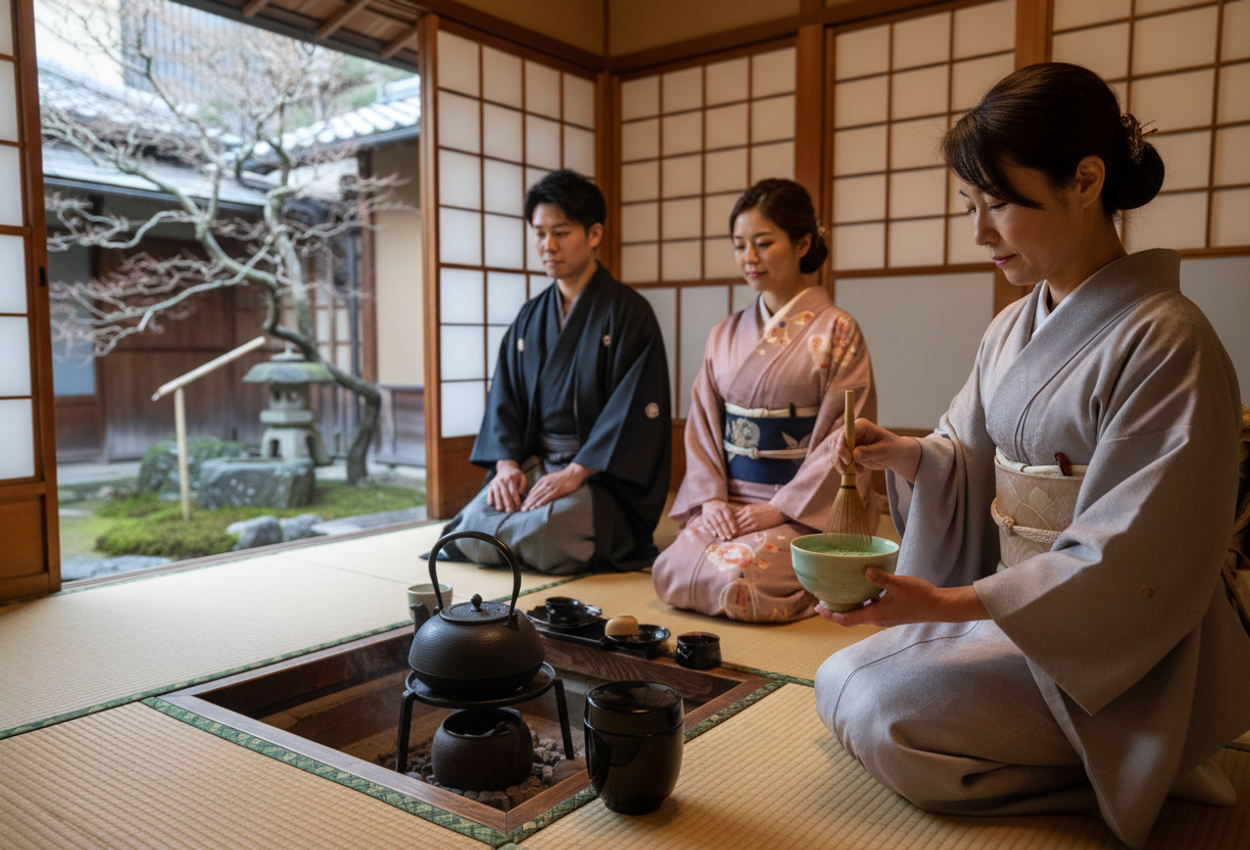
You and your partner are guided into a compact tea room that gazes out onto a small, carefully composed garden: a stone basin ringed with moss, a weathered lantern half-veiled by bamboo, the silhouette of Ryoan-ji’s trees rising beyond the low wall. Even in February’s sparse palette, the garden feels alive – the silvery branches etched against a pale sky, the moss still bright where the ground holds warmth. The tokonoma alcove holds a single hanging scroll, its ink strokes spare yet powerful, and perhaps a modest flower arrangement in a bamboo vase, a camellia bud promising color against the season’s restraint.
The host enters with a bow, robes whispering against the tatami. Every movement is deliberate yet unforced: the folding of the fukusa cloth, the turn of the bamboo ladle, the precise placement of each utensil. You become acutely aware of small sounds – the hollow ring as the ladle touches the iron kettle, the susurrus of hot water poured into the tea bowl, the muted click as ceramic settles onto the tatami. The room is perfumed with the faint, metallic sweetness of freshly boiled water and the clean fragrance of the tatami straw, with a whisper of incense that lingers from the morning’s preparations.
A lacquered tray arrives with seasonal wagashi, traditional sweets crafted to balance the bitterness of the matcha to come. In this cool season, perhaps you are offered a soft mochi wrapped around sweet azuki bean paste, its surface dusted with fine rice flour that clings like winter’s last snow. The first bite is a study in contrast: the gentle resistance of the mochi giving way to the smooth, honeyed paste within, textures echoing the interplay of softness and strength in the garden outside. You and your partner exchange the slightest nod, tasting not only the confection but the care embedded in its making.
As the host begins to whisk the matcha, vivid green powder blooms against the warm ceramic bowl. The bamboo chasen moves quickly yet gracefully, tracing a small circle that expands into a froth of microbubbles. The scent of the tea unfurls – grassy, marine, and faintly sweet – filling the air with a subtle energy. When the bowl is placed before you, its rim turned just so, you bow in thanks, rotate it with both hands to avoid the front, and then lift it towards your lips. The first sip is velvety and thick, coating your tongue with a satisfying bitterness that resolves into an almost creamy finish.
Sharing this bowl, or taking turns with your own, becomes unexpectedly intimate. You find yourself attuned to the rhythm of each gesture: the way your partner cradles the bowl, fingers grazing the rough glaze; the pause before the next sip; the quiet exhale afterward. The tea ceremony, rooted in Zen, is less about the drink than the cultivation of awareness – of each breath, each sound, each fleeting detail. In this small room, the rest of your trip falls away; there is only the warmth of the bowl in your hands, the soft rustle of kimono fabric, the silhouette of a single branch beyond the shoji screen.
Your host speaks briefly, perhaps mentioning the coming expansion of Camellia’s world. Opening in March 2026, the new Flower Annex will offer a dedicated private tea ceremony room upstairs, a space designed for couples and small groups craving an even more secluded experience. You imagine returning then, climbing a narrow staircase to a room washed with afternoon light, where a private garden view frames a tea ceremony tailored to just the two of you. The thought lingers like the aftertaste of matcha – slightly bitter, deeply satisfying, and filled with anticipation.
When the ceremony ends, you bow once more and step back into the small garden. A chill rides the air, but you feel warmed from within. The simple actions of whisking, bowing, sipping have braided your movements together in memory. In a city famed for grand temples and gilded pavilions, this quiet corner of Ryoan-ji’s neighborhood offers one of the most romantic experiences: the chance to slow down enough to discover how the person beside you moves through stillness.
Lost in Time: Bamboo Forest's Emerald Canopy
Later, you find yourselves in Arashiyama, that storied western district where mountains lean close to the Katsura River and time seems to loosen its grip. You have arrived by the Sagano Romantic Train, the vintage carriages rattling gently as they traced the river’s curves, windows framing cliffs, cedars, and water glinting in winter sunlight. Stepping off at Torokko Arashiyama Station, you walked up the stone steps and followed a narrow lane until the air itself seemed to change – cooler, tinged with the green, peppery scent of bamboo.
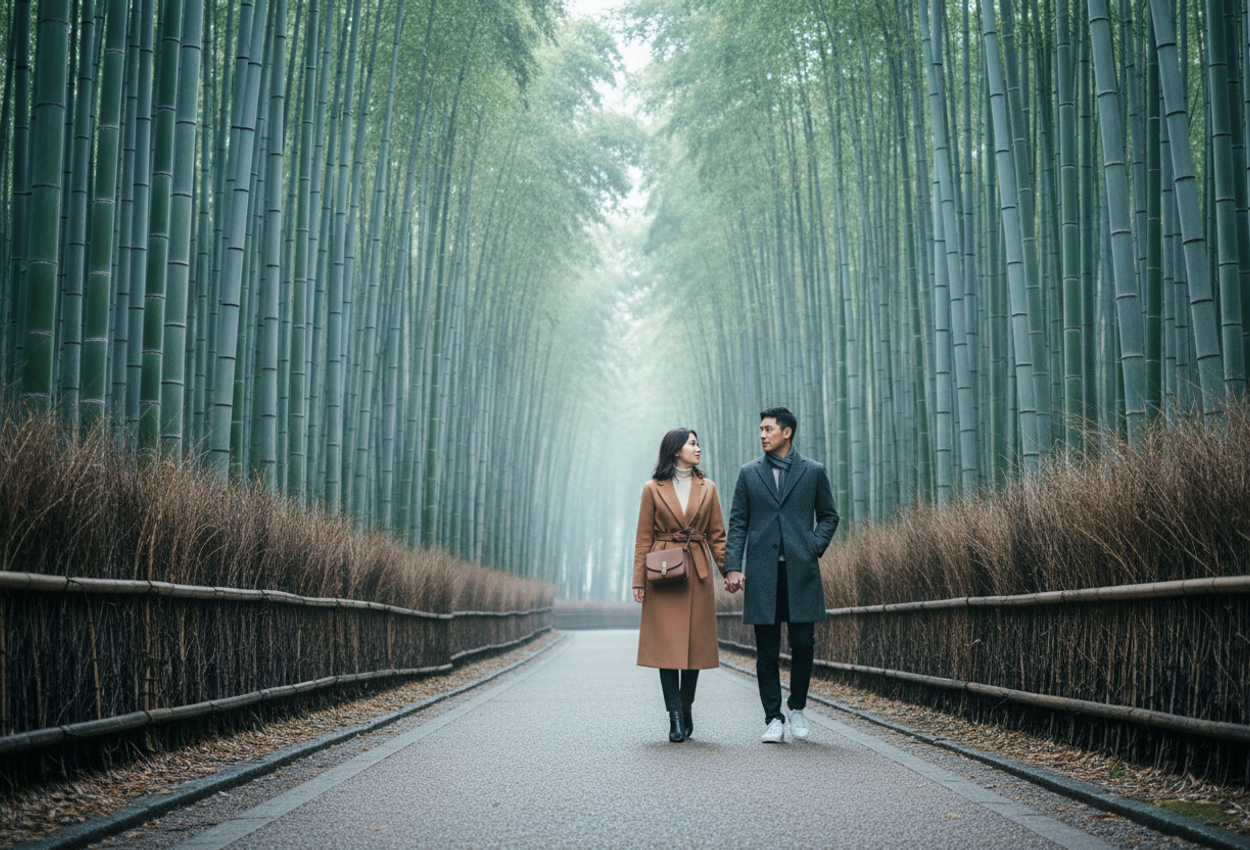
The entrance to the Arashiyama Bamboo Grove appears almost unassuming: a simple path slipping between stands of tall stalks. But a few steps in, and the world transforms. Around you, thousands of bamboo culms rise impossibly straight, pale green trunks dusted with a powdery bloom that catches the light. They soar overhead, their feathery leaves weaving an emerald canopy that filters the sky into a soft, diffused glow. The path is a muted ribbon beneath your feet, lined with simple railings of bamboo and the scuff marks of countless pilgrims.
Sound behaves differently here. The outside world recedes into a faint murmur, replaced by the gentle percussive clatter of stalk against stalk when a breeze stirs the grove. The leaves whisper overhead like distant rain, a continuous shushing that seems to slow your heartbeat. Your steps fall naturally into sync with your partner’s, your voices drop to a murmur without your realizing, as though the tall bamboo demand reverence. The air is cool and faintly moist, carrying the green, slightly spicy perfume of living bamboo and the earthy undertone of decomposing leaves.
Sunlight spears through gaps in the canopy in delicate shafts, striping the path with shifting bands of brightness and shadow. When you pause and look up, the scene becomes almost abstract – slender columns receding into infinity, a lattice of leaves etched against a bleached winter sky. You might reach out to touch a nearby stalk, feeling the unexpected smoothness of its surface, the subtle segmentation under your fingertips. Your partner’s hand finds yours as a small group passes, their footsteps quickly swallowed by the grove’s hush. Despite the crowd, you feel strangely alone together, wrapped in a shared dream of green.
For a quieter moment, you veer away from the main thoroughfare toward Arashiyama Station on the Randen tram line. Here, a lesser-known wonder awaits: the Kimono Forest. Outside the station, hundreds of transparent pillars stand like a gathered grove of light, each one filled with glowing bolts of Kyoto textile. Rich indigo, soft vermilion, blush pink, and gold – traditional kimono fabrics bloom behind glass, their patterns of cranes, chrysanthemums, and flowing water illuminated from within. At dusk, the pillars turn the station into an otherworldly corridor of color, reflections rippling across the polished stone underfoot.
Hand in hand, you wander between these cylindrical lanterns, reading the stories in their patterns. The rustle of the tram, the murmur of waiting passengers, the distant echo of the bamboo grove all mingle into a gentle urban lullaby. In the center of the installation, a small pond captures the glow of the fabric pillars, doubling their beauty. You pause there, watching your own reflections haloed by floating patterns of silk, and feel as though you have stepped into a living ukiyo-e print, a fleeting world of color and light.
When you eventually make your way back through the bamboo as the day wanes, the grove has changed. The light is cooler now, running toward blue, and the path feels more mysterious. You listen again to the click and sigh of the bamboo in the evening wind. Standing still for a moment, you close your eyes and imagine couplings who have walked this same path over the centuries – courtiers on pilgrimages, poets dreaming of distant loves, modern travelers clutching each other’s chilled fingers. The bamboo have witnessed them all, and in their patient, swaying stillness, they seem to bless your own quiet passage through their emerald cathedral.
Secluded Bliss at Gio-ji Temple's Moss Garden
A short ride from the well-trodden lanes of Arashiyama brings you deeper into the Sagano hills, where the air cools and the houses thin. Here, tucked along a narrow lane that feels almost rural, stands Gio-ji, a small temple with an outsized capacity for enchantment. Crossing its modest threshold is like stepping into a folktale that has been told for centuries by lantern light.
Legend binds this temple to the sorrowful figure of Gio, a dancer who once captivated the powerful warlord Taira no Kiyomori. When his favor shifted to another, she left the capital and retreated here with her sister and mother, embracing the quiet austerity of a nun’s life. That mixture of heartbreak and release seems to have seeped into the very soil, now carpeted with a luxuriant pelt of moss that has made Gio-ji famous.
As you and your partner step into the main hall and look out, the garden appears less like a designed space and more like a fragment of untouched forest floor. A seamless expanse of moss stretches beneath a stand of maple and cedar, undulating gently around the bases of trees and stones. The moss is impossibly lush, its surface rising and falling in soft hummocks, glowing in multiple shades of green – deep bottle-green in the hollows, bright lime where sunlight brushes its nap, olive where dry branches cast shifting shadows. You half expect that if you stepped onto it, your feet would sink into some otherworldly softness.
The air is cool and damp, laden with the earthy scent of wet soil and decaying leaves, the faint metallic tang of a tiny stream threading through the garden. In early February, the maples stand bare, their elegant branches drawing fine calligraphic strokes against the sky, so that light falls unhindered onto the moss, making it seem almost self-luminous. New ferns unfurl from the green carpet, their coiled fronds studded with tiny droplets of moisture. Somewhere nearby, water slips over stones with a sound like whispered conversation, almost masked by birds chirping from the branches overhead.
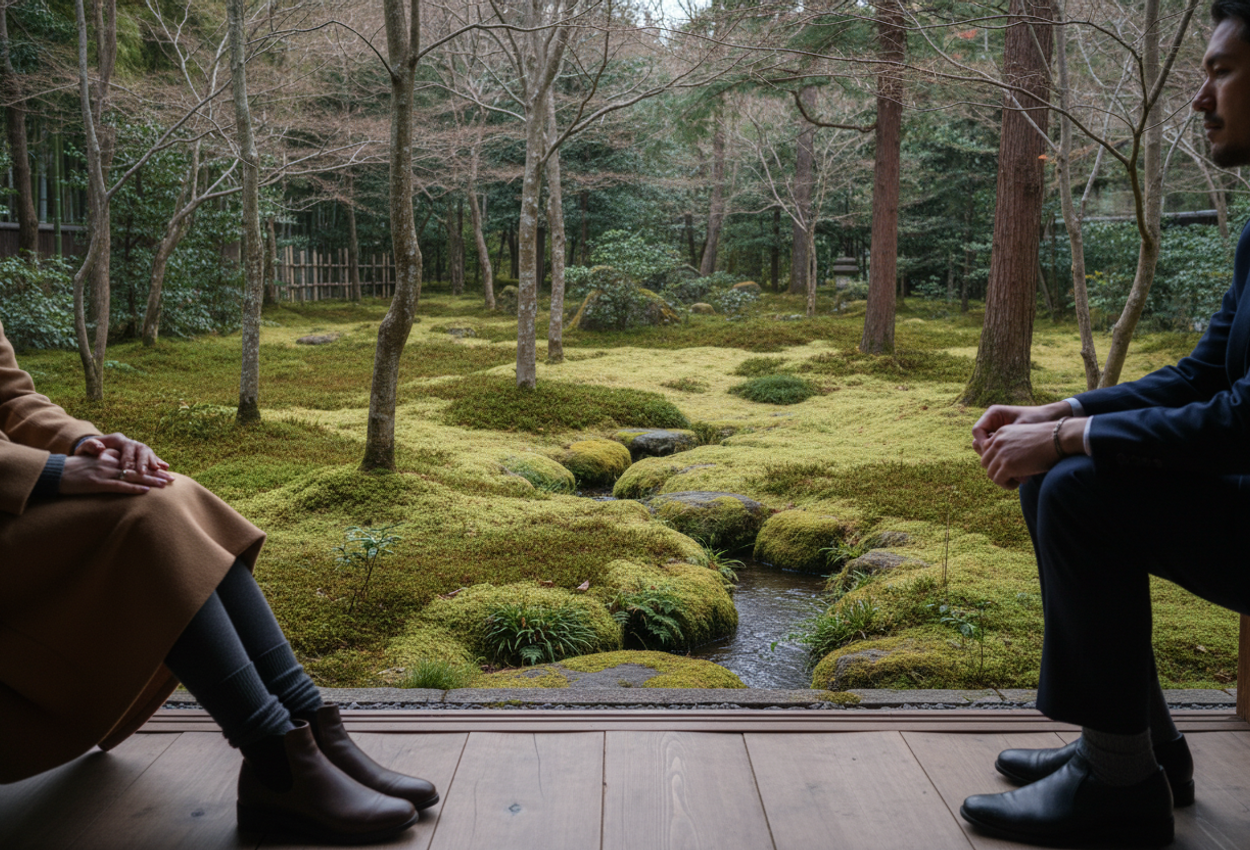
You sit together on the wooden engawa, the veranda’s edge marking a clear yet porous boundary between your human world and the garden’s other realm. A breeze moves through the trees, sending a light cascade of last year’s leaves drifting down in slow spirals. One lands just at the boundary between wooden plank and moss, teetering between your side and theirs, and you find yourselves oddly invested in which way it will fall. When it finally tips onto the moss, spinning gently, it is as if the garden has accepted a small, quiet offering from your shared presence.
In this tucked-away corner of Kyoto, romance is not about spectacle. It lives in a shared intake of breath at the sight of morning mist pooled low among the moss mounds, in the delicate brush of your sleeves as you lean closer to point out a particularly tiny fern emerging near a gnarled root. The story of Gio’s unrequited love casts a soft shadow over the scene, but it also heightens your awareness of the tenderness in your own journey – this chance to sit with someone who stayed, who chose to share this view with you.
When you finally stand to leave, you walk the narrow path that skirts the garden, careful not to disturb the emerald carpet that feels almost sacred. Small stepping stones guide you past a diminutive bamboo grove and a stone basin where cold water gathers, inviting a purifying splash across your fingertips. You and your partner exchange a glance, quietly grateful that places like Gio-ji still exist – small, secluded sanctuaries where love can be felt not through declarations, but through the shared willingness to sit in silence and notice the tiny, persistent miracles of the living world.
Imperial Echoes: Kyoto Gyoen National Garden's Grandeur
Back in the center of the city, a vast green refuge unfurls like a secret between avenues and bus routes. Kyoto Gyoen National Garden once held the residences of court nobles; today it is a broad, park-like domain where locals jog along gravel paths, children chase pigeons under towering camphor trees, and couples drift side by side through a landscape steeped in imperial memory.
You enter through one of the simple gates and immediately feel the city fall away. The air, even in winter, is scented with pine, earth, and the faint sweetness of dried leaves. Wide allées of gravel radiate from the center, flanked by groves of zelkova, cherry, and plum. Here and there, winter-bare branches reveal the elegant silhouettes of the Kyoto Imperial Palace buildings rising behind ocher walls and slate-gray roofs, their quiet dignity standing in contrast to the casual strollers and cyclists who claim the garden as their everyday escape.
Walking arm in arm, you make your way toward the palace complex itself. Even from outside, you can sense its measured rhythm: gates aligned along a north-south axis, courtyards opening one into another, rooflines curling just so at the corners. This was once the seat of emperors, the center of a refined world where poetry, ceremony, and meticulously ordered gardens shaped the pace of life. As you stand together near the walls, listening to the crunch of gravel under passing footsteps, you cannot help but imagine the rustle of layered silk robes that once marked this place.
Yet some of the garden’s most romantic spaces are tucked slightly away from this grandeur. You turn toward the southeast, following a narrower path that threads between groves of evergreen and bare-branched cherry. Here you find Shusui-tei, a tea house that once formed part of a noble residence. Set beside a pond edged with stones and low shrubs, its wooden veranda looks out onto a compact landscape where water, rock, and tree converse in graceful, understated tones. Standing there, you imagine slipping off your shoes, kneeling at the edge of a tatami room while a host prepares tea, the soft notes of the whisk and ladle blending with the garden’s quiet rustle.
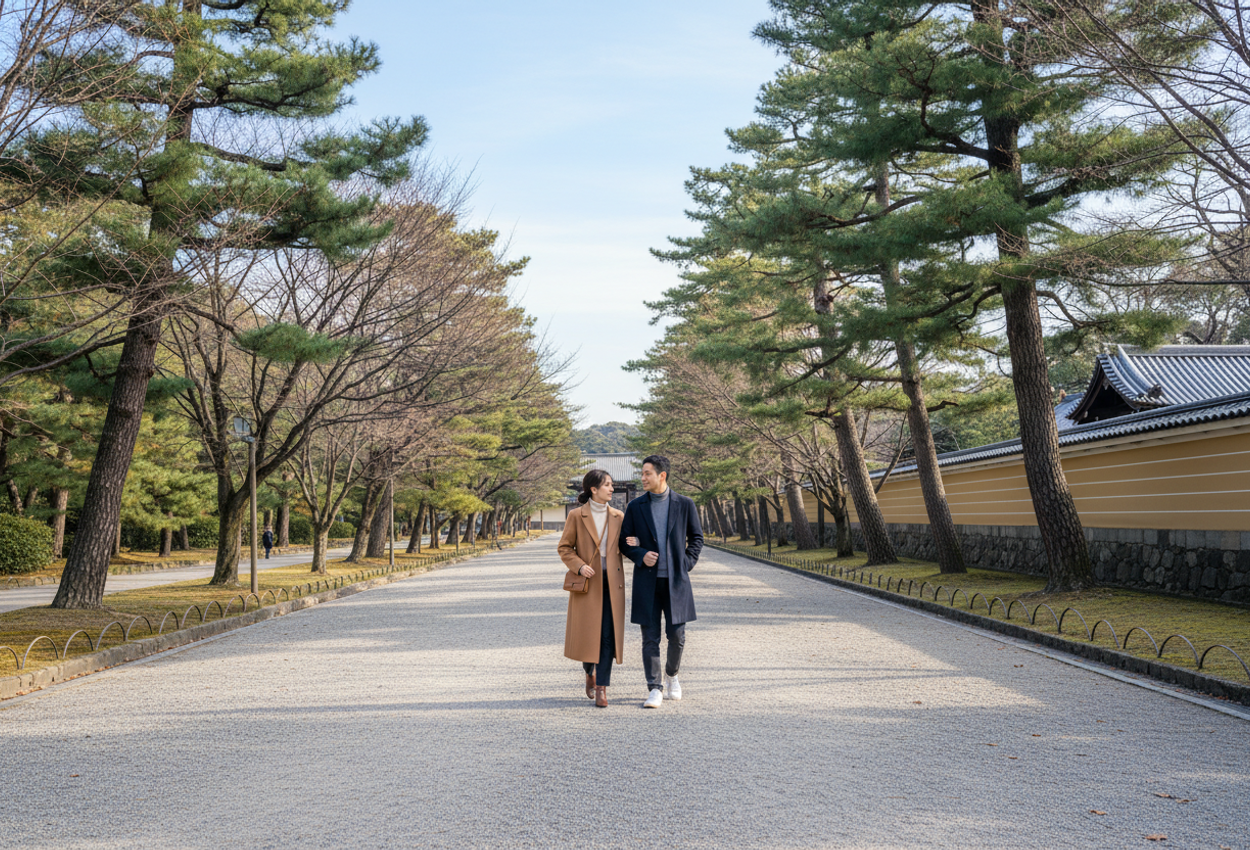
In early February, the garden is in a state of suspended anticipation. Plum trees begin to nudge into bud, promising clouds of fragrance in the weeks to come, while the cherries bide their time, their bare branches rising like calligraphy strokes against a pale sky. This half-resting, half-awakening landscape has its own beauty. You and your partner walk beneath lines of trees that will soon become tunnels of bloom, feeling privileged to see them like this – stripped to their essence, every curve of branch visible. On a bench near a grassy expanse, you share a thermos of steaming green tea, the cup warm between your hands as a chill breeze ruffles your scarves.
A short detour leads you to the restored garden at the Site of the Kan-in no Miya Residence, one of the hidden gems of Kyoto Gyoen. Here, a pond has been re-shaped to echo its Edo-period form, cradled by low hills, rocks, and carefully placed trees. You step onto a small bridge that crosses a narrow inlet, pausing at its center. The water’s surface holds a subdued palette now, but even in winter you can read the promises of seasons to come: irises sleeping at the water’s edge, maples patiently bearing buds, pines maintaining their evergreen watch.
Standing together at this quiet corner of an imperial garden, you feel close not only to each other, but to the countless lives that have played out against this backdrop of carefully composed nature. Young aristocrats walking here under the watchful eyes of chaperones, poets seeking inspiration, modern office workers on lunch breaks – their footsteps have worn the paths you now share. As you leave Kyoto Gyoen, shoes dusted with fine gravel, you carry with you the sense that romance here is not separate from history, but another layer of story written softly into the landscape.
Autumn's Palette: Tofuku-ji Temple's Garden Variety
To the southeast, where the city gives way again to hills and temple roofs, Tofuku-ji awaits – a sprawling Zen complex renowned for its autumn spectacle, yet equally captivating when viewed through the quiet lens of winter. Even in February, the temple’s gardens, carved into precise geometry and charged with symbolic meaning, offer an unexpectedly warm backdrop for a romantic ramble.
You enter through the main gate and follow signs toward the Hojo, the Abbot’s Quarters, where four distinctive dry gardens wrap the building like an intricate frame. Designed in the 20th century yet steeped in ancient principles, they present an almost modernist take on Zen aesthetics. On one side, a checkerboard of moss and stone squares creates a rhythmic pattern that feels both playful and meditative. The moss, dulled slightly by winter yet still alive, fills the alternating squares with roughened green, while pale stone tiles occupy the others. The result is like a living go board, an abstract pattern that seems to invite strategic contemplation.
In another quadrant, raked gravel is punctuated by low, angular rocks suggesting constellations scattered across the cosmos – a “star” garden that reaches beyond its small scale to conjure a sense of infinite space. You and your partner lean against a wooden pillar, tracing imagined lines between stones as though connecting stars. The light slants in through the open walkways, brightening the silver gravel and throwing sharp-edged shadows that shift as a cloud passes overhead. In the stillness, each scrape of a gardener’s rake in the distance sounds astonishingly loud, like a single note plucked on a koto string.
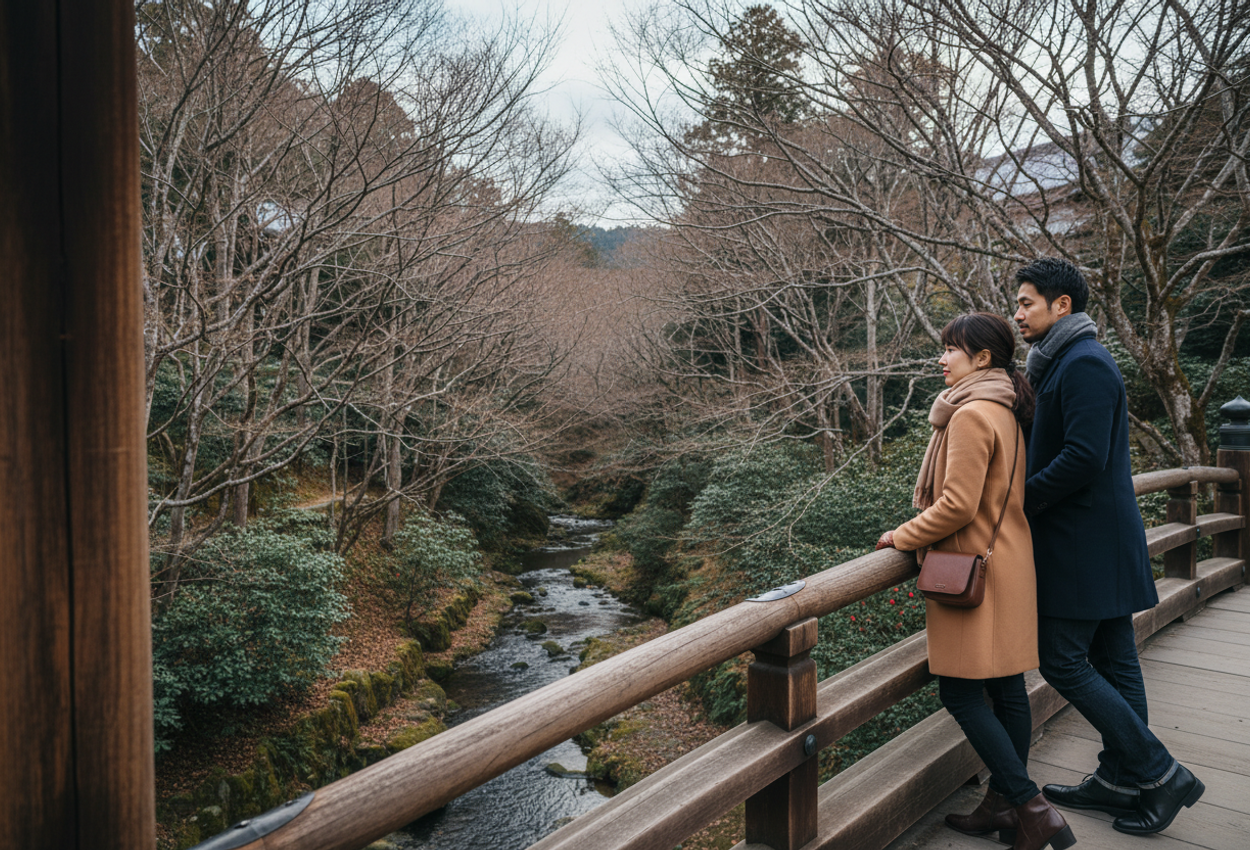
From the Hojo, you move toward the famed Tsuten-kyo bridge, which soars above a valley carved by a small river. In November this view becomes a blaze of scarlet and gold as thousands of maple leaves catch fire; lovers and photographers crowd the bridge to drink in the color. Standing here in February, however, grants a different intimacy. The maples are bare, revealing the graceful architecture of their branches and the subtle, mossy undergrowth that is usually hidden under fallen leaves. The valley becomes a study in line and form rather than color, and the bridge itself feels more like a private vantage than a public stage.
You pause at the center of Tsuten-kyo, looking down into the quiet ravine. The stream is narrow but bright, its water flashing between rocks worn smooth with time. A chill breeze spills along the valley, tugging at your coats; instinctively, you move closer, sharing warmth as your joined hands rest on the wooden railing. In your mind’s eye, you overlay the memory of photographs you have seen – the valley aflame with autumn leaves – onto this spare, wintery scene. The awareness that this landscape will transform so dramatically in months to come fills you with a kind of sweet, anticipatory ache, mirroring how a relationship itself moves through seasons.
Beyond the bridge, the Founder's Hall garden continues the theme of borrowed scenery, using the surrounding hills and forest as an extension of the temple grounds. Stones placed in the foreground mimic distant peaks; mossy mounds echo hillsides; pruned pines stand in for entire forests. Seen from the veranda, the eye moves seamlessly from constructed garden to natural slope, and it is difficult to discern where one ends and the other begins. You and your partner sit side by side, following this visual path together, feeling how the garden encourages a gentle expansion of attention from the intimate to the vast.
Even without the famed explosion of autumn color, traces of that fiery season linger. A few scarlet leaves cling stubbornly to low branches; others gather in sheltered corners, pressed flat and darkened, like memories you are not quite ready to release. As you walk back toward the exit, you exchange a quiet promise to return someday in November, to see Tofuku-ji in full blaze. But part of you already knows that this winter visit, with its subdued hues and thin, crystalline light, will remain equally vivid in your shared recollections – the time when you had the bridge, the gardens, and the temple’s measured silence almost to yourselves.
Cherry Blossom Dreams at Heian Jingu Shrine
Your garden pilgrimage concludes at Heian Jingu, whose vermilion torii rise like a gate between eras at the eastern edge of the city. Passing under the towering arch, you step onto a broad approach that leads to a shrine complex modeled on the ancient Imperial Palace of the Heian period. The vast courtyard, flanked by low, sweeping buildings painted bright vermilion with green roof tiles, feels both grand and surprisingly open, like a stage awaiting some forgotten courtly pageant.
Behind these stately halls lies the true heart of romance here: the Shin’en gardens, a series of strolling landscapes arranged around mirror-still ponds. In early spring, these gardens transform into one of Kyoto’s most beloved cherry blossom sanctuaries. Even now, in February, as you wander the winding paths, you can sense the gathering promise. Weeping cherry trees, their long, flexible branches held in tight bud, arch over paths and water, tracing soft curves against the sky. You and your partner walk beneath their bare boughs, imagining the moment when they will erupt into clouds of pink, each branch a cascade of delicate, double-layered petals.
In your mind’s eye, the Byakko Pond shimmers with reflected color. Soon, the blossoms will trail their fingers along the surface, scattering into the water with every breeze. The fragrance – light, almost almond-like – will hang over the water in a veil. Lanterns will glow in the dusk, and couples will stand on the shore, their silhouettes framed by branches that look like falling silk. Even without that spectacle, the pond is captivating now, holding the muted winter sky and the subtle greens of evergreen shrubs in a gently distorted reflection.
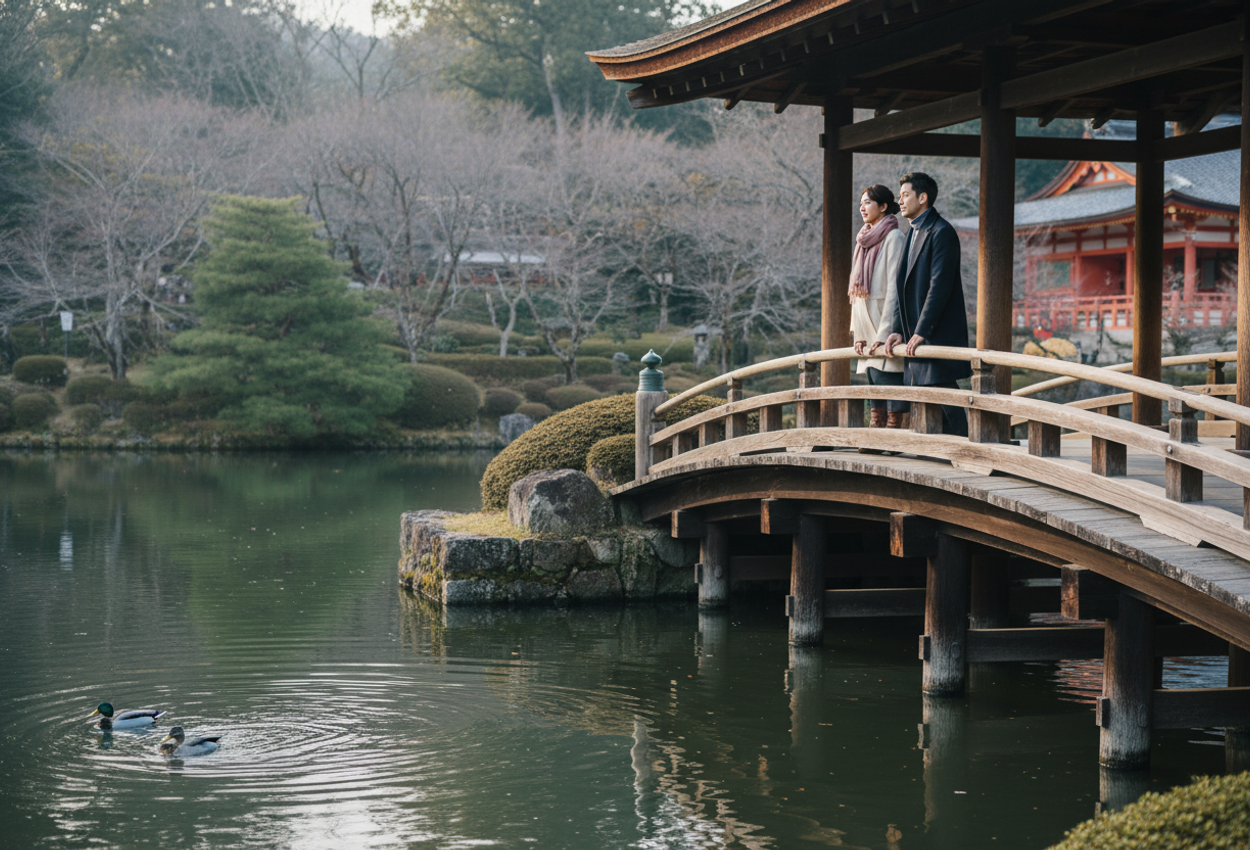
The east garden centers on Seihou Pond, spanned by the elegant Taihei-kaku bridge and its attached pavilion. Inspired by classical Chinese architecture, with graceful eaves and ornamental details, the covered bridge offers a continuous series of views as you cross: here, a cluster of stones rising from the water like small islands; there, a grove of weeping cherries that will soon blur into pink haze; further on, a stand of irises that will later ignite the shoreline in purple. Today, the wind is cool along the bridge’s length, ruffling the pond into a quilt of small ripples and making you grateful for the shelter of its wooden roof.
You walk slowly along the bridge side by side, your footsteps muted on the wooden planks. At each opening between pillars, the garden composes itself anew – a still-life of rocks, shrubs, and sky, waiting just long enough for your gaze before slipping away as you move onward. At the center, you pause to watch a pair of ducks cut twin V-shaped wakes across the water, their movements leaving temporary calligraphy behind them. The scene is so serene that you and your partner fall silent, letting the rhythm of the garden dictate the pace of your thoughts.
As you exit the gardens, cherry trees flank your path once more, their branches reaching overhead like an archway built for future blossoms. You imagine returning in early April, when Heian Jingu becomes a dreamscape of pink and white. The weeping cherries will drape every path, each blossom-laden branch forming a private curtain where couples can pause, half-hidden, to share a quiet word or a lingering touch. The ponds will overflow with reflections of petals and vermilion, and the shrine’s classical lines will appear softened, as if drawn through gauze.
Yet there is something uniquely poignant about standing here in the prelude to all that beauty, when the promise is stronger than the spectacle. You and your partner leave through the grand courtyard, turning once to look back at the vermilion halls and the mountains rising behind them. In that moment, Kyoto feels like a single, vast garden – a place where history and nature conspire to slow time and magnify the small, glowing details of shared experience. From the raked gravel of Ryoan-ji to the future blossoms of Heian Jingu, the city has wrapped you in a quiet, enduring embrace, the kind that lingers long after you have boarded your train home.