There is a particular kind of silence that falls on a train at dusk, a soft hush between the click of the tracks and the low murmur of strangers becoming lovers of the same landscape. On America’s great long-distance trains, that silence becomes a shared heartbeat, carrying you from prairie to canyon, from misted coastlines to wine-scented valleys, at the unhurried pace of romance itself.Embark on the California Zephyr: Chicago to San Francisco
Every great rail romance deserves a ceremonious beginning, and few departures feel as momentous as stepping aboard the California Zephyr at Chicago Union Station. Under the vaulted Great Hall, light pours through the high windows in pale ribbons, glancing off marble floors where generations of travelers have hoisted leather suitcases, clutched paper tickets, and kissed goodbye or hello beneath the same ornate ceiling. Outside, the long silver train waits on the platform, stainless-steel sides catching a muted Midwestern sun, its windows promising a front-row seat to the continent.
Onboard, romance lives in the details. In a Superliner bedroom, you close the door on the city’s rush and find yourself in a cocoon of polished wood, crisp linens, and cleverly tucked-away comforts. There is just enough room for two to move past each other with a brush of shoulders, to sit side by side at the broad window, legs touching as freight yards and brick warehouses slip away, replaced by the tawny sweep of Illinois prairie. A small fold-down table holds a bottle of wine you picked up in the station; the attendant has left chocolates on the pillow, a quiet nod to the journey ahead.
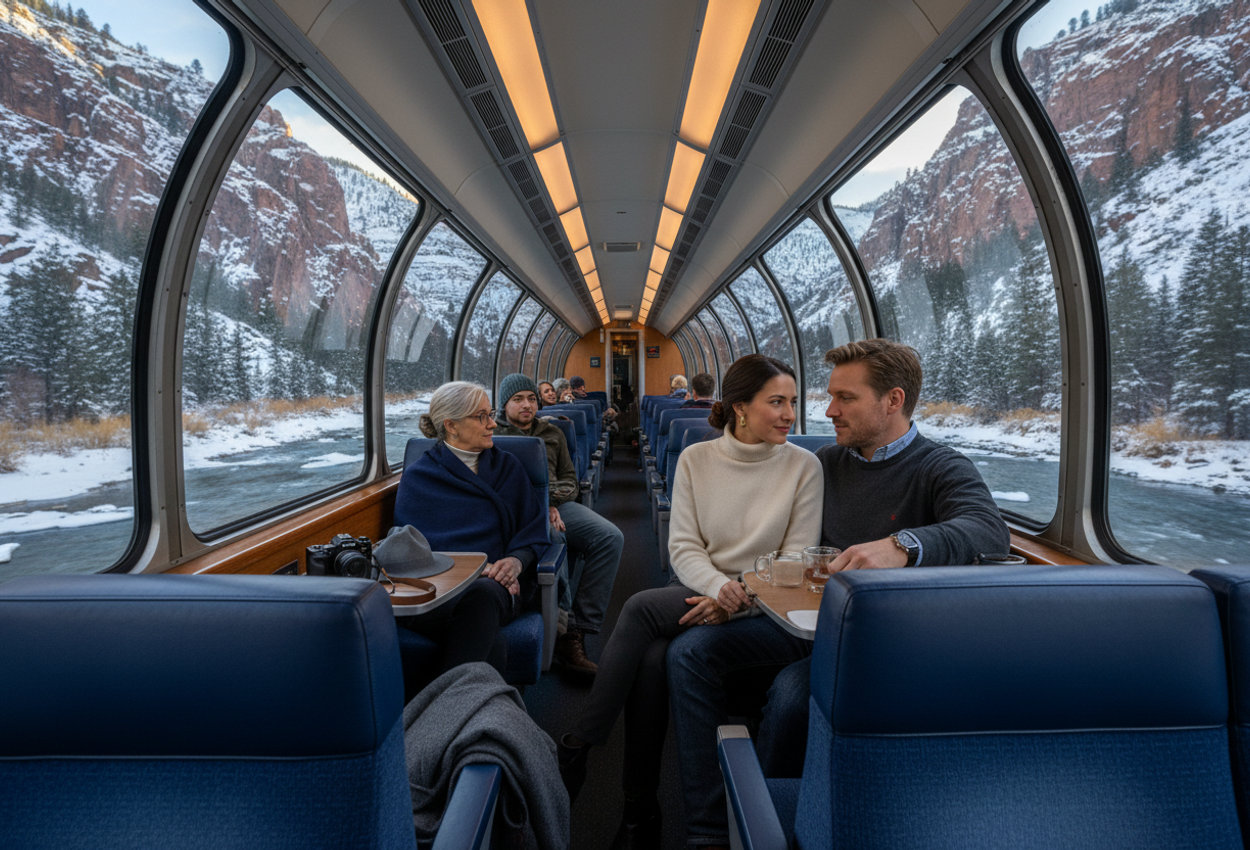
Within an hour you are drawn to the life of the train, and you drift toward the observation car as if by instinct. The Zephyr’s Sightseer Lounge feels like the heartbeat of the route: floor-to-ceiling windows arch overhead, wrapping along the sides of the car so that sky and earth seem to fold around you. Couples settle into swivel chairs and banquettes, cameras in hand but often forgotten as they lean into one another, watching the world widen. The Midwest unspools outside in a tapestry of cornfields, grain silos, and small towns gathered around church steeples. Smoke curls from farmhouse chimneys; a boy on a bicycle waves as the train glides past, your brief encounter framed in glass before it disappears.
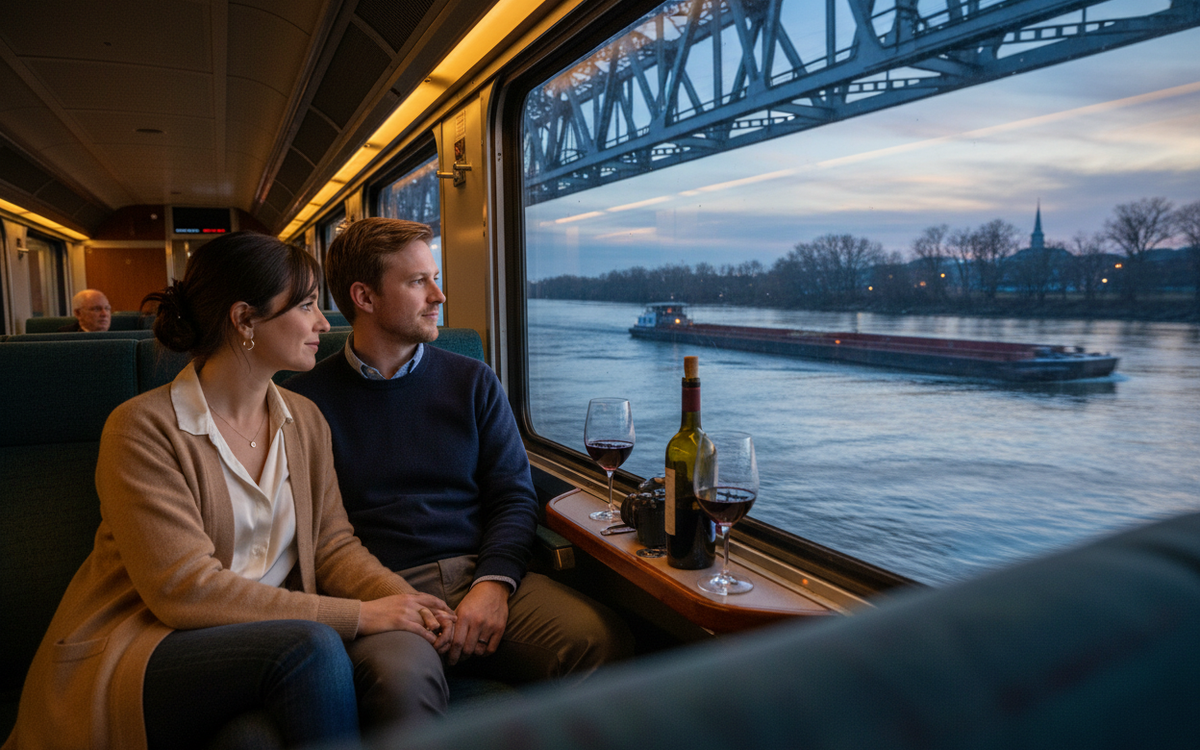
By the time the train reaches the Mississippi River, the light has shifted to honeyed gold. You stand together at the observation window as the Zephyr eases onto the bridge, the water broad and steel-blue beneath. Barges sit heavy in the current; bare cottonwood branches etch the sky. There is the faintest rocking as the train crosses, and for a few suspended minutes you feel as though you are floating, carried not just across a river but into a new rhythm of time.
Nights on the Zephyr are their own kind of enchantment. Over white tablecloths in the dining car, you share a table with strangers who will know your love story only for this brief stretch between timetables. The menu is classic and comforting: herb-roasted chicken, a decent steak, a surprisingly indulgent chocolate torte. Silverware chimes gently; wine glasses catch the lamplight as darkness presses against the windows, broken now and then by the lights of distant farmhouses. Long after dessert, you linger over coffee, not quite ready to give up the illusion that the train is the whole world and everything beyond the glass is just a passing dream.
By dawn the train has slipped into Nebraska, and the prairies glow with a wash of pastel light, frost glistening on the winter stubble. The flatlands begin to ripple as you cross into Colorado, the horizon gathering itself into distant, jagged silhouettes. In the observation car the conversation quiets; people tilt their chins toward the windows as the Rocky Mountains rise, deep blue against a hard, clean sky. Snow clings to the peaks and nestles in ravines, shadowed and luminous at once.
The climb into the Rockies is intimate and dramatic. The train curls along canyon walls, threading through a succession of tunnels that plunge you into velvety darkness and then fling you out into sudden brilliance. Beside you runs the Colorado River, flashing slate and silver depending on the light. Rafters might be scarce in winter, but in warmer months they drift along below, raising paddles to wave at the passing train as if you are fellow adventurers in parallel worlds. At certain points, the canyon walls are so close you could reach out and trace the geology with your fingertips, layers of rust, ocher, and sandstone recording epochs of time.
As evening approaches on the second day, the train reaches Salt Lake City, and here, for romantics with time to linger, the journey can briefly shift from rails to roots. A short stay at the Asher Adams, Autograph Collection turns a simple transfer into a chapter of its own. Housed in the restored Union Pacific Depot, the hotel is a love letter to the golden age of train travel: soaring ceilings, stained-glass windows, and original murals depicting the driving of the golden spike, all softened by plush contemporary furnishings and warm lighting. In the bar, cocktails nod to railroad lore, and jazz murmurs under the low hum of conversation. From your room, you can look down on the former platforms, now reimagined as a grand urban forecourt, and imagine the steam and bustle of departures past.
From Salt Lake City, a side trip adds historical heft to the romance. North of the Great Salt Lake, at Golden Spike National Historical Park, the landscape is harsh, beautiful, and almost eerily quiet. Sagebrush and ocher earth stretch toward low hills, and the sky feels immense. Here, in 1869, a ceremonial spike united the nation’s first transcontinental railroad. Standing on the windswept grade, where replica Victorian locomotives sometimes puff and hiss in re-enactments, you and your partner can read the plaques together, trace the names, and consider the improbable convergence of ambition, sweat, and steel that made coast-to-coast journeys – and this very trip – possible.
When you return to the California Zephyr and follow the line west through Nevada’s stark basins and into the granite drama of the Sierra Nevada, the history lingers. Snow-dusted pines blur past, then open suddenly to reveal broad vistas: frozen lakes mirroring a sky streaked rose at sunset, viaducts arcing over ravines, and at last the slow descent toward the San Francisco Bay Area. As the train curves through Emeryville, the scent of saltwater mingles with diesel and sea breeze. The journey that began among prairie shadows ends in a wash of marine light, and for couples disembarking here, there is a sense that your shared story has been subtly rewritten by everything you watched together through the glass.
Local tip for lovers of indulgence: in the months ahead, private charter railcars attached to the California Zephyr promise an even more cocooned experience, with chef-prepared meals and lounge-like salons. For a milestone anniversary or a once-in-a-lifetime proposal, reserving one of these vintage-style cars can transform a beautiful journey into a truly cinematic one.
Coastal Dreams: Seattle to Los Angeles on the Coast Starlight
If the California Zephyr is a love letter to the mountains, the Coast Starlight is a whispered poem to the sea. It departs from Seattle beneath a canopy of drizzle-silvered clouds, the air smelling of roasted coffee and wet cedar. As the train pulls away from King Street Station, its clock tower receding, you settle into your roomette or bedroom, where picture windows frame the Puget Sound. Ferries glide across the water like patient white birds, and dark forested islands hover in the mist.
Northwest light is moody and mercurial; one moment the world outside is a chiaroscuro of steel water and charcoal hills, the next it breaks into shards of sun scattered on waves. In the first hours southbound, the route threads through evergreens and small coastal towns, the scent of salt occasionally catching in the air when doors open at station stops. You drift to the Pacific Parlour–style lounge or observation car, a shared living room where couples tuck into armchairs, shoulders brushing as they watch the scenery drift by. The pace is gentle, the sense of distance almost abstract – miles tick away, but you are not racing them.
By the time the train glides into Portland, the sky often clears to a soft pewter, revealing bridges spanning the Willamette River, cyclists gliding along riverfront paths, and the distant snowcap of Mount Hood. If your itinerary allows, breaking the journey here for a night or two can add a rich urban interlude – craft cocktails in softly lit bars, shared doughnuts from a cult bakery, a stroll through the Japanese Garden, all before reboarding and sinking back into the rhythm of the rails.
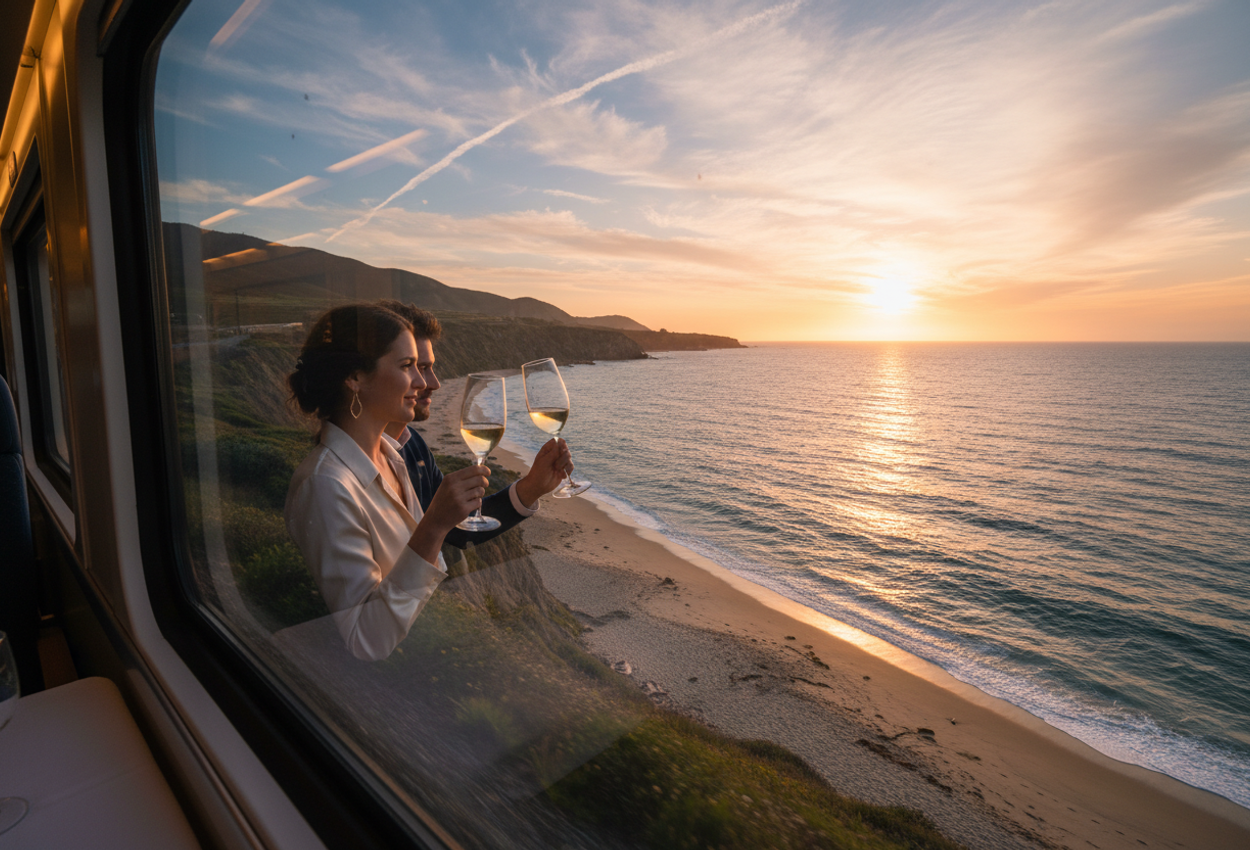
Farther south, the landscape stretches and warms. California announces itself in orchards and golden hills, in the sharp blue of the sky and the way the light pools in the folds of the terrain. Somewhere south of San José, the Coast Starlight begins its flirtation with the sea in earnest. Between San Luis Obispo and Santa Barbara, the train hugs a stretch of Pacific coastline so remote that it feels almost conspiratorial. The tracks cut between bluffs and surf, the ocean only a stone’s throw away. Waves collapse in foaming crescents against narrow beaches; shorebirds rise in startled clouds as the train thunders past; dolphins sometimes arc in the distance, their backs slick and dark against the glittering water.
Here lies one of the true hidden luxuries of this route: a series of secluded beaches accessible only by the railroad and a few service roads, tucked along the protected lands of the Vandenberg coastline and beyond. There is no official station stop for a picnic, but knowing they exist transforms the journey. You and your partner can assemble your own mobile feast – artisan cheese from Seattle’s markets, a crusty baguette, figs, a split of sparkling wine chilled in an ice bucket – and claim a pair of seats in the observation car just as the Pacific reveals itself. As the sun begins to slide toward the horizon, you clink plastic cups over the rhythmic rush of the tracks and watch the water catch fire.
Sunset on the Coast Starlight is a slow unfurling. The sky deepens from washed-out blue to molten gold, then to streaks of tangerine and magenta, all mirrored in the restless skin of the ocean. From your vantage point behind glass, the world feels both vast and intimately yours. The murmur of other passengers softens, and you become aware of the smaller sounds: the soft clink of ice in a glass at the café counter, the rustle of pages turning, the low hum of the engine far ahead. The train seems to float between sea and sky, a silver needle stitching daylight to night.
As darkness settles, the train coasts into Santa Barbara, its station framed by palm trees and Spanish Colonial facades warmed by lamplight. If you choose to pause your journey here, you can trade the gentle sway of the train for the lapping of waves along East Beach, the scent of jasmine winding through quiet streets, and a glass of local Chardonnay at a wine bar in the Funk Zone. For couples, there are oceanfront walks and rooftop tapas bars where the night air tastes of salt and citrus.
Reboarding the Coast Starlight for the final stretch to Los Angeles, you wake to a softer, more urban California. The train threads through coastal suburbs and cityscapes, past surf breaks and highway overpasses, graffiti-bright walls and glinting office towers. Yet even as you approach the stately arched façade of Los Angeles Union Station, with its Art Deco glamour and swaying palms, the mood remains unhurried. Stepping onto the platform hand in hand, you carry with you the memory of sea light on glass, of that long golden hour when time felt elastic and the horizon was yours alone.
Hidden gem for romantics: when booking, aim for a sleeping accommodation on the ocean-facing side of the train between San Luis Obispo and Santa Barbara; seasoned rail fans quietly time their dinner reservations so they can abandon dessert and dash to the observation car precisely as the train meets the sea. This small act of anticipation, shared between two, can become a cherished ritual in itself.
Empire Builder: Chicago to the Pacific Northwest
Where the California Zephyr and Coast Starlight woo you with drama, the Empire Builder seduces slowly, its romance rooted in vastness and the quiet miracle of wildlife glimpsed from a moving train. Once again you depart from Chicago Union Station, but this time the compass points toward the upper Midwest and the far forests of the Pacific Northwest.
The first hours carry you past lakes and tidy towns in Wisconsin and Minnesota, the tracks threading between dairy farms and stretches of birch and maple woodland. In winter, these forests stand bare and skeletal, their branches etched sharply against a pearl-gray sky; in summer they are lush and verdant, flickering green against the train windows. In the observation car, a quiet game begins: who will spot the first deer edging out of the trees at dusk, the first hawk circling above a fallow field?
By the time you wake on the second morning, the land has expanded into the immense, rolling plains of eastern Montana. The sky feels almost impossibly high, a pale dome clearing to a luminous blue as the sun climbs. Coupled together in a pair of lounge seats, you watch long freight lines slide past, their cars painted in sun-faded company colors. Small towns are scattered like punctuation marks, each announced by a grain elevator rising from the horizon. The intimacy here is not in tight canyons or close coasts but in the way the two of you are alone together in such big country, sharing the hush and the passing miles.
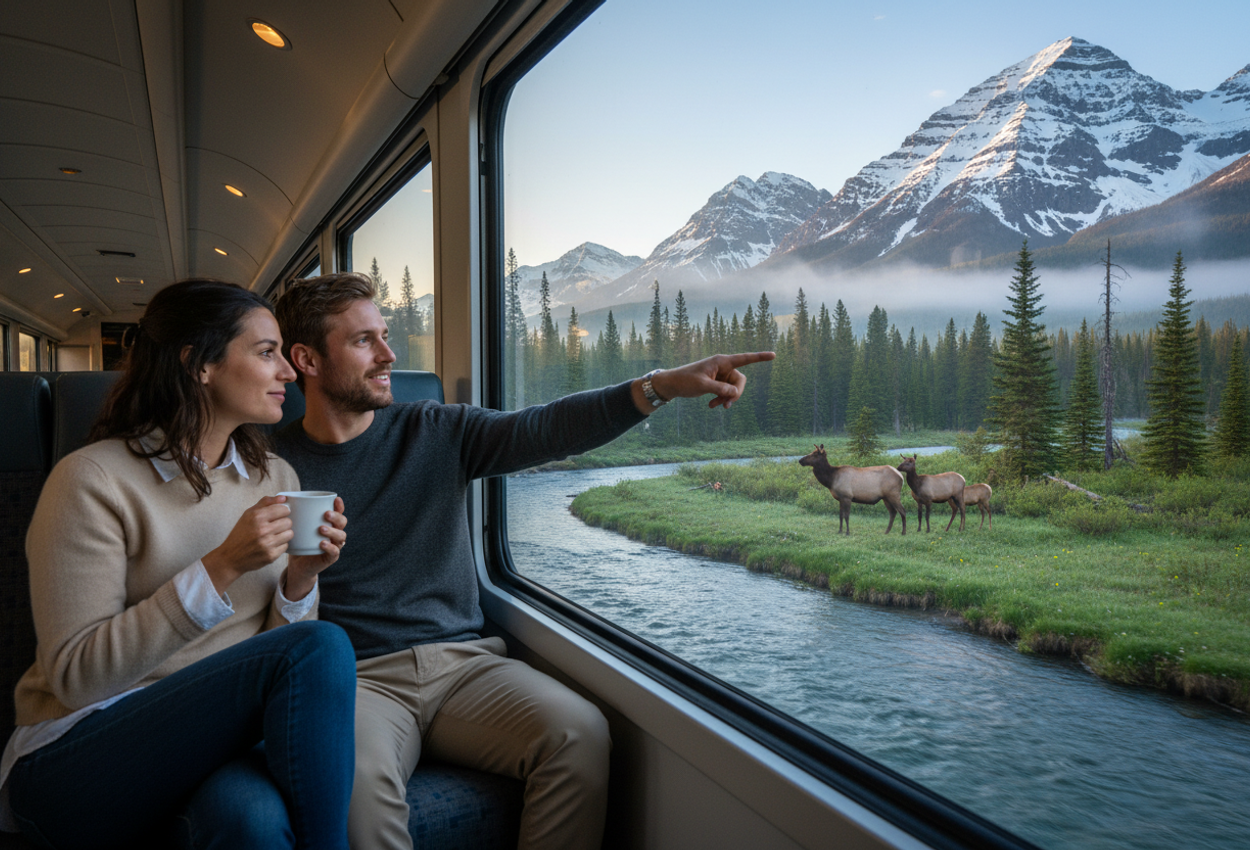
Then, almost imperceptibly at first, a darker line appears along the far edge of the world. The Rocky Mountains gather themselves again, this time sharper and wilder, their snowfields gleaming even in late spring. The Empire Builder skirts the southern boundary of Glacier National Park, and this is where the journey’s romance reaches a kind of crescendo. You press close at the observation windows, searching the slopes for movement. There – a small herd of elk clustered in a meadow, antlers tipped with frost. There again – the distant, unmistakable silhouette of a bear, lumbering across a talus slope. Above the treeline, shadows drift that might be bald eagles, their white heads catching flashes of light as they soar.
For those willing to step off the timetable for a night or two, the stop at East Glacier Park opens onto another world. Here, shuttles and roads lead to the weathered, timbered charm of Glacier Park Lodge, where towering Douglas fir pillars hold aloft a lobby that smells of resin and wood smoke. In the evenings, the air cools quickly; you and your partner can wrap yourselves in wool blankets on the veranda, glasses of local huckleberry wine in hand, and watch alpenglow ignite the peaks of the Lewis Range. The quiet is profound, punctuated only by the distant hoot of an owl or the low murmur of fellow travelers trading trail stories by the fire.
The romance of this segment lies as much in story as in scenery. On certain departures, cultural interpreters or invited tribal storytellers from nearby Native communities board the train to share traditional tales. You might find yourselves in the observation car after dinner, the lights dimmed slightly, as a Blackfeet elder begins to speak. There are no quotation marks, only the cadence of his voice as he recounts legends of the mountains that now glide past in your peripheral vision, of a time when these valleys were peopled by spirits and animals whose paths prefigured the rails you are riding.
Long before iron tracks carved this route, these were trails of migration and ceremony, of buffalo and salmon, of people who listened to the wind and the river as closely as any timetable.
As he speaks, the train hums and sways, and you feel the present layered over the past like translucent paper. You reach for your partner’s hand, and in that simple touch is an acknowledgment that travel can be an act of witnessing as much as escape.
Beyond Glacier National Park, the Empire Builder splits: one branch continues to Seattle, the other veers toward Portland. On the Portland-bound leg, the climax arrives in the approach to the Columbia River Gorge, where basalt cliffs plunge to meet a vast, wind-churned river. Vineyards cling to hillsides; waterfalls ribbon down mossy rock faces in silver veils. The train hugs the water’s edge, and you can lean against the glass watching windsurfers streak across whitecapped waves like bright confetti.
By the time you roll into either Seattle or Portland, the Empire Builder will have given you thousands of shared, wordless moments: a flash of moose in marshland at dawn, fog lifting from pine forests, the sudden blaze of sunset across grain fields. It is a route that encourages a particular kind of togetherness – one defined not by constant conversation but by the quiet, steady act of looking outward, side by side, as the continent reveals itself in slow motion.
Sunset Limited: New Orleans to Los Angeles
If the northern routes are about space and solitude, the Sunset Limited is a tapestry of cultures stitched along a line of steel from the Mississippi to the deserts of the Southwest. It begins in New Orleans, where romance is already thick in the air – in the humid sweetness of magnolia and beignets, in the brass curl of a trumpet from a doorway in the French Quarter, in the way light lingers on the balconies of Royal Street.
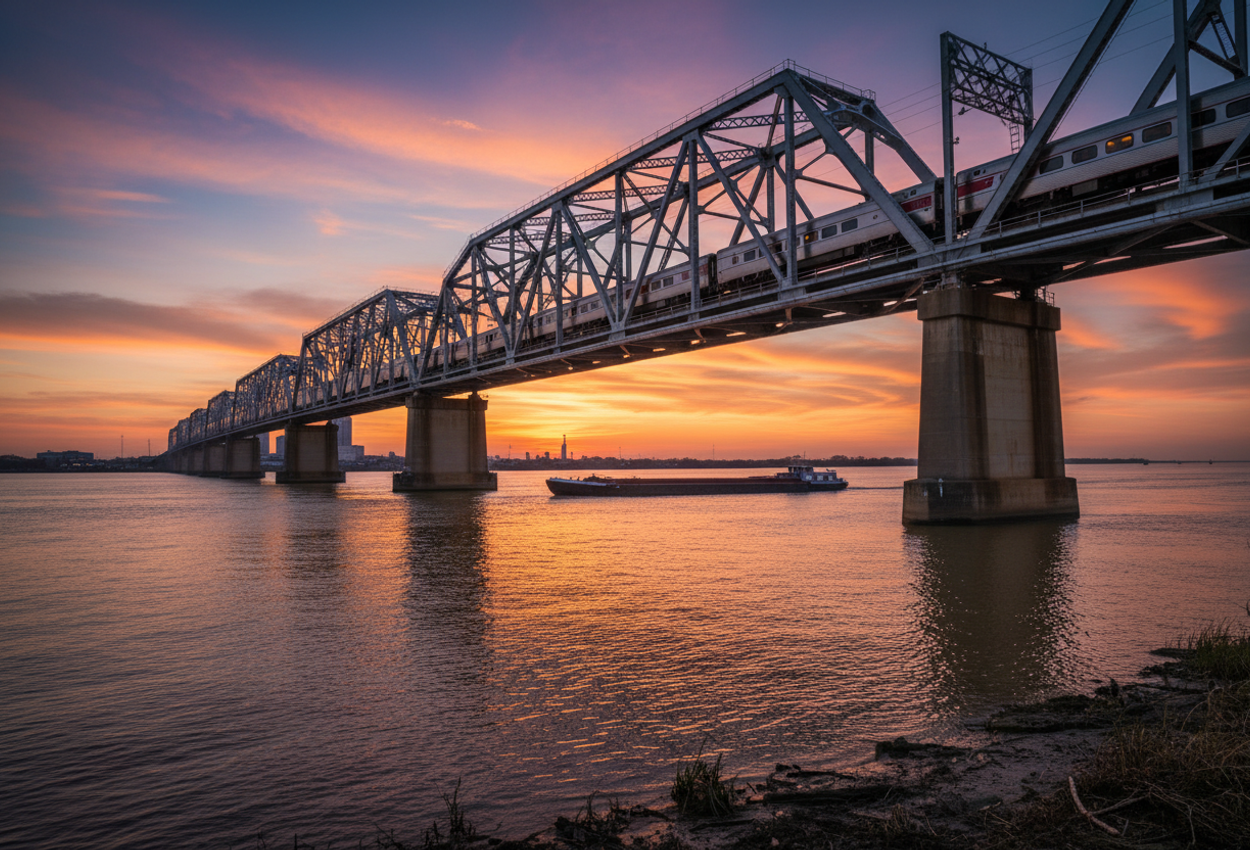
At New Orleans Union Passenger Terminal, as you board the Sunset Limited, the atmosphere shifts from the heady chaos of the city to an anticipatory calm. Your sleeper compartment feels almost nautical, cozy and wood-paneled, ready to carry you smoothly across the South. As the train eases out of the city, the tracks lift onto the legendary Huey P. Long Bridge, its steel trusses framing the broad, muddy sprawl of the Mississippi River below. Couples crowd the observation car windows at this moment, cameras forgotten in their hands as they watch freighters and tugboats slide along the water far beneath, tiny against the vastness of river and sky.
Once across, the train slips into the bayous and wetlands of southern Louisiana. Here, romance lies in atmosphere: cypress knees jutting from still, tea-colored water; Spanish moss hanging in ghostly tendrils; a lone heron poised like a thought at the edge of a marsh. In the heavy, warm air that filters into the vestibules at small-town stops, you can smell brine and mud, wood smoke from distant houses, the faint sweetness of wildflowers in bloom. The tracks curve through small communities tethered to waterways, their houses perched on stilts, their cemeteries bright with above-ground tombs. This is a landscape that moves slowly even when the train does not.
As day deepens, the Sunset Limited continues through Mississippi, Alabama, and into Texas, where the scale begins to adjust itself upward. In the dining car, over plates of étouffée or grilled salmon, you trade glances across the table as the conductor announces the state line crossings, each one a subtle shift in accent and terrain. Outside, pine forests thin, replaced by ranchland and scrub, then by the austere beauty of the West Texas desert. The sky blooms with pink and apricot as the train chases the last light toward San Antonio.
In high season, a National Park Service guide might join you in the observation car for an informal talk about the ecosystems you are sliding past. You and your partner settle with coffee or a nightcap as the guide traces routes of migration and conquest, of Spanish missions and cattle drives, of the complex human and natural histories layered across Texas, New Mexico, and Arizona. It adds a contemplative undercurrent to the romance, reminding you that this seemingly effortless journey rides on centuries of story.
There is, too, a quieter, more private tradition that some couples have made their own. Somewhere along a modest bridge west of San Antonio, where the train slows to cross a narrow ravine, passengers have taken to fastening small, inscribed locks to a discreet section of railing during maintenance stops or rare sanctioned pauses. You will not find it in the timetables, but word travels from rail enthusiast to rail enthusiast: a lovers’ ritual tucked into the infrastructure of the line. You and your partner might choose instead to bring a small lock to clip to a shared travel bag or to your cabin key fob, a symbolic nod to the mythic bridge, promising that your own story will remain moored to this journey long after the rails are behind you.
Beyond El Paso, the colors drain from the land in the midday sun, leaving a palette of pale gold, dun, and dusty green. High desert stretches toward low, serrated ranges; dry riverbeds wind like scars across the earth. Yet as the sun tips toward afternoon, the desert transforms. Shadows lengthen; the sky deepens to a startling cobalt; ridges catch the light in bands of rust and violet. From the observation car, the two of you sit in spellbound quiet as the train becomes a solitary moving point in a landscape that feels almost lunar.
In the small hours, if you wake and venture to the vestibule window, the darkness outside is thick and star-pricked. Far from city lights, the Southwest reveals a canopy of stars that seems to rest just above the train, constellations sharp and shimmering. You might find yourselves whispering not out of necessity but out of reverence, tracing Orion or the Pleiades with your fingertips on the glass as the desert slips by unseen beneath.
By the time you approach Los Angeles, the desert gives way to suburbs, freeways, and finally the palm-lined boulevards and mission-style arcades that herald the city’s spread. Yet even as you step off the Sunset Limited into the tiled, sunlit concourse of Los Angeles Union Station, with its leather armchairs and terrazzo floors, the languid spell of the route lingers. The journey has been a slow unraveling of the continent’s southern edge, and somewhere between bayou mist and desert starlight, your shared sense of time has loosened, giving way to something softer and more expansive.
Grand Canyon Railway: A Journey to the Heart of the Canyon
From coastlines and deserts, your rail odyssey can arc inward to one of the continent’s great natural cathedrals: the Grand Canyon. While the national park is served by roads and buses, the most romantic way to approach its rim remains the Grand Canyon Railway, departing from the high-country town of Williams, Arizona. Here, at the Williams Depot, the spirit of early 20th-century rail travel has been carefully preserved; the air smells of creosote, pine, and wood smoke from nearby fireplaces, and the platform is alive with anticipation as families and couples gather beneath a Western sky.
The train itself is a procession of lovingly restored coaches and dome cars, each with a distinct personality. In the Luxury Dome, leather seats are oriented toward the broad arc of glass overhead, where sky and treetops tumble past. The Luxury Parlor offers upholstered armchairs, polished brass fixtures, and a private rear platform where the tracks unfurl behind you like a silver ribbon. As you settle in with a mug of coffee or a glass of sparkling wine, Western musicians begin to stroll the aisles, guitars slung casually over their shoulders, filling the car with the warmth of live fiddle tunes and old trail songs.
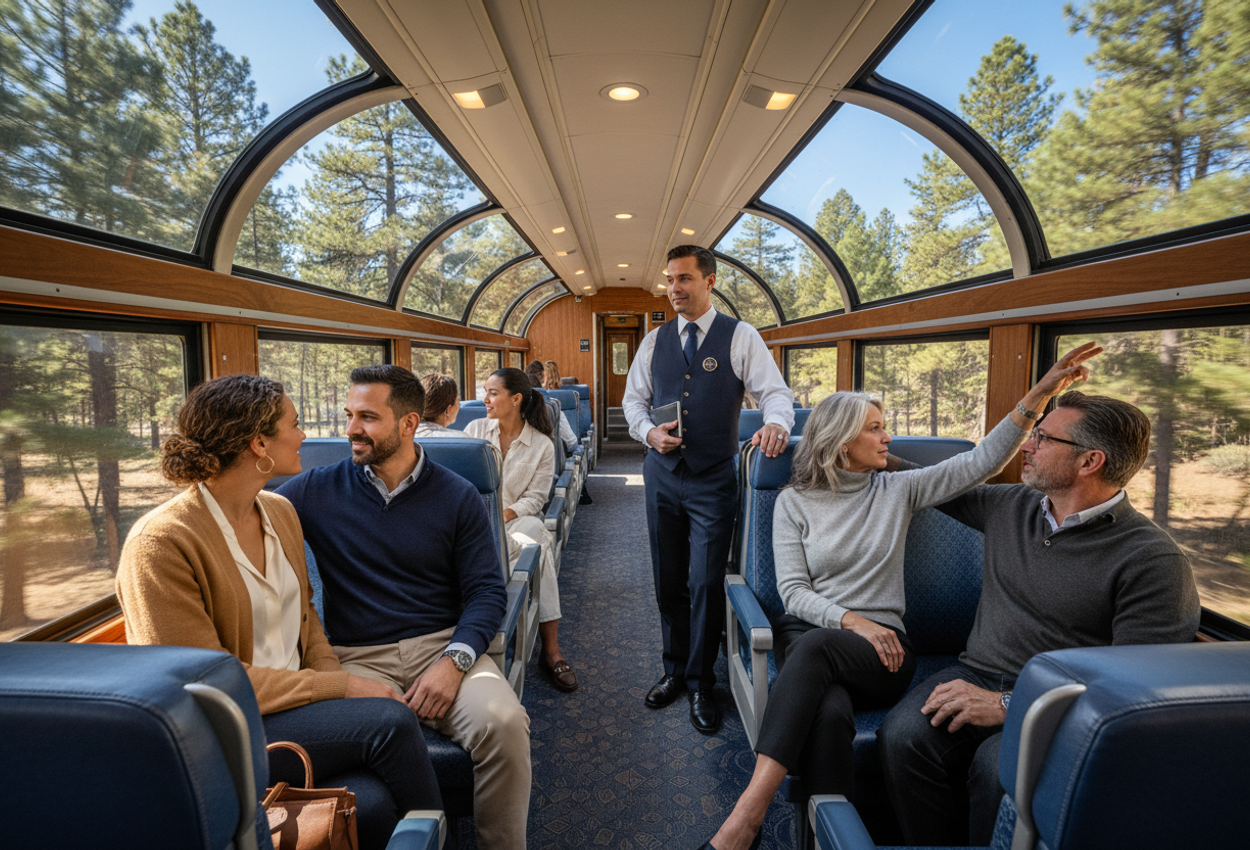
At first, the landscape outside feels familiar to anyone who has driven across northern Arizona: sagebrush flats dotted with ponderosa pine, distant buttes rising from the horizon. But as the train gains elevation, the terrain subtly shifts. Grasslands give way to thicker pine forests; the air that breezes through an open vestibule door is cooler, sharper, carrying the resinous scent of needles and the faint, mineral tang of high-desert soil. In winter, patches of snow gather in the shadows of trees and along the embankments, bright against the dark trunks.
The onboard entertainment adds to the sense of traveling backward in time. Cowboy characters, holsters at their hips and spurs chiming faintly, trade jokes and tall tales in the aisles. A conductor in a brimmed hat stamps tickets with a satisfying, old-fashioned thunk. Children giggle as a mock train robbery plays out – bandits on horseback galloping alongside the train, leaping aboard for a theatrically bumbling holdup before they are inevitably foiled. For couples, the performance is both charming and strangely touching, a reminder that railroads were once the stage upon which much of the American West’s mythology was written.
But the real magic of the Grand Canyon Railway is in the way it prepares you for the canyon itself. As the miles tick by, you feel the altitude in your ears and lungs; the sky seems to broaden; the spaces between trees widen into glimpses of distant ravines. When the train finally rolls into the historic Grand Canyon Depot, one of the last remaining log depots still in operation, you step down onto the platform not into a parking lot but into a forested rim village where the roar of buses is replaced by the soft echo of footsteps on stone.
A short walk carries you and your partner to the first viewpoint, where the world falls away in a vast, rust-colored revelation. The Grand Canyon is too immense to fully comprehend in a single glance; instead, it reveals itself in layers of light and shadow, in the way cliffs stack upon cliffs, in the silver thread of the Colorado River glinting far below. Standing there, shoulder to shoulder at the railing, you might find that your conversation simply vanishes. All the miles of track, all the little dramas of the journey, seem to condense into this single quiet moment of awe.
In the late afternoon, as the sun begins to angle toward the horizon, the canyon’s palette shifts through a spectrum of colors – ocher, rose, deep violet in the recesses. For an unforgettable romantic experience, arrange a stargazing session through a local observatory partner in or near the park. After dinner at one of the classic rim lodges, you stroll out into the darkness with a small group, guided by an astronomer who leads you to a clearing away from lodge lights. The air is cold and beautifully still; you can hear only your own breath and the faintest whisper of wind rising from the canyon.
Beneath this sky, the canyon you saw in daylight is only half the story – above you stretches the other half, a canyon of stars.
Through the eyepiece of a telescope, you might see the swirling bands of Jupiter, the delicate scatter of a distant cluster, the pinprick light of a nebula. But perhaps the most intimate view is with the naked eye, lying back with your partner on a blanket, fingers entwined as you trace the Milky Way arcing overhead, bright and granular in the dry, high-country air. When you finally return to your room, the memory of that starfield follows you into sleep, twined with the distant, comforting thought of rails waiting to bear you back to the world.
The next morning, as the Grand Canyon Railway carries you back to Williams, the train feels different. Faces are tanned by canyon sun, conversations more hushed, as if everyone onboard has been slightly rearranged by the scale of what they have seen. For couples threading this experience into a longer rail itinerary, it becomes a kind of emotional keystone – a reminder that romance thrives not just in candlelit dinners but in shared astonishment at something far larger than yourselves.
Napa Valley Wine Train: Romance on the Rails
No cross-country rail romance would be complete without an ode to indulgence, and for that, you turn to California’s most storied valley. The Napa Valley Wine Train is not about distance covered but about savoring each mile – a rolling salon of polished mahogany, etched glass, and gourmet cuisine winding slowly through vineyards that seem designed for love stories.
Your journey begins at the Napa Valley Wine Train Station in downtown Napa, where the vintage railcars wait gleaming on the tracks, their burgundy and cream livery rich against the greenery of the valley. Stepping aboard is like entering a carefully curated time capsule: plush upholstered seats, brass fittings, white tablecloths already laid with polished silverware and crystal stemware. The air carries the faint bouquet of wine, butter, and rosemary from the galley, where chefs in starched whites are already at work.
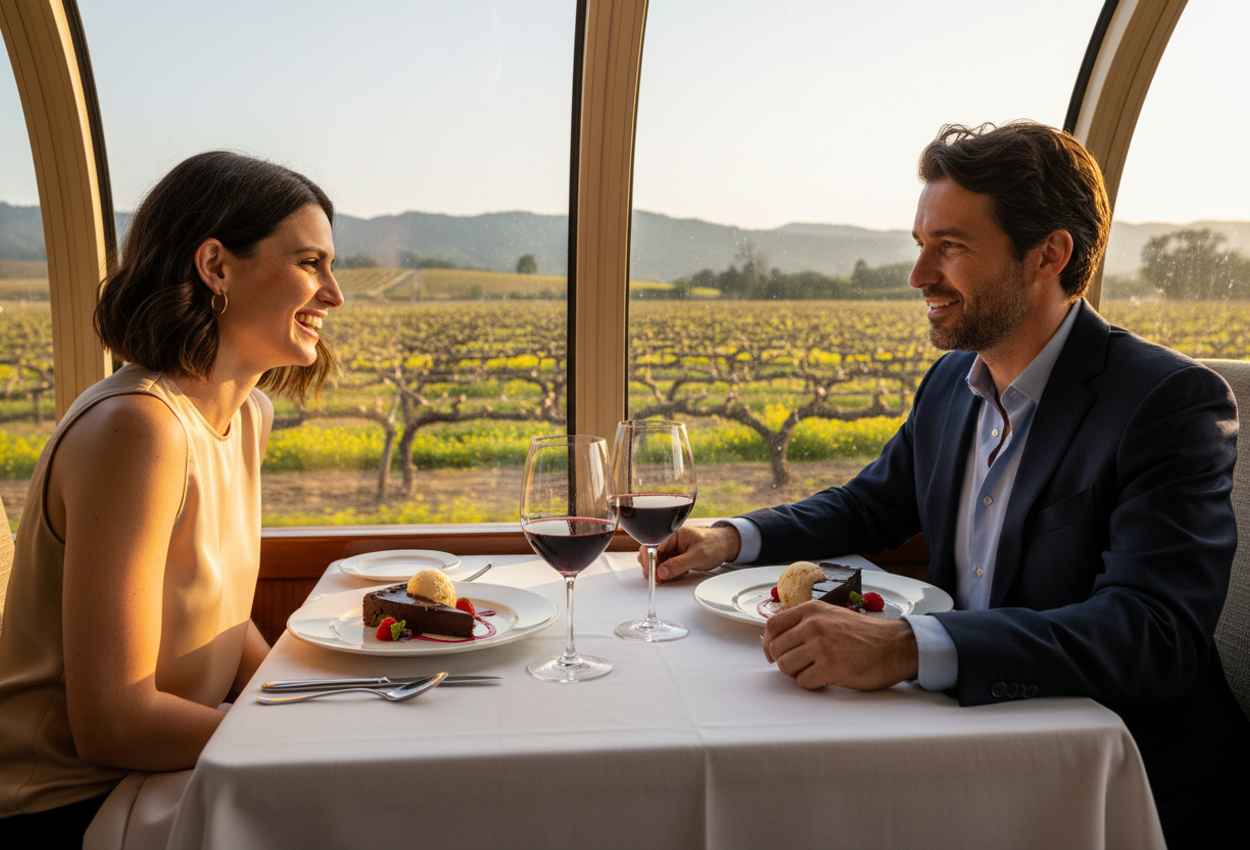
Couples seeking the most cinematic experience gravitate toward the Vista Dome, an elevated glass-domed car where every table is a window seat and the valley seems to flow in slow motion past your plates. As the train glides out of town, you feel the subtle shift from urban streets to rows of vines marching neatly toward distant hills. Depending on the season, the vineyards offer a changing sensual tapestry: in late winter and early spring, the electric yellow of mustard flowers; in summer, dense green canopies; in autumn, leaves flaming crimson and gold, heavy clusters of grapes hanging low on the vines.
The culinary rhythm of the journey is a kind of choreography. A flute of sparkling wine arrives as your server introduces the day’s menu: perhaps a velvety soup lifted with truffle oil, a main course of seared duck breast with cherry reduction, a dessert that leans into chocolate and berries. Silver domes are lifted in unison, revealing artfully arranged plates; the clink of cutlery is punctuated by the soft murmur of conversation and the occasional exclamation as a particularly good pairing lands just right. Outside, wineries famous and small slip by, their names etched on hillside signs, their tasting rooms visible down gravel drives.
Thematic excursions like Romance on the Rails amplify the atmosphere. Tables might be decorated with rose petals; a string duo could move quietly through the car, violin and cello weaving familiar love songs into the air. In an open-air vestibule or specially designed outdoor platform, you and your partner can step out between courses to feel the breeze lifting your hair, to take in the smell of sun-warmed earth and grape leaves, to listen to the soft rhythm of wheels on track set against birdsong drifting from the fields.
Midway through the journey, the train pauses at select wineries, inviting you to step into the landscape you have been admiring through glass. At Charles Krug Winery, the oldest wine estate in Napa Valley, you walk up a tree-lined drive to a historic stone cellar building, where tastings unfold in elegant, high-ceilinged rooms. Barrels line cool corridors; wine in your glass glows ruby or pale straw in the filtered light. You and your partner compare notes – cherry and cedar, citrus and slate – discovering as much about each other’s palates as about the wines themselves.
Later, at V. Sattui Winery, the mood softens into something almost pastoral. Picnic tables cluster beneath ancient oaks; a deli counter groans with artisan cheeses, charcuterie, and still-warm loaves of bread. The scent of grilling meats mingles with lavender on the breeze. You might choose to linger here for a while, assembling a picnic basket to enjoy back on the train, or simply wandering the manicured grounds, glasses in hand, as bells chime from a nearby tower.
For couples who crave a deeper, more hands-on immersion, some itineraries offer a quiet hidden gem: a private wine-blending session at a partnered winery. Guided into a small lab-like room overlooking the vines, you are introduced to barrels of Cabernet, Merlot, and other varietals, each with its own personality. Under the gentle instruction of a winemaker, you begin to experiment, mixing small amounts in beakers, swirling and tasting, adjusting ratios until you land on a blend that feels uniquely yours – brighter and more playful, or dark and brooding, or elegantly balanced. The final result is bottled, corked, and labeled, a liquid keepsake of the afternoon you spent creating it together.
As the train turns back toward Napa in the late afternoon, the light tilts warm and golden, casting long shadows between the vine rows. Live music drifts from an open-air car – perhaps a jazz trio this time, or a singer with a husky voice leaning into a classic ballad. The train slows almost imperceptibly as it passes some of the prettiest stretches of the valley, and you might find yourselves leaning against the rail of an open platform, your personalized bottle tucked safely away, watching as hot air balloons float like lanterns above the hills in the distance.
Back at the station, as you step down from the Napa Valley Wine Train, the world feels both sharper and softer at once. Colors seem more saturated; the memory of oak and tannin lingers on your tongue. The experience has been shorter than your long-distance journeys, but no less profound – a concentrated, sensorial distillation of what makes romance on the rails so enduringly irresistible. It is not just about where the tracks take you, but how they invite you to move more slowly through taste and time, to savor each shared glance and each unfolding view.
For those stitching these experiences into a grand cross-country itinerary, the secret is to treat each route not merely as transport but as a chapter in a larger love story. Begin in the marble echoes of Chicago, weave through mountains, coasts, deserts, canyons, and vineyards, and let the rails teach you the subtle art of moving slowly together. On America’s great trains, romance is not an exception but the very logic of the journey – a steady, rhythmic invitation to fall in love with the world, and with one another, all over again.