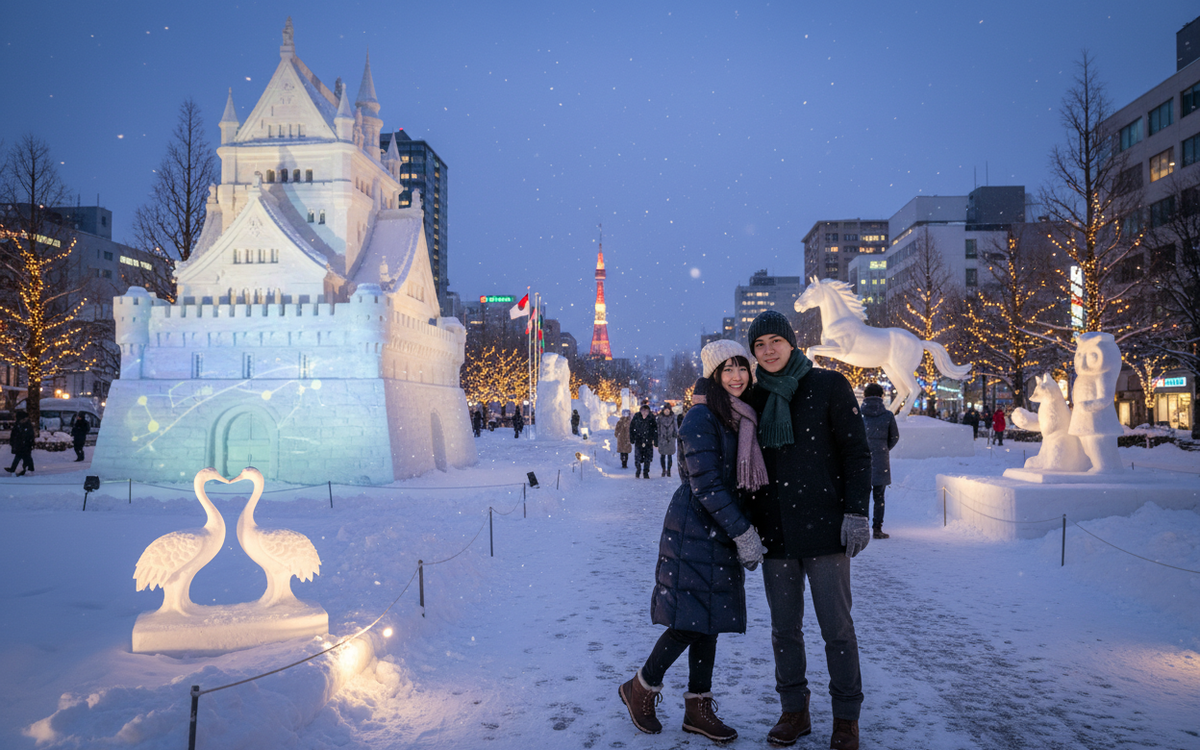
In the heart of Hokkaido’s deepest winter, when breath turns to silver and the sky hangs low with snow, the Sapporo Snow Festival becomes less an event and more a love story written in ice and light.First Impressions A Blizzard of Romance
Stepping out of Sapporo Station on a February afternoon, the first thing that hits you is the air. It is sharp and crystalline, like biting into an apple straight from the snow. Cars hum past on wet, salted streets, but above that low urban murmur floats something else entirely the distant thrum of music, the bright peal of laughter, and the faint crackle of loudspeakers from Odori Park, where the Sapporo Snow Festival unfurls like a frozen fairytale down the spine of the city.
You and your partner follow the current of bundled-up festivalgoers, boots squeaking in compacted snow. The sky is turning the soft blue of approaching dusk, and ahead, through a haze of drifting flakes, towers the first snow sculpture a gleaming white colossus rising above the treetops. Food stalls begin to appear as you near the park, each sending different aromas into the frosty air: the buttery perfume of grilled Hokkaido corn, the briny steam from giant crab legs, the smoky whisper of charcoal yakitori. Each scent seems magnified by the cold, as if the winter air sharpens every note.
At the edge of Odori Park, the city slips away. Snowbanks shoulder the pathways, sculpted more by human footsteps than by plows, and fairy lights wrap themselves around bare branches. Children shriek happily as they tumble in powder beside the paths, mittens fat and clumsy, while couples walk arm in arm, cheeks flushed pink above scarves. Somewhere, a busker strums a guitar with gloved hands, the chords slightly muffled yet oddly soothing in the muffled acoustic of the snow.
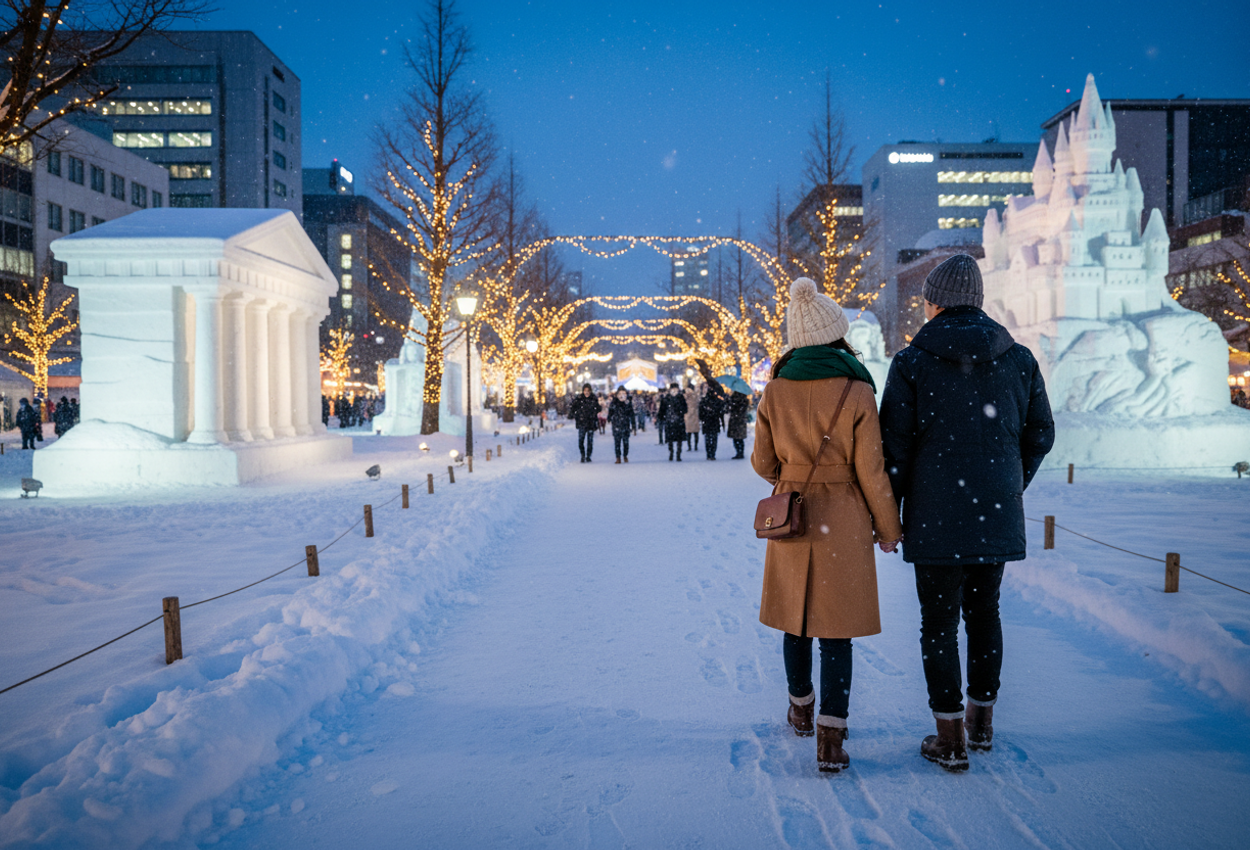
It is here that the romance of the festival really takes hold in the details, in the way your partner’s hand finds yours as a gust of wind sends snow spiraling between the sculptures, or in the soft hiss of snow settling onto the shoulders of a snow-carved castle. Each breath you share hangs briefly in front of you before disappearing into the same cold ether, as if the city is quietly absorbing your presence into its winter story.
Ahead, the broad white avenue of the main site stretches from block to block, with sculptures ranging from modest, chest-high figures to monumental facades the size of apartment buildings. Yet your first true moment alone together will likely happen not in front of the largest, most crowded installation, but on the periphery. Slip westward beyond the densest crowds, toward the quieter blocks of Odori Nishi 10-chome and 11-chome, where the stream of visitors thins and the sculptures stand a little more solitary against the night.
Here, the snow crunches more distinctly underfoot, unsoftened by constant trampling. The chatter fades to a background murmur, and you can hear the faint swish of falling flakes landing on down jackets and wool hats. A small snow statue of a fox, unnoticed by most, hides near the base of a towering installation its face tipped upward as if sniffing the sky. Nearby, a bench dusted in fresh snow waits under a lamppost that glows with a halo of light caught in the drifting flakes. For a moment, the festival belongs entirely to you. You brush the snow from the bench, sit close, and watch as the ice and snow ahead begin to glow with the deepening of evening.
Hidden Gem The observation deck of the Sapporo TV Tower, at the eastern end of Odori Park, is no secret during the day. But time your visit for early evening, just as the lights on the sculptures flicker on, and you will often find fewer people than at peak night hours. From this height, the festival is transformed into a glittering corridor of white and pastel lights, a perfect tableau to share in quiet awe before descending hand in hand back into the snowy streets.
Odori Park Sculptures A Love Story in Snow
By full nightfall, Odori Park has turned into an illuminated gallery under the open sky. The snow beneath your boots is packed and granular, catching the colored lights in tiny flecks of ice. Music drifts from one of the main stages where a local choir sings, their harmonies rising like white breath into the darkness. The sculptures themselves stand in regal silence, each one a chapter in the festival’s decades-long history, which began in 1950 with just six statues sculpted by local students and has grown into one of the world’s most acclaimed winter events.
The most dramatic of these creations tower above you. One block might be dominated by a painstaking reproduction of Neuschwanstein Castle, its turrets and balconies reduced to their purest architectural lines in compacted snow. Another might feature a galloping thoroughbred carved mid-stride, every muscle and tendon captured with improbable delicacy. Floodlights wash these frozen facades in shades of blue, violet, and pearl white, lending them a dreamlike, almost lunar quality. As projection mapping begins, animated light races across the surfaces, transforming a snowy palace into a canvas for auroras, constellations, and scenes from Japanese folklore.
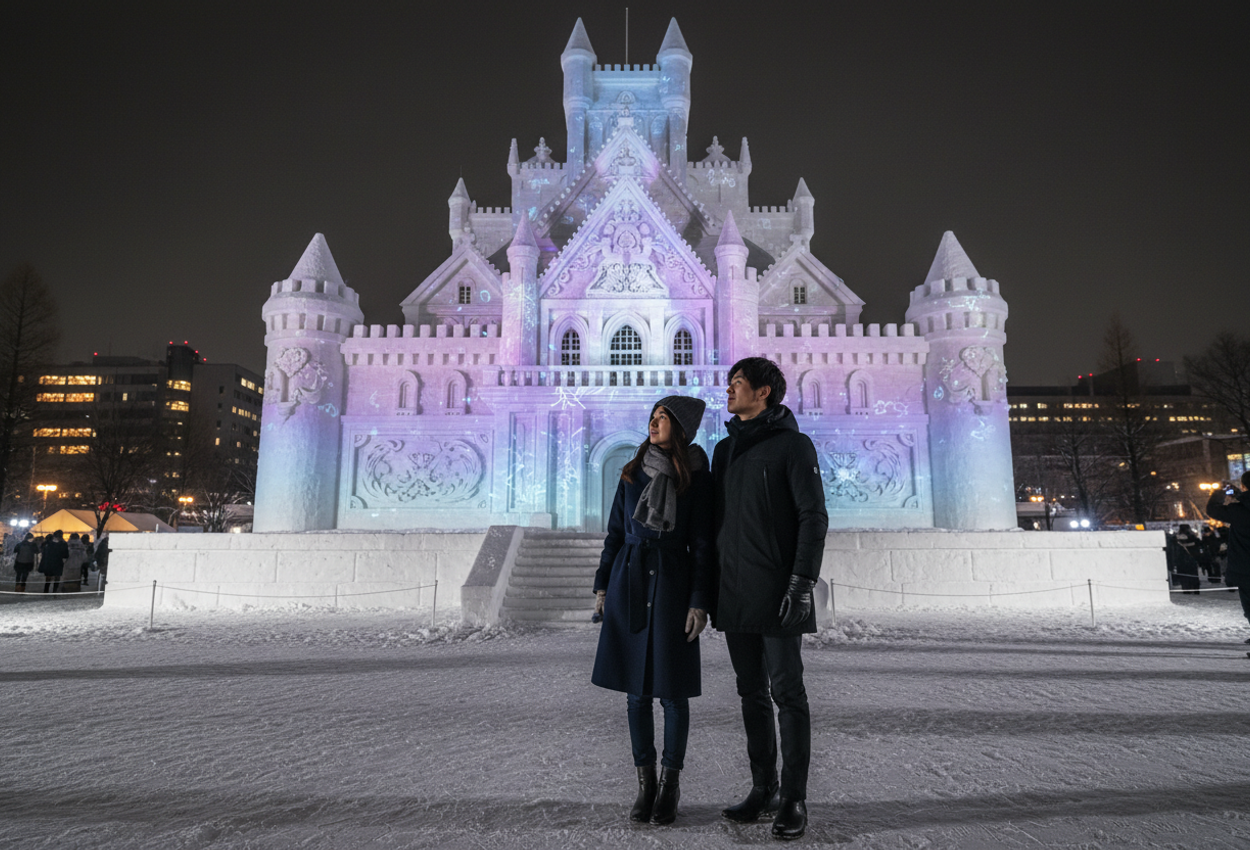
Amid the spectacle, your eyes are drawn to smaller, more intimate details: the curve of a snow-sculpted hand resting on a balustrade; the lacework of snow carved into a kimono sleeve; the suggestion of wind in the folds of a cloak. One sculpture presents an elegantly carved couple standing side by side, modeled after traditional wedding figures from northern Japan. Their faces are serene, turned slightly toward each other, noses almost touching. You stand there with your partner, inches from these frozen lovers, noticing how the sculptor has carved a single delicate snowflake on the hairpin of the bride a detail many visitors breeze past without seeing. Under the lights, that modest motif glows softly, like a secret blessing for anyone who notices.
Not far away, the International Snow Sculpture Contest transforms a section of the park into a global village of creativity. Each block of snow is a canvas for a team from a different country, their national flags fluttering above scaffolding. You might find an intricately carved naga serpent from Thailand, a swirling dream motif from Lithuania, or a powerful human figure depicting harmony crafted by artists from Portland or Daejeon. Couples wander slowly from piece to piece, sometimes catching the sculptors at work during the early days of the festival, chisels flashing in the floodlights, the sound of metal on snow like the clinking of porcelain.
There is a romance in watching the transformation happen in real time. One evening, you pause at a half-finished sculpture a great arc of snow curling like a breaking wave while a young sculptor from Mongolia steps back, eyes narrowed in concentration. You exchange a few words through smiles and gestures, ask about the inspiration for the piece. They describe it as a story of dreams and promises the way snow, ephemeral and fragile, can still be shaped into something meaningful. As you walk away, you and your partner find yourselves talking not about the cold, but about your own shared dreams, drawn out by the quiet poetry of their work.
Scattered between the showstoppers and the contest entries are citizen sculptures, the beating heart of the festival. Here is where local schoolchildren carve beloved anime characters, where community groups shape owls, foxes, and cranes inspired by Hokkaido’s wildlife, and where families pose proudly beside wonky snowmen with lopsided grins. It is easy, in the glow of the larger installations, to overlook a small tableau near the back of one block a modest snow sculpture of intertwined cranes, their long necks forming a heart. Look closer and you will see that each feather has been delicately scored into the snow, giving the birds a surprising lightness, as if they might shake free of their frozen state and take flight.
Hidden Gem Among the citizen sculptures, seek out the medium-sized piece often dedicated to Snow Miku, the winter incarnation of virtual singer Hatsune Miku. Beyond the obvious charm of the character, the real magic lies at her feet. Many years, the sculptors etch tiny motifs of Hokkaido’s winter produce scallop shells, ears of corn, crab claws, or steaming bowls of soup curry into the base. Kneel to trace these details with your eyes; they tell a quiet love story between the region and the people who call it home, one that couples with a fondness for food and culture will appreciate together.
Susukino Ice Sculptures Neon Nights and Frozen Dreams
If Odori Park is the heart of the Sapporo Snow Festival, then Susukino, the city’s legendary entertainment district, is its pulse after dark. From Odori, you ride the subway just one stop south, emerging into a riot of neon signs, steamy noodle shops, and the muffled thump of bass from underground bars. Here the air is scented with grilled lamb from jingisukan eateries and the faint tang of shochu on the breath of office workers spilling out of izakaya. Yet as you walk up Ekimae-dori, an unexpected serenity appears: rows of crystalline ice sculptures lining the avenue like a parade of frozen spirits.
These are no simple blocks of ice. Under the streetlights and colored spot beams, the sculptures gleam with an inner luminosity. Some capture marine life in astonishing detail translucent salmon leaping mid-arc, octopus tentacles curling around an invisible current, crabs with every segment of shell and claw meticulously etched. Others take the form of mythical beasts, dragons whose scales catch and scatter the neon glow from nearby cocktail bars, or phoenixes mid-rise, their wings rendered in delicately fanned sheets of ice as thin as rice paper.
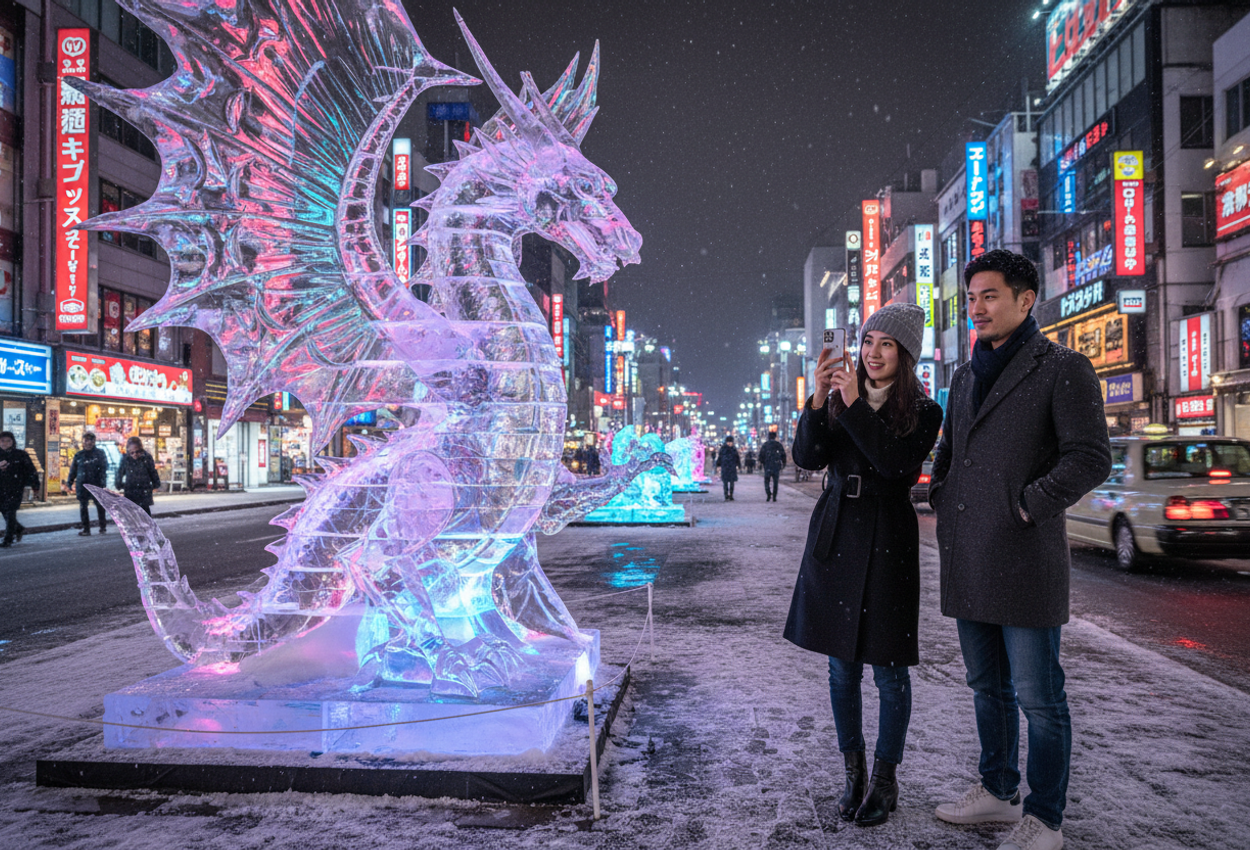
The atmosphere is electric and strangely intimate at once. Couples in thick coats walk shoulder to shoulder down the central path, their boots slushing through plowed snow, while taxis push past on the adjacent road, headlights smearing into bands of white and amber across the reflective ice. Somewhere, a bar door swings open, releasing a fleeting burst of warm air laced with cigarette smoke, laughter, and jazz saxophone before snapping shut again. The contrast between the warmth within and the glittering cold without defines Susukino’s particular brand of romance a promise of shelter at the edge of winter.
As you move among the sculptures, the ice begins to play tricks. The neon kanji from a towering sign above a ramen shop bends and fractures within a clear pane, multiplying into a cascade of floating characters. Your partner’s reflection appears suddenly inside a block of ice carved into the shape of a heart, their face doubled and softened by refraction. You step closer, press gloved hands together around the cold edge, and for a moment it feels as though you are both preserved within this brief, glittering instant of midwinter.
Every so often, you encounter interactive installations tables of ice where glasses of hot amazake are served, or small, illuminated alcoves where local bartenders mix drinks inspired by the festival. One ice bar might offer a cocktail laced with yuzu and Hokkaido vodka, served in a glass that has been chilled until its rim frosts over in seconds. The first sip sends warmth racing through you, the citrus lifting sharply against the deep chill of the night.
It is easy to be distracted by the glow and the crowds, but look for a more tranquil vantage point. Just off the main avenue, on an upper floor overlooking the sculptures, lies Bar Yamazaki in the heart of Susukino, a legendary cocktail bar revered by locals. From a window-side table, you and your partner can watch the flow of people weaving between the ice artworks while cradling perfectly balanced drinks in heavy crystal glasses. Inside, the only sounds are soft jazz and the gentle clink of ice cubes; outside, colored light continually washes over the sculptures, tinting them now blue, now pink, now gold. The effect is like watching a silent film of the festival in slow motion.
Hidden Gem For an unexpectedly romantic interlude, seek out one of the smaller side streets parallel to the main Susukino ice display. Here, lesser-known sculptures often appear in front of individual bars and restaurants small ice lanterns, fish encased in blocks of ice for dramatic display, or hand-carved logos glinting by doorway lights. These quieter corners are ideal for slipping away from the crowds to whisper over plans for a late-night bowl of ramen or a final nightcap, wrapped in the district’s kaleidoscope of reflections.
Tsudome Site A Playground for the Young at Heart
When daylight returns and the frost on the hotel window melts into intricate patterns, the festival reveals another personality altogether at the Tsudome site. Located a short ride from central Sapporo, this sprawling snow park trades neon and nightlife for laughter and the squeals of delighted children. Yet for couples, it offers something just as precious the chance to be unabashedly playful together, to rediscover the giddy thrill of speeding down a slope or tumbling into snow without care.
As you arrive, the first sound you hear is the low rush of people sliding over snow. Wide, groomed hills stretch out before the dome, carved into multiple lanes like frozen waves. Couples, families, and groups of friends queue patiently with inflatable rafts and giant tubes, each ascent rewarded by the adrenaline of the ride down. The air is alive with the whoosh of rubber on packed snow and the rising chorus of delighted screams that break into laughter at the bottom.
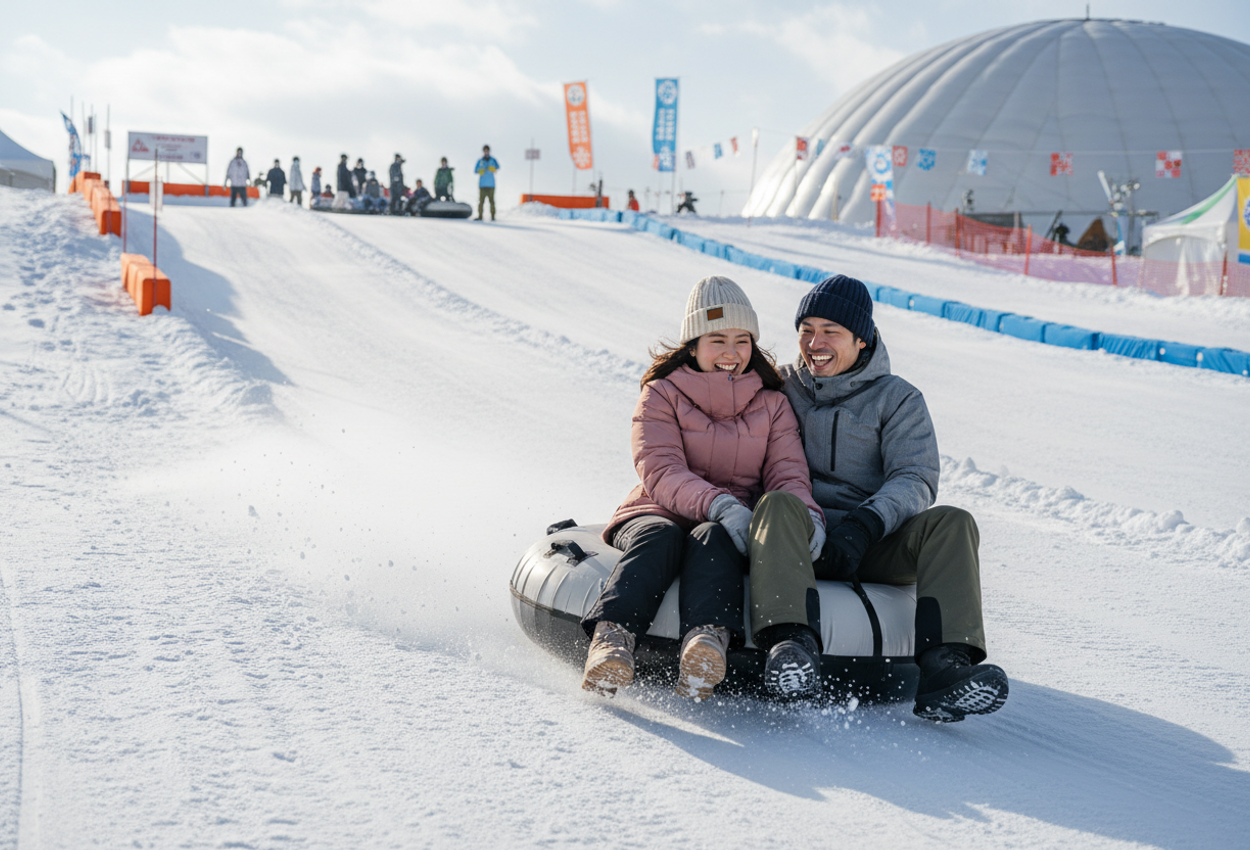
You and your partner grip the handles of a shared snow raft, hearts thudding beneath thick layers of fleece. A staff member gives a cheerful push, and suddenly you are hurtling downward, the cold wind slicing tears from the corners of your eyes, the snowbanks on either side blurring into white streaks. You lean into one another instinctively a shared reflex of balance and trust and by the time you skid to a stop, both of you are doubled over in breathless laughter, cheeks stinging but spirits soaring.
A little further on, smaller slopes beckon with snow tubing and child-sized slides, each one a miniature version of the main run. The scene is a study in winter joy helicopter parents jogging alongside sliding toddlers; teenagers filming each other on phones, shrieking as they spin uncontrollably; couples making snow angels in the untouched drifts between the official play zones. The scent of grilled sausages and hot chocolate drifts from nearby stalls, blending with the crisp, almost metallic smell of very cold air.
Inside the dome itself, the energy shifts. You step through heavy doors into a cavernous space humming with warmth and the buzz of hundreds of voices. Children clamber across inflatable playgrounds, while couples wander between food booths sampling regional specialties. Strings of lights hang from the ceiling, their golden glow making cheeks rosier and eyes brighter. You and your partner share a steaming cup of corn soup, its sweetness heightened by the chill you left at the door, or perhaps nibble on hot, buttered potatoes until your fingers thaw.
But it is outside, beyond the most boisterous slides, that Tsudome reveals its most romantic side. As afternoon wanes and the low northern sun casts long, blue shadows across the snowfield, a quieter path leads away from the central hub. Following it, you find a small staging area where a pair of sturdy horses wait, their breath steaming in thick plumes, harnesses adorned with bells that chime softly with every shift of weight. Here begins one of Tsudome’s most enchanting experiences a horse-drawn sleigh ride through the snow.
You and your partner climb into the wooden sleigh, its seat piled with thick blankets that smell faintly of straw and wool. As the driver gives a gentle command, the horses set off with a gentle lurch, hooves muffled against the snow. The world narrows to the rhythmic jingle of bells, the creak of leather harnesses, and the near-silence of runners cutting twin lines across the frosted field. Snow-laden trees rise on either side, their branches bending under the weight, and a faint glow from the dome and surrounding stalls lingers behind you as you glide into a softer darkness.
In this pocket of quiet, the festival feels far away. The sky deepens from pale gray to a wash of indigo, and the first stars appear above the low city skyline. You lean in close under the shared blanket, your partner’s shoulder pressed warmly against yours, the air around you crisp enough that every exhale appears like a tiny cloud. The driver, sensing the mood, keeps conversation to a minimum, letting the winter landscape speak for itself. There is a feeling here of being suspended in time, your sleigh gliding somewhere between childhood memory and a scene from an old romance film set in a Hokkaido snowfield.
Hidden Gem Many visitors rush through Tsudome, checking off the big slides and snow rafting before racing back to Odori. Resist the urge. Linger until late afternoon, when day trippers begin to thin out. The late-day sleigh rides, when the sky is just tipping from gold to blue, are often quieter and infinitely more atmospheric, offering couples a chance to experience the festival’s playful side giving way to something deeper and more reflective.
Festival Flavors Hokkaido's Culinary Delights
No matter how wondrous the sculptures, love stories in winter are sustained by warmth and flavor. At the Sapporo Snow Festival, this warmth is everywhere in the form of steam rising from street stalls, the glow of lanterns over food courts, and the shared ritual of wrapping chilled fingers around a bowl of something hot and comforting. Nowhere is Hokkaido’s culinary soul more vividly on display than at the festival’s many food zones, where local specialties turn the cold into an excuse for indulgence.
At the Odori site, dense clusters of food stalls anchor several blocks, their canopies flapping lightly in the wind. From a distance, you see columns of steam drifting upward like ghostly banners, marking the places where soups bubble and grills sizzle. Walking closer, you pass handwritten signs advertising buttery jagabata baked potatoes split open and slathered with thick Hokkaido butter, skewers of scallops grilling in their shells, and bowls of miso-laden Sapporo ramen crowned with slabs of chashu pork.
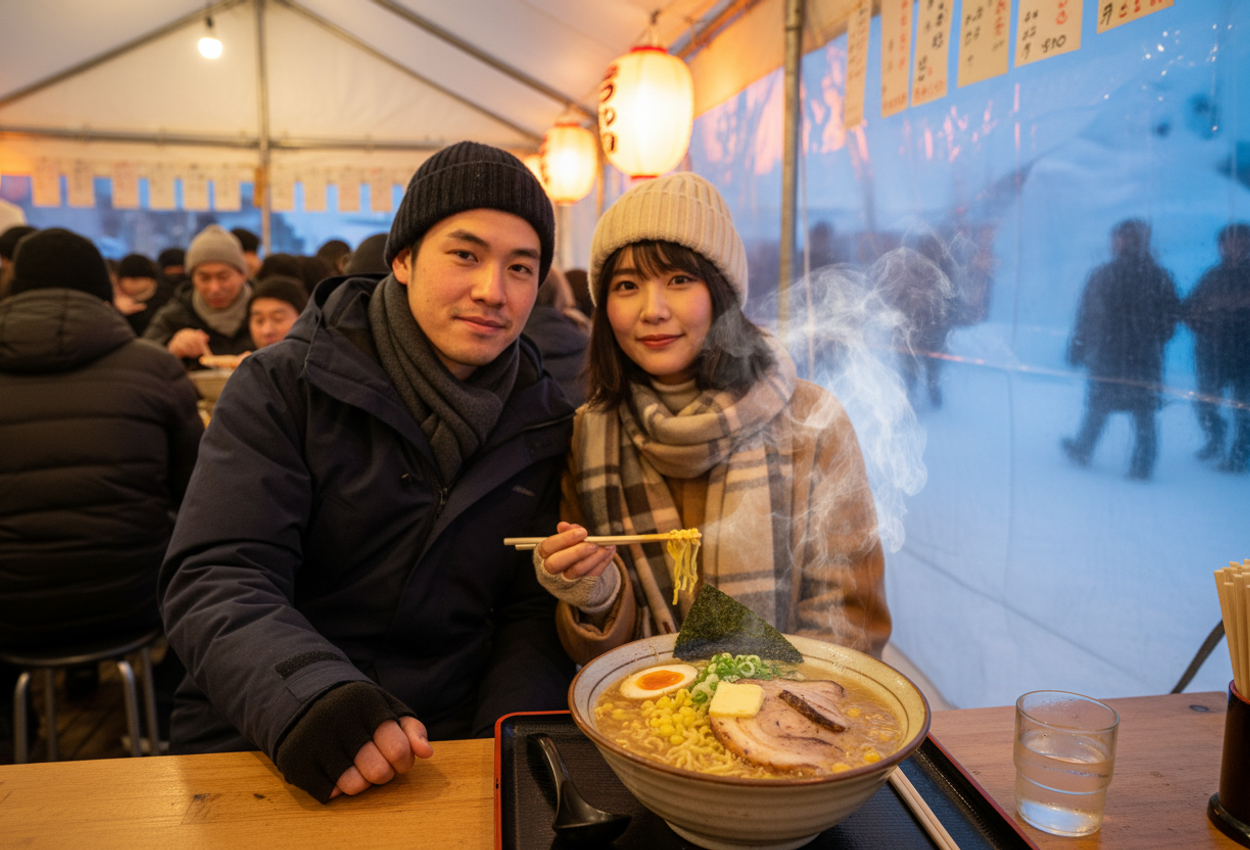
You and your partner duck into a semi-enclosed food tent, its plastic flaps rattling softly as the wind tugs at them. Inside, the air turns immediately warm and fragrant. Long communal tables are packed with festivalgoers hunched over bowls of ramen, cheeks flushed as if kissed by both wind and steam. You squeeze into a spot at a stall specializing in miso ramen, order two bowls to share, and watch as the cook works quickly: noodles plunged into boiling water, ladles of broth enriched with pork fat and miso whisked in deep pots, toppings arranged with practiced grace.
When the bowls arrive, the aroma alone is enough to silence conversation. The broth is thick and cloudy, shimmering with a thin layer of oil that catches the tent’s yellow light. Corn kernels float among strands of curly noodles; a square of butter softens slowly on the surface, its richness melting into the soup. You pass the bowl back and forth, taking turns with the chopsticks, laughing as your glasses fog with each steaming mouthful. Outside, the temperature may be well below freezing, but inside this modest stall, warmth radiates from bellies, bowls, and the proximity of strangers sharing the same fleeting refuge.
Beyond ramen, the festival is an ideal showcase for Hokkaido’s famed seafood. Near one of the Odori food zones, a stall does brisk business selling freshly grilled king crab legs, their shells charred at the edges and split open to reveal sweet, steaming flesh. You share a single leg between you, the meat firm yet delicate, the briny sweetness heightened by the surrounding cold. Nearby, skewers of scallops sizzle in their shells over charcoal, basted with soy butter until the edges caramelize and the centers turn creamy.
In Susukino, the culinary adventure continues after your stroll among the ice sculptures. Slip into an intimate seafood izakaya like Hyosetsu no Mon, known for showcasing Hokkaido crab in all its glory, or wander over to the legendary Sapporo Beer Garden area on another night for a romantic jingisukan feast grilled lamb cooked on a convex iron grill shaped like a mountain, the meat’s juices running down into a moat of vegetables. There is something inherently bonding about cooking together at the table, turning slices of meat, trading morsels, and sipping on frosty mugs of Sapporo beer while snow piles up quietly outside.
Sweetness, too, finds its own seasonal expression during the festival. While Hokkaido is rich in dairy year-round, February brings a few limited-edition treats worth hunting for. In a corner of Odori’s food zone, you might discover a small stand selling yuki no purin, snow pudding a silky custard made with local milk and a veil of whipped cream as light as the snowfall outside, sometimes flavored subtly with seasonal fruits or caramel. Couples stand together, sharing spoonfuls under the glow of paper lanterns, the pudding’s cool, velvety texture contrasting with the bite of cold air on their faces.
Even more ephemeral are the festival-only snow cookies and chocolates shaped like miniature sculptures. Some are molded to resemble beloved festival icons tiny snowmen, cranes, or stylized versions of the year’s star sculpture. They are sold in limited batches, often disappearing from stalls by evening. Tucking a small box of these into your bag to share back in your hotel room becomes a ritual an edible keepsake that turns a late-night conversation under warm covers into an extension of the day’s wanderings.
Hidden Gem Keep an eye out for specialty stalls from regional Hokkaido towns invited to showcase their winter treats at Odori and Tsudome. One year, a small stand from coastal Otaru offered a festival-only hot dessert a bowl of warm, sweet red bean soup topped with lightly grilled mochi and a scoop of Hokkaido soft-serve ice cream, the cold cream slowly melting into the hot soup. It is exactly the kind of indulgent, shareable dish that seems designed for two spoons and one bowl.
As you and your partner walk back through the festival for one last look at the sculptures, the flavors of the evening linger butter and miso, smoke and sugar. The snow underfoot squeaks in the deepening cold; above, the lights bathe the ice in their final colors before the nightly shutdown. Around you, other couples move with the same slow reluctance to leave, stretching out the night with just one more photo, one more look, one more shared breath in the luminous cold.
This is the real romance of the Sapporo Snow Festival not just the grand spectacles of ice and snow, but the way the event weaves together sensation and memory: the feel of a partner’s gloved hand in yours, the shared thrill of a sleigh ride, the steam from a shared bowl of ramen fogging both your glasses at once. In a world that moves too quickly, seven days in February in Sapporo become an invitation to slow down, bundle up, and fall in love not only with each other, but with winter itself.