In the hushed darkness of the Atacama Desert, where the air is thin and time feels suspended, the night sky does not simply appear above you; it descends, folding you and the person beside you into its luminous embrace.Whispers of the Cosmos: Finding Each Other Under Ancient Skies
Long before your plane dips toward Calama, the Atacama Desert begins to work its quiet spell. From the cabin window, the land looks like another planet: rust-red ridges, salt-encrusted basins, and volcanoes sharp as obsidian blades, all washed in a dry, golden light. By the time you drive toward San Pedro de Atacama, the village that serves as the beating heart of this high desert, you realize that you have left behind not just cities and forests, but almost everything familiar. What remains is space – endless, humbling space – and a sky that seems to be gathering itself for night.
At more than 2,400 meters above sea level, the Atacama stretches beneath some of the clearest, driest air on Earth. The desert receives almost no rain; clouds are rare visitors, and humidity is a forgotten word. There is little industry, almost no light pollution, and the nearest major cities lie days, not hours, away. When darkness falls, it is absolute. Streetlights in San Pedro de Atacama are low and discreet, and beyond the last adobe wall the desert opens like an ink-black sea. It is in this stillness that couples begin to understand why astronomers ship their most delicate mirrors and instruments to this remote corner of northern Chile.
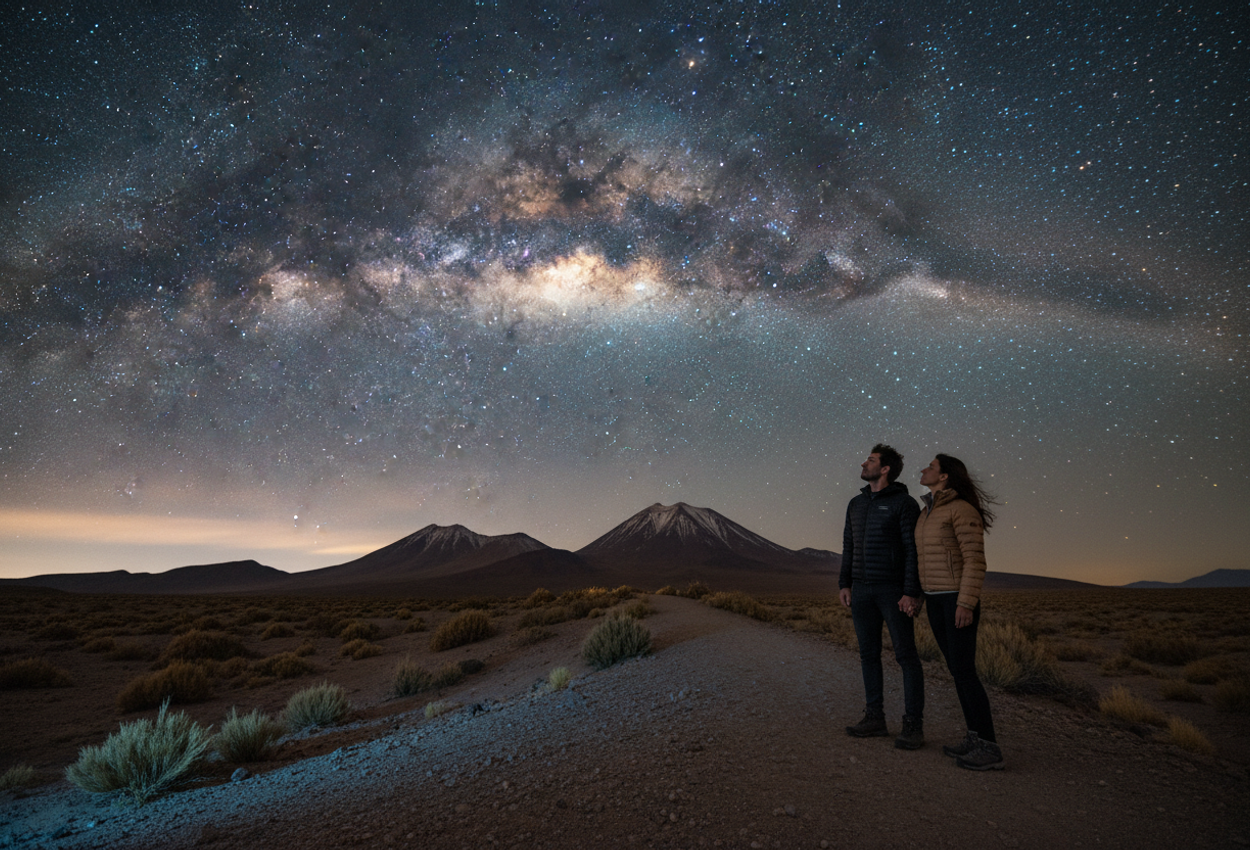
The first night, you step outside your lodge and the breath leaves your body. The sky is not a dome but a living, three-dimensional ocean of stars, layered and impossibly deep. The Milky Way splits the heavens, a bright, frothy band of light so vivid it seems to cast its own shadows across the gravel path. Constellations that are strangers in the Northern Hemisphere reveal themselves: the Southern Cross tilting on its axis; the twin Magellanic Clouds, those ghostly satellite galaxies, hovering like pale lanterns on the horizon. The familiar Orion has rotated, as if reminding you that you, too, have crossed into a different perspective.
To stand here, hand in hand, is to feel gloriously small. The problems and logistics that follow you through daily life – commutes, inboxes, the next big decision – shrink until they feel as distant as those tiny pinpricks of light. In their place grows a sense of shared insignificance that somehow makes your connection more powerful. Under this sky, you are not two professionals negotiating calendars; you are two warm bodies pressed close together, blinking up at starlight that left its source long before humans learned to write.
The desert accentuates every sensation. The nighttime air is cool and dry, with a faint mineral smell that seems to rise from the cracked earth itself. Gravel crunches sharply underfoot. In the near-total silence, even a whispered joke between you and your partner carries farther than you expect, before dissolving into the vastness. When a small breeze moves through the sparse shrubs, the sound is so delicate it might be mistaken for the rustle of distant galaxies. The altitude gives everything a crystalline sharpness – the stars, the chill on your cheeks, the edge of your own heartbeat.
There is intimacy in being dwarfed together. Couples find themselves speaking more softly, as though afraid to disturb the constellations overhead. Old stories emerge: childhood memories of lying on suburban lawns, half-remembered myths about Orion and Andromeda, shared dreams that suddenly feel less impossible when you can see the universe humming along just fine without your worries. The Atacama invites these confidences. There is nowhere to hide from the sky, and in that exposure you often discover new, more vulnerable versions of each other.
The cosmic perspective here is not abstract. Many guides will point to a star and note casually that its light began its journey toward you before your grandparents were born, or when empires on the other side of the world were rising and crumbling. As a couple, you feel your shared timeline compress – your years together, your arguments and reconciliations, your private shorthand – into a bright, vivid point against a backdrop measured in light-years. Instead of making romance feel small, this scale elevates it: if everything is fleeting, then what you choose to hold onto, who you choose to hold close under this sky, matters even more.
By day, the desert blazes under a sun so stark it washes colors into pale pastels. But at night, the Atacama belongs to lovers and stargazers. It is the perfect stage for a relationship at any age: a honeymoon or a long-delayed escape, a proposal whispered after midnight or a quiet recommitment between people who have already weathered many seasons together. Out here, under ancient skies that have watched over Andean caravans and astronomers alike, you can feel the universe bearing silent witness as you reach for each other’s hands.
Luxury Lodges and Celestial Suites: Sleeping Under a Million Stars
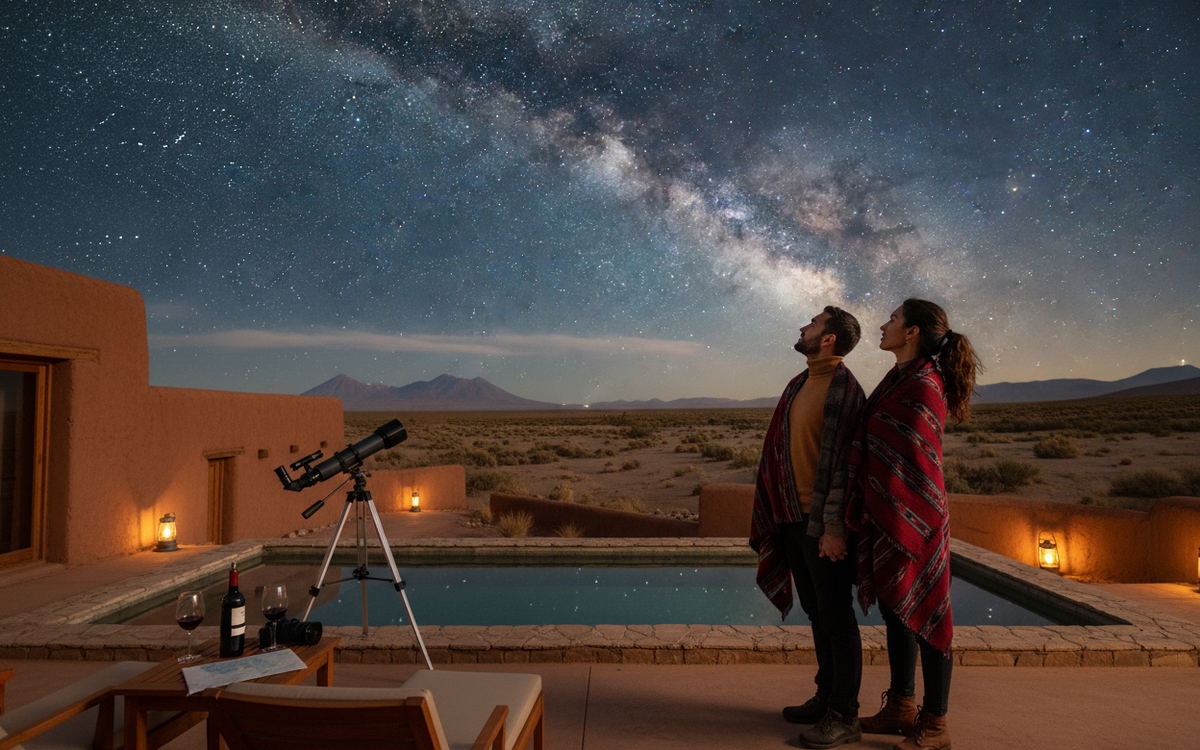
Romance in the Atacama is not only about raw wilderness. Some of South America’s most imaginative desert lodges have learned to translate this stark landscape into sensual comfort. Behind thick adobe walls and hand-hewn wooden doors, couples find candlelit courtyards, plunge pools reflecting starlight, and beds oriented precisely so that the first thing you see when you wake in the night is the Milky Way framed in your window.
On the outskirts of San Pedro de Atacama, cradled by ochre hills and the whispering line of a riverbed, Nayara Alto Atacama feels like a desert citadel dreamed into existence. Its low-slung adobe buildings blend into the terracotta cliffs, their exteriors textured like sunbaked clay. Inside, rooms wrap you in earth tones: thick Andean textiles in deep reds and indigos drape over wide beds; woven rugs soften polished concrete floors; carved wooden lamps cast patterned shadows along the walls. Step out onto your private terrace at night and you are met with a sweep of darkness broken only by flickering lanterns and the glimmer of the lodge’s pools. The desert scent here is layered: warm dust, faint herbs from the native garden, and, when the wind is right, the cool, metallic hint of water hidden in the canyon.
Many suites at Nayara Alto Atacama have private outdoor nooks that double as impromptu observatories. A bottle of Chilean carménère waits on a small table; two lounge chairs face the valley. Wrapped in alpaca blankets, you lie back and watch as familiar daylight colors drain from the cliffs and the first stars scratch lines into the velvet sky. The lodge’s own small telescopes can be set up on your terrace on request, turning your room into a celestial suite. There is a particular intimacy in sharing an eyepiece – one of you peering into the lens, murmuring descriptions of Saturn’s rings or the craters of the moon, the other leaning close enough to feel each breath against your cheek.
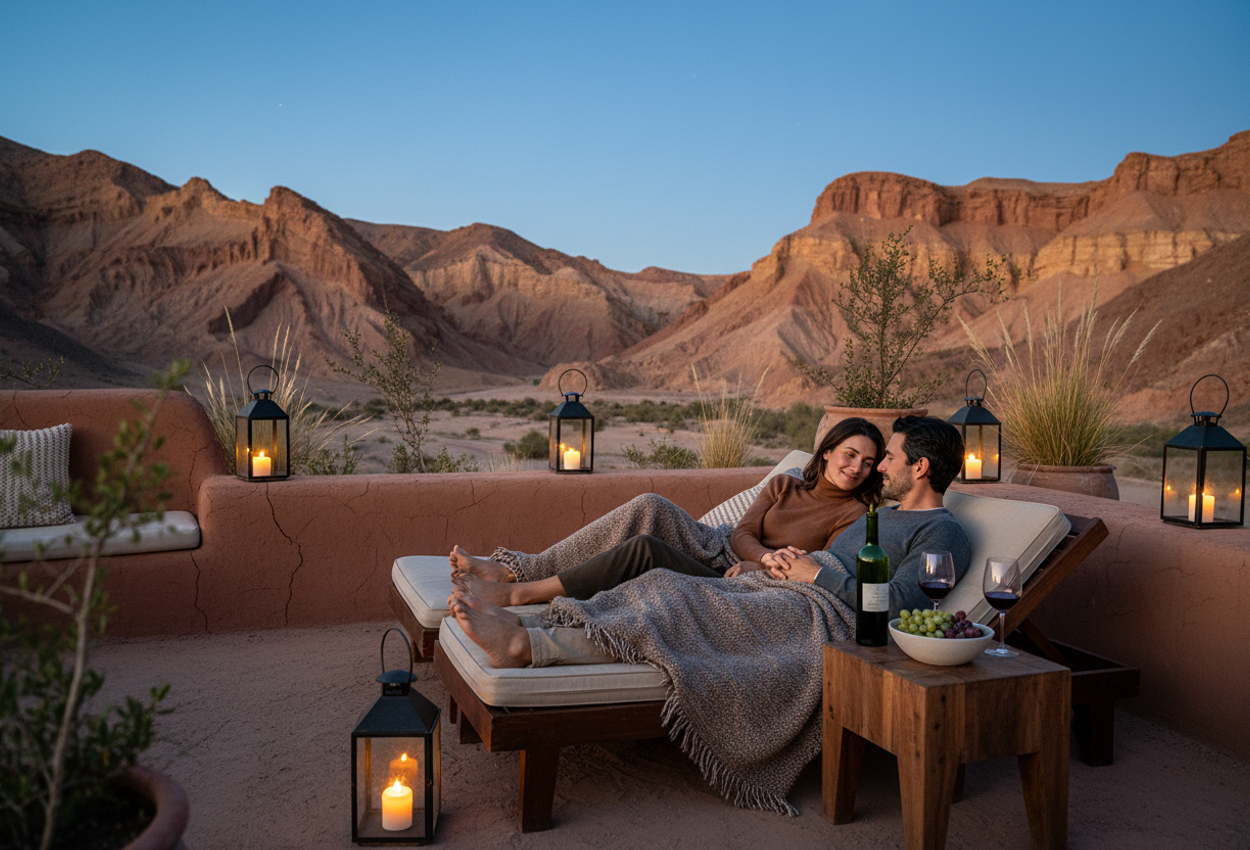
Across town, hidden behind adobe walls along a quiet lane, Awasi Atacama feels like a secret desert village designed for those who prize privacy and romance. Each round suite is crafted in ochre-toned adobe and topped with thatched roofs, creating a kind of luxurious desert hut. Inside, the design is at once minimalist and deeply tactile: smooth plastered walls, thick wool throws, leather armchairs positioned by windows that frame sculptural cacti. Outdoor showers are tucked into walled patios where the desert air feels all the more thrilling against warm skin. At night, golden lamplight spills into these courtyards, and you can shower under a canopy of stars, the water’s warmth contrasting deliciously with the cool air on your shoulders.
What makes Awasi Atacama particularly compelling for couples is its tailor-made approach. Each room comes with a private guide and 4x4 vehicle, meaning your desert days and nights can be orchestrated just for two. You might arrange a late return from a sunset excursion, timing it so that you drive back to town beneath a rising Milky Way, windows open to the smell of dust and sage, headlights extinguished for a few minutes to drift through the darkness together. Back at the lodge, dinner unfolds in a softly lit courtyard, the crisp scent of Chilean sauvignon blanc lifting notes of citrus and desert herbs from your plates while the sky overhead deepens from cobalt to black.
Further from the village center, where the night feels a touch wilder, Tierra Atacama Hotel & Spa is a hymn to elemental luxury. Its architecture is all clean lines and floor-to-ceiling windows, aligning rooms so that volcanoes loom just beyond your bed. In the Spa, an open-air hot tub lets you soak while the evening cools around you, the sky changing color above steaming water. Wooden decks creak softly under bare feet, and the air carries a faint fragrance of wet stone and eucalyptus from the nearby gardens. Come nightfall, the lodge often dims remaining exterior lights, and fireplaces become islands of warmth where couples curl into deep sofas, listening to logs crackle while distant dogs bark from the town far below.
If your idea of romance leans toward the adventurous, Explora Atacama offers another way to sleep close to the sky. This pioneering desert lodge, with its sleek, low-profile buildings and shady courtyards, sits within a private expanse of desert just outside town. Alongside its renowned excursions program, Explora maintains its own observatory, a gleaming white dome that houses a powerful telescope shielded from stray light. After long days hiking high-altitude lagoons or horseback riding across salt flats, couples can wander to the observatory and let expert guides translate the night. There is a shared thrill in ducking through the dome’s small door, hearing it whirr open above you, and watching a slice of the universe slide into view.
Romance under glass takes on a new meaning further south in the Elqui Valley, where Elqui Domos has become an almost mythical destination among stargazing devotees. Here, geodesic domes and stilted cabins dot a steep hillside, each oriented toward the clearest piece of sky. Many domes feature retractable roofs or huge overhead windows above the bed, allowing you to lie under a literal window to the universe. The sensations are unforgettable: the coolness of cotton sheets against sun-warmed skin, the creak of the dome’s structure adjusting to the nighttime breeze, the distant sound of a dog somewhere in the valley, and above, an unbroken stream of stars marching across the opening. You doze and wake throughout the night, catching new constellations each time, your partner’s breathing syncing with the soft, cosmic rhythm beyond.
At all of these lodges, the details conspire to deepen connection: a carafe of infused water glimmering with slices of local fruit on a bedside table; the heavy feel of handwoven blankets that invite you to linger in bed just a little longer; candles and fire pits arranged so that you can talk late into the night, faces lit by amber flames while the desert cools around you. The sky is the showstopper, but the way these properties frame it – through windows, from private terraces, above outdoor tubs and showers – turns stargazing into an exquisitely curated ritual for two.
Stargazing Tours: Expert Guides to the Galaxy of Love
As intoxicating as it is to simply lie back and let the stars wash over you, the Atacama reveals even more of its magic when you experience it with those who have dedicated their lives to reading the sky. Around San Pedro de Atacama, a network of observatories and tour operators unlocks the universe with high-powered telescopes and storytelling that transforms distant light into intimate narratives. For couples, these evenings become part science lesson, part mythological theater, and wholly romantic.
One of the best-known is San Pedro de Atacama Celestial Explorations, often referred to simply as SPACE. Located a short drive from the village, its modest buildings and rows of telescopes are strategically placed far from stray illumination. After your transfer from town, you step into a courtyard kept deliberately dim – just enough light to find the path, but not so much that it steals from the sky. The air holds a thin, alpine chill, and guides hand out ponchos or blankets, the coarse wool warm against your shoulders as you settle in with your partner on low benches.
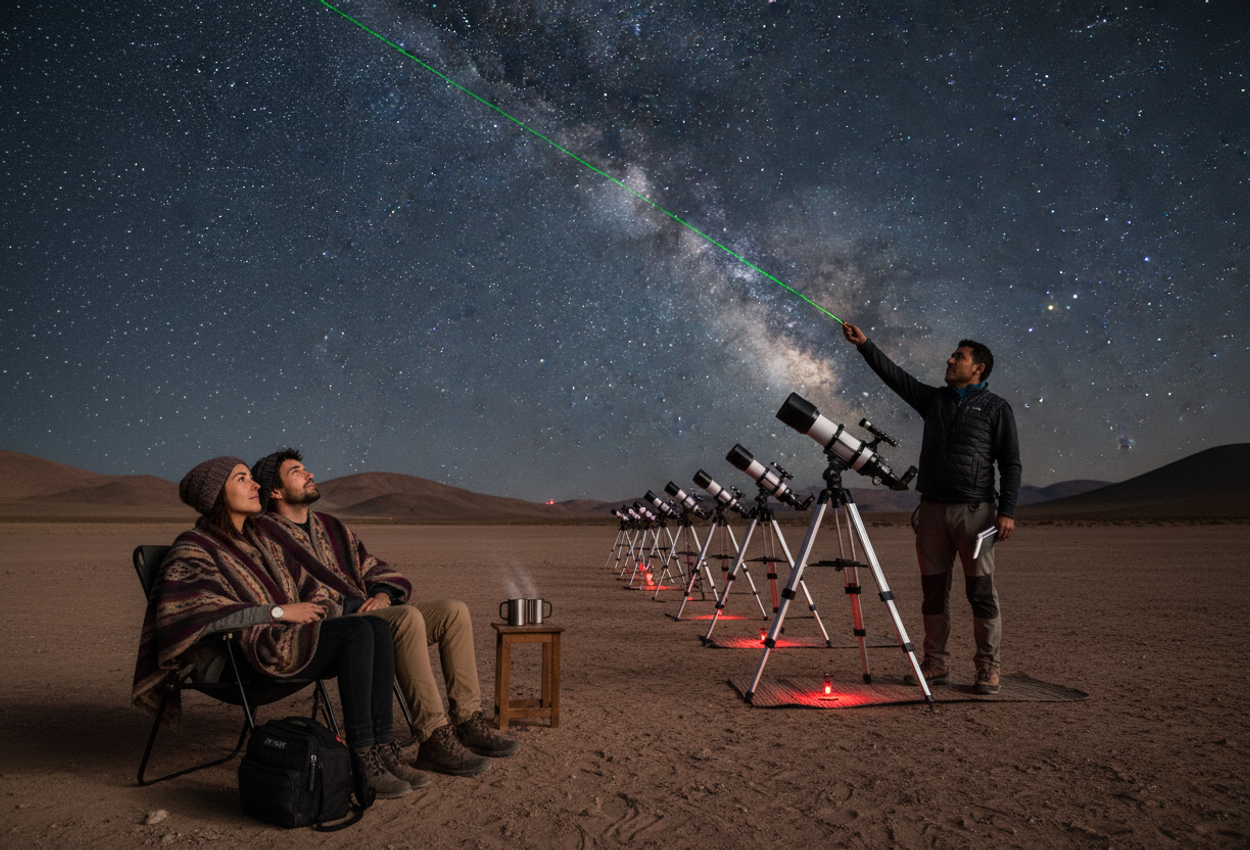
The experience begins with naked-eye astronomy: your guide lifting a laser pointer to etch emerald lines across the sky, connecting stars into shapes both familiar and entirely new. You learn to locate the Southern Cross, to trace the dark cosmic clouds that form animals in Andean lore rather than the bright stars themselves. In traditional Indigenous cosmologies of the high Andes, the dark patches of the Milky Way depict creatures whose positions once guided planting and harvest seasons. As you listen, you squeeze your partner’s hand, realizing that love stories, too, have always been written into these shimmering patterns – tales of loyalty and separation, of journeys and homecomings.
Then comes the telescopic feast. Moving from instrument to instrument, you share eyepieces like passing secret messages. One scope may reveal the jewel tones of a star cluster, another the delicate blue-white halo of a distant nebula. Peering at Saturn, its rings thin but unmistakable, you cannot help but let out the soft gasp that so many before you have given. Jupiter swims into focus with its attendant moons, each a tiny bead of light, reminiscent of a string of pearls. Between viewings, you tuck yourselves into each other for warmth, your breath visible in the cold air, each new stellar object a quiet revelation you experience together.
Further along the desert roads, the Ahlarkapin Observatory offers a distinctly Andean perspective on the sky. Run with a deep respect for local Likan Antai culture, Ahlarkapin weaves ancestral stories into its stargazing sessions. You might gather in a circular space, the ground underfoot gritty with desert dust, while elders or guides explain how their ancestors read the heavens not only for navigation and timekeeping but as a moral and social compass. The constellations here are not just Greek myths transplanted onto southern skies; they are llamas and serpents, cosmic rivers and guardians. To hear these stories told under the same vault of stars that inspired them is to feel as though you and your partner are being initiated into a far older romance between Earth and sky.
Many tours now incorporate astrophotography, turning the desert into a studio where you and the stars are both subjects. Under a canopy of glittering light, guides show you how to set your camera to capture long exposures: wide apertures, high ISO, shutter speeds measured in tens of seconds. Together, you experiment with framing a lone cactus against the arc of the Milky Way, or standing in silhouette at the edge of a dune while your guide paints the foreground with a faint beam of red light. There is a playful intimacy in adjusting each other’s scarves and hoods between shots, or in discovering that one of you is better at patiently keeping still while the shutter remains open.
For couples new to astrophotography, a few principles make all the difference. Visit during the new moon or when the moon sets early, so its brightness does not overpower the stars – typically, the clearest and darkest skies in the Atacama appear during the austral winter months, from May through August, when nights are longer and the air even drier. Bring a sturdy tripod; the desert can be breezy, and even the tiniest vibration will blur your stars into streaks. Use a remote or timer to trigger the shutter, then step back into each other’s arms while the camera does its quiet work. When the image appears on the screen – that delicate river of light captured above your outlines – it feels like holding a tiny, portable version of the universe you shared. Many couples later print these photographs, hanging them at home as reminders that there was a night when eternity seemed to fit between them.
Across operators, the most cherished moments are often unscripted: a guide dimming the last light and giving you a few minutes of silence to lie side by side on reclining chairs, necks craned back, the dome of the cosmos stretching from horizon to horizon; an impromptu lesson in recognizing shooting stars versus satellites, and the delighted tug on your sleeve when one of you spots a meteor first; the shared thermos of hot chocolate or spiced tea that warms your hands as your eyes adjust fully to the dark. These tours transform stargazing from mere viewing into a ritual of connection – to the land, to the cultures that first mapped this sky, and, most of all, to each other.
Local Tip for Lovers: Request a smaller group or even a private session, if your budget allows. With fewer people, the observatory becomes a more intimate theater. There is something unforgettable about standing alone with your partner and your guide beneath the Milky Way, the only voices in the desert as the laser traces paths across the heavens, mapping out not just stars but the contours of your shared adventure.
El Tatio Geysers: A Sunrise Spectacle for Two
Romance in the Atacama does not belong only to the night. One of its most transcendent experiences unfolds in the blurred hours between darkness and dawn, high in the Andean plateau where the Earth itself seems to breathe. The excursion to the El Tatio Geysers begins in the deepest night, when stars still burn fiercely overhead and most of San Pedro de Atacama sleeps behind shuttered windows.
Your driver collects you in the cold pre-dawn, breath blooming in small clouds as you climb into the vehicle. Wrapped in layers – thermal base, soft fleece, thick down jacket – you and your partner huddle side by side as the road leaves the village and begins to climb. Outside the windows, the desert is reduced to silhouettes: low shrubs, occasional ghostly shapes of vicuñas frozen in the beam of the headlights, the jagged edge of distant volcanoes like the spine of some giant sleeping creature. Above, the sky is at its darkest, the stars so bright that even through the glass you can trace patterns. Conversation quiets to a murmur; the rhythm of the engine and the gentle sway of the vehicle turn the journey into a shared dream.
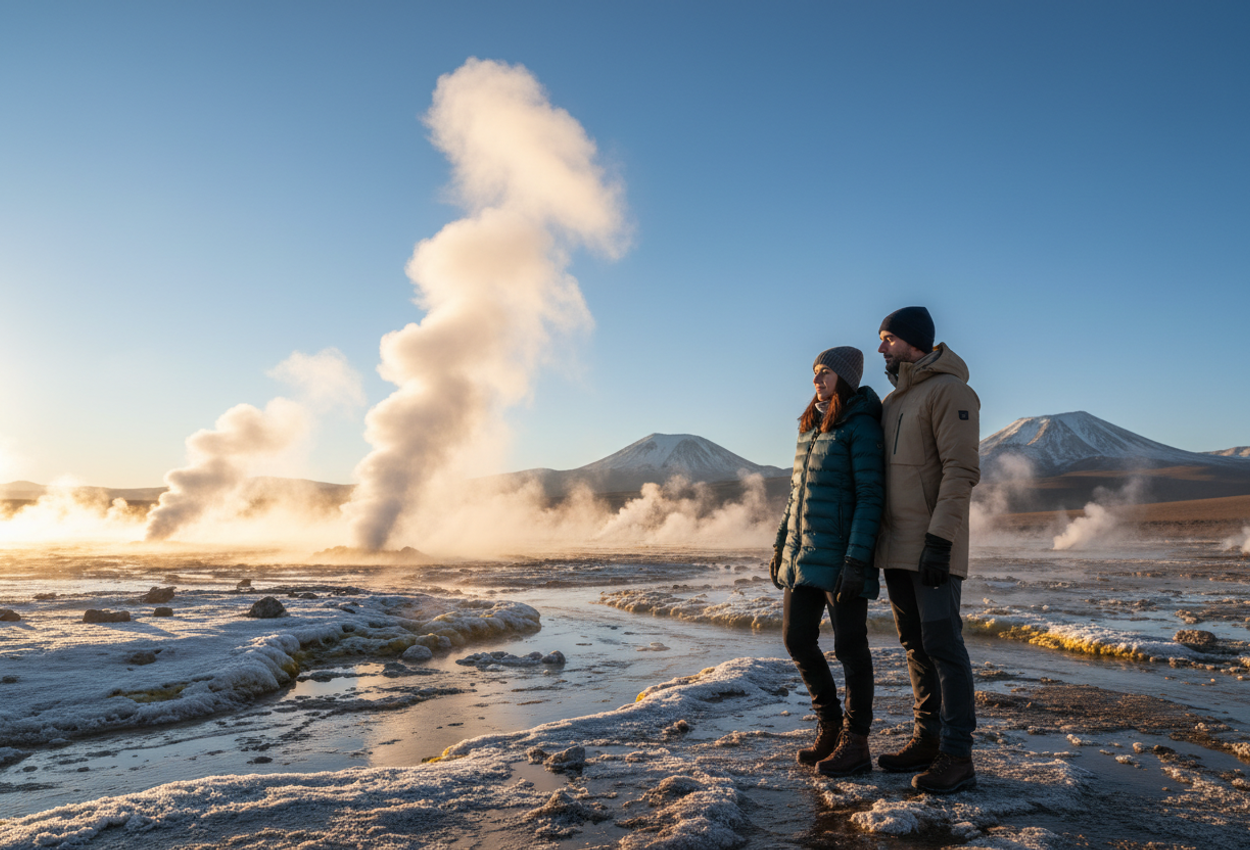
As you ascend toward nearly 4,300 meters above sea level, the temperature drops sharply. When you finally step out at the geyser field, the cold bites instantly – a sharp, clean sensation that wakens every cell. Your boots crunch on frost-hardened earth. From the ground all around you, plumes of steam rise into the air, each geyser a column of warmth meeting the frigid dawn. In the darkness, these plumes appear as ghostly pillars, shifting and billowing, their edges catching the first fragile hints of color in the eastern sky.
Before the sun crests the surrounding ridges, the stars are still visible overhead, though beginning to fade. This is a secret moment of double spectacle, when you can look up to see the last of the night’s constellations and then down to watch the earth exhale. The hiss and burble of boiling water becomes the soundtrack to your private morning. Hands tucked into each other’s sleeves, you move carefully between small pools and vents, the metallic smell of minerals rising with the steam. Droplets condense on your eyelashes; tendrils of vapor lick at your cheeks and then vanish into the thin air.
Then, slowly, the sky shifts. A band of pale lavender blooms on the horizon, deepening through rose and apricot. As the first rays of sunlight spill over the surrounding peaks, the steam columns ignite in color, transforming from grey ghosts into pillars of molten gold. Shadows stretch across the ground, sharp and long, and you and your partner become silhouettes dancing among clouds. The cold against your face softens just a fraction, and when you touch your partner’s gloved hand, it feels like anchoring yourself to the only other warm body in this otherworldly scene.
Most excursions to El Tatio Geysers include a simple but satisfying breakfast, laid out on folding tables near the geothermal field or in a sheltered spot close by. In the thin, bright air, even the most modest spread feels luxurious. Steam from your coffee or hot chocolate rises in slow curls that blend with the fumaroles in the distance. Bread tastes sweeter, eggs richer; slices of local cheese and ham become small feasts when eaten standing close together, the sun now high enough to paint your faces in gentle warmth. There is a camaraderie among the small groups spread across the site, but it is easy to carve out a quiet corner – a boulder that doubles as a bench, a patch of ground near a small bubbling pool – where you can lean into each other and watch the last dramatic spurts of steam as the morning stabilizes.
Some tours end with a dip in a nearby thermal pool, where steaming water collects in rocky basins. Slipping out of your many layers in the crisp air is a bracing moment: fingertips numb, breath sharp, every movement quick. But once you and your partner sink into the mineral-rich warmth, all that tension melts away. The contrast between the chilly air on your shoulders and the liquid heat around your waist is delicious, a full-body reminder of the desert’s extremes. You float shoulder to shoulder, watching thin plumes of steam drift upward into an increasingly brilliant blue sky, feeling as if you are swimming in the boundary between worlds.
At these elevations, the light is almost surgical in its clarity. Colors saturate to an intensity that surprises the eyes: the blue of the sky, the rust of the rocks, the white of salt rims edging small pools. For lovers, this sharpness lends the morning a dreamlike precision, like a memory that will never blur with time. The photographs you take here – of each other wrapped in scarves, smiling with flushed cheeks as steam roils behind you; of joined hands silhouetted against a geyser plume; of your footprints side by side on frosty ground – become anchors to a shared experience that is both fragile and immense.
On the drive back to San Pedro de Atacama, most travelers slip into a quiet, satisfied fatigue. The sun now pours over the altiplano, revealing herds of llamas grazing in golden light, solitary flamingos picking through shallow lagoons, distant volcanoes capped with streaks of snow. You and your partner lean against each other, eyes half-closed, letting the landscape slide by. It is still morning, but you have watched a full transformation – from the universe’s deepest darkness through the earth’s steaming exhalations to the blazing clarity of day. The intimacy of having shared such a complete cycle before breakfast lingers long after you return to town.
Valley of the Moon: Lunar Landscapes and Lovers' Whispers
When evening returns to the Atacama, there is one place where romance and otherworldliness reach an almost cinematic peak: the Valle de la Luna, or Valley of the Moon. Just a short drive from San Pedro de Atacama, this protected area of wind-carved dunes, salt-encrusted ridges, and jagged rock formations feels like the set of a science-fiction epic. Yet under the stars, it becomes a stage for quieter dramas – a whispered promise, an arm slipped through another’s, a shared silence as the universe puts on its most dazzling show.
You arrive in late afternoon, when the sun is still high but softening, turning the valley’s colors into an ever-shifting palette of ochres, russets, and chalky whites. The air tastes faintly of salt; the ground underfoot is a crisp crust that cracks delicately as you walk. Guides lead small groups along narrow paths threaded between towering rock walls, their surfaces striated like layers of ancient pastry. In the stillness, your footsteps and hushed voices seem almost too loud, as if you have entered a cathedral that demands reverence.
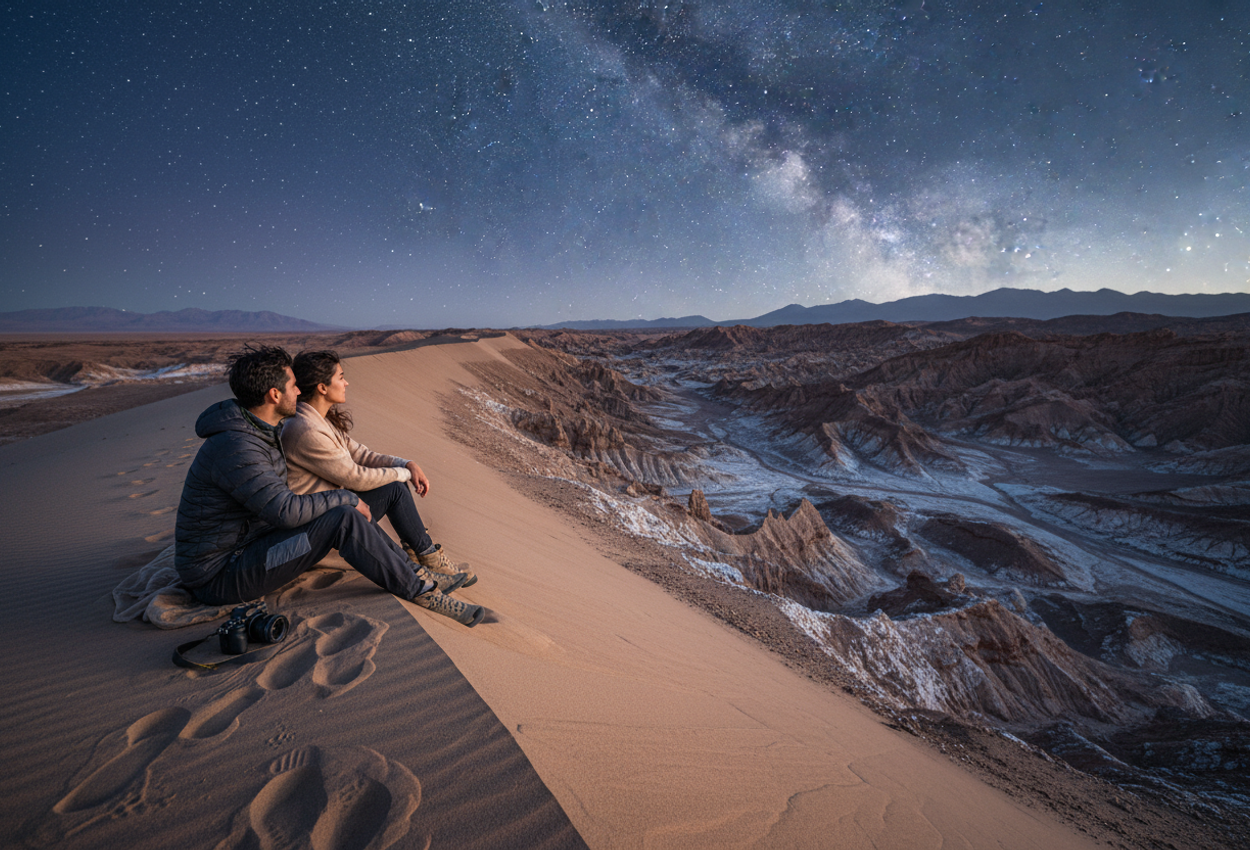
As the sun tips toward the horizon, you and your partner climb a sand dune that rises like a frozen wave from the valley floor. The ascent is slow and deliberate: each step sinks, grains sliding back under your boots, your breathing deepening with the effort. The sand is fine and cool near the surface, but dig your fingers in and you still find a whisper of warmth from the day. Reaching the crest, you are rewarded with a panoramic view that steals whatever breath remains. Ridges roll away in layered folds, their edges so sharply defined they seem drawn with charcoal. Far beyond, volcanoes stand sentinel, their perfect cones backlit by the fading light.
Sunset here is a masterclass in slow transformation. First the valley glows amber, then blushes shades of pink and violet. Shadows lengthen and pool in the creases of the dunes, turning them into fluid shapes that seem to move as you watch. You sit close together on the ridge, feeling the temperature drop minute by minute, the dune firming and cooling beneath you. When the sun finally slips behind the horizon, the last rays ignite the western sky in an explosion of color, and for a few seconds the entire valley appears to hover between fire and shadow.
Then comes what locals sometimes call the blue hour, though in the Atacama it can feel more like a cobalt hush. The first stars appear timidly, then, emboldened by the deepening dark, multiply at a dizzying pace. The Milky Way rises, arcing over the lunar landscape as if poured from some celestial vessel. If the moon is high, it bathes the Valley of the Moon in a silver radiance that obliterates many stars but adds a different kind of enchantment: shadows grow sharp and inky, rocks glow ghost-pale, and the dunes take on a sculptural clarity. Walking hand in hand along the sand ridge, your elongated silhouettes precede you like twin companions.
On moonless nights, the valley becomes a prime stage for astrophotography. Away from the minimal lights of the entrance area, guides may lead you to a quiet spot where you can set up a tripod on solid rock, its legs splayed for stability. Together, you frame the jagged outline of the valley against a sky now thick with stars. You experiment with compositions – a single rock spire in the foreground, the Milky Way arching above like a luminous bridge; a wide-angle shot that captures the curve of the dune, its texture etched in faint starlight. One of you stands at the edge of the frame, headlamp turned briefly on to trace a line of light, then off again to preserve the darkness.
Photographing here is as much about patience as technique. You pause for long exposures, counting slowly as the camera’s shutter remains open, the tiny indicator light blinking like a heartbeat in the dark. These pauses become pockets of intimacy. With nothing to do but wait, you lean into each other, borrowing warmth from shared jackets and exchanged breath. The wind skims fine grains of sand across the dune’s surface, making a sound like a distant ocean. Somewhere below, another group laughs softly, their voices carried thin and tinny on the dry air. Above, the universe simply continues – distant, impartial, and yet somehow the most generous witness to the way your shoulders press together.
Hidden Gem for Stargazing Couples: Ask your guide if it is possible to linger a little longer after the main sunset crowds depart. Many tours are timed to return soon after the last light fades, but small operators or private excursions may allow you to stay until full darkness. The transformation from tourist throng to near solitude is profound. With fewer people, the crunch of your footsteps becomes the dominant sound, and you can whisper without fear of being overheard. In those quiet minutes, the valley feels as if it belongs only to you and the stars.
When it is finally time to descend from the dunes, you do so carefully, toes digging into the slope, sand sliding in soft avalanches around your ankles. The valley floor, which felt familiar at sunset, now seems subtly altered. Outcroppings you've passed before loom as hulking shadows; salt crystals catch the starlight and flash like scattered shards of glass. Your guide’s red-filtered flashlight casts just enough glow to mark the path without spoiling your night vision. You follow, hand in hand, occasionally stopping to tilt your heads back and drink in the sky once more.
Driving back toward San Pedro de Atacama, the headlights carve a narrow tunnel of light through the darkness. Out the side windows, the valley recedes into a featureless black, but overhead the stars remain confident and bright. Your body is dusted with fine sand; your hair smells faintly of dry wind and salt. In your camera or phone, a handful of images now hold slivers of the night – star trails over a jagged ridge, your two silhouettes etched against a galaxy. Yet the truest impressions are the ones that resist capture: the way your partner’s gloved fingers searched for yours in the cooling dusk, the quiet awe that settled between you when the Milky Way first appeared, the sense that here, in a Valley named for the moon, your own orbit around each other had subtly, irrevocably shifted.
Best Time to Visit for Romance Under the Atacama Sky: While the Atacama delivers extraordinary stargazing year-round, couples seeking the clearest, most dramatic nights should consider planning for the austral winter months, roughly May through August, when nights are long, rainfall is minimal, and atmospheric stability often reaches its peak. Aim for periods around the new moon to maximize star visibility, checking local lunar calendars as you plan. Even in other seasons, the combination of altitude, dryness, and remoteness ensures that the Atacama’s night sky remains a near-constant invitation – a glittering canopy under which soulmates can trace their own constellations, over and over again.