There is a particular kind of intimacy that comes not from candlelit dinners or infinity pools, but from muddy boots, shared mosquito repellent, and the quiet satisfaction of knowing that your holiday left a place just a little better than you found it.More couples are discovering that the most memorable trips are not defined by how many resorts they sample, but by the communities and ecosystems they help support along the way. Volunteer vacations invite you to trade passive sightseeing for active participation, to swap a week of lounging for days of learning, listening, and lending a hand. This is not about swooping in as saviors; it is about joining ongoing, locally led projects where your skills, your time, and your curiosity become tools for meaningful connection.
From tracking elephants through the bush in Zimbabwe to planting trees in the misty hills of Costa Rica, couples can find projects that match who they are and what they care about. The key is to approach your journey with humility, intention, and careful research. Done thoughtfully, a volunteer vacation becomes less of a getaway and more of a shared mission: a story you write together, one early morning turtle patrol or classroom conversation at a time.
Crafting Your Couple's Mission: Finding the Perfect Fit
The most rewarding volunteer vacations begin long before you step on a plane. They start at the kitchen table, with a shared question: What do we both care about enough to give our time, our comfort, and our energy to? Take an evening, silence your notifications, and treat this conversation like planning your wedding or your first home. Spread out notebooks, pour a glass of wine, and begin listing the issues that tug at your hearts. Perhaps one of you lights up when talking about ocean conservation while the other is drawn to education and literacy. Maybe you both feel strongly about climate resilience, women’s rights, or access to clean water.
As your list grows, start to circle the overlaps and patterns. Environmental conservation might encompass those sea turtle nests you have seen in travel magazines, but it could also mean rewilding degraded landscapes or regenerating soil on small organic farms. Education might be about teaching English in a rural classroom in Thailand, but also about after-school programs, adult literacy classes, or mentoring young entrepreneurs. Community development might involve building homes after an earthquake in Nepal or helping to improve basic sanitation infrastructure in underserved neighborhoods.
Once you have a sense of your shared priorities, you can begin to match your values with concrete projects. Reputable organizations such as International Volunteer HQ, GoEco, and long-established NGOs like the Peace Corps provide a starting point for research, particularly if this is your first foray into service travel. These organizations work with vetted local partners, provide clear project descriptions, and tend to prioritize safety, cultural sensitivity, and measurable impact. As a couple, you may find comfort in platforms that offer side-by-side placements, where you can volunteer on the same project or in complementary roles while still sharing accommodation and free time.
Look closely at how organizations describe their work. Meaningful programs emphasize collaboration with local communities, long-term goals, and accountability. They are transparent about where your fees go, who leads the project on the ground, and what qualifications are required. Be wary of any program that promises easy heroics or glamorous photo opportunities without acknowledging the slow, often unglamorous reality of genuine development and conservation work. Ethical volunteering is rarely tidy; it is patient, iterative, and honest about limitations.

As you narrow your choices, turn the focus inward again. Many couples assume that the only useful skills in a volunteer context are medical training, teaching experience, or advanced technical expertise. Hidden in your day-to-day lives, however, are abilities that can be surprisingly valuable. Perhaps one of you is a keen photographer, able to frame a story through images that help local NGOs communicate their work to donors or communities. Maybe the other has a knack for social media, graphic design, or writing newsletters that make project updates more compelling.
Even basic construction or DIY experience can be transformative on the ground. If you have ever tiled a bathroom, built simple furniture, or learned how to mix cement, those skills can translate into painting and refurbishing classrooms, helping to install handwashing stations, or assisting local builders where extra hands are genuinely helpful. Hospitality or customer service backgrounds can support projects that depend on guesthouses or community tourism; accounting skills can be shared with local cooperatives learning to track expenses and manage small grants. The hidden gem of volunteer travel is this: when you zoom out from job titles and look instead at what you know how to do in everyday life, you begin to see just how much you can bring.
Finally, think about how you travel together. Are you comfortable with basic conditions and cold showers, or do you need a private room and at least one decent coffee a day to stay kind to each other? There is no shame in acknowledging your limits; in fact, honesty here is an ethical imperative. It is better to choose a placement that offers modest comfort and structured support than to sign up for an ultra-remote project that leaves you exhausted, resentful, and less effective. Align your expectations about free time, cultural immersion, and work intensity. Some couples thrive on twelve-hour days in the field and simple communal meals; others prefer a balance that allows time for reflection, journaling, or exploring the local town together.
When those pieces come together – shared cause, realistic logistics, and a clear sense of the strengths you each bring – the idea of a volunteer vacation stops being abstract. It becomes a mission, one that belongs to both of you. The flights and packing lists will come later. First, you craft the why.
Turtles in Greece, Elephants in Zimbabwe: Ethical Wildlife Conservation
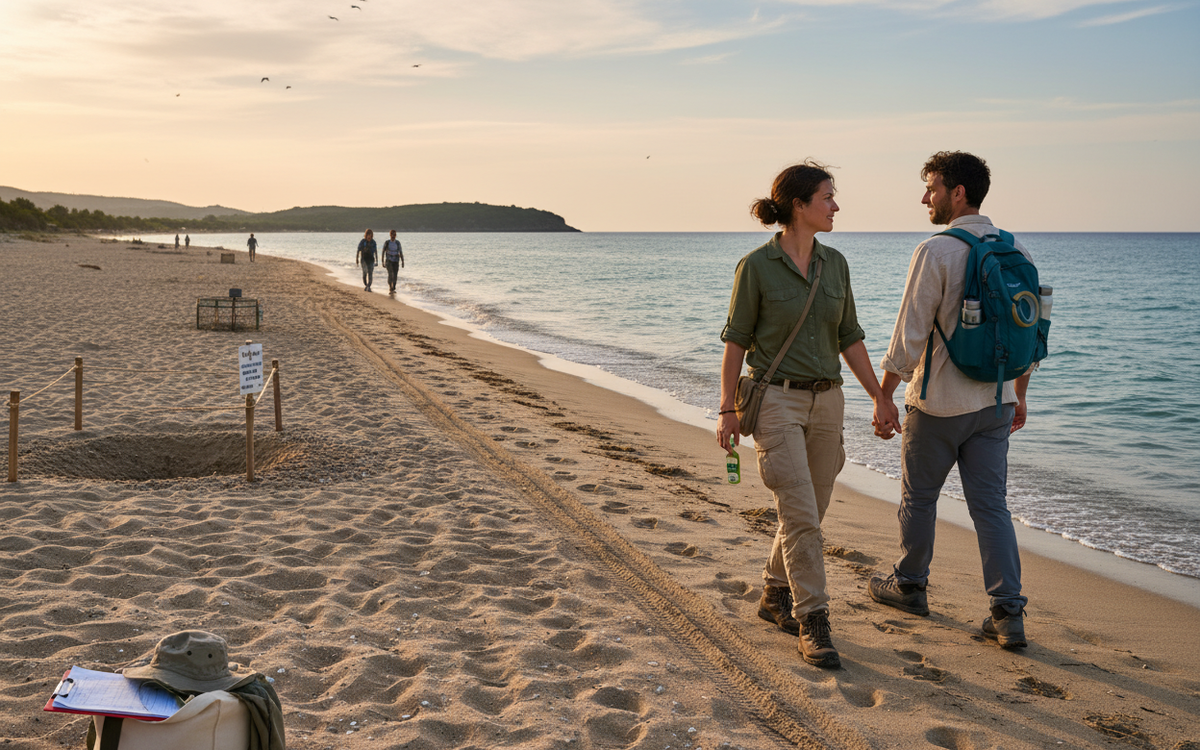
On the western coast of Greece, the Ionian Sea glows pewter-blue at dawn. The beach is quiet except for the hiss of the surf and the muted crunch of sand beneath your boots. As a couple, you walk together along the wrack line, eyes scanning the sand for the delicate signature of last night’s visitors: the faint tractor-like tracks where a female sea turtle might have hauled herself ashore to nest. The air smells faintly of salt and wild thyme; gulls wheel overhead, their cries merging with the soft sigh of waves. Volunteering with a conservation organization such as GVI, your mornings might look like this – patient, meditative, and charged with the knowledge that every nest you record could help protect a threatened species.
Later in the season, you might find yourselves kneeling in a shallow pit as the sun slides toward the horizon, sand still warm under your palms. Tiny hatchlings, no bigger than the palm of your hand, wriggle and tumble over one another, instinctively orienting toward the glitter of the sea. You learn how to minimize your presence, how to shield them from artificial light, how to record their numbers carefully so that biologists can track survival rates over time. It is slow, painstaking work, but as you stand shoulder to shoulder watching the last hatchling disappear into the foam, you feel a shared humility: these small creatures have been making this journey for millions of years. You are here only to help tip the odds slightly in their favor.
Thousands of miles away, in the savannah and bushveld of Zimbabwe, the sensory palette shifts dramatically. The morning light is sharper, slanting across acacia trees and tall grass the color of lion’s fur. The scent of the African bush is complex and earthy: dust, dry leaves, the faint musk of animals you cannot yet see. Volunteering with a responsible operator such as Kaya Responsible Travel, you and your partner might spend days assisting with wildlife monitoring: riding out in open vehicles with local conservationists, noting the location and behavior of elephants, lions, or rhinos, checking camera traps, and recording any signs of snares or human-wildlife conflict.
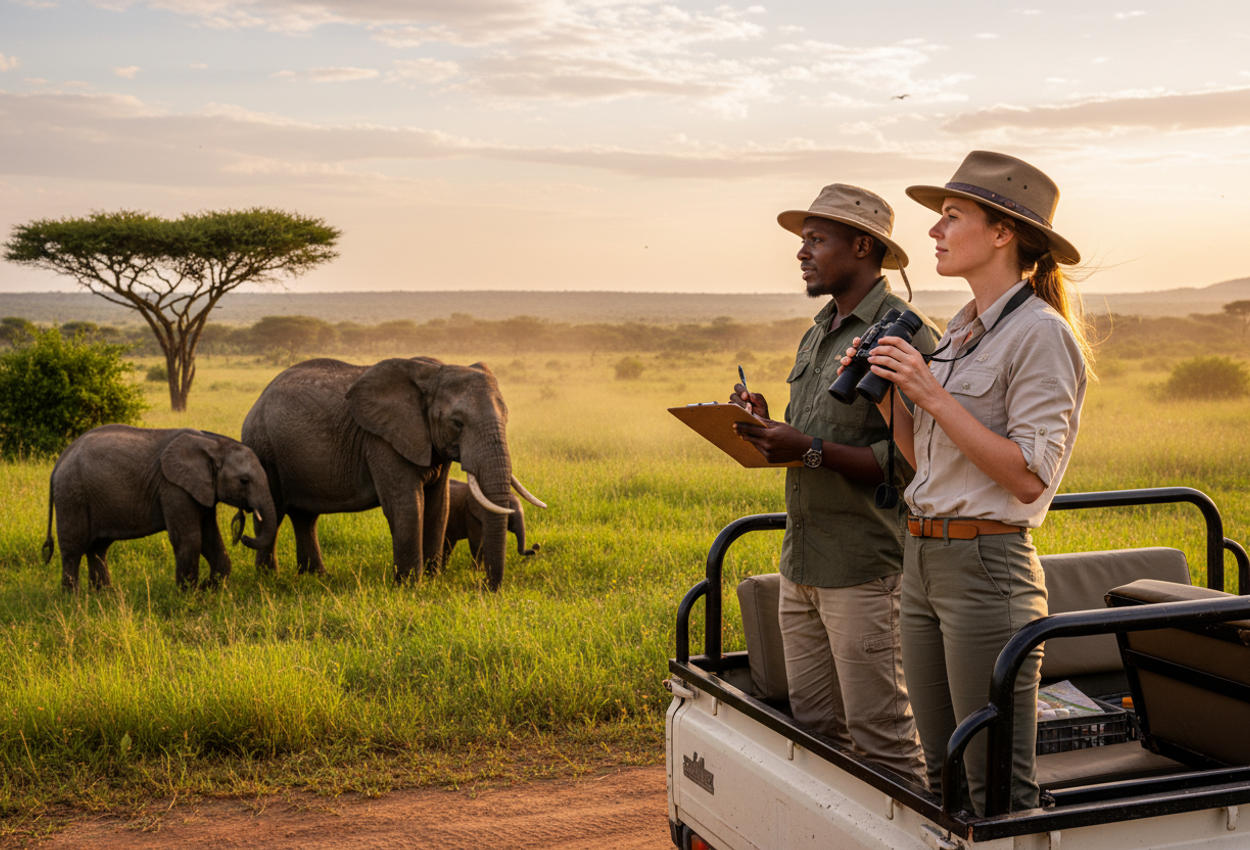
Nothing quite prepares you for your first close encounter. Perhaps you are walking quietly with a guide, learning to recognize tracks and droppings baked into the dusty earth. The air shimmers with heat; cicadas whine in the background. Then, ahead, the slow, deliberate movement of an elephant emerges from the brush – ears gently fanning, trunk sampling the air. You keep a respectful distance, heart pounding, trusting your guide’s instructions. Later, safely back at the research base, you help log the sighting: approximate age, sex, condition, any visible injuries or snare marks. What could have been a fleeting safari moment becomes a data point in a long-term study that informs anti-poaching patrols and habitat management.
In these projects, the ethical stakes are high. Wildlife volunteering has faced criticism in recent years, especially where animals are bred or handled primarily for tourist interaction. As a couple, your responsibility is to ask hard questions before you sign up. Does the project allow direct contact with wild animals, and if so, is this contact truly necessary for their welfare or research, or is it for visitor entertainment? Are animals bred in captivity for profit, or are they being rehabilitated with the goal of release where possible? Who runs the project, and what do local conservationists and communities say about it?
Prioritize programs that focus on observation, data collection, and habitat protection rather than cuddling or bottle-feeding wildlife that will never return to the wild. Ethical organizations will emphasize that you are there to support trained staff, not replace them. They will be clear about safety protocols, limit group sizes, and discourage any behavior that could stress animals, such as loud noise, flash photography, or off-trail wandering. When in doubt, seek out independent reports and be prepared to walk away from any placement that treats wild animals as props.
The hidden gem in many conservation projects is the chance to become part of citizen science in a meaningful way. You might help calibrate acoustic monitors that record whale songs, enter decades of nesting data from field notebooks into digital databases, or assist with mapping camera-trap images to identify individual leopards by their spot patterns. These tasks may sound mundane, but they are the scaffolding of serious research. Together, you learn patience, attention to detail, and the art of contributing to something vast and ongoing. Long after you fly home, you may receive project updates showing how the data you helped gather informed new protected areas, anti-poaching strategies, or legislative advocacy. In these moments, the memory of dawn patrols and dust-filled afternoons transforms into something more enduring: a sense that your holiday is woven into the future of the places and species you briefly called your own.
Building Homes, Building Bonds: Community Projects in Nepal
In the soft morning light of the Kathmandu Valley, prayer flags ripple between rooftops like lines of bright script against the sky. The smell of incense and frying dough wafts from alleyway tea shops, mingling with the low murmur of temple bells and motorbikes. From a simple guesthouse terrace in Kathmandu, you and your partner watch the city wake up, cups of milky chiya warming your hands. Soon, a van will take you out of the capital, climbing past terraces carved into the hillsides, where women in vivid saris bend over fields of mustard and rice. This is where many community-focused volunteer projects in Nepal unfold: in villages still rebuilding from earthquakes, landslides, and decades of underinvestment.
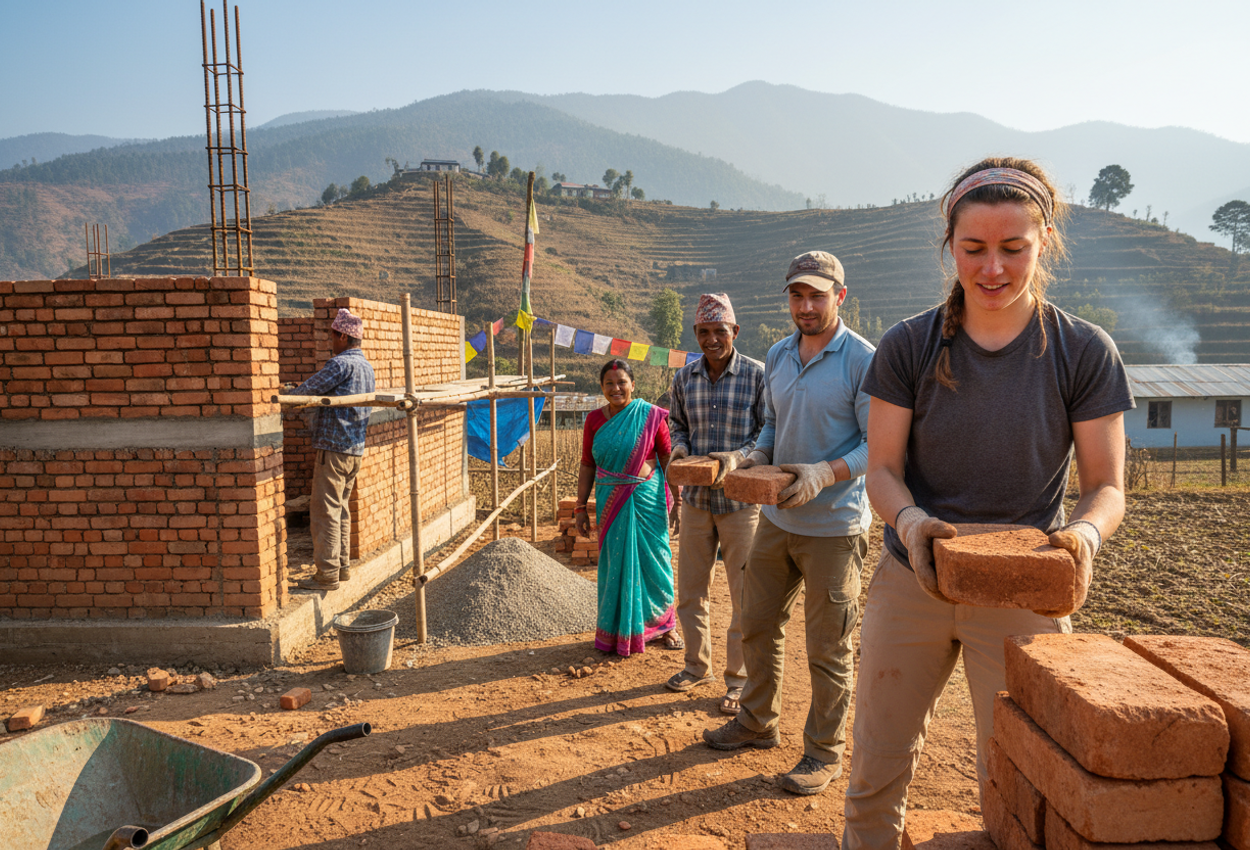
Construction and infrastructure projects in Nepal rarely resemble the glossy before-and-after shots that dominate fundraising brochures. On the ground, progress looks like a slow choreography of shovels, bricks, and conversations. One morning you may be helping to mix cement in a shallow pit, the grit biting into your palms as you stir sand, gravel, and water with a makeshift hoe. Another day you might be painting the inside of a newly built classroom, the smell of fresh limewash mixing with wood dust and the faint sweetness of nearby orange trees. Around you, local masons, carpenters, and laborers move with an efficiency born of experience, and your task is to support rather than lead.
In rural communities, houses, schools, and sanitation facilities are not just buildings; they are symbols of resilience. You might be assigned to help with the construction of a simple, earthquake-resilient home built with reinforced frames and lightweight roofing. As you learn how to tie rebar, align bricks, or assemble latrine walls, the technical details take on human meaning. You are not simply stacking materials; you are contributing to a sense of safety for a family that has spent years in temporary shelters. At lunchtime, you might sit on a low wall and share a plate of dal bhat – lentils, rice, and curried vegetables – with local workers, the spice of homemade achar prickling your tongue.
Community projects in Nepal are as much about cultural exchange as they are about concrete and steel. In Pohkara, a lakeside city ringed by the snowy peaks of the Annapurna range, you may spend your free hours wandering the shore of Phewa Lake, prayer flags reflecting in the water. Local partners often arrange homestays or community-based lodgings where couples can share meals with Nepali families, learning about everything from festival rituals to the fine art of making momos, the beloved dumplings folded with deft, practiced fingers. Evening conversations might drift from cricket matches to marriage traditions, from the Hindu and Buddhist festivals that punctuate the year to the dreams parents hold for their children’s education.
A small but powerful gesture is to learn a handful of Nepali phrases before you arrive. Even basic greetings – namaste for hello, dhanyabad for thank you – can soften initial shyness and open doors to deeper connection. As you practice, perhaps stumbling over unfamiliar sounds, your hosts will often respond with laughter, encouragement, and their own attempts at your language. Learning to say your name, to ask how someone is, or to compliment the food in Nepali communicates something essential: that you have come not just to work, but to listen and to learn.
Of course, responsible building projects require humility about your role. Not all construction tasks are suitable for inexperienced volunteers, and no community should have to slow down essential work simply to accommodate a constant flow of short-term visitors. The most ethical organizations in Nepal partner with local engineers, builders, and community leaders to ensure that volunteers support, rather than disrupt, established plans. You might spend only a week on site, carrying bricks and mixing mortar, but the project itself spans years and belongs to the community. Your satisfaction should not come from dramatic transformation, but from knowing that, for a brief time, you worked alongside people who continue to build long after you have gone.
In the evenings, as the sky over Kathmandu fades into a haze of orange and purple, you and your partner might walk back from a local market with pockets full of spices and tiny brass bells. Your clothes are dusty, your muscles ache, and yet you feel a grounded contentment. You have learned how much care it takes to build something that will last – a school wall, a water tap, a relationship. In Nepal, building together becomes an act of both service and partnership, a reminder that every foundation begins with someone choosing to stay, to show up again the next day, to keep laying one brick at a time.
Teaching English, Touching Hearts: Educational Programs in Thailand
In the cool early hours of a school day in northern Thailand, the streets of Chiang Mai smell of grilled pork skewers, jasmine, and charcoal. As you and your partner walk through a neighborhood of low-slung houses and golden temple spires, roosters crow and scooters buzz past, their riders in crisp uniforms. At a local school, children tumble into the courtyard in neat lines, chattering and laughing as they adjust their bright neckerchiefs. A bell rings, and the sound of a morning assembly begins: a national anthem sung in unison, followed by a few minutes of stillness as everyone stands in quiet respect.
Teaching English in Thailand as volunteers is not about parachuting in as experts, but about supporting local teachers who juggle large class sizes and limited resources. In a classroom decorated with hand-drawn posters and carefully taped-up alphabet charts, you might stand at the front, heart thudding a little faster than you expected, as thirty pairs of curious eyes turn toward you. Your partner hovers near the whiteboard or moves between desks, ready to encourage shy students and gently correct pronunciation.
The challenge – and joy – lies in making English feel less like a set of rules and more like a bridge. You might design simple role plays set in a market or a bus station, using everyday situations from Thai life. One day you could practice directions by pretending to guide a visitor to Wat Phra That Doi Suthep, the hilltop temple overlooking Chiang Mai; another day, you might use vocabulary around food, inviting students to describe their favorite dishes from a night market. When their faces light up as they realize they can express themselves in a new language, you feel the crackle of shared achievement.
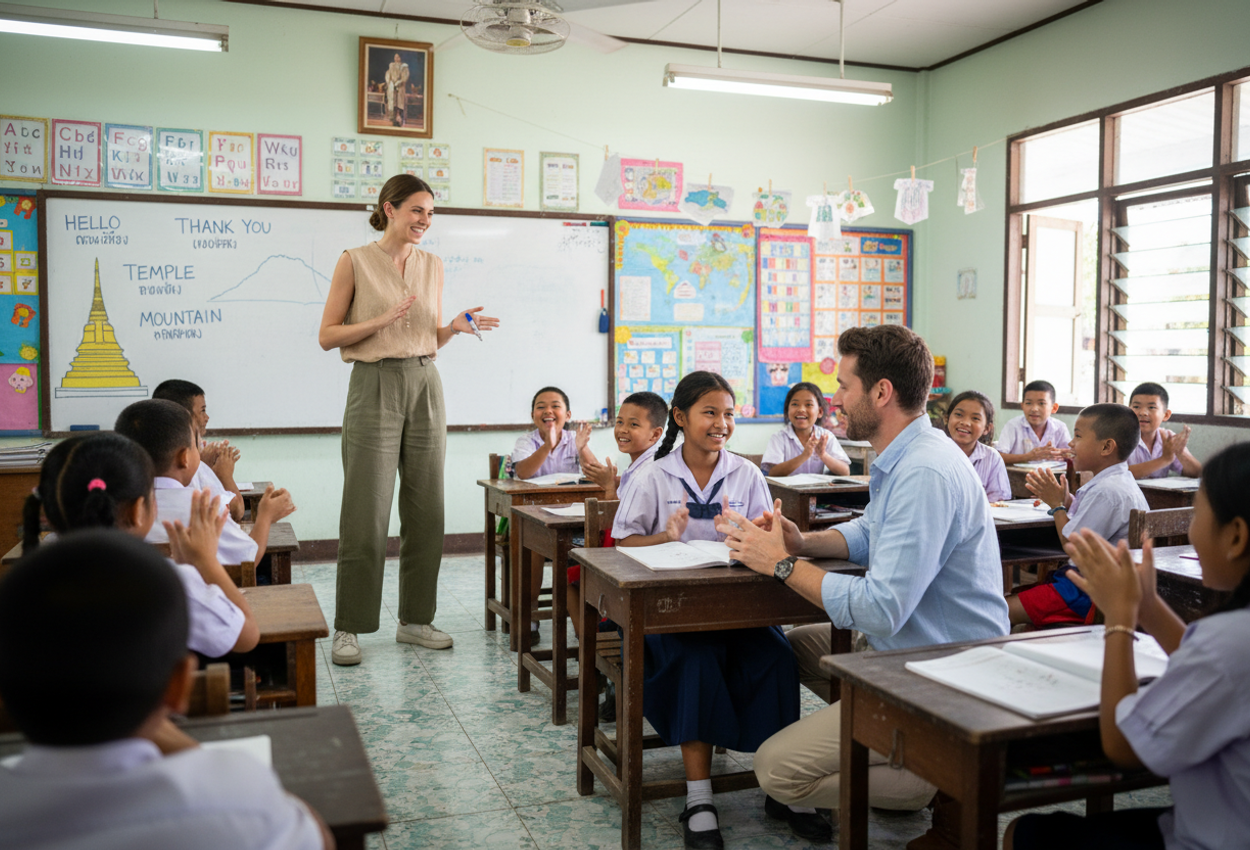
Along the breezy Gulf of Thailand, in the coastal town of Hua Hin, the rhythm is different but the essence is the same. Here, you might work in a community center where children arrive in flip-flops, sticky with mango juice and sea salt. Fans whir overhead as you set up colorful flashcards and simple games. Instead of rote repetition, you invite them to move: to form a circle and toss a soft ball to each other, saying a new word with every catch. When energy dips, you and your partner pull out your secret weapons: Thai games and songs you have learned from local colleagues.
This is the hidden gem of educational volunteering in Thailand. By weaving local culture into your lessons – clapping games, call-and-response songs, simple traditional dances – you transform the classroom into a space where students can see their own world reflected in this foreign language. Rather than imposing unfamiliar scenarios, you ask students to teach you. What games did they grow up playing in the schoolyard? Which songs do they sing at festivals? How do they welcome guests at home? As they demonstrate, you take notes and brainstorm together how to adapt these traditions into English practice. Suddenly, you are no longer just the foreign teacher; you are co-creators.
Designing engaging lessons as a couple allows you to play to your strengths. One of you might excel at storytelling, crafting short tales set in Thai towns that incorporate useful vocabulary and simple grammar structures. The other might have a flair for visuals, sketching quick scenes on the board that help cement new words in students’ minds. On weekends, you can scout local markets, temples, and festivals for inspiration: a Loy Krathong lantern release becomes a unit on wishes and dreams; a bustling fresh market inspires exercises about colors, tastes, and bargaining phrases.
Equally important is understanding when not to speak. As outsiders, there will be cultural nuances about discipline, classroom hierarchy, and educational priorities that you cannot fully grasp in a short stay. Observing local teachers, asking thoughtful questions, and deferring to their judgment when conflicts arise are crucial. Some days, your most valuable contribution may be one-on-one support for students who are falling behind, or preparing materials that save the teacher an extra hour of work at night.
In the quiet moments after class, when the noise of the day has receded and the sun slants low through the windows, you and your partner might sit together at a scuffed wooden desk, covered in chalk dust and stray crayons. You sort through drawings and practice sheets, laughing over unexpected sentences and wonderfully imaginative spelling. You remember the shy student who finally answered a question aloud, the teenager who asked hesitantly about studying abroad, the grandmother in an adult class who told you, slowly and proudly, that she wanted to learn English to speak with her grandchildren. In these small victories, you feel the tenderness of education – not as a grand transformation, but as a series of tiny, shared steps.
Costa Rica's Calling: Eco-Adventures in the Rainforest
The first thing you notice in the rainforest of Costa Rica is the sound. It is not a single noise but a layered, living symphony: the staccato call of distant toucans, the high-pitched trill of tree frogs, the low drone of insects that seems to vibrate in your bones. Mist clings to the canopy, where leaves the size of umbrellas intercept shafts of early sunlight and scatter them across the forest floor. The air is thick and warm, carrying the scent of damp earth, crushed leaves, and something floral you cannot quite name. Standing on a muddy trail in your rubber boots, hand in hand with your partner, you realize this is not a backdrop for adventure; it is the protagonist.
Environmental conservation projects in Costa Rica often unfold in reserves and community-run forests where reforestation and sustainable agriculture go hand in hand. One morning might find you and your partner at a tree nursery, gently loosening seedlings from trays and inspecting their roots. Under a simple tin roof, rain drumming overhead, you learn to distinguish native species – delicate cloud forest trees, hardy pioneer plants that restore degraded pastureland, shade-giving species that will protect coffee bushes below. Carefully, you tuck each sapling into soil-filled bags, labeling them for future planting. Your fingers become stained with rich, volcanic earth; your clothes carry the green smell of chlorophyll and compost.
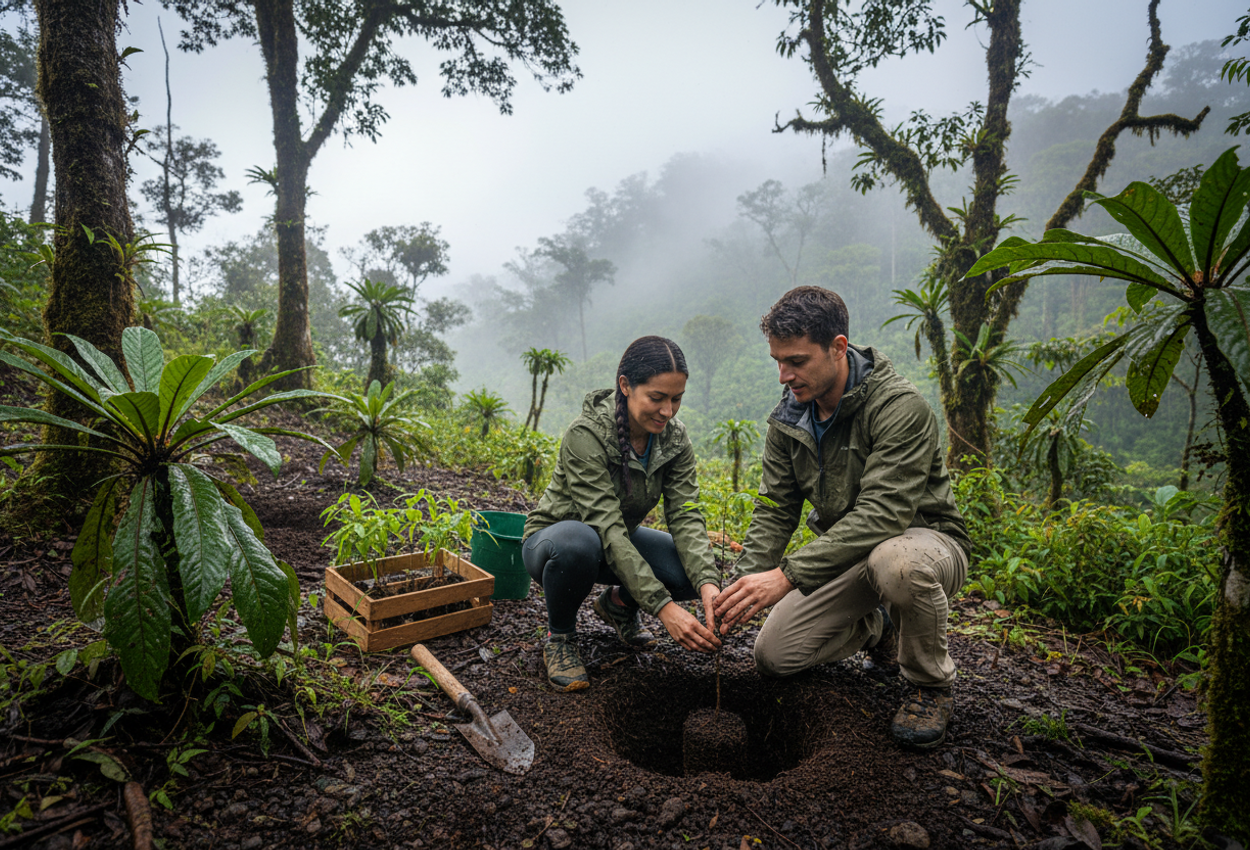
Later in the week, you might hike out with a small team to a steep hillside scarred by past cattle ranching. The sun presses down through broken cloud, and sweat beads at your temples. Each tree you plant becomes a small act of faith. You dig a hole, place the sapling, tamp the soil around it, and step back to imagine this slope years from now: roots holding the land in place during heavy rains, birds nesting in branches, monkeys swinging through a patchwork of regenerated canopy. The work is repetitive, but as you trade off tasks with your partner – one digs while the other carries water from a nearby stream – you fall into a rhythm that feels almost meditative.
Costa Rican conservation projects often intersect with sustainable agriculture, particularly on small organic farms known as fincas. On one such farm, perhaps near the misty heights of Monteverde or in the fertile lowlands of the Central Valley, you may spend a day learning how coffee, cacao, and bananas can be grown in harmony with the forest rather than at its expense. Chickens scratch in the leaf litter; bees hum around flowering shrubs. Your host, a farmer whose family has worked this land for generations, shows you how shade-grown coffee thrives under a canopy of native trees, providing habitat for birds and insects while stabilizing the microclimate.
Here, the hidden gem is making the connection between your volunteer tasks and the cup of coffee you drink every morning. A visit to a local coffee cooperative or plantation that prioritizes sustainability brings the story full circle. You follow the beans from cherry to drying patio to roasting room, the aromatic heat wrapping around you like a warm blanket. You learn how fair pricing and environmentally sensitive practices help small producers weather climate shocks and fluctuating markets. When you sit down with your partner to taste the final brew – chocolatey, bright, perhaps with a hint of citrus – you are no longer just consumers. You are participants in a relationship that stretches from hillside terraces to your kitchen back home.
Between workdays, the rainforest invites quieter kinds of adventure. In the stillness after a tropical downpour, droplets cling to every surface, reflecting the sky in a thousand tiny mirrors. A sloth might hang, motionless, from a high branch, while a line of leafcutter ants marches purposefully along a log, each holding a bright green burden. As you walk slowly along a forest path, your guide points out medicinal plants, explains how local communities harvest them sustainably, and shares stories of how conservation policies in Costa Rica have transformed deforested slopes into thriving ecosystems once more.
At night, lying under a mosquito net in a simple cabin, you listen to the rising chorus of frogs and distant howler monkeys that sound like a chorus of drums and distant thunder. The humidity wraps around you, your muscles ache pleasantly from the day’s work, and your boots sit drying by the door, crusted with red mud. In that darkness, you might whisper together about how your understanding of paradise has shifted. The Costa Rica you will remember is not just beaches and hot springs, but the weight of a spade in your hand, the texture of soil beneath your fingernails, the quiet pride of having added a few more trees to a recovering forest.
Galapagos Guardians: Marine Conservation in Ecuador
The Galápagos Islands rise out of the Pacific like a scattered constellation of volcanic shapes, their black lava shores softened by pale sand and turquoise inlets. Landing on one of the main islands – perhaps Santa Cruz or San Cristóbal – you are struck first by the clarity of the light. Sea lions nap on benches along the waterfront, utterly unbothered by human presence. Marine iguanas bask like prehistoric statues on rocks glazed with salt. Blue-footed boobies stand in improbable poses, their sky-colored feet a surreal contrast against the cinder landscape. It is easy to understand why this archipelago captured the imagination of Charles Darwin, and why it now sits at the heart of global conversations about conservation.
Volunteering on marine conservation projects in the Galápagos means stepping into a place where human impact is both tightly controlled and acutely felt. Days often begin at the waterfront, where the air smells of brine and fish, and the sun climbs quickly, painting the bay in bands of silver and blue. You and your partner might join local staff to check monitoring equipment, prepare snorkeling gear, or load supplies into a small research boat. Out on the water, the swell rocks you gently as frigatebirds glide overhead, their silhouettes carving slow arcs across an enormous sky.
One core focus of many projects is wildlife monitoring. Slipping into the water, you feel the cool shock of the ocean against your skin, your breath steadying through the snorkel. Below, an entire world opens up: schools of parrotfish flit between coral outcrops; a sea turtle glides past with slow, unhurried strokes, its shell mottled with algae. Maintaining a respectful distance, you count individuals, note their behavior, and, when trained to do so, photograph distinguishing marks that help researchers track their movements. Back on land, you and your partner might spend afternoon hours entering these observations into databases, cross-referencing them with historical records to build a clearer picture of population health.
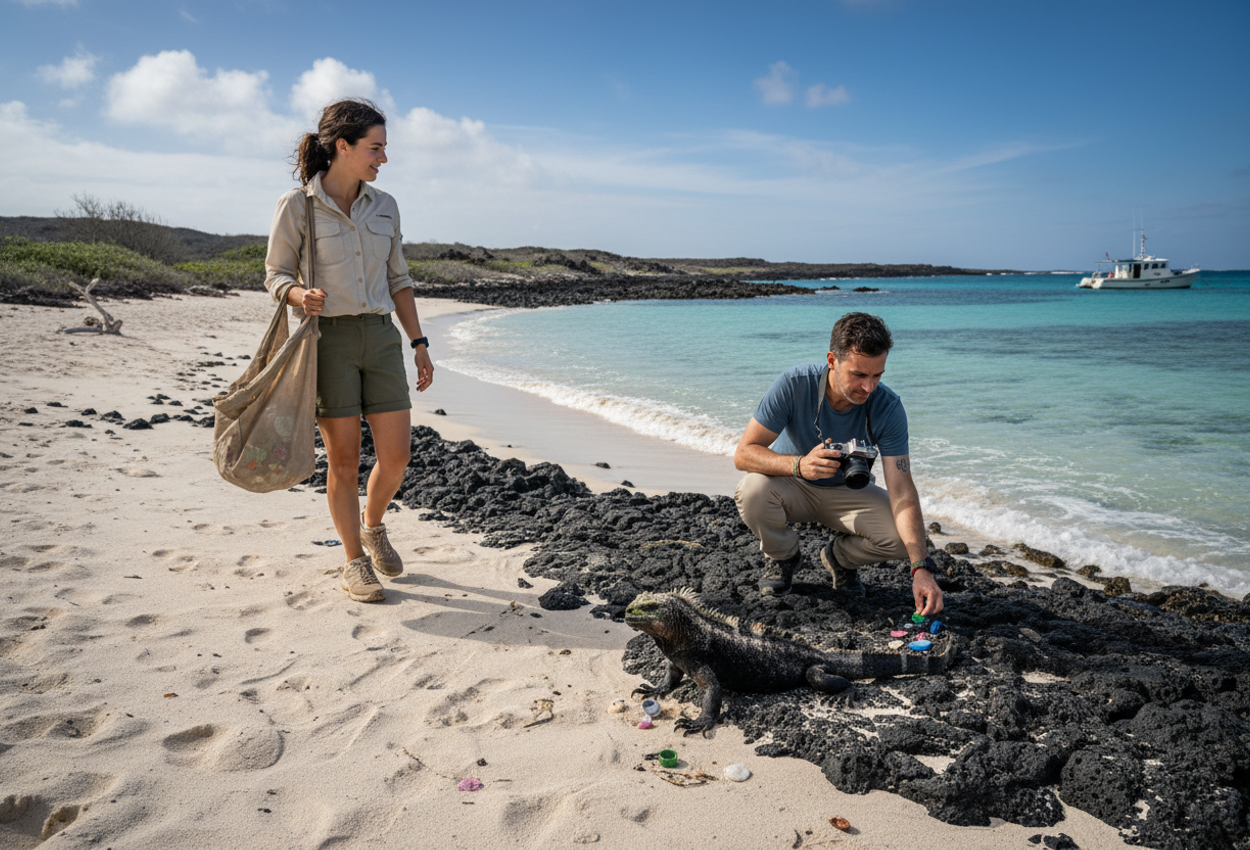
Beach cleanups, at first glance, can seem like a humble task in such a storied landscape. Yet as you stand on a beautiful cove, volcanic cliffs on one side and sparkling water on the other, the reality of plastic pollution becomes painfully tangible. Fragments of fishing nets, bottle caps, and microplastics pepper the tideline, brought here by currents from across the globe. Working in pairs, you and your partner move slowly along the shore, collecting, sorting, and documenting every piece. The sun bakes your shoulders; sand sifts into your shoes. You pause now and then to watch a marine iguana shuffle down to the water or a pelican dive with astonishing precision. The contrast between the archipelago’s wild beauty and the manufactured debris you hold in your gloved hands is stark.
This is where citizen science becomes a hidden gem of impact. Instead of simply disposing of the trash, you log each category according to established protocols – type of plastic, brand when visible, approximate size. Over time, these meticulous records help scientists and policymakers track sources, advocate for changes in packaging and fishing practices, and measure the effectiveness of regulations. You are not just cleaning a beach for the next tourist snapshot; you are contributing to a data-driven strategy to reduce pollution at its origin.
Education is another pillar of Galápagos conservation work. You might help design and deliver short workshops for visitors, explaining why they must keep a respectful distance from animals, stick to marked trails, and avoid bringing unauthorized food or materials onto the islands. In a small interpretation center, perhaps in Puerto Ayora, you and your partner could assist staff in updating displays, translating materials, or guiding school groups through exhibits on endemic species like Darwin’s finches or the flightless cormorant. It is delicate work, speaking about fragility and limits in a place marketed worldwide as a bucket-list destination, but it is also deeply rewarding. When you see visitors shift from casual curiosity to attentive care – picking up a stray wrapper, reminding each other not to touch the animals – you glimpse the ripple effect of your efforts.
Life beyond the volunteer schedule is a reminder that the Galápagos are not a museum but a living, inhabited region. Fishermen mend nets by the dock, children wheel bikes along the malecón, and local families gather in small restaurants where the smell of ceviche, lime, and grilled fish fills the air. In the evenings, you and your partner might sit on a low wall watching the sun sink behind distant islets, the sky streaked with orange and indigo. Sea lions bark lazily; waves slap against the pier. Your muscles are tired from hours in the water, your hair stiff with salt, but there is a lightness in the knowledge that your presence has been, in some small way, protective rather than extractive.
When you leave, it will not be with bags of souvenirs, but with a deeper understanding of the delicate balances that keep a place like the Galápagos alive. You will carry home the memory of a sea turtle’s unhurried gaze, the feel of volcanic sand between your toes, the sound of finches chattering in thorny bushes. More than that, you will carry the discipline of paying attention – to where your plastic ends up, to how your travel choices reverberate far beyond the airport gate, to the quiet, daily labor of the people who choose to stay and guard these islands long after volunteers like you have moved on.
Empowering Women: Supporting Communities in India
In the dense, historic heart of Kolkata, mornings begin in a rush of color and texture. Trams rattle along tracks older than most of the buildings, flower sellers string garlands of marigolds under peeling colonial facades, and the smell of chai spiced with cardamom drifts through narrow lanes. It is here, in this cacophony of the everyday, that many grassroots projects focused on women’s empowerment quietly unfold. Walking into a community center tucked above a busy market, you and your partner might climb a narrow staircase and emerge into a bright room where women and girls sit cross-legged on woven mats, notebooks open, eyes attentive.
Volunteer roles in India that support women and girls are as varied as the communities they serve. You might assist local educators with after-school tutoring, focusing on literacy, numeracy, or exam preparation for girls who are the first in their families to stay in school past puberty. In basic health workshops, you could help create simple, culturally sensitive visual aids about nutrition, menstrual health, or hygiene, always guided by local staff who understand the nuances of language and custom. Some initiatives support women’s self-help groups – small collectives that pool savings, access microloans, and start home-based enterprises ranging from tailoring to snack production.
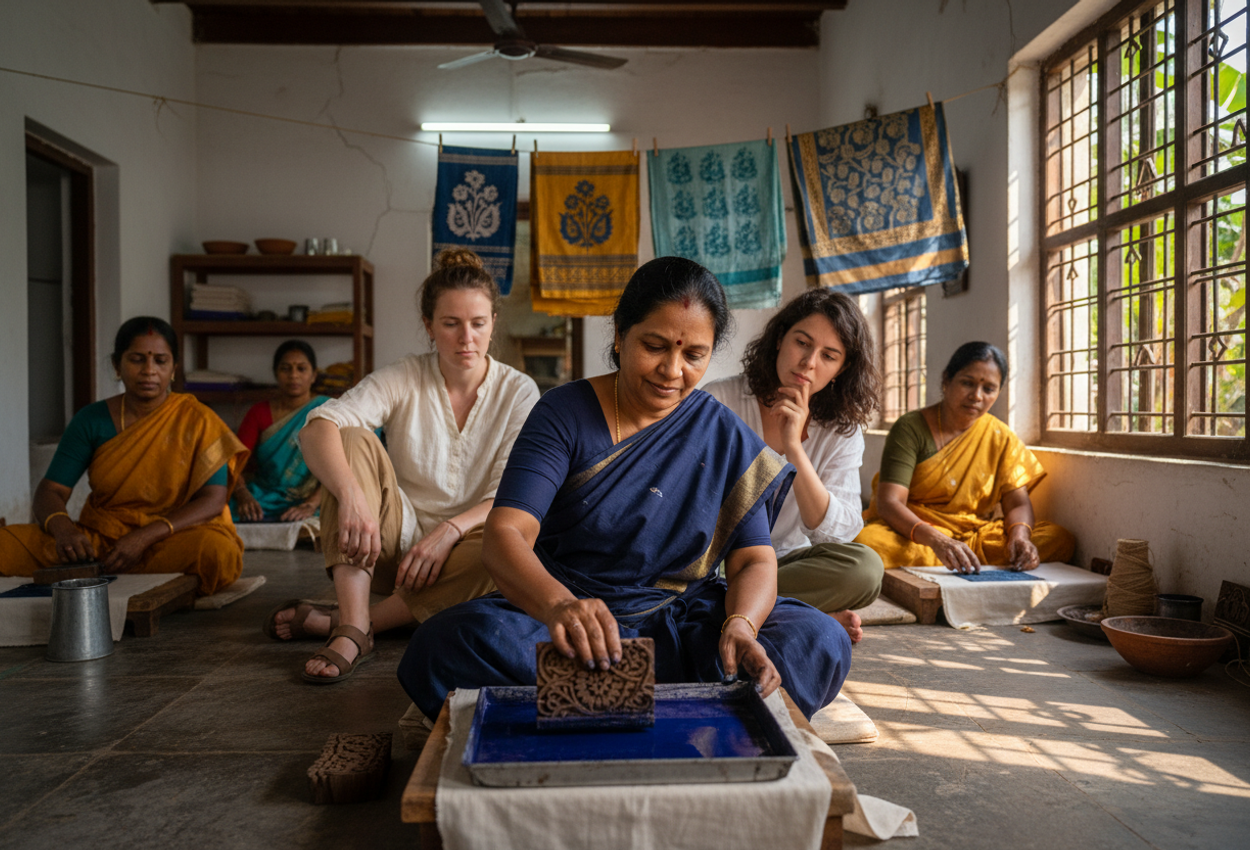
Far to the south, in the lush backwaters and coastal towns of Kerala, the atmosphere shifts but the undercurrent of women’s leadership remains strong. Coconut palms lean over canals where wooden boats slide silently past; the scent of curry leaves sizzling in coconut oil floats from family kitchens. In a village workshop, you might find yourself sitting at a low table with a group of women, learning how to roll coir rope from coconut husk fibers or watching as they block-print intricate patterns onto cotton fabric. As you chat – sometimes through a translator, sometimes with gestures and shared laughter – stories emerge of how these skills have allowed them to send children to school, repair homes, or negotiate more equal roles within their households.
One of the most meaningful ways couples can support these efforts is by using their existing skills to complement, rather than direct, local initiatives. If one of you has a background in marketing or business development, you might help a women’s cooperative think through how to present their products to tourists or online customers without compromising authenticity or underpricing their labor. If the other has experience in health, education, or social work, you might help refine monitoring tools or create simple training modules that local staff can adapt and lead themselves. The emphasis should always be on capacity building and knowledge sharing, not on imposing your own ideas of what empowerment should look like.
A beautiful hidden gem of volunteering in India is the chance to engage with traditional crafts not just as souvenirs, but as lifelines. Instead of buying mass-produced trinkets in airport shops, seek out local artisan cooperatives and fair-trade boutiques that work directly with women’s groups. In Kolkata, this might mean visiting a workshop where survivors of trafficking create hand-stitched bags or embroidered textiles. In Kerala, it could mean choosing handwoven sarees or naturally dyed scarves from a women-run weaving society. When you purchase these items, ask about the stories behind them. How are prices set? How are profits shared? Your curiosity signals that you see the makers not as anonymous vendors, but as entrepreneurs and artists.
Day to day, volunteering alongside women in India requires sensitivity and a willingness to learn new rhythms. Time may run differently than you are used to; meetings might start later than scheduled, conversations may wander before circling back to a task. Respecting local norms around dress, gender interaction, and privacy is vital. Couples may sometimes need to work separately if projects are gender-segregated, meeting up afterwards to share experiences over plates of steaming idli or spicy jhal muri on a street corner. These parallel stories, woven together each evening, can deepen your understanding of how gender shapes daily life in ways that neither guidebook nor statistics can fully capture.
As your time in India draws to a close, you may find your suitcase filled not just with fabrics and spices, but with a subtle recalibration of what power looks like. It is in the quiet confidence of a girl who now raises her hand in class. It is in the steady gaze of a woman negotiating a better price for her cooperative’s work. It is in the realization that your role as a volunteer was not to deliver transformation, but to witness, support, and invest in transformations that women were already leading. Traveling as a couple, you carry these lessons home in duplicate, shaping the choices you make about where you spend, how you speak, and what you stand up for together.
Across all these journeys – from the Ionian coast to the Costa Rican rainforest, from Nepali hill villages to Indian backwaters – a pattern emerges. Volunteer vacations are not a shortcut to virtue or an easy path to adventure. They are invitations: to step into ongoing stories with humility, to share your skills and your willingness to learn, and to remember that love can be expansive enough to hold both each other and the wider world. When you choose to give back together, the memories you make are not just postcards in a photo album. They are seeds, planted in two hearts at once, that grow into a shared commitment to live more thoughtfully long after your passports have been tucked away.