Zanzibar is not merely a destination; it is a slow, unfolding love letter written in tides and trade winds, in the smoky sweetness of cloves and the hush of moonlit surf.Whispers on White Sands: Finding Your Secluded Beach
Arriving on Zanzibar, the island first reveals itself through scent: warm seaweed drying on coral rock, frangipani drifting from hidden courtyards, and the faint, sugary trace of cloves riding the breeze. But it is the beaches that will claim your heartbeat. On the north-eastern shore, beyond the busier stretches, the long ribbon of Matemwe unfurls like a promise of secrecy. Here the sand is a soft, powder-fine ivory that sighs under bare feet, crushed shells and coral smoothed to talc by centuries of waves. Fishermen steer slender dhows toward the horizon at dawn, their triangular sails ghostly against a pale apricot sky, while the lagoon beyond glows a palette of milky turquoise and deep cobalt.
Walking together along Matemwe Beach, you feel time stretch and thin. The tide pulls back to reveal intricate tidal pools, each a miniature universe of darting fish and sea urchins; the water is so clear it seems less a liquid than a lens. The only sounds are the measured hush of the surf and the soft slap of a fisherman’s paddle, punctuated by the distant, melodic calls from the village. Under your toes the sand is cool where the waves have kissed it, warmer higher up where the sun has baked it to the texture of sifted flour. Hand in hand, you trace each other’s footprints at the edge of the foam until they are erased, as if the ocean is conspiring to keep your secrets.

Further south along the east coast, the shoreline curves into a more intimate embrace around Pongwe Beach. Sheltered by a low, rocky headland and shaded by leaning palms, this crescent feels like a private cove discovered by chance. The sea here shifts through impossible shades of blue, from the milky jade of the shallows to the inky sapphire of the reef edge. At high tide, waves lick the trunks of the palms; at low tide, a shining expanse of rippled sand stretches far into the ocean, turning the reef into a distant, shimmering line. Couples linger in the dappled shade, reading, dozing, or simply watching the slow choreography of clouds mirrored in the lagoon.
On the Michamvi Peninsula, where the island’s eastern spine begins to bend toward the south, the light feels different. Michamvi is where you come for sunsets that seem to set the entire sky alight. Facing west across the calm waters of Chwaka Bay, the beaches here are quiet and contemplative. As evening approaches, you can slip away from your lodge and wander along the shore, the sand still warm underfoot, the breeze gaining a faint chill as the heat bleeds out of the day. The sea turns to liquid metal, reflecting bands of peach, rose, and violet as the sun sinks. Shore birds stitch the waterline with their delicate steps; in the distance, the silhouette of a dhow drifts slowly home, its dark sail a single brushstroke on the flaming canvas of the horizon.
For couples seeking something truly personal, make your way to Bwejuu Beach on the south-east coast, where dawn arrives with a soft, pearly glow and the world feels brand new. Arrange a private sunrise yoga session with a local instructor who will meet you under a simple palm-frond shelter or on a linen mat spread directly on the sand. As you move through slow, fluid stretches, the tide whispers closer, the light brightens from silver to gold, and the scent of salt and wet coral sharpens in the cool morning air. Your breathing syncs with the rhythm of the waves; the only other sounds are the rustle of palm fronds and the occasional low murmur of passing seaweed farmers wading out in the gentle shallows.
After the final pose, when the sun has cleared the horizon and your skin glows with that pleasant, post-practice warmth, a private breakfast appears as if summoned by the sea itself. A low table is set on the sand, shaded by a canvas parasol. There is chilled coconut water still sweet from its green husk, ruby slices of watermelon, fragrant mango and pineapple, and tiny, tart passion fruits split open like floral jewels. Freshly baked chapati are wrapped in a cloth to keep them warm, ready to be torn and dipped into creamy coconut yoghurt drizzled with island honey. A thermos of spiced chai breathes out hints of cardamom and cinnamon. With bare feet buried in the sand and the tide creeping closer by the minute, you share bites from the same plate, watch the day fully bloom, and feel yourselves slide into the island’s slower, softer tempo.
Spice Route Rendezvous: Aromatic Adventures for Two
Inland from the coast, where the sea breeze softens and the air grows heavy with green, Zanzibar reveals the other half of its soul. This is the legendary Spice Island, once the beating heart of the global clove trade, where aromatic harvests sailed across oceans to scent faraway kitchens and apothecaries. Today, wandering through a spice plantation hand in hand is one of the most intimate experiences a couple can share, a slow, sensory journey through the island’s fragrant history.
At Siso Spice Farm, just outside Zanzibar City, the tour begins beneath a canopy of glossy leaves. Your guide, perhaps Mr. Siso himself or one of his team, plucks curious pods and leaves from seemingly unremarkable trees, transforming each into a small revelation. He crushes a clove bud between his fingers and holds it out; when you lean in, the scent is sharp and sweet, like Christmas and wood smoke, tinged with something medicinal. Cinnamon bark is shaved from a slender trunk, its fragrance warm and comforting, conjuring memories of baked desserts and mulled drinks. Nutmeg fruits are split to reveal their marbled inner seed veined with bright red mace, like a small, beating heart enclosed in lace.

As you wander the plantation’s shaded paths, you taste your way through the island’s pantry. Freshly grated coconut is mixed with cane sugar and a pinch of cardamom, sticky and rich on the tongue. You chew a sliver of raw ginger; its fiery heat blooms at the back of your throat, chased with sips of cool herbal tea brewed from lemongrass cut moments before. Vanilla vines loop up rough tree trunks, their green pods exuding only the faintest hint of the lush fragrance that will come later, after curing. Pepper vines twist like serpents, paradoxically bearing clusters of tiny, potent beads that tingle on your lips.
This is not a hurried sightseeing stop but an invitation to linger. When the tasting ends, instead of returning to the car park, you are led to a simple open-sided kitchen shaded by palm leaves. Here, over a charcoal stove, a private Swahili cooking class becomes your afternoon’s romance. Aprons tied, you stand side by side as your instructor spreads an array of freshly harvested spices in small ceramic bowls: earthy cumin, smoky paprika, crushed cloves, pale coriander seeds, cardamom pods fat with aroma. The air turns hazy with fragrant smoke as onions sizzle in coconut oil, their sweetness waking the spices when you sprinkle them in.
Together, you learn to build a classic Zanzibari pilau, stirring rice into a pot already perfumed with cloves, cinnamon sticks, and cardamom. You taste and adjust, adding a pinch more salt or nutmeg, learning how these flavors have traveled through centuries of Arab, Persian, Indian, and African exchange. You pound a kachumbari salad of tomatoes, onions, and lime with a mortar and pestle, the rough stone cool under your palms, and simmer a mild coconut curry flecked with turmeric the color of deep marigold. As you cook, your instructor shares stories of grandparents who measured spices by instinct and of wedding feasts where these same dishes still take center stage.
When the meal is finally ready, the pots are carried to a low, beautifully set table under a jackfruit tree or beside a patch of rustling banana leaves. You eat with your fingers in the traditional style, scooping rice and curry with tender pieces of chapati, the food somehow tasting more vivid because you have helped coax it into being. Around you, the plantation is a living soundtrack: distant calls of children, the soft hum of insects, the heavy thud of a falling coconut somewhere in the undergrowth. As you finish with cardamom-scented coffee or sweet black tea, sticky with sugar, you realize this spice tour has become something far more intimate—a shared sensory memory rooted in the soil of the island itself.
Stone Town Secrets: Unveiling History Hand-in-Hand
Down on the western coast, where dhows crowd the harbor and the call to prayer drifts over rooftops, Stone Town rises like a mirage of coral stone and weathered timber. Officially inscribed as a UNESCO World Heritage Site, this old quarter of Zanzibar City is a maze made for lovers who enjoy getting a little lost together. The streets are barely wider than an outstretched arm, hemmed in by houses whose plastered walls range from sun-bleached white to tawny ochre, their facades stitched with balconies, ironwork, and a profusion of laundry fluttering like flags of everyday life.
You begin your walk at the seafront, where the imposing bulk of the Old Fort looms above a small amphitheater and market stalls. Its crenellated walls of rough coral stone are softened by bougainvillea, splashes of magenta cascading down to meet the pavement. Inside the courtyard, vendors arrange handwoven baskets, carved soapstone, and paintings in bright, naive strokes. The air tastes slightly metallic with sea mist; the soundscape is a blend of gull cries, vendors’ calls, and the distant rumble of a departing ferry. Hand in hand, you slip out of the sunlight and into the shadowed alleys, following the cool draft that snakes between the buildings.
Here, the romance is in the details. Doorways seem almost too grand for the narrow lanes they command, each carved wooden door a story in teak and brass. Some are studded with ornate metal spikes, a design seeded centuries ago from Indian merchants who adapted motifs from the subcontinent’s elephant-proof doors; others are framed by floral arabesques, echoes of Omani and Persian influence. A local guide—booked in advance for a private, door-focused tour—pauses at each particularly elaborate example, inviting you to trace your fingers lightly along the patterns. He decodes the language hidden in the carvings: the lotus blooms and rosettes that once symbolized prosperity, the Quranic verses etched in graceful calligraphy, the combination of dates and initials that quietly proclaim a family’s lineage and fortunes.

As you wander, the city reveals its contrasts. You step into a hidden café tucked behind an unmarked door, where the courtyard is paved with cool tiles and shaded by an ancient mango tree. Light filters through latticed windows and the air is velvety with the aroma of strong Zanzibari coffee and cardamom-spiced cake. Couples lean close over low tables; a ceiling fan turns lazily overhead, its blades pushing a soft breeze that stirs the patterned shadows on the walls. Outside again, the alley opens unexpectedly onto a tiny square where children play football, ducking around parked scooters, and women in bright kangas gossip on doorsteps, their laughter ricocheting between the buildings.
Eventually your footsteps draw you back to the seafront and the wide terrace of the House of Wonders, also known as Beit-al-Ajaib. Though portions of the building have been undergoing restoration, from the outside it still dominates the skyline with its layered balconies and slender clock tower, a reminder of the island’s era as the seat of sultans and an important node in Indian Ocean trade. Standing on the square in front of it, you can almost imagine the days when foreign envoys and traders disembarked from wooden dhows, bringing with them fabrics, porcelain, and stories from across the ocean. Behind you, the Old Dispensary and other colonial-era buildings add to the impression of a place stitched together from many worlds.
In the late afternoon, as the sun lowers and the heat eases, Stone Town becomes particularly enchanting. The alleys cool, and the muezzin’s call hangs in the air like a ribbon of sound. This is when your guide leads you to one last, secret door: a modest entrance to a townhouse whose owner has opened it exclusively for your tour. On the first floor, an airy salon looks out over a crisscross of rooftops. Here, amid faded tiles and the faint scent of sandalwood, you sit with a local historian specializing in the island’s famed doors. Over cups of sweet, spiced tea, you listen as he explains how each door once communicated its owner’s origins—Indian, Arab, Swahili—their trade, and their aspirations. Together, you practice spotting details from photographs, his stories layering new meaning onto every carving you have seen. By the time you step back into the alley, Stone Town feels less like a picturesque backdrop and more like a living manuscript you have just learned to read, every door a new stanza in the island’s long poem.
Ocean Rhythms: Sunset Dhow Cruises and Starlit Skies
As day gives way to evening on the western shore of Zanzibar, the harbor begins its nightly transformation. The heat softens, the sky turns the color of ripe papaya, and the silhouettes of wooden dhows gather offshore, their hulls rocking gently in the swell like a flotilla of patient sea birds. For couples, this is the moment to step away from the bustle of the waterfront and board a traditional dhow for a sunset cruise—the quintessential Zanzibari romance, poised between sea and sky.
The boat itself feels timeless: a long, slender wooden hull, its planks dark and smooth from years of salt and sun, and a single triangular sail hoisted with a rhythmic creak of rope through wood. As you step aboard from the small jetty or directly from the beach, your feet meet the grainy warmth of the deck, scattered with bright kanga cloths used as cushions. The air is thick with the smell of sea spray, teak, and perhaps a trace of grilled fish from a nearby beach stall. When the crew casts off, the city’s sounds—motorbikes, laughter, the clink of bottles at Forodhani—begin to fade, replaced by the slosh of the hull cutting through the water and the occasional slap of a rope against the mast.

As the dhow glides away from the shore, the late sun turns liquid and spills its colors across the Indian Ocean. The waves seem to catch fire along their crests, flickering gold and rose. A local musician strums a taarab melody on an oud or a simple guitar; the music is both melancholy and joyful, drawn from Swahili, Arab, and Indian traditions. He sings in Swahili, his voice soft and unhurried, and though you may not understand the words, the emotion translates perfectly. You sit close, shoulders touching, as the warm wind tugs at your hair and the taste of salt gathers on your lips.
Soon, a platter of local seafood and snacks appears from a small galley: skewers of octopus brushed with a smoky, chili-flecked marinade; tender prawns grilled with lemon and garlic; coconut samosas encasing spiced vegetables; and wedges of lime to squeeze over everything. You eat with your fingers, licking traces of chili and salt, washing each bite down with chilled beer, fresh sugarcane juice, or ginger-lime soda. As you dine, the sun reaches the edge of the world and pauses, a molten disk whose reflection stretches in a bright path straight toward your boat as though inviting you to follow.
But the true magic comes after the last blaze of color drains from the sky. Many cruises turn back at this point, but the most memorable ones linger, drifting further into the deepening dusk. The crew lowers the sail, the dhow rocking more softly now, surrendered to the languid rhythm of the swells. Overhead, one by one, the stars emerge—from faint pinpricks near the horizon to dazzling pinwheels high above, unmarred by city glare. The Milky Way unfurls like a ghostly river of light, and the Southern Cross settles into position low in the southern sky.
A local astronomer, often a young Zanzibari with a passion for both science and storytelling, lies back on the deck with you and begins to map the heavens. Instead of laser pointers and telescopes, he uses his hands and voice, connecting Western constellations with Swahili names and Indian Ocean lore. He traces Orion’s belt, points out the bright beacons of Sirius and Canopus, and shares how fishermen once read these stars to guide their dhows across open water under clouded moons. You learn which constellations announce the coming of the kaskazi and kusi winds, how traders timed their journeys with the seasonal sky. The stars feel closer on the water, their reflections shimmering in tiny ripples around the boat.
Wrapped in a light shawl or kanga, you rest your head on your partner’s shoulder, listening to the astronomer’s voice taper off into a comfortable silence. The creak of the wooden mast, the soft clink of rigging, and the rhythmic breath of the sea become a lullaby. Out here, halfway between the lit shoreline and the dark vastness beyond the reef, you experience a rare kind of intimacy—a sense of being suspended in a private universe of starlight and tide, where tomorrow’s plans feel as distant and unimportant as the shoreline’s diminishing glow.
Underwater Love: Exploring Zanzibar's Coral Gardens
Beneath the surface of the Indian Ocean, Zanzibar conceals some of its most poetic encounters. Off the north-eastern coast, the protected waters of Mnemba Atoll form a circular reef that has become almost mythical among snorkelers and divers. From the beach at Matemwe, you watch small boats skimming toward a faint smudge of green on the horizon; a short ride later, you are hovering above water so clear it seems impossible, the sandy seabed glowing like frosted glass meters below.
Slipping into the sea together, you feel the immediate, embracing coolness of the water, a relief from the island’s heat. The surface closes over you with a soft shush, and the noises of the boat and human chatter fade into a muffled, distant hum. In front of your mask, a kaleidoscopic world unfolds. Branching corals reach upward like frozen flames; brain corals curve in labyrinthine folds; anemones sway gently, their tentacles alive with tiny clownfish darting in and out. Sunlight filters down in golden shafts that flicker with each passing wave, turning the entire scene into a slow-motion dance of color and light.

You point out a parrotfish the color of tropical fruit salad—turquoise, fuchsia, lime green—its beak-like mouth busily rasping algae from the coral. Schools of yellow-and-silver fusiliers stream past in synchronized flashes, like a ribbon being drawn by an unseen hand. A hawksbill turtle glides into view, its patterned shell dappled by the shifting light; for a few suspended seconds, it seems to regard you with mild curiosity before angling a lazy fin and drifting away into deeper blue. Together, you follow the turtle’s path until it dissolves into the distance, leaving only its memory in the quiet thrum of your heartbeat.
For couples who dive, the romance deepens with each descent. Guided by local dive masters familiar with every contour of the reef, you descend along steep walls bedecked with soft corals that ripple like wind-tossed silk. Lionfish flare their ornate fins as they hover motionless, dangerous and beautiful; moray eels peer from crevices, their sinuous bodies coiled like questions in the dark. On sandy patches between coral bommies, blue-spotted rays rest like painted ornaments, taking flight in a shimmer of electric dots when you draw too near. Communicating only through hand signals and shared glances, you and your partner become a silent team, each pointing out wonders the other might have missed.
To capture this underwater reverie without sacrificing your presence in the moment, arrange a private underwater photography session with a local expert. Equipped with a professional housing and strobes, your photographer joins your small group, unobtrusively framing the two of you against coral walls and shimmering fish clouds. At one point, you kneel together on a patch of white sand, fingers just touching, while a swirl of anthias brushes past like a living veil. At another, you float side by side at the safety stop, silhouetted against a cascade of bubbles, your profiles framed by the dappled surface above. Between dives, on the boat’s shaded deck, you trade sips of cool water and bites of fresh pineapple, sticky juice mingling with sea salt on your lips, reviewing a glimpse of the shots taken so far.
Even non-divers can claim their chapter of underwater love. In the shallows off Nungwi or Kendwa, simple snorkeling trips reveal coral gardens scaled for beginners—patches of lettuce coral sheltering damselfish, sandy channels where starfish sprawl like forgotten toys. As the boat turns back toward shore, wet hair plastered to your forehead and skin tingling from salt, you look at your partner and realize you both carry a new, shared intimacy: the memory of having floated weightless in another world, reliant on each other’s presence and trust.
Eco-Chic Escapes: Luxurious Stays with a Conscience
On an island as prized as Zanzibar, where coral reefs and fragile coastal ecosystems form the canvas of every holiday snapshot, it feels particularly meaningful to choose a stay that gives back. Fortunately, some of the archipelago’s most romantic hideaways are also among its most forward-thinking, weaving sustainability into luxury so effortlessly that your only task is to relax and let the sea breeze turn the pages of your book.
On the north-western shore of Unguja, the main island, Zuri Zanzibar cascades down a gentle hillside toward a curving beach, its thatched-roof bungalows tucked into lush, perfumed gardens. Here, winding sandy paths thread through groves of ginger, banana, and frangipani, the air spiced with the green scent of tropical foliage. Villas are designed to dissolve the boundary between indoors and out: louvered wooden panels invite in the breeze; open-air showers let you wash off the salt beneath a canopy of stars. Solar panels discreetly harvest the island’s generous sunlight, while an on-site water treatment system quietly handles the less glamorous side of paradise, reducing the resort’s footprint on the surrounding sea.

Afternoons at Zuri can unfold lazily in hammocks strung between palms or on cushioned daybeds facing the lagoon, where the ocean twinkles with a constant, flirtatious shimmer. The resort’s spice garden doubles as an outdoor classroom, where staff lead herb-scented tours explaining how local plants flavor Swahili cuisine and traditional remedies. Community engagement runs quietly but deeply here: many staff hail from neighboring villages, and the resort supports local schools and cultural initiatives, ensuring that tourism’s benefits extend beyond its leafy boundaries. For couples, this alignment between indulgence and responsibility adds an extra layer of satisfaction to every sundowner cocktail and every barefoot stroll to dinner.
South-west of Stone Town, in the turquoise waters of a marine protected area, Chumbe Island Coral Park offers perhaps the most singular eco-romantic experience in the region. Accessible only by boat, the tiny island is home to a handful of eco-bungalows and a coral reef so pristine that marine biologists from around the world come to study it. The accommodations are whimsical yet deeply sustainable: open-sided bungalows catch the trade winds, rainwater is harvested for showers, and solar panels power discreet lighting. At night, lying beneath a mosquito net while geckos chirp in the rafters, you can hear the ocean breathing against the shore, a gentle, constant hush.
Days on Chumbe revolve around the reef. Guided snorkeling excursions lead you through coral gardens dense with life, from neon parrotfish to sweeping schools of snapper. Between outings, you may take a naturalist-led walk along the island’s nature trail, learning how rare trees and crabs fit into this self-contained ecosystem. Many couples find that the island’s remoteness invites a uniquely intense kind of closeness—without televisions or constant connectivity, conversation deepens, and moments as simple as watching hermit crabs scuttle along the beach at sunset become strangely profound.
Back on the north-eastern coast, Matemwe Lodge combines intimate scale with a strong sense of place. Perched on a coral outcrop facing Mnemba Atoll, its thatched bungalows are draped in mosquito nets and cooled by sea breezes, each with a wide veranda strung with hammocks. From here, you can watch the choreography of daily life unfold: women in brightly patterned kangas wading out to tend seaweed farms at low tide, fishermen returning in their dhows with the day’s catch, the tide breathing in and out across the reef. The lodge works closely with the neighboring village, supporting education and sustainable livelihoods, and many of the smiling faces you encounter in the restaurant or dive center are from just down the shore.
For couples eager to do more than simply admire the reef, look for properties or partner organizations that offer hands-on reef restoration experiences. Increasingly, lodges along the east coast collaborate with marine conservation groups to run coral nurseries—underwater gardens where broken fragments are nurtured on ropes or frames before being transplanted back to degraded sections of the reef. Joining a supervised session, you and your partner might spend an afternoon snorkeling over a shallow nursery, carefully attaching coral fragments to small structures or checking on the progress of previous plantings. It is meditative work, performed to the soundtrack of your own breathing and the faint crackle of shrimp in the reef, and it leaves you with a tangible sense that your love story has left a positive imprint on this seascape.
Village Vibes: Immersing Yourselves in Local Life
Beyond the beaches and boutique lodges, the true heart of Zanzibar beats in its villages, where life still moves to the cadence of tides, harvests, and daily prayer. On the south-east coast, near the palm-fringed arcs of Bwejuu and Paje, the village of Jambiani offers couples a chance to step gently into this rhythm, to trade the curated calm of resorts for the textured warmth of real community.
A thoughtfully arranged cultural tour—ideally with a locally run cooperative—begins in the cool of the morning. You walk along sandy lanes lined with coral-stone houses, their walls washed in shades of cream and honey, roofs thatched with woven palm fronds. Chickens dart underfoot; children in crisp school uniforms wave and practice their English greetings, their shy smiles quickly broadening into giggles. The air is a blend of wood smoke, sea salt, and the faint sweetness of ripe bananas stacked in woven baskets near doorways.
Your guide, perhaps a young woman from the village in a bright kanga knotted over her shoulder, points out the mosque where families gather on Fridays, the modest shop where fishermen’s wives sell freshly caught octopus, and the shade trees that become informal meeting places in the heat of the afternoon. She explains how the tides shape daily life here: at low tide, women walk far out onto the reef flat to tend their seaweed farms, stooping to check each rope; at high tide, the same stretch of ocean turns into playground and fishing ground, with boys leaping from boats and men casting nets as they have for generations.
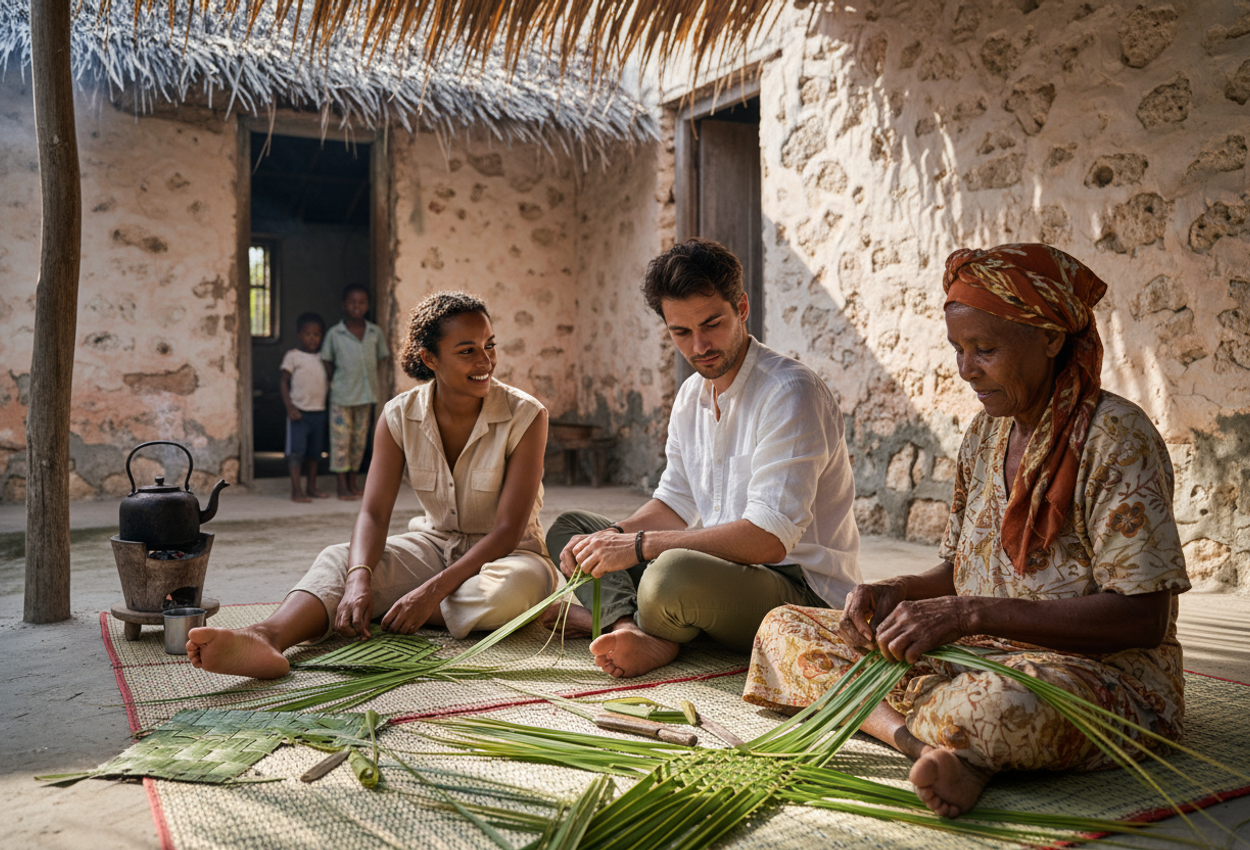
Part of your visit is dedicated to learning a traditional craft that is as practical as it is beautiful. In a shaded courtyard, seated on woven mats, you and your partner are introduced to the art of coconut palm weaving. A basket of long, supple palm fronds rests between you, their surfaces smooth and slightly waxy to the touch. Under the patient guidance of an elder—her fingers flying quicker than your eyes can follow—you begin to fold and plait the leaves into simple forms: belts, small baskets, decorative flowers. The repetitive motion becomes soothing, a quiet rhythm mirrored in the rustle of the leaves. Soon you are laughing at your own clumsy attempts, sharing glances as your creations gradually resemble the examples laid out before you.
Another option is to try your hand at a local instrument. In a family compound where chickens scratch in the dust and a kettle steams on a charcoal stove, a musician introduces you to the resonant tones of the msondo drum or the delicate, lute-like taarab instruments. He shows you how to hold the drum between your knees, how to strike it with open palms so that the sound blooms rich and deep. You learn a simple rhythm, then another, layering them together until your tentative beats line up with his sure, confident pattern. The courtyard fills with overlapping sound—drumbeats, clapping, distant conversations, the soft hiss of frying bread from a neighbor’s kitchen.
Throughout the visit, there are countless small moments that deepen the sense of connection: being invited to peek into a home kitchen where coconut milk is being strained through fine cloth; trying your first still-warm mandazi, a gently spiced, doughnut-like pastry dusted with sugar; sitting under a mango tree to share stories about weddings, families, and hopes for the future. These exchanges remind you that beyond the postcard-perfect views lies a living culture, generous in its hospitality yet deserving of respect and sensitivity.
As the afternoon light slants golden across the village, you find yourselves back on the edge of the beach. Children race each other along the shoreline, their laughter carried by the wind, while women gather on overturned boats to chat as they mend nets. You and your partner walk back toward your lodge, sandals dangling from your fingers, the sand cool now beneath your feet. In your bag are a few woven souvenirs and perhaps a small drum; in your hearts, a quieter, more enduring souvenir—the feeling of having been welcomed, however briefly, into the everyday life of this island.
Flavors of Zanzibar: A Romantic Culinary Journey
As twilight spills over Stone Town, the city’s waterfront undergoes its own nightly metamorphosis. The shaded seafront park known as Forodhani Gardens transforms into the Forodhani Night Market, a carnival of smoke, fire, and fragrance where the island’s culinary heritage unfolds under bare bulbs and a rising moon. For couples, an evening here is both a feast and a flirtation—an excuse to wander arm in arm, pausing wherever curiosity and appetite lead.
The air is alive with sizzling and chatter. Vendors in white coats stand behind long, steel-topped stalls lined with skewers of seafood arranged like edible art: ruby-red lobster tails, glossy prawns, fillets of kingfish marinated in turmeric and lime. Flames leap as oil kisses the grills, sending up plumes of savory smoke that mingle with the sweetness of frying dough and the sharp tang of freshly squeezed lime. You weave through the crowd together, letting the aromas guide you, stopping when a stallholder lifts a grilled octopus tentacle toward you with a grin, its edges charred and blistered, its flesh tender and fragrant.

You share a plate of Zanzibar’s most famous street food invention, commonly known as Zanzibar pizza. Despite the name, it is closer to a stuffed, griddled crepe than anything from Italy: a thin sheet of dough stretched on a flat grill, topped with finely chopped vegetables, egg, a choice of meat or cheese, and perhaps a smear of spicy sauce, then folded into a neat parcel and fried until crisp. Cut into bite-sized squares and drizzled with hot sauce, it is messy in the best possible way, juices running down your fingers as you feed each other pieces and try not to lose the battle against gravity. Nearby, sugarcane juice is pressed to order, the canes fed through a squealing machine with slices of lime and ginger, resulting in a pale green elixir that tastes like sweet grass and sunshine, with a bite of heat at the end.
Beyond the market, Zanzibar’s romantic culinary journey continues in quieter, more intimate settings. In the historic quarter, rooftop restaurants above old merchant houses invite you up narrow staircases to tables overlooking the city and sea. Lanterns sway in the evening breeze, casting soft pools of gold on white tablecloths; the scent of cloves and grilled fish drifts through the air. Here, you can linger over courses that remix Swahili classics with contemporary finesse: coconut-crusted prawns with a tamarind dipping sauce; slow-cooked lamb in a clove and cinnamon jus; plantain cooked until caramelized and served with vanilla ice cream made from local pods.
To conclude your journey on an unforgettable note, arrange a private dinner on a secluded stretch of beach—perhaps near your lodge on Michamvi or Bwejuu. Arriving just after sunset, you find a table set directly on the sand, its legs sunk deep for stability, the surface dressed in crisp linen and strewn with bougainvillea petals. Lanterns and candles in glass jars trace a flickering path from the shoreline to your table. The sea is now a dark, breathing presence at your feet, the waves brushing the shore with a sound like whispered secrets. Overhead, stars reclaim the sky, bright and multitudinous.
Your meal has been crafted around the island’s traditional Swahili dishes, each course a quiet celebration of the spices and ingredients you have encountered over the days. You begin with a bowl of supu ya pweza, tender octopus soup infused with ginger and coriander, its steam fragrant against the cool evening air. Next comes a platter of pilau, the rice studded with cardamom, cloves, raisins, and slivers of caramelized onion, served alongside a mild fish curry bathed in velvety coconut sauce tinged with turmeric. Between bites, you sip chilled white wine or a non-alcoholic hibiscus cooler, its tartness a refreshing counterpoint to the richness of the food.
Dessert might be as simple and perfect as fresh fruit with spiced syrup—mango, papaya, and pineapple drizzled with a reduction of passionfruit, vanilla, and star anise—or mkate wa ufuta, fragrant sesame bread served warm with cardamom-scented coffee. The staff maintain a discreet distance, appearing only when needed and vanishing again into the darkness, leaving you with the illusion of absolute privacy. Around you, the night deepens: crabs leave delicate hieroglyphs in the damp sand, and the breeze lifts the edge of the tablecloth, carrying with it the mingled aromas of sea salt and clove-scented night air.
In the end, what lingers from Zanzibar is not a single beach or dish or sunset, but a layered impression: the feel of powdery sand under bare feet at dawn, the bright sting of ginger on your tongue, the echoing alleys of Stone Town, the hush of coral gardens humming with unseen life. For couples, it is a place where romance is neither orchestrated nor forced, but arises naturally from the island’s own generous rhythm—a spice-scented shore that invites you not just to visit, but to listen, taste, and fall in love a little more deeply, with each other and with the world.