

Nytorv 2, Copenhagen Travel Guide
Historic marketplace transformed into Copenhagen's vibrant cultural heart, where medieval heritage meets modern urban life.
Nytorv (New Square) is a historic public square in central Copenhagen, Denmark, forming a unified space with the adjoining Gammeltorv as part of the Strøget pedestrian zone. Created by Christian IV in 1610, the square is dominated by the imposing Neoclassical façade of the Copenhagen Court House, designed by Christian Frederik Hansen and completed in 1815. Once a bustling marketplace where butchers worked and executions took place, Nytorv has transformed into a vibrant cultural hub hosting jazz festivals and public gatherings. Today it stands as a lively centerpiece of Copenhagen's medieval old city.
A brief summary to Nytorv 2
- Nytorv 2, Copenhagen Municipality, København K, 1450, DK
- Duration: 0.5 to 2 hours
- Free
-
 Outdoor
- Mobile reception: 5 out of 5

Know before you go
Hi, I'm Eve. Here are a few practical things to know before exploring Nytorv 2.
- Visit during the Copenhagen Jazz Festival to experience live performances on the octagonal podium, transforming the square into an open-air concert venue.
- Examine the paving stones carefully—the paler stone markings show the footprint of the original City Hall, creating a historical map beneath your feet.
- Look up at the skyway connecting the Court House to the former jailhouse across Slutterigade—the 'Bridge of Sighs' carries centuries of history in its architecture.
- Explore the adjoining Gammeltorv to experience the complete medieval square complex and understand the historical contrast between the two spaces.
- Visit the 1913 Baroque Revival kiosk on Kongens Nytorv nearby, which now operates as a café and once hosted Copenhagen's first public telephone service.
Do you manage this location?
Take control to get all the benefits, like improved information, better appearance, and stronger visibility across AI-powered discovery. Learn more about listing your business on Evendo
Activate your presenceOther nearby places you may find interesting
The closest places of the same kind, if this one is not quite what you had in mind.



Explore Nytorv 2 on the Map
A handpicked selection of must-see spots near Nytorv 2, mapped for you.
Getting There
-
Metro
The Kongens Nytorv Metro Station on the Metro Cityring line is located approximately 100 meters east of Nytorv. Travel time from Copenhagen Central Station is approximately 5–7 minutes. Single journey tickets cost around 24 DKK for adults within Zone 1–2.
-
Walking
Nytorv is centrally located within Copenhagen's pedestrian zone. From Tivoli Gardens, the walk takes approximately 8–10 minutes heading northeast through the city center. From Copenhagen Central Station, it is approximately 10–12 minutes on foot via Strøget. The entire route is flat, paved, and fully accessible.
-
Bus
Multiple bus routes serve the area surrounding Nytorv, including lines 1A, 2A, 5C, and 14. Journey times from Central Station range from 5–12 minutes depending on the route and traffic. Single tickets cost approximately 24 DKK within Zone 1–2. Buses run frequently throughout the day.
-
Bicycle
Copenhagen's extensive cycle network connects directly to Nytorv via Strøget and surrounding streets. Bike rental is available throughout the city at approximately 80 DKK per day. The journey from Central Station takes approximately 5–8 minutes by bicycle on flat, dedicated cycle paths.
For the on-the-go comforts that matter to you
-
 Restrooms
-
 Drink Options
-
 Food Options
-
 Seating Areas
-
 Information Boards
Discover more about Nytorv 2
From Marketplace to Modern Square
Nytorv was established by Christian IV in 1610 when he cleared an area behind the existing City Hall as part of his Renaissance-style renovation of the building. The square quickly became a thriving marketplace, distinct from its neighboring Gammeltorv on the opposite side of the City Hall. While Gammeltorv served as the primary sales venue, Nytorv functioned as the working heart of the market—it was here that butchers conducted their trade and where the darker side of medieval justice played out, with execution facilities dominating the square's grim landscape.The 18th-century writer Ludvig Holberg, who lived on the border between the two squares from 1728 to 1740, captured the contrasting character of these adjoining spaces in his observations. Gammeltorv represented refinement and culture, while Nytorv embodied the raw, practical necessities of urban life. This duality defined the square's identity for centuries.Architectural Transformation and the Court House
The most significant transformation came in the early 19th century with the construction of a grand new building designed by Christian Frederik Hansen, the leading Danish architect of his era. Completed in 1815, this Neoclassical structure served dual purposes as both City Hall and courthouse, establishing the architectural identity that dominates the square today. The building's imposing façade, featuring ionic order columns, occupies most of the western side of Nytorv. Connected to the courthouse was a jailhouse, linked by a distinctive skyway that earned the nickname "Bridge of Sighs" due to its use in transporting prisoners between the two buildings.The architectural ensemble reflected Copenhagen's ambitions as a modern European capital, with Hansen's design drawing inspiration from contemporary civic buildings across the continent. The courthouse remained the City Hall until 1905, after which it continued its judicial functions exclusively.The Evolution of Public Space
During the first half of the 20th century, Nytorv underwent a gradual transformation as traditional market activities faded and automobile traffic increasingly dominated the square. This period marked a shift from Nytorv's role as a working marketplace to something more ambiguous—neither fully public nor fully functional. The turning point came in 1962 with the establishment of the Strøget pedestrian zone, which unified Nytorv and Gammeltorv into a single continuous public space and reclaimed the area from vehicular traffic.The 1993 refurbishment, overseen by city architect Otto Käszner, brought further renewal and symbolic restoration. An octagonal podium was constructed at the exact location where the execution scaffold once stood, serving as both seating and occasionally as a bandstand. The footprint of the former City Hall was marked in the paving with paler stone, creating a subtle historical map embedded in the square itself.Nytorv Today
Today Nytorv stands as a lively and integral part of Copenhagen's historic core, seamlessly integrated into the pedestrian Strøget shopping street. The square hosts cultural events throughout the year, most notably during the Copenhagen Jazz Festival, when the octagonal podium transforms into a performance stage. The surrounding architecture tells multiple stories—the imposing Court House anchors the western side, while the skyway connecting it to the former jailhouse remains a distinctive architectural feature.The square's character blends historical significance with contemporary vitality. Visitors encounter layers of Copenhagen's past at every turn: the medieval marketplace heritage, the Neoclassical civic pride, the 19th-century justice system, and the modern pedestrian-focused urban design. The paving stones themselves serve as a historical document, marking where previous structures once stood and inviting reflection on the square's transformation from execution ground to cultural gathering place.












Your all‑in‑one travel companion app
Explore expert travel guides, compare and book tours, experiences, hotels, and more—all from the palm of your hand. Download now for seamless trip planning wherever your wanderlust takes you.


Explore More of Copenhagen
Looking beyond Nytorv 2? Discover Copenhagen for broader travel guides, local hot-spots, and regional highlights.
Explore Copenhagen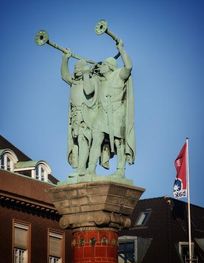
A towering column of bronze horn players above Copenhagen’s City Hall Square, blending Bronze Age symbolism, brewer philanthropy and urban theatre in one landmark.

Historic 1890s covered arcade where telephone wires once connected a nation, now a charming shopping passage in Copenhagen's heart.
