Bishop's Square Travel Guide
Free Guide: A thousand years of Aarhus history layered beneath a lively, tree‑lined square between the cathedral, theatre and Latin Quarter.


A brief summary of Bishop's Square
A thousand years of Aarhus history layered beneath a lively, tree‑lined square between the cathedral, theatre and Latin Quarter.
Bispetorv, or Bishop’s Square, is a broad, cobbled plaza at the historic heart of Aarhus, framed by the soaring Aarhus Cathedral, the ornate Aarhus Theatre and the lanes of the Latin Quarter. Once a Viking burial ground and later a car‑packed parking lot, it was transformed in the 2010s into a green, multi-use urban space with groves of trees, wooden decks, fountains and the equestrian statue of King Christian X. Today it hosts festivals, flea markets and everyday city life, making it an easy, atmospheric pause between museums, shops and cafés.
On-site amenities
 Restrooms
 Drink options
 Drinking water
 Food options
 Seating areas
 Sheltered areas
 Trash bins
 Information boards
 Visitor centre
Opening hours
- Every dayOpen 24 hours
Opening hours as listed on the venue’s Google Business Profile. Hours can change for services and special events, so check with the venue before you go.
- Address
- Bispetorvet, 8000 Aarhus
- Website
Getting there
On foot from Aarhus H central station
City bus within Aarhus
Light rail to Skolebakken and short walk
Car or taxi within Aarhus
Discover more about Bishop's Square
From Pagan Burial Ground to Bishop’s Front Yard
Standing on Bispetorv today, it is hard to imagine that this open, sociable square began as a pagan burial site in the early Viking settlement of Aarhus. Over a thousand years ago, graves clustered here at what was then the edge of a small trading town, long before church spires and theatres defined the skyline. When Aarhus became the seat of a diocese in the 900s, the area shifted from sacred pagan ground to Christian stronghold, with clergy and canon houses shaping the streets around it.In the late 11th century bishop Peder Vognsen began building Aarhus Cathedral just north of the burial site, firmly anchoring the emerging city around this point. After the Reformation, the nearby chapter house became the bishop’s residence, fronted by a substantial garden and a wall along what is now Kannikegade. For centuries the square’s immediate surroundings were dominated by ecclesiastical buildings, giving the later name “Bishop’s Square” its literal meaning.
Creating Space for the Cathedral and the City
By the late 19th century, Aarhus had outgrown its medieval shell and the cathedral felt hemmed in by dense building lines. In 1881 the municipality bought and demolished the bishop’s house to open up a proper city square and allow the vast brick church “room to breathe”. A final building between Store Torv and the new space disappeared in 1921, giving Bispetorv roughly the footprint you see today.For decades the square functioned primarily as a practical open area and, eventually, as a large car park. Yet even then, market stalls and gatherings hinted at its potential as a civic stage. Archaeological digs in the 1960s uncovered rich Viking‑age layers beneath the asphalt, finds that would later inspire the creation of the small Viking Museum nearby. These discoveries underscored how tightly the history of Aarhus is layered beneath seemingly ordinary cobbles.
A Contemporary Square Reimagined
A turning point came in the late 2000s, when the city chose to reclaim Bispetorv for people rather than cars. A design competition led to a comprehensive redesign completed around 2016–2017. Parking disappeared, replaced by a broad wooden deck that ripples gently across the sloping site, connecting three clusters of trees. This timber landscape doubles as seating, informal play space and a natural amphitheatre for performances and festival stages.Low sandstone edges define the square, while two small fountains offer drinking water and a soft acoustic backdrop on quieter days. By blending greenery, open paved zones and flexible staging areas, the new layout allows several activities to happen at once: a concert at one end, children playing or sledging on the deck at another, friends lingering with takeaway coffee in the shade of the trees.
Monuments, Footprints and Neighbours
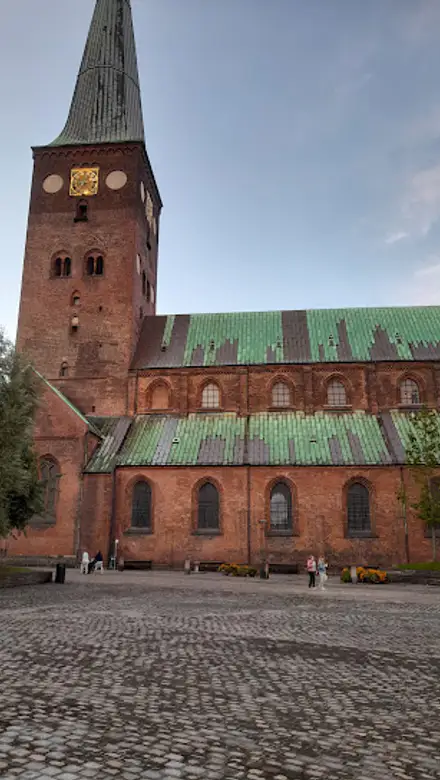
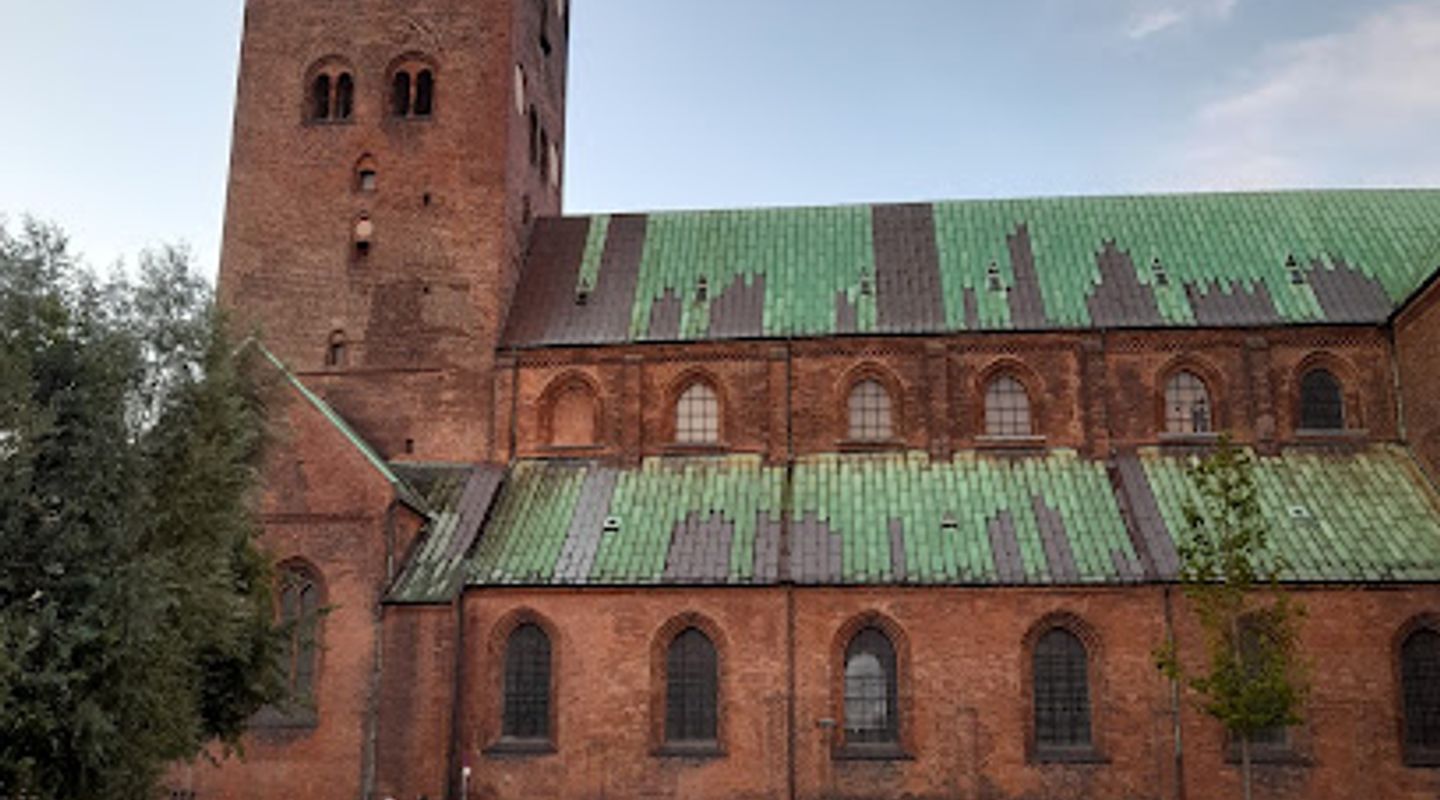
Bispetorv’s setting is as compelling as its design. To the north, the long Gothic nave and tower of Aarhus Cathedral dominate the view, their pale brickwork and green copper roofs forming a striking backdrop. To the east, the richly decorated façade of Aarhus Theatre adds a splash of art‑nouveau drama, especially when illuminated after dark. A short walk away, the Viking Museum dips underground to reveal the very layers once excavated beneath the square.On the grassy corner northwest of the main open space rises an equestrian statue of King Christian X. During the Second World War he became a potent symbol of quiet resistance, known for riding daily through occupied Copenhagen without guards. His bronze presence here ties local space to national memory. Look down, too: in among the cobbles you may notice an intriguing dinosaur footprint motif, a playful nod that underlines how the square delights in small surprises.
Everyday Stage for Markets and Festivals
Today Bispetorv functions as both living room and stage for Aarhus. During the city’s festival week, the square fills with music, installations and temporary landscapes that test new ways of using public space. At other times, flea and car‑boot markets line up stalls in front of the theatre, turning the square into a treasure hunt of vintage clothes, books and curios.Even on an ordinary weekday, the atmosphere is gently lively rather than hectic. Office workers cut across the cobbles, cyclists thread past the trees, and visitors pause to photograph the cathedral or map their next move into the Latin Quarter’s narrow streets. The space remains open around the clock and access is free, making it an easy place to detour through, linger with a snack, or sit quietly and absorb the layered story of Aarhus that lies just beneath your feet.
Evendo Review Centre
 Google
Guest reviews
Best time to go
Quietest: Jan, Feb & Mar · before 6am
Busy times are Evendo estimates for a typical year, to help you plan. Actual crowds vary with events, school holidays and the weather.
Explore Bishop's Square on the map
A handpicked selection of must-see spots near Bishop's Square, mapped for you.
Get your free copy of our complete guide to Bishop's Square, delivered straight to you.
Everything on this page, from opening hours and how to get there to Eve’s tips and the best time to go, in one PDF you can read offline, print or share.
Already have an account? Sign in
Your Bishop's Square guide is ready.
We'll send it to · Not you? Sign out

Getting your guide ready…
We are putting together a fresh copy of the Bishop's Square guide. This can take up to a minute.
This can take a few moments. If your browser asks, choose Allow so the download can start. You'll find the guide in your Downloads folder.
Nothing happened? Download it again
Sorry, the guide is taking longer than usual. Please try again in a minute, or get it by email instead.
Other nearby places you may find interesting
The closest places of the same kind, if this one is not quite what you had in mind.
-
-
-
-
-


Swipe for more places
More to explore near Bishop's Square

 Best experiences near Bishop's Square
 Best hotels near Bishop's Square
 Best landmarks near Bishop's Square
 Best attractions near Bishop's Square
 Best shops near Bishop's Square
 Best restaurants near Bishop's Square
 Best bars near Bishop's Square
Do you manage this location?
Take control to get all the benefits, like improved information, better appearance, and stronger visibility across AI-powered discovery.
Explore more

Explore more of East Jutland
Discover East Jutland, Denmark's enchanting region blending vibrant cities, rich history, and stunning natural landscapes, perfect for every type of traveler.
Explore East Jutland
Explore more of Denmark
Discover Denmark: A perfect blend of history, modern design, and the cozy concept of hygge. Explore vibrant cities, serene landscapes, and world-class cuisine.
Explore Denmark