H. C. Andersen skulptur i havnen Travel Guide
Free Guide: A larger‑than‑life Hans Christian Andersen strides through Odense Harbour, half submerged in the water below the harbour baths in a bold, story-filled bronze.


A brief summary of H. C. Andersen skulptur i havnen
A larger‑than‑life Hans Christian Andersen strides through Odense Harbour, half submerged in the water below the harbour baths in a bold, story-filled bronze.
Half-submerged in the clear water below Odense Havnebad, this striking bronze sculpture of Hans Christian Andersen offers one of the city’s most unusual encounters with its famous fairy-tale author. Created by local artist Jens Galschiøt, the three‑meter figure appears to stride through the harbour basin, his long coat trailing behind him as if he has just stepped out of a story and into the fjord. Accessible at all hours, it’s a quirky, thought-provoking art stop that pairs well with a stroll along Odense’s redeveloped waterfront and a visit to other Andersen-related sights in the city.
On-site amenities
 Restrooms
 Drink options
 Drinking water
 Food options
 Seating areas
 Sheltered areas
 Trash bins
 Information boards
Opening hours
- Every dayOpen 24 hours
Opening hours as listed on the venue’s Google Business Profile. Hours can change for services and special events, so check with the venue before you go.
- Address
- Odense Fjord
- Website
Getting there
On foot from central Odense
City bus within Odense
Bicycle from the wider urban area
Taxi from outer Odense or suburbs
Discover more about H. C. Andersen skulptur i havnen
A fairy-tale figure walking through the harbour
The Hans Christian Andersen sculpture in Odense Harbour is not the sort of monument you expect for Denmark’s most beloved storyteller. Instead of standing on a high pedestal in a garden, the three‑meter bronze figure strides straight through the harbour basin below Odense Havnebad, his coat flaring out behind him as if caught in a sudden gust from the fjord. From the quayside you see his upper body emerging from the water, while the lower part of the figure is hidden beneath the surface, creating the uncanny impression that Andersen is calmly wading through the basin.The sculpture’s placement at the water’s edge connects it playfully to tales like “The Little Mermaid” and “The Ugly Duckling.” Reflections of the bronze in the shifting water add an extra layer of movement, especially on breezy days when ripples distort his silhouette and make him seem almost alive.
An artwork born of protest and persistence
The piece was created by Odense-based artist Jens Galschiøt, known for large-scale, emotionally charged sculptures. Originally, this Andersen figure was intended for a central fountain project known as The Storyteller’s Well. When funding disappeared and no suitable downtown site emerged, the finished bronze stood in limbo outside Odense City Hall for several years, a monument without a permanent home.Frustrated by the bureaucracy, Galschiøt staged a symbolic “burial” in 2011, transporting the statue in a ceremonial procession to the harbour, complete with brass band and spectators, before lowering it dramatically into the water. The event became a story in its own right, blurring the line between performance and protest and underlining how public art can spark debate about who decides what belongs in a city’s shared spaces.
From burial to resurrection beneath the bathing pools
The harbour “burial” was not the end of the story. The statue was later raised again and spent a period touring other locations in Denmark before the original was sold. Under cover of night, a reproduction appeared back in Odense Harbour, installed without formal approval. This quietly subversive act turned the work into a kind of urban legend: the author who refused to disappear from his hometown’s waterfront.Today, the sculpture stands directly below Odense Havnebad, the outdoor harbour bath. Swimmers looking down from the pools see Andersen from above, while visitors on the quay look across at him from eye level. The dialogue between the cool geometry of the bathing platforms, the industrial lines of the harbour and the expressive bronze figure gives the site a layered, contemporary feel.
Experiencing art at the edge of Odense Fjord
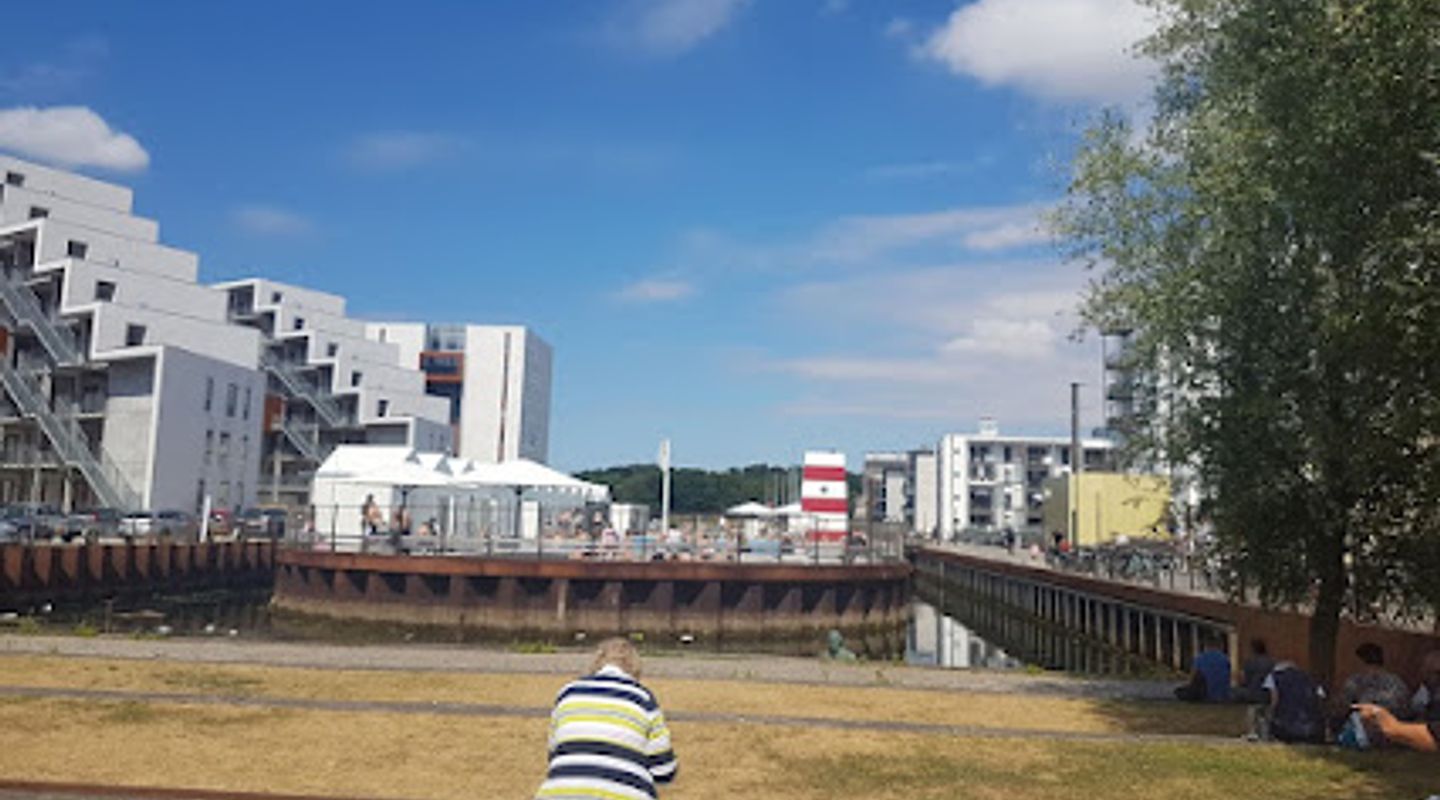
The harbour area around the sculpture has transformed from a working dockland into a mixed urban waterfront with paths, seating and recreational spaces. The sculpture feels integrated into this environment: joggers pass by, cyclists roll along the quays, and people pause at the railing to study Andersen’s profile and the play of water around his submerged legs.Because the artwork is outdoors and accessible at all hours, you can experience it in very different moods. On a bright, clear day the bronze gleams against the sky, and you can study the details of his coat, hat and facial expression. At dusk, harbour lights and the glow from the bathing facility reflect off the water, turning the scene into something more atmospheric and almost theatrical.
A small stop on a larger Hans Christian Andersen trail
For anyone tracing Andersen’s footsteps through his native Odense, this harbour piece adds a contemporary, slightly rebellious chapter to the story. Traditional statues of the author in the city’s parks emphasise reverence; here, the emphasis is on dialogue, questioning and playfulness. The fact that the figure stands half in and half out of the water can be read as a metaphor for Andersen himself, poised between reality and fantasy.The site works well as a short stop during a walk along the waterfront or as a detour from visits to Andersen’s museums and other fairy‑tale sculptures scattered across Odense. It does not demand a long stay, but it rewards a few quiet minutes of looking from different angles and thinking about how a familiar cultural icon can be reimagined for a new era.
Evendo Review Centre
 Google
Guest reviews
Best time to go
Quietest: Jan, Feb & Mar · before 3am
Busy times are Evendo estimates for a typical year, to help you plan. Actual crowds vary with events, school holidays and the weather.
Explore H. C. Andersen skulptur i havnen on the map
A handpicked selection of must-see spots near H. C. Andersen skulptur i havnen, mapped for you.
Get your free copy of our complete guide to H. C. Andersen skulptur i havnen, delivered straight to you.
Everything on this page, from opening hours and how to get there to Eve’s tips and the best time to go, in one PDF you can read offline, print or share.
Already have an account? Sign in
Your H. C. Andersen skulptur i havnen guide is ready.
We'll send it to · Not you? Sign out

Getting your guide ready…
We are putting together a fresh copy of the H. C. Andersen skulptur i havnen guide. This can take up to a minute.
This can take a few moments. If your browser asks, choose Allow so the download can start. You'll find the guide in your Downloads folder.
Nothing happened? Download it again
Sorry, the guide is taking longer than usual. Please try again in a minute, or get it by email instead.
Other nearby places you may find interesting
The closest places of the same kind, if this one is not quite what you had in mind.
-
The Funen Village Step into a full‑scale Funen village of thatched farms, mills and animals, where 18th‑ and 19th‑century rural Denmark is carefully brought back to life.
-
Parsonage Experience authentic 18th-century Danish village life through restored buildings, costumed interpreters, and hands-on traditional crafts.
-
The Sea Horse A powerful bronze sea horse with a mermaid rider bursts from the Odense River, bringing Hans Christian Andersen’s underwater world to life at Munke Mose’s edge.
-
Brickworks Authentic 19th-century brick-making workshop preserving Denmark's industrial heritage within a living open-air village museum.
-
King's Garden Odense’s historic royal garden: a baroque-era green gateway where castle views, sculptures and summer concerts meet everyday city life.
Swipe for more places
More to explore near H. C. Andersen skulptur i havnen
-
 Best experiences near H. C. Andersen skulptur i havnen
-
 Best hotels near H. C. Andersen skulptur i havnen
-
 Best landmarks near H. C. Andersen skulptur i havnen
-
 Best attractions near H. C. Andersen skulptur i havnen
-
 Best shops near H. C. Andersen skulptur i havnen
-
 Best restaurants near H. C. Andersen skulptur i havnen
-
 Best bars near H. C. Andersen skulptur i havnen







Do you manage this location?
Take control to get all the benefits, like improved information, better appearance, and stronger visibility across AI-powered discovery.
Explore more
Explore more of Funen
Discover Funen, Denmark's lush island treasure, where fairy tales come to life amidst scenic landscapes, historic castles, and vibrant cultural heritage.
Explore Funen
Explore more of Denmark
Discover Denmark: A perfect blend of history, modern design, and the cozy concept of hygge. Explore vibrant cities, serene landscapes, and world-class cuisine.
Explore Denmark