The Danish Parliament, North Zealand Travel Guide
Where copper spires, royal salons and granite façades frame the working heart of Danish democracy on Copenhagen’s historic Island of Power.
Set on the historic islet of Slotsholmen in central Copenhagen, the Danish Parliament sits within Christiansborg Palace, a rare complex that unites legislature, Supreme Court, Prime Minister’s Office and royal state rooms under one immense copper‑topped tower. This neo‑Baroque palace, completed in 1928 yet rooted in 800 years of power on the site, blends parliamentary democracy with remnants of royal grandeur, from formal chambers and committee rooms to grand halls, ruins and riding grounds.
A brief summary to The Danish Parliament
- Christiansborg, Indre By, Indre By, 1218, DK
- Click to display
- Click to display
- Duration: 1.5 to 4 hours
- Mid ranged
-
 Mixed
Mixed
- Mobile reception: 5 out of 5

Know before you go
Hi, I'm Eve. Here are a few practical things to know before exploring The Danish Parliament.
- Join an official guided tour of the Folketing to access the chamber and key rooms; timings vary, so check schedules in advance.
- Combine a visit to the parliamentary wing with the tower and the ruins beneath the palace to understand the full historical depth of the site.
- Security screening is similar to an airport; allow extra time and avoid bringing large bags or sharp objects.
- Plan at least half a day if you wish to see Parliament, the Royal Reception Rooms and the underground ruins on the same visit.
- Look for views of the tower from nearby bridges and canals to photograph the Parliament as part of Copenhagen’s skyline.
Do you manage this location?
Take control to get all the benefits, like improved information, better appearance, and stronger visibility across AI-powered discovery. Learn more about listing your business on Evendo
Activate your presenceOther nearby places you may find interesting
The closest places of the same kind, if this one is not quite what you had in mind.
Explore The Danish Parliament on the Map
A handpicked selection of must-see spots near The Danish Parliament, mapped for you.
Unlock the Best of The Danish Parliament
Buy tickets
-
No tickets available
Book tours with entry


Getting There
-
Metro
From central Copenhagen, take the M3 or M4 metro line to Gammel Strand or Kongens Nytorv; both stations are within about 10–15 minutes’ level walk of Christiansborg Palace. Trains run every few minutes throughout the day, and a single zone ticket typically costs around 20–30 DKK. Stations and approaches are step‑free, making this the most convenient option for visitors with limited mobility.
-
City Bus
Several city bus routes stop near Slotsholmen and the Danish Parliament, with journey times of roughly 10–25 minutes from most central districts depending on traffic. Standard bus fares in Copenhagen are usually the same as metro tickets, around 20–30 DKK for inner‑city travel, and services run frequently during daytime and early evening. Buses are low‑floor and generally accessible for wheelchairs and strollers.
-
Bicycle
Copenhagen’s cycling network makes it easy to reach Christiansborg by bike in about 5–20 minutes from most inner‑city neighbourhoods. The route is almost entirely on dedicated bike lanes and flat terrain. Numerous public bike‑share schemes and rental shops operate nearby; expect to pay roughly 100–150 DKK for a full‑day rental. Cycle parking is available around the palace area but can be busy in peak hours.
-
On Foot from City Centre
If you are staying in the historic centre, Christiansborg is comfortably reachable on foot within roughly 10–25 minutes, depending on your starting point. The walk takes you along paved streets and bridges with only gentle gradients, suitable for most visitors. Surfaces are generally smooth, though some stretches include cobblestones that may be less comfortable for wheelchairs or thin‑wheeled strollers.
For the on-the-go comforts that matter to you
-
 Restrooms
-
 Drink Options
-
 Drinking Water
-
 Food Options
-
 Seating Areas
-
 Sheltered Areas
-
 Trash Bins
-
 Information Boards
-
 Visitor Center
Discover more about The Danish Parliament
A Palace Where Power Still Lives
Christiansborg Palace is far more than a photogenic backdrop to Copenhagen’s skyline: it is the working seat of the Danish Parliament, known as the Folketing. Within its heavy granite walls, laws are debated, governments are formed and prime ministers address the nation, all beneath a tower crowned with three royal crowns symbolising the long intertwining of monarchy and state. The great staircases, colonnades and courtyards set a formal tone, yet this is very much a living workplace where the rhythms of modern democracy unfold day after day.The palace stands on Slotsholmen, often dubbed Denmark’s “Island of Power”. Here the legislative chamber, committee rooms and offices sit alongside the Supreme Court and the Prime Minister’s offices, creating an unusually concentrated centre of authority. Visitors who join guided tours step straight into this world, passing security into corridors lined with portraits and documents that chart political life from absolute monarchy to a constitutional, representative system.Centuries of Rule Beneath Your Feet
Although the present palace dates from the early 20th century, the site’s story reaches back to the 1100s, when Bishop Absalon raised a fortress on this tiny island. That stronghold was succeeded by Copenhagen Castle and later by successive Christiansborg palaces, two of which were destroyed by catastrophic fires in 1794 and 1884. Each disaster left layers of masonry and memory that still lie beneath the building you see today.Below the parliament, archaeological ruins reveal the remains of Absalon’s ring wall and Copenhagen Castle. Walking among the foundations, you trace the evolution from medieval stronghold to royal residence and finally to democratic institution. Above ground, fragments from earlier palaces survive in the riding school, show grounds and chapel, allowing you to read the building as a vertical timeline from the Middle Ages to the present.Architecture That Speaks of Authority
The current Christiansborg, completed in 1928 to designs by Thorvald Jørgensen, is a monumental exercise in neo‑Baroque historicism. Its broad façades, tall segmental windows and emphatic tower were conceived to project solidity after decades of political debate and rebuilding. Granite cladding, heavy cornices and sculptural details lend the complex a gravitas that befits a national centre of power.Look closely and you can see how different eras leave their mark. The palace chapel, rebuilt in the 1820s, is a study in clear neoclassical lines, while the showgrounds and stables echo 18th‑century Baroque. Inside the parliamentary wing, however, the tone is more restrained: high but functional ceilings, wood panelling and disciplined ornament reflect early‑20th‑century ideals of efficient governance tempered by respect for tradition.Royal Ceremonies Within a Democratic House
Unusually, the Danish Parliament shares the building with the Royal Reception Rooms, still used for state banquets, official dinners and the New Year levee. In these gilded suites, towering mirrors, glittering chandeliers and elaborate stucco set a courtly stage for modern constitutional monarchy. The Great Hall, lined with colourful tapestries narrating a thousand years of Danish history, forms a vivid counterpart to the sober parliamentary chamber nearby.This cohabitation of politicians and palace ceremonies gives Christiansborg a distinctive atmosphere. On some days, red carpets and uniforms mingle with business suits and briefcases; on others, the focus is firmly on committee work and legislative detail. For visitors, it offers a concise lesson in how Denmark has evolved from royal power to a balanced relationship between crown and elected representatives.Experiencing the Seat of Danish Democracy
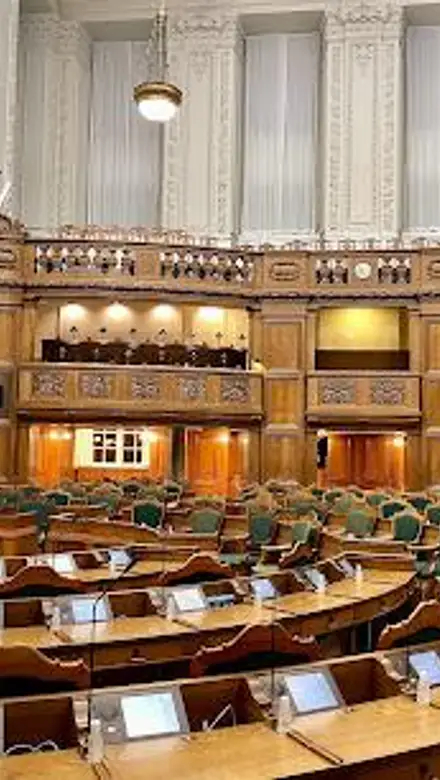
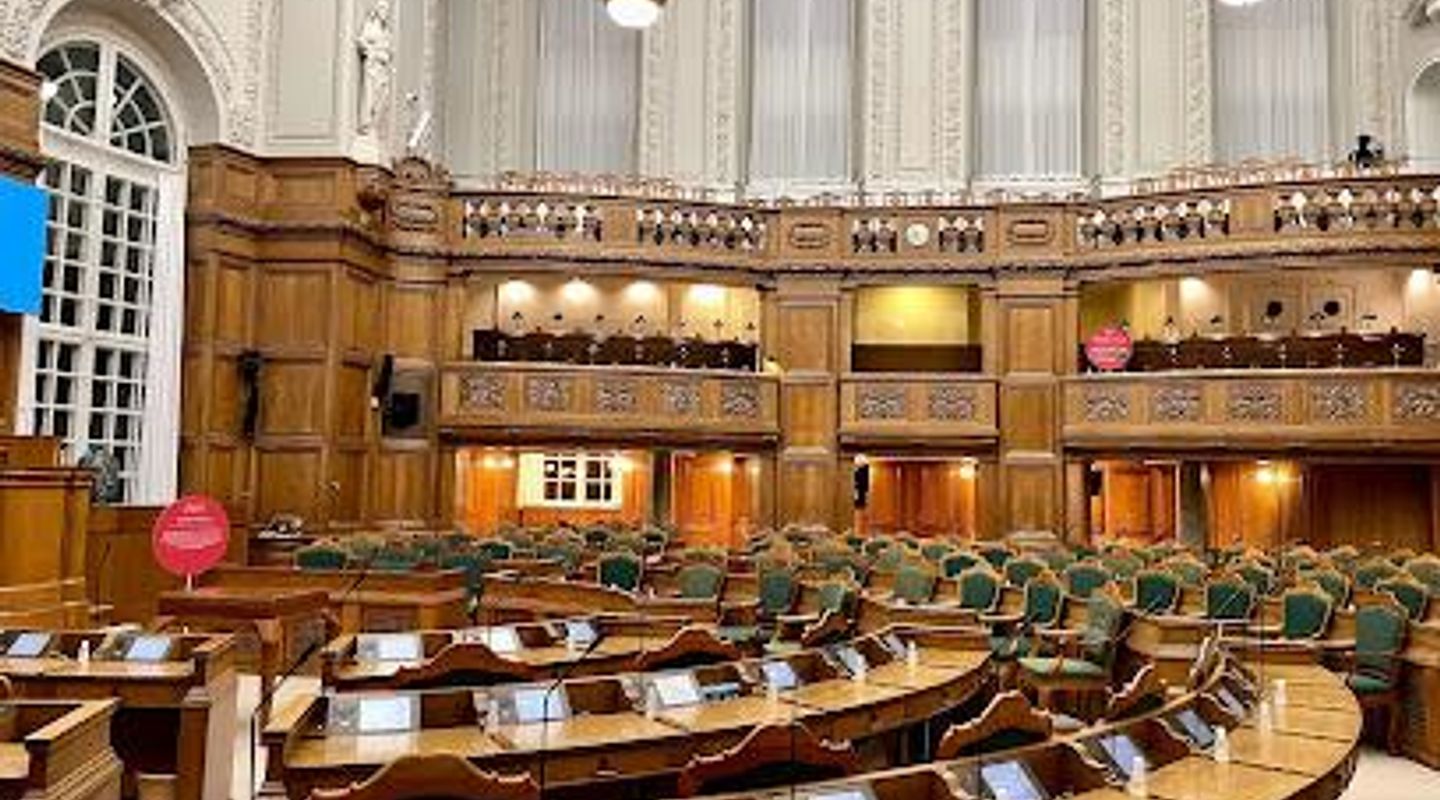
As a visitor, you can explore selected areas on guided tours that may include the parliamentary chamber, public galleries and halls where parties negotiate and press conferences are held. From the public seating above the chamber, the layout of desks, speaker’s rostrum and electronic voting panels becomes clear, turning abstract news headlines into a tangible space.Outside formal spaces, the tower offers sweeping views over Copenhagen’s rooftops, while the courtyards and arcades give quieter glimpses of daily routines, from TV crews setting up outside to civil servants hurrying between meetings. Taken together, the Danish Parliament at Christiansborg offers a rare chance to see, in one complex, the layered story of power in Denmark: fortified castle, royal palace and, today, an open, working democracy.












Your all‑in‑one travel companion app
Explore expert travel guides, compare and book tours, experiences, hotels, and more—all from the palm of your hand. Download now for seamless trip planning wherever your wanderlust takes you.


Explore More of North Zealand
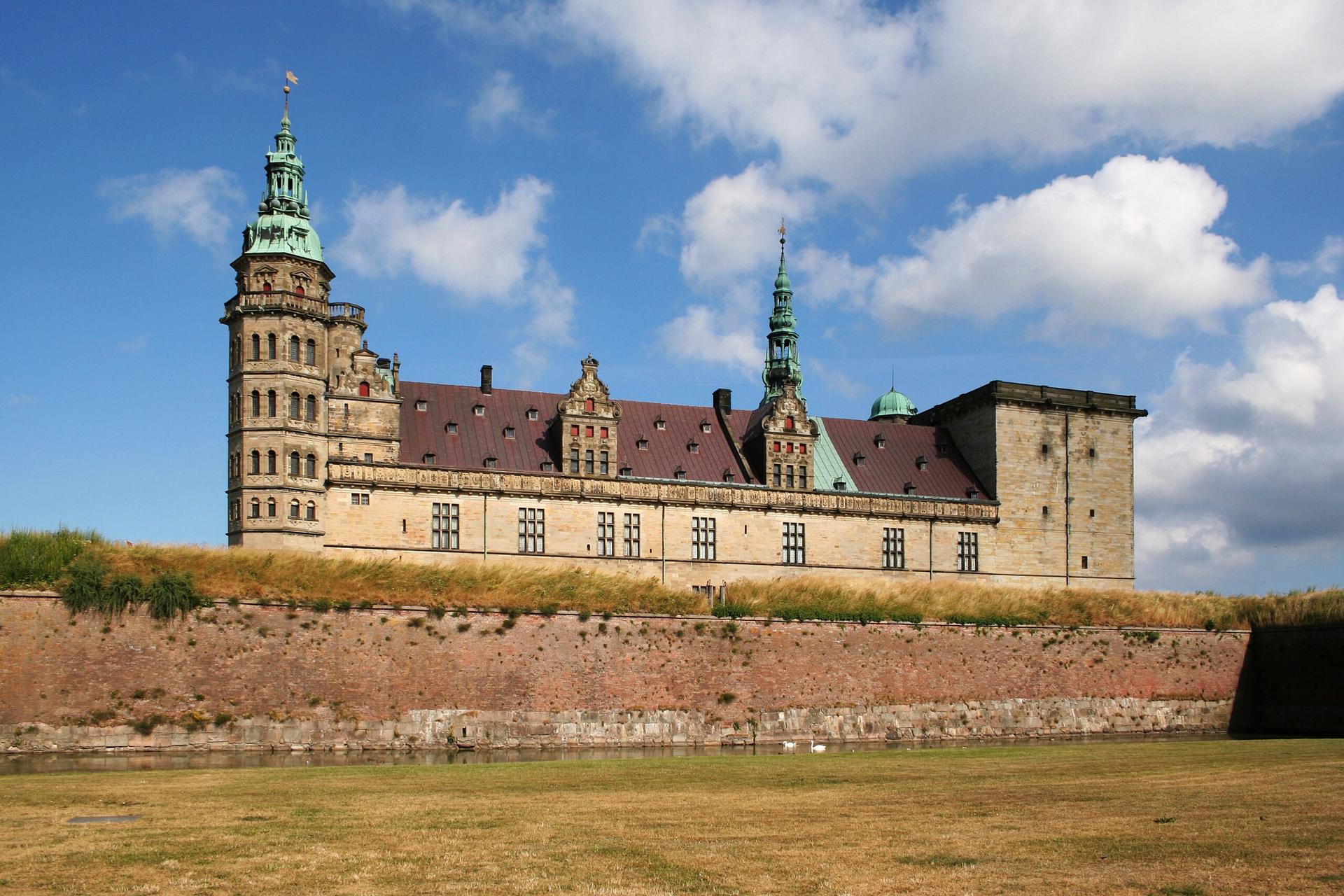
Looking beyond The Danish Parliament? Discover North Zealand for broader travel guides, local hot-spots, and regional highlights.
Explore North Zealand