DR Koncerthuset, Køge Travel Guide
Free Guide: Jean Nouvel’s blue concert cube in Ørestad, where world‑class acoustics, bold architecture and Denmark’s national ensembles come together under one luminous roof.


A brief summary of DR Koncerthuset
Jean Nouvel’s blue concert cube in Ørestad, where world‑class acoustics, bold architecture and Denmark’s national ensembles come together under one luminous roof.
Rising like a sculptural blue lantern in Copenhagen’s modern Ørestad district, DR Koncerthuset is the Danish Broadcasting Corporation’s striking concert house and home stage of the Danish National Symphony Orchestra. Designed by French architect Jean Nouvel with acoustics by Yasuhisa Toyota, the complex contains four very different halls wrapped in raw concrete, glass and coloured interiors. From grand symphonic evenings and jazz to contemporary and pop productions, it is one of Scandinavia’s leading live music venues and a bold architectural landmark.
On-site amenities
 Restrooms
 Drink options
 Food options
 Seating areas
 Sheltered areas
 Trash bins
 Information boards
 Visitor centre
- Address
- Ørestads Blvd. 13, 2300 København
- Phone
- Website
Getting there
Metro
Bus
Bicycle
Car / Taxi
Discover more about DR Koncerthuset
A modern landmark in Copenhagen’s Ørestad skyline
DR Koncerthuset anchors the southern edge of Copenhagen with a bold, cubic volume that immediately stands out from the surrounding glass-and-steel offices of Ørestad. Clad in a translucent blue screen and standing beside the rest of the DR Byen broadcasting complex, it looks almost like a glowing lantern after dark, hinting at the performances within rather than revealing them outright. The main entrance opens into a lofty foyer where exposed concrete, steel and expanses of glass create an urban, almost industrial atmosphere, softened by warm lighting and the buzz of audiences gathering before a performance.The building was conceived as a cultural statement as much as a practical concert facility. Its position next to the DR Byen metro station makes it a prominent visual marker for anyone travelling across Amager. Inside, the levels, walkways and open voids of the foyer provide changing perspectives on the different halls, allowing visitors to sense the scale of the house even before they take their seats.
Jean Nouvel’s four contrasting music worlds
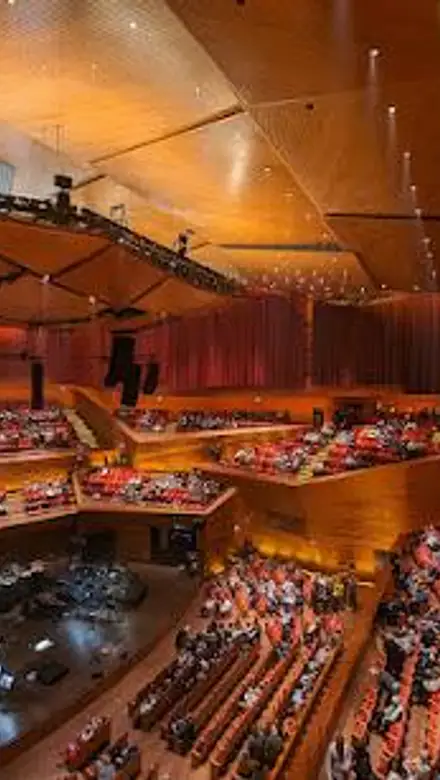
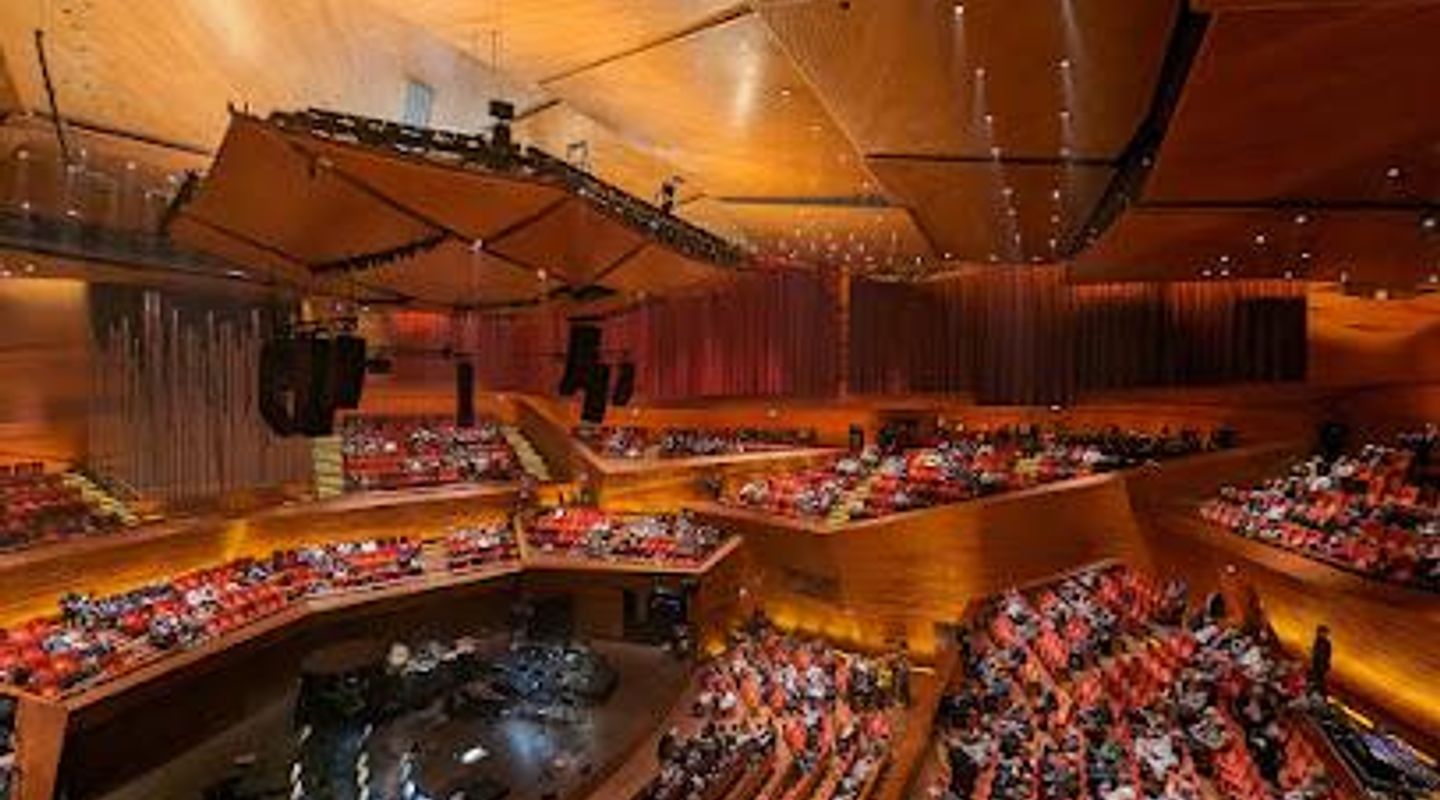
At the heart of DR Koncerthuset is a family of four halls, each with its own character and colour palette. The large main Concert Hall is arranged as an arena space with the audience wrapped around the stage on multiple tiers, creating an unusually intimate connection between musicians and listeners even with around 1,800 seats. Warm timber and amber tones give this room a glowing, almost cocoon-like feel that contrasts sharply with the raw exterior.Elsewhere in the complex, a cooler black-and-white studio hall lends itself to amplified music, television productions and cross-genre projects, while a compact red hall provides an intense setting for chamber music, talks and smaller ensembles. These spaces are not just visually distinct; each has adjustable acoustic features that can be tuned to the demands of anything from solo recitals to large orchestral scores, reflecting the close collaboration between architect Jean Nouvel and renowned Japanese acoustician Yasuhisa Toyota.
Home stage for Denmark’s national ensembles
DR Koncerthuset serves as the primary home of several of Denmark’s flagship ensembles, including the Danish National Symphony Orchestra and the Danish National Vocal Ensembles. The main Concert Hall regularly hosts symphonic series, film-in-concert productions, choral projects and crossovers with jazz, pop and world music. The smaller studios support everything from intimate jazz sets and contemporary music festivals to live radio and television recordings.Beyond the regular concert calendar, the house has provided the stage for major national and international events, such as state celebrations and televised ceremonies. This dual role as both a public concert venue and a broadcast hub gives the building a distinctive energy; a rehearsal in one hall might coincide with a television production in another, and visitors are never far from the sense that this is a working centre of Danish musical life.
Architectural detail, acoustics and access
The experience of DR Koncerthuset is shaped as much by its details as by its overall form. In the foyer, views of the metro line and city beyond are framed by large panes of glass, while overhead a partial glass roof hints at the changing sky and, on clear evenings, the stars. Inside the main hall, carefully shaped wooden surfaces, suspended acoustic reflectors and tiered seating are all part of the acoustic design that has made the building internationally noted for its sound.The concert house also incorporates a range of practical features. Wide foyers, elevators and reserved wheelchair spaces in all main halls ensure step-free circulation. Seating layouts are flexible in the studios, allowing different stage positions, standing-room configurations or more formal rows as the program requires. Information desks and signage help visitors navigate between foyers, cloak areas and halls.
Planning a visit to the concert house
A visit to DR Koncerthuset can be as simple as attending an evening performance or as involved as joining a guided tour that explores both the concert halls and parts of the surrounding DR Byen complex. Many guests arrive early to enjoy the atmosphere in the foyer, browse information displays about upcoming seasons or simply watch the flow of musicians and technicians moving through the building.Performances take place throughout the year, with a particularly rich program in the autumn and winter concert seasons. Events range from full-length symphonic programs to family concerts and special productions built for television broadcast. For those interested in architecture and sound, even a single evening here offers a chance to experience how a carefully designed building can shape the way music is heard and shared.
The wider Ørestad setting
Stepping outside after a concert, visitors find themselves back in the contemporary urban landscape of Ørestad. The raised metro tracks, canals and broad boulevards give the area a spacious, almost theatrical quality that mirrors the scale of the concert house itself. Nearby offices and university buildings empty out after working hours, making the glowing cube of DR Koncerthuset an even more dominant presence after dark.This setting underlines the building’s role as a cultural destination for the whole city, not just the immediate neighbourhood. Whether approached on a crisp winter evening or a lingering summer night, the house stands as a beacon for live music in Copenhagen, bringing together architecture, performance and broadcasting under one distinctive roof.
Evendo Review Centre
 Google
Guest reviews
Best time to go
Quietest: Jan, Feb & Jul · before 9am
Busy times are Evendo estimates for a typical year, to help you plan. Actual crowds vary with events, school holidays and the weather.
Explore DR Koncerthuset on the map
A handpicked selection of must-see spots near DR Koncerthuset, mapped for you.
Get your free copy of our complete guide to DR Koncerthuset, delivered straight to you.
Everything on this page, from opening hours and how to get there to Eve’s tips and the best time to go, in one PDF you can read offline, print or share.
Already have an account? Sign in
Your DR Koncerthuset guide is ready.
We'll send it to · Not you? Sign out

Getting your guide ready…
We are putting together a fresh copy of the DR Koncerthuset guide. This can take up to a minute.
This can take a few moments. If your browser asks, choose Allow so the download can start. You'll find the guide in your Downloads folder.
Nothing happened? Download it again
Sorry, the guide is taking longer than usual. Please try again in a minute, or get it by email instead.
Unlock the best of DR Koncerthuset
Skip-the-line tickets, guided tours with entry, and walking tours of the area, booked in a few clicks.



Other nearby places you may find interesting
The closest places of the same kind, if this one is not quite what you had in mind.
-
-
-
-
-


Swipe for more places
More to explore near DR Koncerthuset

 Best experiences near DR Koncerthuset
 Best hotels near DR Koncerthuset
 Best landmarks near DR Koncerthuset
 Best attractions near DR Koncerthuset
 Best shops near DR Koncerthuset
 Best restaurants near DR Koncerthuset
 Best bars near DR Koncerthuset
Do you manage this location?
Take control to get all the benefits, like improved information, better appearance, and stronger visibility across AI-powered discovery.
Explore more
Explore more of Køge
Explore Køge, Denmark's coastal gem, with its medieval charm, beautiful marina, and close proximity to the stunning Stevns Klint UNESCO World Heritage site.
Explore Køge
Explore more of Denmark
Discover Denmark: A perfect blend of history, modern design, and the cozy concept of hygge. Explore vibrant cities, serene landscapes, and world-class cuisine.
Explore Denmark