

The Playhouse, Køge Travel Guide
Free Guide: Contemporary Danish drama in a hovering waterfront landmark, where sharp Scandinavian architecture meets a broad wooden pier and sweeping views of Copenhagen’s inner harbour.


A brief summary of The Playhouse
Contemporary Danish drama in a hovering waterfront landmark, where sharp Scandinavian architecture meets a broad wooden pier and sweeping views of Copenhagen’s inner harbour.
Set on Copenhagen’s inner harbour at Sankt Annæ Plads, the Royal Danish Playhouse is a striking modern theatre dedicated to spoken drama. Opened in 2008 as part of the Royal Danish Theatre, it pairs contemporary Scandinavian design by Lundgaard & Tranberg with a broad wooden pier that wraps around the building, creating a public promenade over the water. Inside, three stages host Danish and international plays, while floor‑to‑ceiling glass, warm timber and harbor views make it as much an architectural attraction as a cultural venue.
On-site amenities
 Restrooms
 Drink options
 Food options
 Seating areas
 Sheltered areas
 Trash bins
 Information boards
- Address
- Sankt Annæ Pl. 36, 1250 Indre By
- Phone
- Website
Getting there
Metro and short walk from central Copenhagen
Harbour bus along the inner harbour
City bus services to Sankt Annæ Plads area
Bicycle access via harbourfront cycle paths
Discover more about The Playhouse
Modern drama on Copenhagen’s inner harbour
The Royal Danish Playhouse, known locally as Skuespilhuset, anchors the tip of Kvæsthusbroen on Copenhagen’s inner harbor, a short stroll from colorful Nyhavn yet set in its own calm pocket of waterfront. Purpose‑built for spoken drama within the Royal Danish Theatre family, it opened in 2008 to give contemporary plays a dedicated home separate from the historic Old Stage and the grand Copenhagen Opera House.From the city side, the building reads as a low, elongated volume, but as you approach the harbor edge the architecture reveals its complexity: a deep overhanging roof, long horizontal lines and a dark, compact body that seems to hover above the water. Large panes of glass expose the foyer and bar, turning the interior into a glowing lantern after dusk and signaling that this is a house for performance and public life.
Architecture that floats above the water
Designed by Danish studio Lundgaard & Tranberg, the Playhouse quickly became a reference point in contemporary Scandinavian architecture. Its façade is clad in deep brown brick and coppery tones, which echo traditional Copenhagen materials while feeling distinctly modern. Most striking are the irregular, almost Venetian‑style angled columns that support the volume as it projects over the harbor, giving the impression that the theatre lightly rests on the water.A wide wooden deck wraps around the building, blurring the line between pier, plaza and promenade. This generous public space invites you to wander along the water’s edge, sit with your feet dangling above the waves, or frame photographs of the harbor and the mirrored glass of the Opera House across the channel. On bright days, the contrast between the dark building and the glittering water is particularly dramatic.
Inside the house of spoken theatre
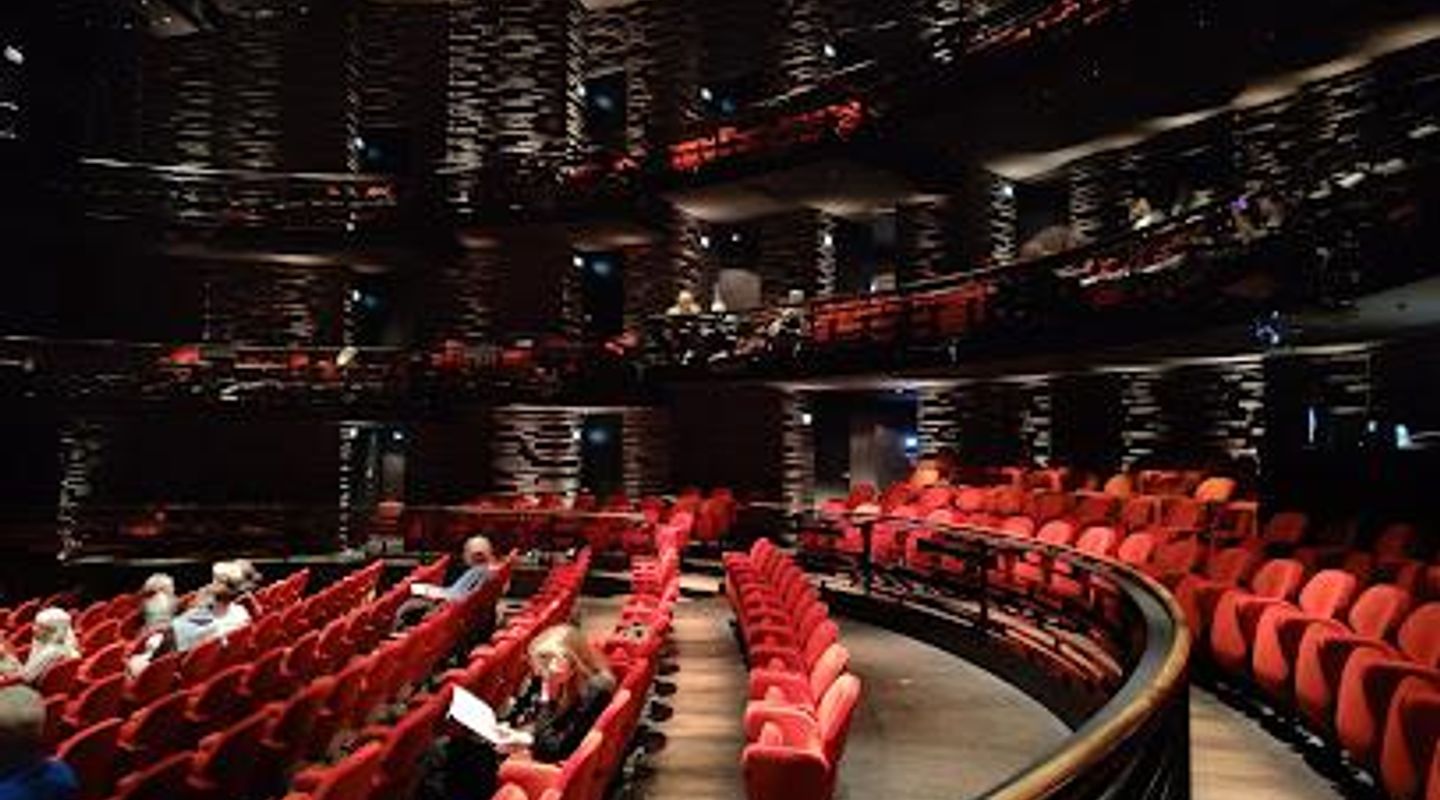
Behind the glass façade, the foyer is a long, linear space lined with timber, soft lighting and clusters of seating. Bars and café counters make it as much a social hall as a circulation area, filling with pre‑show anticipation and the comfortable murmur of intermission conversations. From here, staircases and corridors lead to three different stages, each with its own personality and size, allowing the theatre to present large‑scale dramas, intimate chamber plays and experimental work under one roof.The main auditorium is designed for clarity of speech and close connection between actors and audience. Seating tiers wrap the stage in a gentle arc, and carefully tuned acoustics ensure that even whispered lines carry to the back rows. Backstage, the building is a compact machine for theatre‑making, with rehearsal spaces, workshops and technical facilities arranged to support a constant cycle of productions.
A harbourfront cultural hub, day and night
Even if you are not attending a performance, the Playhouse serves as an accessible cultural landmark. The waterfront café and restaurant, with large windows facing the channel, make the most of the location, turning the theatre into an all‑day meeting place for locals and visitors. On sunny afternoons, the outdoor seating spills onto the pier, where people linger over drinks while watching ferries, kayakers and harbor buses glide by.The building forms part of a broader cultural axis that links the Royal Danish Theatre’s historic Old Stage at Kongens Nytorv with the modern Opera House across the water. Seen from the opposite bank, the Playhouse’s low profile, glowing foyer and sharp lines compose a distinctive silhouette that anchors this side of the harbor. As light changes through the seasons—from winter dusk to late Nordic summer evenings—the atmosphere of the pier shifts, offering fresh perspectives on the architecture and the city.
Planning your visit to the Playhouse
The Royal Danish Playhouse operates primarily as a working theatre, with a program of Danish‑language drama and occasional international productions. Performances typically take place in the evening, with some matinees, and tickets are sold through the Royal Danish Theatre’s booking channels. While much of the repertoire is in Danish, the building alone is worth a detour for anyone interested in architecture or contemporary urban waterfronts.You can explore the exterior and pier at any time, and the foyer, café and restrooms are generally accessible when the building is open for rehearsals or shows. The flat timber decks and spacious interior circulation make it relatively easy to navigate for most visitors, and large windows ensure that even a brief visit offers generous views of the harbor. Combined with nearby Nyhavn, Amalienborg and the Opera House, the Playhouse fits naturally into a half‑day exploration of central Copenhagen’s cultural waterfront.
Evendo Review Centre
 Google
Guest reviews
Best time to go
Quietest: Jan, Feb & Mar · before 9am
Busy times are Evendo estimates for a typical year, to help you plan. Actual crowds vary with events, school holidays and the weather.
Explore The Playhouse on the map
A handpicked selection of must-see spots near The Playhouse, mapped for you.
Get your free copy of our complete guide to The Playhouse, delivered straight to you.
Everything on this page, from opening hours and how to get there to Eve’s tips and the best time to go, in one PDF you can read offline, print or share.
Already have an account? Sign in
Your The Playhouse guide is ready.
We'll send it to · Not you? Sign out

Getting your guide ready…
We are putting together a fresh copy of the The Playhouse guide. This can take up to a minute.
This can take a few moments. If your browser asks, choose Allow so the download can start. You'll find the guide in your Downloads folder.
Nothing happened? Download it again
Sorry, the guide is taking longer than usual. Please try again in a minute, or get it by email instead.
Unlock the best of The Playhouse
Skip-the-line tickets, guided tours with entry, and walking tours of the area, booked in a few clicks.
 Tour with entry
Copenhagen Highlights: Small Group Walking Tour - Max 10 people
from $44.77 Tour with entry
Copenhagen: Small Group E-bike Tour With Local Guide
from $67.65 Tour with entry
Copenhagen Old Town, Nyhavn, Canal Walking Tour & Christiana
from $410.57 Tour with entry
Discover Copenhagen's amazing architecture private walking tour
from $684.44


Other nearby places you may find interesting
The closest places of the same kind, if this one is not quite what you had in mind.
-
-
-
-
-


Swipe for more places
More to explore near The Playhouse

 Best experiences near The Playhouse
 Best hotels near The Playhouse
 Best landmarks near The Playhouse
 Best attractions near The Playhouse
 Best shops near The Playhouse
 Best restaurants near The Playhouse
 Best bars near The Playhouse
Do you manage this location?
Take control to get all the benefits, like improved information, better appearance, and stronger visibility across AI-powered discovery.
Explore more
Explore more of Køge
Explore Køge, Denmark's coastal gem, with its medieval charm, beautiful marina, and close proximity to the stunning Stevns Klint UNESCO World Heritage site.
Explore Køge
Explore more of Denmark
Discover Denmark: A perfect blend of history, modern design, and the cozy concept of hygge. Explore vibrant cities, serene landscapes, and world-class cuisine.
Explore Denmark
