Vilde heste Travel Guide
Free Guide: A free‑roaming herd of hardy Exmoor ponies shaping a wild coastal landscape of grassland, marsh and cliffs at the southern tip of Langeland.


A brief summary of Vilde heste
A free‑roaming herd of hardy Exmoor ponies shaping a wild coastal landscape of grassland, marsh and cliffs at the southern tip of Langeland.
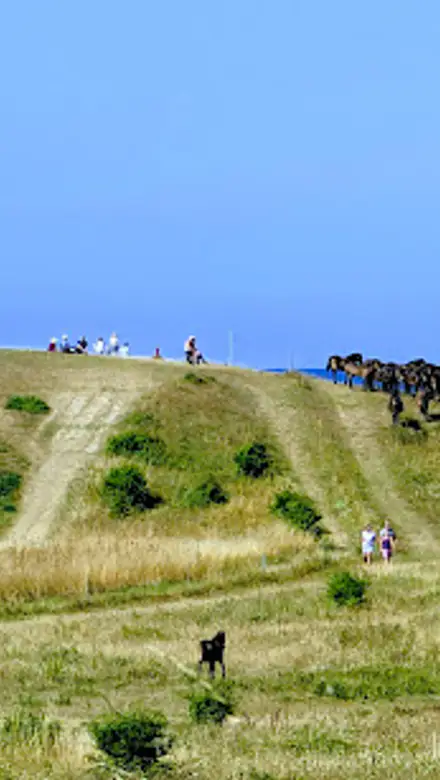
On the southern tip of Langeland near Bagenkop, the wild Exmoor ponies of Gulstav Mose roam a sweeping landscape of open grassland, marshes, small lakes, woodland and coastal cliffs. Around 50–80 hardy ponies live outdoors year‑round with minimal human interference, shaping the habitat as natural grazers and supporting rich biodiversity. Visitors can enter the fenced area freely, follow simple safety rules, and watch the herd against a backdrop of sea views, birdlife and gently rolling hills.
On-site amenities
 Restrooms
 Seating areas
 Sheltered areas
 Picnic areas
 Trash bins
 Information boards
 Visitor centre
Opening hours
- Every dayOpen 24 hours
Opening hours as listed on the venue’s Google Business Profile. Hours can change for services and special events, so check with the venue before you go.
- Address
- Gulstavvej 45, 5935 Bagenkop
- Phone
- Website
Getting there
Car from Rudkøbing (Langeland’s main town)
Public bus plus short walk from Bagenkop
Cycle from Bagenkop and South Langeland villages
Discover more about Vilde heste
Wild ponies on the edge of the Baltic
At the far south of Langeland, just north of Bagenkop, Gulstav Mose opens into a patchwork of grassland, bogs, small lakes, light woodland and steep coastal cliffs. Within this large fenced reserve lives a free‑ranging herd of Exmoor ponies, often simply called the wild horses of Langeland. They stay outdoors in all seasons, moving as a group across roughly 120 hectares of varied terrain.The ponies are compact and sturdy, around 130 centimetres at the shoulder, with dark legs and dense brown coats. In winter their double layer of wool and guard hairs becomes so thick that snow can rest on their backs without melting, a striking sight on frosty days. In summer, foals and family groups dot the slopes, adding a vivid sense of life to the open landscape.
A living link to ancient horse history
Exmoor ponies are considered one of the closest living relatives of Europe’s extinct wild horses. Their ancestors roamed heathlands in south‑west England for thousands of years, adapting to sparse forage, wind and wet ground. The Langeland herd was established in the 2000s from a small group of animals brought from elsewhere in Denmark and has grown steadily since.Management is deliberately light. The animals find their own food in the reserve, browsing grasses, herbs and shrubs throughout the year. Only in unusually harsh winters is straw put out as emergency feed, and a lead stallion is occasionally exchanged to prevent inbreeding. Daily monitoring ensures the herd remains healthy without turning the site into a traditional farm.
Natural gardeners of Gulstav Mose
The ponies play a crucial role as landscape managers. By constantly grazing and trampling, they keep the area from quickly turning into dense scrub or reedbed. Sunlight reaches the ground, allowing many species of wildflowers, grasses and low shrubs to thrive. That, in turn, supports insects, small mammals and a rich birdlife that makes South Langeland one of Denmark’s notable nature areas.This mosaic of open meadow, wet hollows and scattered trees is particularly valuable for rare and specialised species. The horses create paths, bare patches and varied sward heights simply through their daily movements. For visitors, this means a landscape that feels both untamed and subtly shaped, with long views and constant small details to notice underfoot.
Walking among horses and sea views
The reserve is fully fenced but has pedestrian access gates, and you are free to walk inside on grassy paths and informal tracks. From small rises such as the hill known as Ørnehøj, you often gain excellent views over the herd and across the sea. On warm days, the ponies may gather near ponds to drink or stand quietly in the breeze, while in cooler weather they tend to move more purposefully across the area.Simple rules keep both people and animals safe: keep at least 25 metres from the horses, never try to feed or touch them, avoid walking through the middle of the group and keep dogs on a very short leash or outside the enclosure. The ground can be wet and uneven, especially after rain, so sturdy footwear is important. There is no lighting inside the area, and conditions are most easily appreciated in daylight and fair weather.
Birdsong, wind and the rhythm of the herd
Part of the appeal here is the slow rhythm of the place. You might spend time scanning the horizon before suddenly spotting the whole herd appearing over a rise, or find them grazing quietly not far from a gate. Birdsong mixes with the sound of wind in the grass and distant surf from the nearby cliffs at Dovns Klint.Picnic spots and information boards in the wider South Langeland nature area help you understand the wider landscape history, from ancient burial monuments to modern conservation. Yet inside the horse enclosure the focus is simple: sharing space respectfully with a herd that, as far as possible, lives on its own terms in a coastal Danish landscape.
Evendo Review Centre
 Google
Guest reviews
Best time to go
Quietest: Jan, Feb & Dec · before 6am or at 10pm
Busy times are Evendo estimates for a typical year, to help you plan. Actual crowds vary with events, school holidays and the weather.
Explore Vilde heste on the map
A handpicked selection of must-see spots near Vilde heste, mapped for you.
Get your free copy of our complete guide to Vilde heste, delivered straight to you.
Everything on this page, from opening hours and how to get there to Eve’s tips and the best time to go, in one PDF you can read offline, print or share.
Already have an account? Sign in
Your Vilde heste guide is ready.
We'll send it to · Not you? Sign out

Getting your guide ready…
We are putting together a fresh copy of the Vilde heste guide. This can take up to a minute.
This can take a few moments. If your browser asks, choose Allow so the download can start. You'll find the guide in your Downloads folder.
Nothing happened? Download it again
Sorry, the guide is taking longer than usual. Please try again in a minute, or get it by email instead.
Other nearby places you may find interesting
The closest places of the same kind, if this one is not quite what you had in mind.
-
-
-
-
-


Swipe for more places
More to explore near Vilde heste

 Best experiences near Vilde heste
 Best hotels near Vilde heste
 Best landmarks near Vilde heste
 Best attractions near Vilde heste
 Best shops near Vilde heste
 Best restaurants near Vilde heste
 Best bars near Vilde heste
Do you manage this location?
Take control to get all the benefits, like improved information, better appearance, and stronger visibility across AI-powered discovery.
Explore more

Explore more of Langeland
Discover Langeland: Denmark's idyllic island retreat with scenic landscapes, rich history, and vibrant culture. Perfect for nature lovers, history buffs, and festival goers.
Explore Langeland
Explore more of Denmark
Discover Denmark: A perfect blend of history, modern design, and the cozy concept of hygge. Explore vibrant cities, serene landscapes, and world-class cuisine.
Explore Denmark