

Quartier des Antiquaires (Dijon) Travel Guide - Free
Explore Quartier des Antiquaires in Dijon with Evendo's free guide. Find the best shops, historic streets, restaurants, and gems on web or mobile.


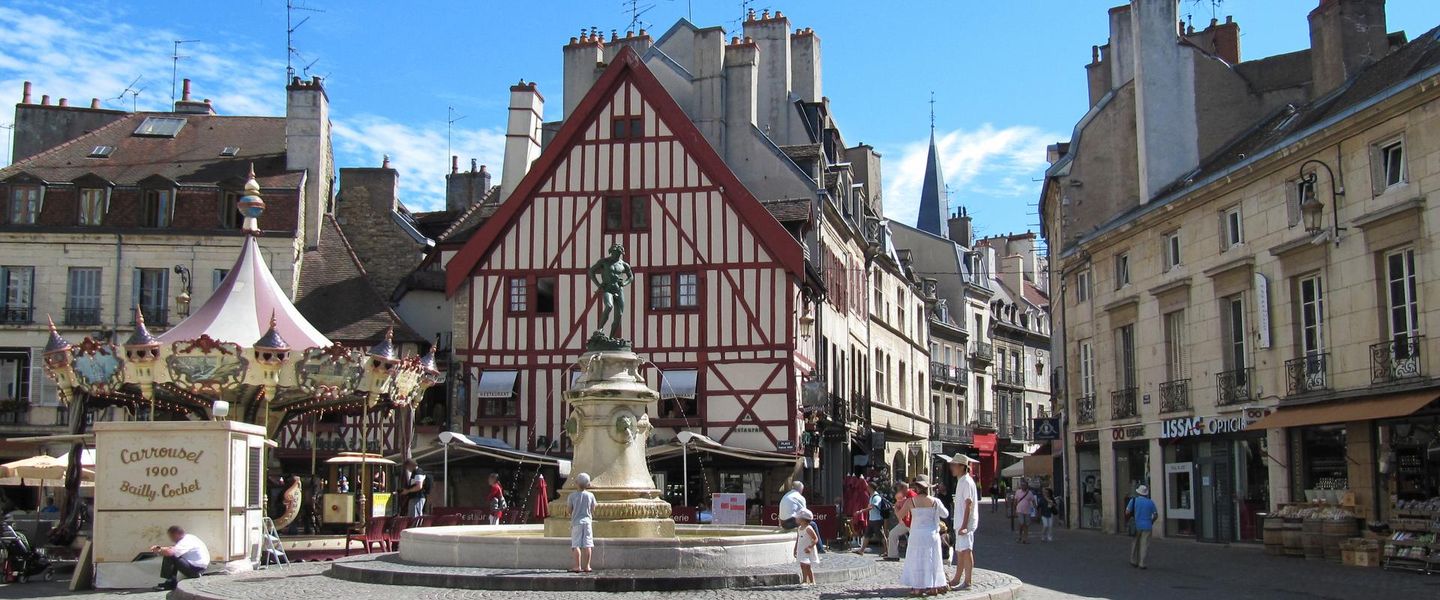


Quartier des Antiquaires in Dijon invites visitors among medieval lanes, antique shops, historic hôtels particuliers, local food and Burgundy culture.
Medieval Lanes and Civilised Elegance
The Quartier des Antiquaires occupies a compact part of Dijon’s historic centre, where narrow medieval streets, Renaissance façades and former merchant houses create an especially atmospheric setting for wandering. Its name reflects the concentration of antique dealers and design specialists found around streets such as rue Verrerie and rue Auguste Comte, although the district is also a lived-in urban quarter rather than a museum preserved behind glass. The streets are close to the principal heritage areas of central Dijon, yet their relatively intimate scale rewards slow exploration.Read more about Quartier des Antiquaires
Architecture and Local Character
A Base for Exploring Old Dijon
Explore Quartier des Antiquaires on the map
A handpicked selection of must-see spots in Quartier des Antiquaires, mapped for you.
Best hotels in Quartier des Antiquaires
Quartier des Antiquaires essentials
Getting There
Getting Around
Safety
Emergency Situations
Do's and Don'ts
Local Tips

From Eve
Local phrases worth knowing
You don't need to get them perfect. A few words go a long way, and locals appreciate the effort.
Basics
| English | Local | Say it |
|---|---|---|
| Hello | Bonjour | [bohn-zhoor] |
| Goodbye | Au revoir | [oh rev-wahr] |
| Yes | Oui | [wee] |
| No | Non | [nohn] |
| Please/You're welcome | S'il vous plaît | [seel voo pleh] |
| Thank you | Merci | [mehr-see] |
| Excuse me/Sorry | Excusez-moi | [ex-kew-zay mwah] |
| How are you? | Comment ça va? | [koh-mohn sah vah] |
| Fine. And you? | Bien. Et vous? | [byan. ay voo] |
| Do you speak English? | Parlez-vous anglais? | [par-lay voo ahn-glay] |
| I don't understand | Je ne comprends pas | [zhuh nuh kohm-prahnd pah] |
Eating & Drinking
| English | Local | Say it |
|---|---|---|
| I'd like to see the menu, please | Je voudrais voir le menu, s'il vous plaît | [zhuh voo-dray vwahr luh meh-noo, seel voo pleh] |
| I don't eat meat | Je ne mange pas de viande | [zhuh nuh mahnj pah duh vee-and] |
| Cheers! | Santé! | [sahn-tay] |
| I would like to pay, please | Je voudrais payer, s'il vous plaît | [zhuh voo-dray pay-ay, seel voo pleh] |
Emergencies
| English | Local | Say it |
|---|---|---|
| Help! | Au secours! | [oh seck-oor] |
| Go away! | Allez-vous en! | [al-lay voo zahn] |
| Call the Police! | Appelez la police! | [ah-pel-ay lah poh-lees] |
| Call a doctor! | Appelez un médecin! | [ah-pel-ay uh mayd-sahn] |
| I'm lost | Je suis perdu(e) | [zhuh swee pair-doo] |
| I'm ill | Je suis malade | [zhuh swee mah-lahd] |
Shopping
| English | Local | Say it |
|---|---|---|
| I'd like to buy... | Je voudrais acheter... | [zhuh voo-dray ah-shet-ay] |
| I'm just looking | Je regarde juste | [zhuh ruh-gard zhoost] |
| How much is it? | Combien ça coûte? | [kohm-byen sah koot] |
| That's too expensive | C'est trop cher | [say troh shair] |
| Can you lower the price? | Pouvez-vous baisser le prix? | [poo-vay voo bay-say luh pree] |
Time & Numbers
| English | Local | Say it |
|---|---|---|
| What time is it? | Quelle heure est-il? | [kehl uhr eh-teel] |
| It's one o'clock | Il est une heure | [eel eh tun uhr] |
| Half past (10) | Dix heures et demie | [dees uhr ay duh-mee] |
| Morning | Matin | [mah-tahn] |
| Afternoon | Après-midi | [ah-pray mee-dee] |
| Evening | Soir | [swahr] |
| Yesterday | Hier | [yehr] |
| Today | Aujourd'hui | [oh-zhoor dew-ee] |
| Tomorrow | Demain | [duh-mahn] |
| 1 | Un | [uhn] |
| 2 | Deux | [duh] |
| 3 | Trois | [twah] |
| 4 | Quatre | [kat] |
| 5 | Cinq | [sank] |
| 6 | Six | [sees] |
| 7 | Sept | [sept] |
| 8 | Huit | [weet] |
| 9 | Neuf | [nuf] |
| 10 | Dix | [dees] |
Transport & Directions
| English | Local | Say it |
|---|---|---|
| Where's a/the...? | Où est le/la...? | [oo eh luh/lah] |
| What's the address? | Quelle est l'adresse? | [kehl eh lah-dress] |
| Can you show me (on the map)? | Pouvez-vous me montrer (sur la carte)? | [poo-vay voo muh mohn-tray (soor lah kart)] |
| When's the next (bus)? | Quand est le prochain (bus)? | [kahnd eh luh proh-shang (boos)] |
| A ticket (to ....) | Un billet (pour ....) | [uhn bee-yay (poor)] |
History of Quartier des Antiquaires
Medieval Streets and Merchant Houses
The area now recognised as the Quartier des Antiquaires developed within Dijon’s medieval urban core, where commerce, craft and domestic life were closely interwoven. Streets such as rue Verrerie preserve the memory of specialist trades and small-scale retail, while the irregular plan reflects the gradual growth of the old town rather than a single act of modern planning. Wealthy merchants, officials and artisans occupied houses arranged around courtyards, leaving behind the narrow frontages, passages and substantial masonry that give the quarter its present texture. Its importance is therefore less tied to one isolated monument than to the survival of an unusually coherent historic street environment.
Ducal Dijon and Urban Refinement
Dijon’s importance as the capital of the Dukes of Burgundy brought investment, administration and elite residence to the historic centre, including the streets around today’s antique quarter. From the late medieval period into the seventeenth and eighteenth centuries, older buildings were altered and new hôtels particuliers introduced more formal portals, staircases and courtyard arrangements. The resulting mixture of medieval fabric and later classical refinement can still be read in the quarter’s façades. Nearby rue des Forges and the ducal precinct illustrate how political power and commercial activity shaped one another across central Dijon, even though the quarter itself remained a network of ordinary streets rather than a single ceremonial avenue.
From Traditional Trades to Specialist Shops
As Dijon modernised, the historic centre retained a mixture of residences, workshops, family businesses and small retailers. Changing transport patterns and the growth of newer commercial streets altered the role of the old lanes, but their compact buildings continued to suit specialist commerce. The identity of the Quartier des Antiquaires emerged in the twentieth century as dealers and collectors established businesses in and around the historic streets, drawing on the architectural atmosphere and proximity to the city’s museums and heritage circuit. This was a commercial evolution rather than a wholesale rebuilding of the neighbourhood, allowing older premises and courtyards to acquire new uses.
Heritage and Contemporary Dijon
The quarter’s present character reflects the wider preservation of central Dijon alongside the pressures and opportunities of a historic city centre. Conservation has helped retain traditional façades, rooflines and street patterns, while independent businesses, galleries, cafés and restaurants have adapted the area for contemporary visitors and residents. The antique trade remains an important part of its public identity, but the neighbourhood is not frozen in one period: it functions as part of Dijon’s everyday centre, connected to the museums, market, shops and civic life around it. Its significance lies in this continuing overlap between historic fabric, specialist commerce and ordinary urban use.
Quartier des Antiquaires in Photos
Browse through our photo collection highlighting the charm and character of the destination.
Neighbourhoods near Quartier des Antiquaires
The closest neighbourhoods to Quartier des Antiquaires, if you have time for more than one stop.
-

-


Swipe for more neighbourhoods
Explore more

Explore more of Dijon
Dijon, France, pairs Burgundian dukes, UNESCO-listed medieval streets, mustard shops, fine cuisine and vineyard culture with elegant city sightseeing.
Explore Dijon