Colonne de la Déesse, Lille Travel Guide
Free Guide: A symbol of Lille's resilience, the Colonne de la Déesse commemorates the city's heroic defense during the Siege of 1792. A must-see landmark!


A brief summary of Colonne de la Déesse
A symbol of Lille's resilience, the Colonne de la Déesse commemorates the city's heroic defense during the Siege of 1792. A must-see landmark!
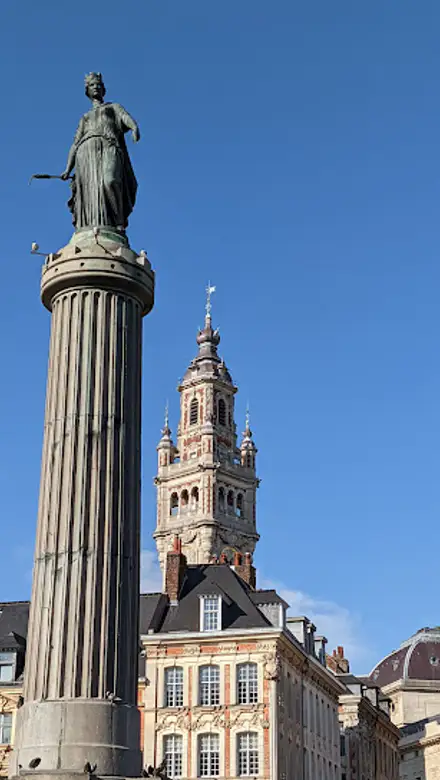
The Colonne de la Déesse (Column of the Goddess) stands tall in Lille's Grand Place, a symbol of the city's resilience and spirit. Erected in 1845, it commemorates the Siege of 1792 when Lille bravely resisted Austrian forces. The monument features a statue of a goddess holding a boutefeu (a tool to ignite cannons), representing Lille's readiness to defend itself.
Opening hours
- Every dayOpen 24 hours
Opening hours as listed on the venue’s Google Business Profile. Hours can change for services and special events, so check with the venue before you go.
- Address
- colonne de la Déesse, Pl. du Général de Gaulle, 59800 Lille
- Website
Getting there
Walking
Public Transport
Taxi
Discover more about Colonne de la Déesse
Overview
The Colonne de la Déesse, prominently situated in Lille's bustling Place du Général de Gaulle (Grand Place), is more than just a monument; it's a powerful emblem of the city's history and the unwavering spirit of its people. Inaugurated on October 8, 1845, the column commemorates the heroic resistance of the Lillois during the Siege of 1792, a pivotal moment when the city stood firm against the Imperial Army.The monument's design, a collaboration between architect Charles Benvignat and sculptor Théophile Bra, showcases both architectural elegance and a deep cultural narrative. The column itself, made of grooved granite, rises to an impressive 12.51 meters. Atop the column stands the statue of the Goddess, an allegorical representation of Lille, crowned with towers symbolizing the city's fortifications. In her right hand, she holds a boutefeu, a tool used to ignite cannon fuses, while her left hand points to an inscription on the base, a defiant response from Mayor François André-Bonte refusing to surrender the city.The statue quickly became known as the 'Goddess' by locals, a name inspired by a poem and one that has endured. Some believe the statue bears a resemblance to Marie-Josephe Bigo-Danel, the mayor's wife at the time. The monument serves as a reminder of Lille's commitment to freedom and resilience against adversity. The square surrounding the Colonne de la Déesse is a vibrant hub of activity, lined with cafes and shops, making it a perfect place to soak in the local atmosphere.
Evendo Review Centre
 Google
Guest reviews
Explore Colonne de la Déesse on the map
A handpicked selection of must-see spots near Colonne de la Déesse, mapped for you.
Get your free copy of our complete guide to Colonne de la Déesse, delivered straight to you.
Everything on this page, from opening hours and how to get there to Eve’s tips and the best time to go, in one PDF you can read offline, print or share.
Already have an account? Sign in
Your Colonne de la Déesse guide is ready.
We'll send it to · Not you? Sign out

Getting your guide ready…
We are putting together a fresh copy of the Colonne de la Déesse guide. This can take up to a minute.
This can take a few moments. If your browser asks, choose Allow so the download can start. You'll find the guide in your Downloads folder.
Nothing happened? Download it again
Sorry, the guide is taking longer than usual. Please try again in a minute, or get it by email instead.
Unlock the best of Colonne de la Déesse
Skip-the-line tickets, guided tours with entry, and walking tours of the area, booked in a few clicks.

Other nearby places you may find interesting
The closest places of the same kind, if this one is not quite what you had in mind.
-
-
-
-
-


Swipe for more places
More to explore near Colonne de la Déesse

 Best experiences near Colonne de la Déesse
 Best hotels near Colonne de la Déesse
 Best landmarks near Colonne de la Déesse
 Best attractions near Colonne de la Déesse
 Best shops near Colonne de la Déesse
 Best restaurants near Colonne de la Déesse
 Best bars near Colonne de la Déesse
Do you manage this location?
Take control to get all the benefits, like improved information, better appearance, and stronger visibility across AI-powered discovery.
Explore more

Explore more of Lille
Discover Lille: A blend of Flemish charm and French elegance, where history, art, and culinary delights await in the heart of Northern France.
Explore Lille
Explore more of France
Explore France: A land of romance, history, and unparalleled beauty, from the iconic streets of Paris to the serene landscapes of Provence and the luxury of the French Riviera.
Explore France