

Blasturm Travel Guide
Free Guide: Explore Schwandorf's iconic Blasturm, a medieval watchtower offering panoramic views and a glimpse into the city's rich history and the legacy of the Bavarian Anthem.


A brief summary of Blasturm
Explore Schwandorf's iconic Blasturm, a medieval watchtower offering panoramic views and a glimpse into the city's rich history and the legacy of the Bavarian Anthem.
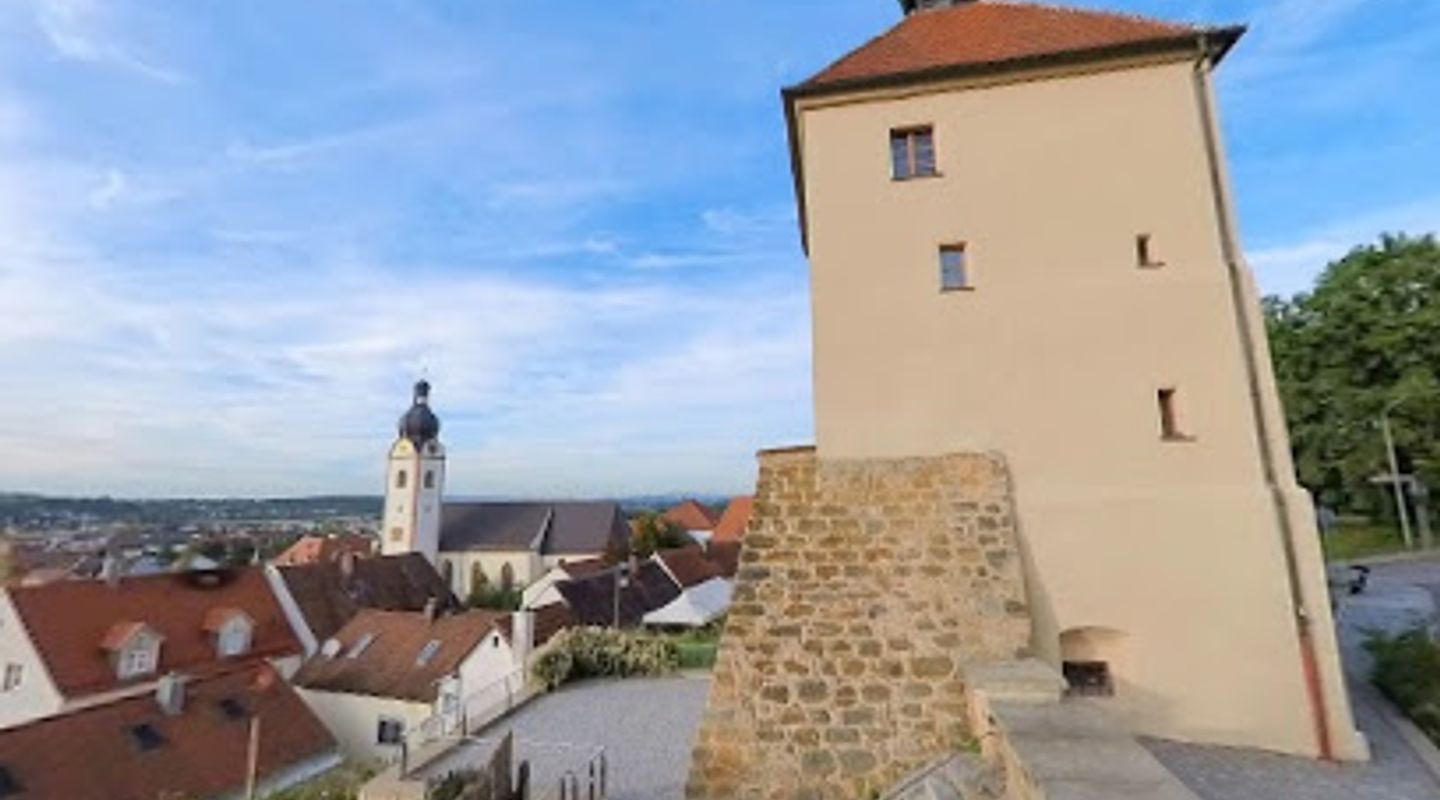
The Blasturm, a well-preserved medieval tower, stands as Schwandorf's iconic landmark and the last remaining vestige of the city's historic fortifications. Built in 1459, it served as a watchtower, offering panoramic views of the surrounding landscape and alerting residents to potential threats. The tower's strategic location on the Weinberg (vineyard) ensured its survival through centuries of urban development. Today, the Blasturm houses a small museum dedicated to its history, the role of the Türmer (tower watchman), and Konrad Max Kunz, composer of the Bavarian Anthem who was born in the tower. Visitors can explore the tower's interior, climb to the top for stunning city views, and learn about its significance in Schwandorf's past. The Blasturm is a testament to Schwandorf's rich heritage and a must-see attraction for history enthusiasts and anyone seeking a glimpse into Bavaria's medieval past. Its enduring presence makes it a symbol of the city's resilience and a reminder of its vibrant cultural identity.
- Address
- Blasturmgasse 4, 92421 Schwandorf
- Phone
- Website
Getting there
Walking
Public Transport
Discover more about Blasturm
Overview
The Blasturm, or 'blowing tower,' a protected monument, proudly stands as the enduring symbol of Schwandorf, a testament to the city's rich history and strategic importance. More than half a millennium has passed since its construction, and it remains the most visible relic of the once-walled city. Located at Blasturmgasse 4, the tower wasn't built on a busy road, but halfway up the Weinberg (vineyard). Originally known as the Neuturm (new tower), the Blasturm was erected in 1459 as part of Schwandorf's city fortifications. Duke Albrecht III granted Schwandorf the right to levy an additional tax on wine, mead, and beer to fund the construction of the city walls, highlighting the importance of the city's defense. Schwandorf served as a border town between the Duchy of Bavaria-Munich and the Electoral Palatinate, both ruled by the Wittelsbach family. The tower's strategic position on the highest point of the city walls provided an unobstructed view of the surrounding landscape, allowing the Türmer (tower watchman) to monitor for approaching threats, be they enemy soldiers or the outbreak of fire. The Türmer played a crucial role in the city's safety. Initially, the watchman was responsible for keeping a lookout for approaching soldiers. Later, their primary duty shifted to fire prevention, as the densely packed wooden houses of the city were highly susceptible to conflagration. The Türmer would use a fire horn or a fire bell, the latter sourced from St. Jakob parish church in 1754, to alert the citizens to danger, indicating the direction of the threat with a red flag during the day and a lantern at night. One notable Türmer was Michael Kunz, father of Konrad Max Kunz, the composer of the Bayernhymne (Bavarian Anthem). Karolina Luschner was the last Türmerin, who served until her death in 1929 after inheriting the position from her husband in 1899. The tower is sometimes referred to as the Luschnerturm in local parlance, after this family. The Blasturm's architectural features reflect its function as a defensive structure. The tower lacks a gate, instead serving as a watch and residential tower. It has a pyramidal roof topped with a lantern on a rectangular base. A 50-meter section of the original city wall still connects to the tower on its south side. Carl Spitzweg, a renowned German Romantic painter, immortalized the Blasturm in his 1860 painting "Schwandorfer Stadtturm im Mondschein" (Schwandorf City Tower in the Moonlight), which is now displayed at the Museum Georg Schäfer. The city declined to purchase the painting in 1960 for 27,000 Deutsche Mark. After World War II, the vacant tower was briefly used as a local history museum. Following the museum's relocation in 1963, the tower remained empty for many years. In 2006, a new small museum opened, dedicated to the history of the Türmer and Carl Spitzweg. The museum showcases the history of the tower, the role of the Türmer, and the life and work of Konrad Max Kunz. Visitors can explore exhibits detailing the tower's construction, the watchman's duties, and the significance of the Bavarian Anthem. The Blasturm is open regularly for free visits and is also included in many city tours. Today, the Blasturm is a popular destination for tourists and locals alike. The observation deck at the foot of the tower offers panoramic views of Schwandorf. The Blasturm stands as a reminder of Schwandorf's past and a symbol of its enduring spirit. Its historical significance, architectural beauty, and cultural connections make it a must-see attraction for anyone visiting the city. The neighboring Türmerhaus (tower watchman's house) has been renovated and now serves as a hiking station since 2018, as several hiking trails converge at this point. Schwandorf itself offers a variety of attractions and activities for visitors. The Felsenkeller Labyrinth, Bavaria's largest rock cellar labyrinth, provides a unique underground experience. The Stadtmuseum Schwandorf showcases the city's cultural and industrial history. The Oberpfälzer Künstlerhaus features contemporary art exhibitions. The Kreuzberg Church, a prominent landmark, offers stunning views of the city and surrounding area. The Upper Palatinate Lake District, located near Schwandorf, offers opportunities for swimming, boating, and hiking. Whether you are interested in history, art, nature, or simply experiencing Bavarian culture, Schwandorf has something to offer. The Blasturm stands as a proud symbol of the city's past and a welcoming beacon for visitors from around the world. Its enduring presence ensures that the stories of Schwandorf will continue to be told for generations to come.
Evendo Review Centre
 Google
Guest reviews
Explore Blasturm on the map
A handpicked selection of must-see spots near Blasturm, mapped for you.
Get your free copy of our complete guide to Blasturm, delivered straight to you.
Everything on this page, from opening hours and how to get there to Eve’s tips and the best time to go, in one PDF you can read offline, print or share.
Already have an account? Sign in
Your Blasturm guide is ready.
We'll send it to · Not you? Sign out

Getting your guide ready…
We are putting together a fresh copy of the Blasturm guide. This can take up to a minute.
This can take a few moments. If your browser asks, choose Allow so the download can start. You'll find the guide in your Downloads folder.
Nothing happened? Download it again
Sorry, the guide is taking longer than usual. Please try again in a minute, or get it by email instead.
Other nearby places you may find interesting
The closest places of the same kind, if this one is not quite what you had in mind.
-
-
-
-
-


Swipe for more places
More to explore near Blasturm

 Best experiences near Blasturm
 Best hotels near Blasturm
 Best landmarks near Blasturm
 Best attractions near Blasturm
 Best shops near Blasturm
 Best restaurants near Blasturm
 Best bars near Blasturm
Do you manage this location?
Take control to get all the benefits, like improved information, better appearance, and stronger visibility across AI-powered discovery.
Explore more

Explore more of Upper Palatinate
Discover Upper Palatinate: A Bavarian treasure trove of medieval charm, natural beauty, and vibrant cultural festivities.
Explore Upper Palatinate
Explore more of Germany
Experience Germany: where history meets innovation, and urban energy blends with natural beauty. Discover diverse cultures, delicious cuisine, and stunning landscapes.
Explore Germany
