

Wli Waterfalls Travel Guide - Free Web & App
Your ultimate guide to Wli Waterfalls. Discover top landmarks, proposed trips, and local tips. Free on the web or via the Evendo companion app.


Wli Waterfalls, Ghana’s highest cascade, offers forest hikes, Lower and Upper Falls, birdwatching and village experiences near Hohoe in the Volta Region.
Rainforest and Water
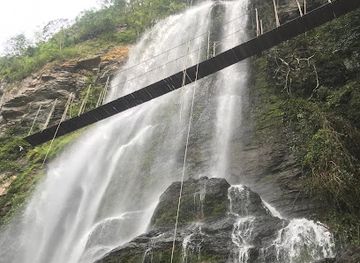
Wli Waterfalls lies near the village of Wli in Ghana’s Volta Region, close to the Togo border and within the forested foothills of the Akwapim-Togo mountain range. The attraction is commonly described as Ghana’s highest waterfall, with water descending in two principal stages. The Lower Falls, reached by a walk through the Agumatsa Wildlife Sanctuary, is the most accessible and widely visited section; the Upper Falls requires a longer, more demanding route into the hills. The sound of falling water, humid forest and steep-sided valley create a markedly different setting from the savannah landscapes found elsewhere in Ghana.Read more about Wli Waterfalls
Forest, Wildlife and Local Life
Exploring the Falls
When is the best time to visit Wli Waterfalls?
Best: December–February · 28°C| Month | High (°C) | Rainfall (mm) |
|---|---|---|
| January (best) | 28 | 15 |
| February (best) | 28 | 15 |
| March | 29 | 20 |
| April | 29 | 25 |
| May | 29 | 30 |
| June | 29 | 35 |
| July | 28 | 35 |
| August | 28 | 35 |
| September | 28 | 30 |
| October | 29 | 25 |
| November | 28 | 20 |
| December (best) | 28 | 15 |
Getting to and around Wli Waterfalls
How to get there
Transportation
Best attractions in Wli Waterfalls
-
Tourist attraction
Boabeng Fiema Monkey Sanctuary
Experience the captivating Boabeng Fiema Monkey Sanctuary, where you can connect with nature and witness endangered primates in their natural habitat.
-
Tourist attraction
Ote waterfall
Discover the enchanting beauty of Ote Waterfall in Amedzofe, where nature's splendor meets tranquility and adventure.
Explore Wli Waterfalls on the map
Plan your trip on one map. See where the top attractions, landmarks, restaurants and hotels are, and book hotels and experiences in a few clicks.
Best hotels in Wli Waterfalls
Get your free copy of our complete guide to Wli Waterfalls, delivered straight to you.
Everything on this page, from attractions and restaurants to essentials and local phrases, in one PDF you can read offline, print or share.
Already have an account? Sign in
Your Wli Waterfalls guide is ready.
We'll send it to · Not you? Sign out

Getting your guide ready…
We are putting together a fresh copy of the Wli Waterfalls guide. This can take up to a minute.
This can take a few moments. If your browser asks, choose Allow so the download can start. You'll find the guide in your Downloads folder.
Nothing happened? Download it again
Sorry, the guide is taking longer than usual. Please try again in a minute, or get it by email instead.
Wli Waterfalls essentials
Currency and Payment
Safety
Emergency Situations
Do's and Don'ts
Local Tips
From Eve
Local phrases worth knowing
You don't need to get them perfect. A few words go a long way, and locals appreciate the effort.
Basics
| English | Local | Say it |
|---|---|---|
| Hello | Afe | [ah-fay] |
| Goodbye | Baako | [bah-ko] |
| Yes | Aane | [ah-neh] |
| No | Daabi | [dah-bee] |
| Please/You're welcome | Mepaakyew | [meh-pah-ah-kyew] |
| Thank you | Medaase | [meh-dah-seh] |
| Excuse me/Sorry | Mepa wo kyew | [meh-pah woh kyew] |
| How are you? | Wo ho te s3n? | [woh hoh teh sen] |
| Fine. And you? | Adi3. Na wo y3? | [ah-dee-eh. nah woh yay] |
| Do you speak English? | Wo b3ka nnawotwe a? | [woh beh-kah n-nah-woh-tweh ah] |
| I don't understand | Menntumi nnwom | [men-too-mee n-nwom] |
Eating & Drinking
| English | Local | Say it |
|---|---|---|
| I'd like to see the menu, please | M3tumi nnkyer3 menu no, mesr3 wo | [meh-too-mee n-nchyer-eh men-oo noh, meh-sreh woh] |
| I don't eat meat | Mente b3gya krakra | [men-teh beh-jah krah-krah] |
| Cheers! | Afehyia pa | [ah-feh-hee-ah pah] |
| I would like to pay, please | M3tumi nnhu, mesr3 wo | [meh-too-mee n-nhoo, meh-sreh woh] |
Emergencies
| English | Local | Say it |
|---|---|---|
| Help! | Bo me | [boh meh] |
| Go away! | Kasa | [kah-sah] |
| Call the Police! | Kyer3 polis | [chyer-eh poh-lis] |
| Call a doctor! | Kyer3 dokita | [chyer-eh doh-kee-tah] |
| I'm lost | Mente asa | [men-teh ah-sah] |
| I'm ill | Mente aka | [men-teh ah-kah] |
Shopping
| English | Local | Say it |
|---|---|---|
| I'd like to buy... | M3tumi nnua... | [meh-too-mee n-noo-ah...] |
| I'm just looking | Mente as3m | [men-teh ah-sehm] |
| How much is it? | Afei bia a, s3n? | [ah-feh bee-ah ah, sen] |
| That's too expensive | Na y3b3 di s3n | [nah yay-beh dee sen] |
| Can you lower the price? | Wo p3 s3n a, s3 wote soro no? | [woh peh sen ah, seh woh-teh soh-ro noh] |
Time & Numbers
| English | Local | Say it |
|---|---|---|
| What time is it? | Nnim afei bia? | [n-neem ah-feh bee-ah] |
| It's one o'clock | Yi afei | [yee ah-feh] |
| Half past (10) | Akwadaa da mu | [ah-kwah-dah dah moh] |
| Morning | Anigyefo | [ah-nee-jeh-foh] |
| Afternoon | Anuonyam | [ah-noo-oh-nyahm] |
| Evening | Anwummere | [ahn-woo-meh-reh] |
| Yesterday | Nkuto | [n-koo-toh] |
| Today | Nna | [n-nah] |
| Tomorrow | Fie | [fee-eh] |
| 1 | Bere | [beh-reh] |
| 2 | Aboa | [ah-boh-ah] |
| 3 | Afi | [ah-fee] |
| 4 | Anan | [ah-nahn] |
| 5 | Anuonum | [ah-noo-oh-noom] |
| 6 | Asr3 | [ah-seh] |
| 7 | Awotwe | [ah-woh-tweh] |
| 8 | Ananmu | [ah-nahn-moo] |
| 9 | Anidaso | [ah-nee-dah-soh] |
| 10 | Aku | [ah-koo] |
Transport & Directions
| English | Local | Say it |
|---|---|---|
| Where's a/the...? | B3tumi...? | [beh-too-mee] |
| What's the address? | S3nea adir3s no? | [sen-eh-ah ah-dee-rehs noh] |
| Can you show me (on the map)? | Wo b3hw3 me (on de mepa)? | [woh beh-hweh meh (on deh meh-pah)] |
| When's the next (bus)? | Afei b3tumi...? | [ah-feh bee-too-mee] |
| A ticket (to ....) | Tiket (na ....) | [tee-keht (nah)] |
History of Wli Waterfalls
A Mountain Landscape Shaped by Water
Wli Waterfalls occupies a deeply incised landscape on the Ghanaian side of the Togo-Akwapim Range, a chain of uplands extending through parts of Ghana, Togo and Benin. The falls were formed as streams descend through resistant rock and forested slopes, creating an upper and lower sequence rather than a single uninterrupted drop. This geological setting helps explain the attraction’s character: a narrow, humid valley beneath higher ground, with seasonal changes in water volume and trail conditions. The physical landscape predates human settlement by immense periods and should be understood as the natural foundation on which later farming, village life and tourism developed.
Ewe Communities and the Volta Foothills
The area around Wli belongs to the cultural landscape of Ewe-speaking communities in southeastern Ghana. Villages in the Volta foothills developed in relationship with fertile lowland areas, forest resources and mountain watercourses, while paths across the region connected settlements and farms. Wli is not an isolated wilderness detached from local life: the waterfall lies beside a lived-in rural environment in which agriculture, community institutions and customary relationships with land remain important. Accounts of the falls and their name are understood within local traditions, although visitors should avoid treating oral history as a single fixed version of the past.
From Local Landmark to Visitor Attraction
For generations, the waterfall was a prominent natural feature known to nearby communities. Its wider recognition grew as roads, regional travel and interest in Ghana’s landscapes brought more visitors to the Volta Region. Tourism developed around walks to the falls, local guiding and visits from Hohoe and other parts of Ghana, rather than through large-scale urban construction. This pattern remains visible in the modest facilities around Wli: the attraction is experienced primarily on foot, with the village and surrounding communities providing the practical and cultural setting.
Sanctuary Protection and Sustainable Tourism
The waterfall is associated with the Agumatsa Wildlife Sanctuary, a protected forest landscape established to safeguard habitat and the natural setting around the falls. Conservation has helped frame Wli as more than a scenic viewpoint, placing emphasis on forest protection, responsible guiding and the management of visitor access. Tourism nevertheless brings continuing responsibilities, including reducing litter, respecting paths and wildlife, and ensuring that local communities benefit from guiding and visitor services. Weather, erosion and increasing visitation can affect trails, making local management important to the long-term character of the site.
Wli Waterfalls in Photos
Browse through our photo collection highlighting the charm and character of the destination.
Neighbouring destination travel guides
The closest destinations to Wli Waterfalls, if you have time for more than one.
-

-

-

-

-


Swipe for more destinations
Explore more

Explore more of Ewe
Explore Ewe Ghana through Volta’s mountain forests, waterfalls, Anlo lagoons, coastal heritage, festivals, food and enduring cultural traditions.
Explore Ewe
Explore more of Ghana
Discover Ghana: A vibrant blend of rich history, stunning landscapes, and warm hospitality in the heart of West Africa.
Explore Ghana