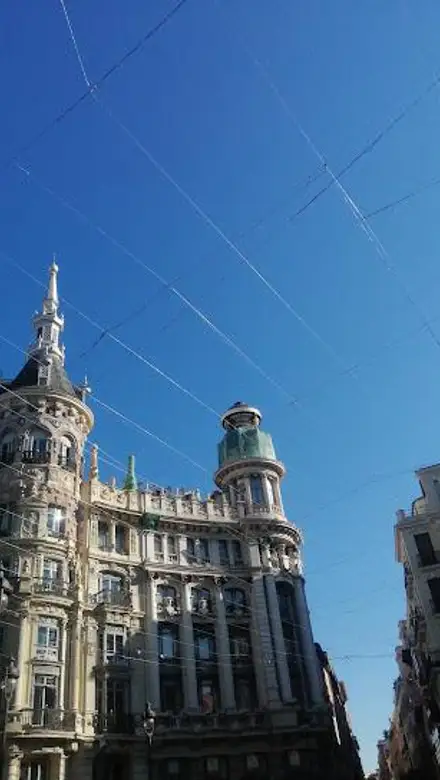
Pl. de Canalejas, Madrid Travel Guide
Free Guide: Madrid's compact plaza where 19th-century stone facades frame luxury hotels, elite boutiques, and pedestrian buzz in Centro's refined commercial nexus.


A brief summary of Pl. de Canalejas
Madrid's compact plaza where 19th-century stone facades frame luxury hotels, elite boutiques, and pedestrian buzz in Centro's refined commercial nexus.
Nestled in Madrid's bustling Centro district, Plaza de Canalejas captivates with its refined 19th-century architecture, luxury facades, and lively urban energy. Surrounded by grand hotels and high-end boutiques, this compact square offers a perfect snapshot of the city's sophisticated charm, where history meets modern vibrancy amid cafe-lined edges and pedestrian flow.
On-site amenities
 Restrooms
 Drink options
 Food options
 Seating areas
 Trash bins
- Address
- Centro, Madrid
Getting there
Metro
Walking
Bus
Discover more about Pl. de Canalejas
Historical Foundations
Plaza de Canalejas emerged in the late 19th century as part of Madrid's urban expansion during a period of economic growth and architectural ambition. Named after José Canalejas, a prominent Spanish prime minister assassinated in 1912, the square reflects the era's blend of neoclassical influences and emerging modernity. Originally a simple open space amid growing commercial districts, it evolved into a focal point for elite social life, with buildings commissioned by affluent families and institutions. The plaza's layout, with its rectangular form and central positioning, was designed to facilitate pedestrian movement while showcasing monumental facades that define Madrid's Centro neighborhood.
Architectural Highlights
The square's perimeter features ornate buildings from the late 1800s and early 1900s, characterized by intricate stonework, balconies with wrought-iron railings, and symmetrical elevations typical of eclectic Madrid architecture. Standout structures include the Hotel Villa Real, housed in a restored 19th-century palace with marble interiors inspired by Roman antiquities, and the nearby Westin Palace, a Belle Époque icon opened in 1912. Opposite, luxury banks and offices occupy restored heritage buildings, their ground floors alive with designer storefronts. The plaza itself remains mostly paved, free of central monuments, allowing unobstructed views of the surrounding elevations and fostering a sense of enclosure amid the city's chaos.
Urban Vibe and Atmosphere
Daytime brings a steady rhythm of office workers, shoppers, and tourists crisscrossing the square, with the hum of conversations in Spanish, English, and beyond. Cafes spill tables onto the pavement, serving cortados and tapas to a cosmopolitan crowd. Evenings transform the space into a more leisurely scene, illuminated by warm street lamps that accentuate the stone textures and cast long shadows. The absence of heavy traffic—thanks to pedestrian prioritization—creates an intimate pocket where the pulse of Madrid feels concentrated yet relaxed. Seasonal markets occasionally appear, adding bursts of color and local crafts.
Cultural and Social Role
Positioned steps from Puerta del Sol and Calle Gran Vía, Plaza de Canalejas serves as a quiet interlude in Madrid's high-energy core. It embodies the city's layered identity: a place where 20th-century political history intersects with contemporary luxury retail and hospitality. Passersby encounter remnants of old Madrid, like faded inscriptions on building corners, while global brands draw international visitors. The square hosts impromptu gatherings, from protests echoing Canalejas's reformist legacy to fashion shoots leveraging its photogenic backdrop. Its scale invites lingering without overwhelming, making it ideal for people-watching or a brief respite.
Practical Visitor Insights
Navigating the plaza reveals subtle details: engraved plaques recounting its namesake's tenure, subtle fountains providing ambient trickle, and vantage points for framing the architecture against the skyline. Proximity to major arteries ensures easy integration into walking tours, yet the square's containment offers seclusion. Weather enhances or challenges the experience—sunny days amplify the golden stone glow, while rain turns cafes into cozy refuges. Over time, preservation efforts have maintained its integrity, resisting over-commercialization to preserve authentic Madrileño character.
Evendo Review Centre
 Google
Guest reviews
Best time to go
Quietest: Jan, Feb & Dec · before 3am
Busy times are Evendo estimates for a typical year, to help you plan. Actual crowds vary with events, school holidays and the weather.
Explore Pl. de Canalejas on the map
A handpicked selection of must-see spots near Pl. de Canalejas, mapped for you.
Get your free copy of our complete guide to Pl. de Canalejas, delivered straight to you.
Everything on this page, from opening hours and how to get there to Eve’s tips and the best time to go, in one PDF you can read offline, print or share.
Already have an account? Sign in
Your Pl. de Canalejas guide is ready.
We'll send it to · Not you? Sign out

Getting your guide ready…
We are putting together a fresh copy of the Pl. de Canalejas guide. This can take up to a minute.
This can take a few moments. If your browser asks, choose Allow so the download can start. You'll find the guide in your Downloads folder.
Nothing happened? Download it again
Sorry, the guide is taking longer than usual. Please try again in a minute, or get it by email instead.
Unlock the best of Pl. de Canalejas
Skip-the-line tickets, guided tours with entry, and walking tours of the area, booked in a few clicks.


Other nearby places you may find interesting
The closest places of the same kind, if this one is not quite what you had in mind.
-
-
-
-
-


Swipe for more places
More to explore near Pl. de Canalejas

 Best experiences near Pl. de Canalejas
 Best hotels near Pl. de Canalejas
 Best landmarks near Pl. de Canalejas
 Best attractions near Pl. de Canalejas
 Best shops near Pl. de Canalejas
 Best restaurants near Pl. de Canalejas
 Best bars near Pl. de Canalejas
Do you manage this location?
Take control to get all the benefits, like improved information, better appearance, and stronger visibility across AI-powered discovery.
Explore more

Explore more of Madrid
Discover Madrid: A city of art, culture, and culinary delights, where history and modern vibrancy meet in the heart of Spain.
Explore Madrid
Explore more of Spain
Discover Spain: A vibrant tapestry of culture, history, and breathtaking landscapes, where every city offers a unique adventure and unforgettable experiences.
Explore Spain