

Richmond Castle Travel Guide
A thousand-year-old Norman fortress commanding the River Swale with panoramic Yorkshire Dales views and layered medieval history.
A Norman Stronghold Born from Conquest
Richmond Castle emerged from the turbulent aftermath of 1066, when William the Conqueror rewarded his loyal followers with lands across northern England. Alan Rufus, a Breton kinsman of William who may have fought at the Battle of Hastings, received extensive holdings in North Yorkshire and began constructing this fortress around 1071. Originally called Riche Mount—meaning 'the strong hill'—the castle was strategically positioned on a cliff above the River Swale to assert Norman dominance and suppress potential rebellions from the local English population. Its triangular enclosure with massive stone walls and commanding hilltop location made it one of the most formidable defensive structures of its era, controlling vital routes through Swaledale and Wensleydale.Medieval Expansion and Royal Significance
During the 12th century, Richmond Castle underwent dramatic transformation under the stewardship of Alan Rufus's great-nephew, Duke Conan IV of Brittany. Between the 1150s and 1170s, Conan oversaw the construction of the castle's most iconic feature: a 100-foot-high keep of honey-coloured sandstone with walls nearly 12 feet thick. This remarkable tower, completed under King Henry II's guardianship after Conan's death, became a statement of exceptional power and wealth. The keep's distinctive straight flights of steps between levels—unusual for Norman architecture—lead to four interior levels and rooftop battlements offering breathtaking vistas. Additional structures including towers, gateways, a barbican with drawbridge, and the Cockpit Garden were added during this period of expansion, transforming the fortress into a more comfortable royal residence. The castle hosted English monarchs including Richard the Lionheart and King John, and played a pivotal role in medieval conflicts including the First Barons' War and border disputes with Scotland.Decline, Military Service, and Wartime History
By the 16th century, Richmond Castle's strategic importance had waned as centralized government reduced the power of individual fortifications. The castle fell into disrepair and was largely derelict by 1540, remaining abandoned for three centuries until the 3rd Duke began restoration work in the 1760s. The 19th century brought new purpose: in 1854, the Duke leased the castle to become headquarters of the North York Militia, and a military barracks block was constructed within the great courtyard. During World War I, the castle gained unexpected historical significance when it was converted into a detention facility for conscientious objectors—men who refused military service on grounds of conscience. The Richmond Sixteen and other prisoners left behind marks and inscriptions that survive today, offering poignant testimony to their principled resistance. Robert Baden-Powell, founder of the Boy Scouts, briefly commanded from the castle between 1908 and 1910 while leading the Northern Territorial Army.Architectural Distinction and Preservation
Richmond Castle stands as the best-preserved example of an early Norman castle in England, rivalled only by fortifications at Colchester and Durham in age and integrity. Its architectural design exemplifies early Norman military engineering, with its original triangular enclosure featuring massive stone walls on two sides and natural cliff protection from the River Swale on the third. The keep's exceptional preservation allows visitors to experience authentic 11th and 12th-century construction techniques and spatial organization. The castle's layout comprises four main sections: the triangular main enclosure, an outer eastern enclosure, the keep at the northern corner, and a small enclosure surrounding the keep. Informative notice boards throughout the grounds provide context for the various structures and their historical periods, while the interactive museum exhibition offers deeper insight into the castle's evolution across nearly a thousand years.Contemporary Experience and Visitor Engagement
Today, Richmond Castle functions as a major heritage attraction managed by English Heritage, welcoming visitors to explore its atmospheric grounds and climb the challenging tower stairs. The reward for ascending the keep's 100 feet is a panoramic vista encompassing Richmond town, the River Swale, and the surrounding Yorkshire Dales countryside—a view that has remained largely unchanged since medieval times. The secluded Cockpit Garden provides peaceful spaces for reflection, while the gift shop and visitor facilities enhance the experience. The castle's dog-friendly policy and accessible grounds make it welcoming to diverse visitors, and the site regularly hosts special events and activities that bring its rich history to life. Whether approached from Richmond's cobbled market place or discovered during exploration of the Yorkshire Dales, this Norman jewel continues to command attention and inspire wonder, much as it did when Alan Rufus first raised its walls nearly a thousand years ago.A brief summary to Richmond Castle
- Tower St., Richmond, DL10 4QW, GB
- Click to display
- Monday 10 am-5 pm
- Tuesday 10 am-5 pm
- Wednesday 10 am-5 pm
- Thursday 10 am-5 pm
- Friday 10 am-5 pm
- Saturday 10 am-5 pm
- Sunday 10 am-5 pm

Know before you go
Hi, I'm Eve. Here are a few practical things to know before exploring Richmond Castle.
- Climb to the top of the keep for spectacular 360-degree views of Richmond and the surrounding countryside. The steep stairs are worth the effort, and halfway up you'll find the historic 'Seat of Power' where the Duke once held court.
- Visit the interactive museum exhibition near the entrance to understand the castle's complex history before exploring the grounds. The notice boards throughout the site provide valuable context for each structure and time period.
- Explore the Cockpit Garden for a peaceful stroll and discover the cells where World War I conscientious objectors were detained—a fascinating and moving part of the castle's 20th-century history.
- Bring a picnic and allow at least two hours to fully explore the castle grounds, keep, and gardens. The site is spacious and dog-friendly, making it ideal for a leisurely day out.
- Visit on a clear day to maximize the views from the keep. The castle is only a short walk from Richmond's market place, making it easy to combine with exploring the historic town centre.
Do you manage this location?
Take control to get all the benefits, like improved information, better appearance, and stronger visibility across AI-powered discovery. Learn more about listing your business on Evendo
Activate your presenceOther nearby places you may find interesting
The closest places of the same kind, if this one is not quite what you had in mind.


Explore Richmond Castle on the Map
A handpicked selection of must-see spots near Richmond Castle, mapped for you.
Getting There
-
By Car
Richmond Castle is located at Tower Street, Richmond, DL10 4QW in North Yorkshire. From the A1(M) motorway, take the A66 westbound towards Scotch Corner. Follow signs to Richmond town centre. There is limited on-street parking near the castle entrance and additional car parks within walking distance of the town centre. Travel time from York is approximately 50 minutes; from Newcastle upon Tyne approximately 90 minutes. Parking costs vary by location but typically range from free to £1.50 per hour in town centre car parks.
-
By Train
Richmond railway station is served by Northern Rail services from Leeds, Darlington, and Newcastle upon Tyne. The journey from Leeds takes approximately 90 minutes; from Newcastle approximately 2 hours. From Richmond station, the castle is a 10-minute walk uphill through the town centre to Tower Street. Day return tickets typically cost £15–25 depending on origin and booking time. The station has ticket offices and information facilities.
-
By Bus
Stagecoach and other regional operators provide bus services to Richmond from surrounding towns including Darlington, Northallerton, and Leeds. Journey times vary from 45 minutes to 2 hours depending on origin and route. Buses stop in Richmond town centre, from which the castle is a 10-minute walk. Single fares typically range from £3–8. Check local timetables as service frequency varies seasonally.
-
On Foot from Town Centre
From Richmond's market place, the castle is accessible via a steep 10-minute walk uphill along Tower Street. The route is well-signposted and passes through the historic town centre. The final approach involves climbing to the castle entrance at the top of the hill. This walk is moderately demanding due to gradient but is the most direct route from the town. No vehicles are required for this final approach.















Your all‑in‑one travel companion app
Explore expert travel guides, compare and book tours, experiences, hotels, and more—all from the palm of your hand. Download now for seamless trip planning wherever your wanderlust takes you.


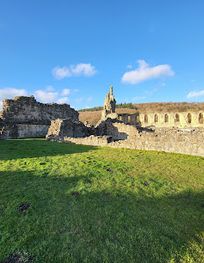
Explore the tranquil ruins and Arts & Crafts gardens of England’s best-preserved Carthusian monastery near Northallerton.
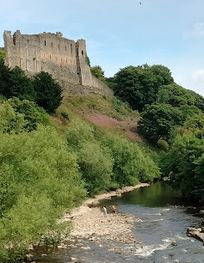
A commanding Norman fortress above the River Swale, with a towering keep, peaceful garden and a powerful story from the Conquest to the First World War.
