

Jedburgh Abbey Travel Guide
Free Guide: Medieval splendour on the Scottish border: a 12th-century abbey where history, architecture, and landscape converge.


A brief summary of Jedburgh Abbey
Medieval splendour on the Scottish border: a 12th-century abbey where history, architecture, and landscape converge.
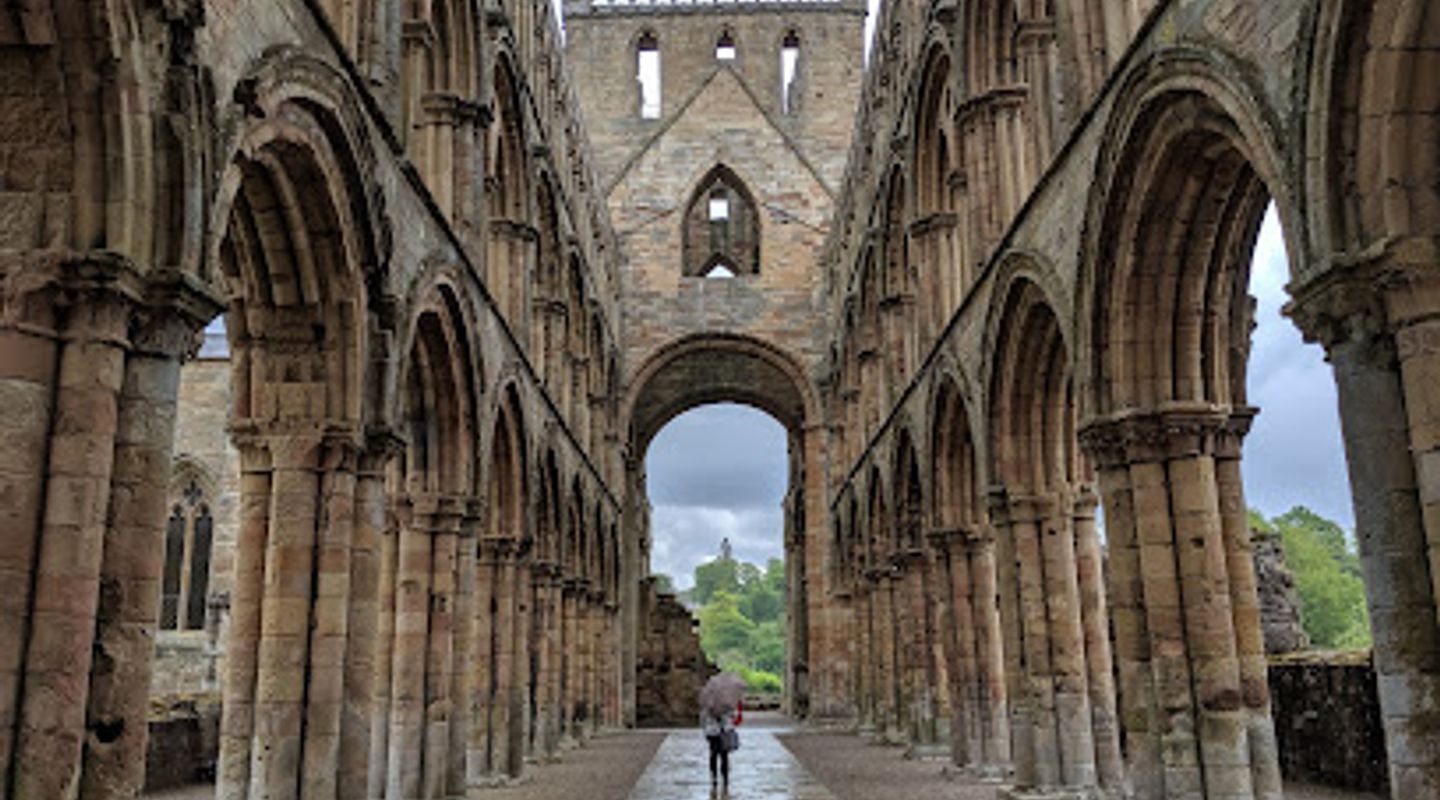
One of Scotland's four great Border abbeys, Jedburgh Abbey stands as a magnificent testament to 12th-century Augustinian architecture. Founded by King David I in 1138, this striking ruin showcases an unusual blend of Romanesque and early Gothic styles, with remarkably intact stonework that conveys the abbey's original grandeur. The visitor centre displays exceptional medieval artefacts, including the celebrated Jedburgh comb, while the recreated cloister garden invites peaceful reflection on monastic life.
On-site amenities
 Restrooms
 Drink options
 Food options
 Seating areas
 Picnic areas
 Trash bins
 Information boards
 Visitor centre
Opening hours
- Every day9:30 am–5 pm
Opening hours as listed on the venue’s Google Business Profile. Hours can change for services and special events, so check with the venue before you go.
- Address
- Abbey Bridge End, Jedburgh TD8 6JQ
- Phone
- Website
Getting there
Car from Edinburgh
Car from Melrose or Dryburgh Abbey
Bus from Edinburgh
Walking from Jedburgh town centre
Discover more about Jedburgh Abbey
A Monument to Medieval Ambition and Border Conflict
Jedburgh Abbey stands as one of the four great abbeys established in the Scottish Borders during the 1100s, founded by King David I around 1138 for Augustinian canons. The king's ambition was bold: to demonstrate to his English neighbours that Scotland could match any grand building south of the border. Yet this very proximity to the disputed frontier would prove both blessing and curse. The abbey's location, just 16 kilometres from the English border, made it a frequent target for invading armies during the Wars of Independence and beyond. Despite repeated destruction and rebuilding, the abbey endured, and today its ruins remain among the most complete and evocative of any Augustinian foundation in Scotland.
Architectural Splendour in Stone
The abbey church was constructed over more than 70 years, creating a striking fusion of Romanesque and early Gothic architectural styles. The apse was rebuilt in the 13th century to complete the church, and a magnificent rose window was inserted into the west facade during the 15th century. Even in its ruined state, the abbey conveys an extraordinary sense of the original structure's magnificence. The remains of ancillary buildings—the vast kitchen and cellar ranges, the dormitories where the brethren slept, and the refectory where they ate—are still visible across the sloping site, allowing visitors to piece together the layout and daily rhythms of monastic life. A narrow spiral staircase (approximately 0.7 metres wide) leads to a balcony at first-floor level in the west end of the nave, offering superb views across the entire interior and revealing the scale of the medieval achievement.
Treasures of Excavation and Discovery
The adjoining visitor centre houses an exceptional collection of artefacts uncovered during excavations around the abbey. Among these treasures is the priceless Jedburgh comb, a delicately carved ivory piece that has miraculously survived from the 12th century. An eighth-century shrine and other early Christian artefacts, which pre-date the abbey by several centuries, are also on display. The visitor centre's upper floor provides an excellent exhibition and viewing area, with a scale model showing what the abbey would have looked like in 1510 when the rose window was inserted, alongside a comprehensive timeline tracing the site's history from its 12th-century establishment through to the present day. Information boards throughout the abbey are presented in five languages, offering more detailed explanations than are typically found at Historic Scotland properties.
The Cloister Garden and Monastic Atmosphere
Visitors can walk through a recreated cloister garden, where the same aromatic herbs once used in the medieval abbey have been replanted. The sweet scent of these plants—used for cooking, medicine, and ritual—evokes the sensory world of monastic life. The peaceful grounds, with benches positioned throughout the cloister and picnic tables in the orchard and west range, invite quiet contemplation. The ability to look through open windows and arches toward the surrounding hills beyond adds to the immersive experience, allowing visitors to imagine the monks' daily lives within these walls. A stone display at the west end of the nave serves as a second exhibition area and should not be missed, while the restored north transept contains the burial aisle of the Earls of Lothian.
Accessibility and Visitor Experience
The site is well-equipped for visitors of varying abilities. The visitor centre shop has level access through wide swing doors, and the exhibition area is accessible via a modern spiral staircase with handrails. A ramp to the first floor is available on request. The main pathways and much of the church are accessible, though some areas feature uneven terrain and steps. The abbey offers audio guides in English (approximately 30 minutes long) included in admission, as well as interactive elements such as a fun fact-finding quiz. Guidebooks are available for purchase, and visitors with disabilities can be set down at the abbey door. Parking is available nearby, and toilets are located in the entrance building.
Seasonal Variations and Conservation
The abbey's preservation is an ongoing commitment, with some areas occasionally closed for essential conservation work. Opening hours vary seasonally: from April to September, the abbey opens at 9:30 am with last entry at 4:30 pm (closing at 5 pm), while from October to March, it opens at 10 am with last entry at 3:30 pm (closing at 4 pm). The site may close at short notice due to adverse weather or essential maintenance. An Explorer Pass, valid for 14 consecutive days, offers excellent value for exploring multiple Historic Scotland sites.
Evendo Review Centre
 Google
Guest reviews
Best time to go
Quietest: Jan, Feb & Nov · before 9am or from 6pm
Busy times are Evendo estimates for a typical year, to help you plan. Actual crowds vary with events, school holidays and the weather.
Explore Jedburgh Abbey on the map
A handpicked selection of must-see spots near Jedburgh Abbey, mapped for you.
Get your free copy of our complete guide to Jedburgh Abbey, delivered straight to you.
Everything on this page, from opening hours and how to get there to Eve’s tips and the best time to go, in one PDF you can read offline, print or share.
Already have an account? Sign in
Your Jedburgh Abbey guide is ready.
We'll send it to · Not you? Sign out

Getting your guide ready…
We are putting together a fresh copy of the Jedburgh Abbey guide. This can take up to a minute.
This can take a few moments. If your browser asks, choose Allow so the download can start. You'll find the guide in your Downloads folder.
Nothing happened? Download it again
Sorry, the guide is taking longer than usual. Please try again in a minute, or get it by email instead.
Unlock the best of Jedburgh Abbey
Skip-the-line tickets, guided tours with entry, and walking tours of the area, booked in a few clicks.
 Tour with entry
Rosslyn Chapel and Hadrian's Wall Tour
from $65.57 Tour with entry
Scottish Castles: Glamis and Dunnottar
from $69.35 Tour with entry
Full Day Trip Hadrian's Wall and The Borders from Edinburgh
from $100.61 Tour with entry
Rosslyn Chapel and Hadrian's Wall Small Group Tour from Edinburgh
from $112.22
 Tour
TourScottish Borders Road Trip Guidebook-Edinburgh, Melrose & Rosslyn
from $13.86 Tour
TourHadrian's Wall, Roman Britain and the Borders small group day tour
from $112.86 Tour
TourHadrian's Wall and The Borders Tour from Edinburgh with Admission
from $117.46 Tour
TourHadrian's Wall Luxury Private Day Tour from Edinburgh
from $1,781.57
Other nearby places you may find interesting
The closest places of the same kind, if this one is not quite what you had in mind.
-
-
-
-
-


Swipe for more places
More to explore near Jedburgh Abbey

 Best experiences near Jedburgh Abbey
 Best hotels near Jedburgh Abbey
 Best landmarks near Jedburgh Abbey
 Best attractions near Jedburgh Abbey
 Best shops near Jedburgh Abbey
 Best restaurants near Jedburgh Abbey
 Best bars near Jedburgh Abbey
Do you manage this location?
Take control to get all the benefits, like improved information, better appearance, and stronger visibility across AI-powered discovery.
Explore more
Explore more of Berwickshire
Discover Berwickshire: A blend of coastal beauty, historic landmarks, and charming villages in Scotland's serene southeastern corner.
Explore Berwickshire
Explore more of United Kingdom
Discover the United Kingdom: A blend of rich history, stunning landscapes, and vibrant cities, offering a unique travel experience for every visitor.
Explore United Kingdom
