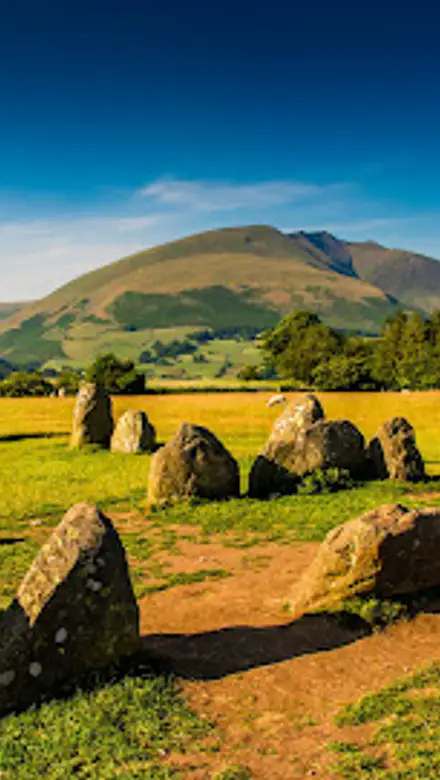
Castlerigg Stone Circle Travel Guide
Free Guide: Explore one of Britain’s oldest stone circles, set amid stunning Lake District fells with panoramic views and ancient mysteries.


A brief summary of Castlerigg Stone Circle
Explore one of Britain’s oldest stone circles, set amid stunning Lake District fells with panoramic views and ancient mysteries.
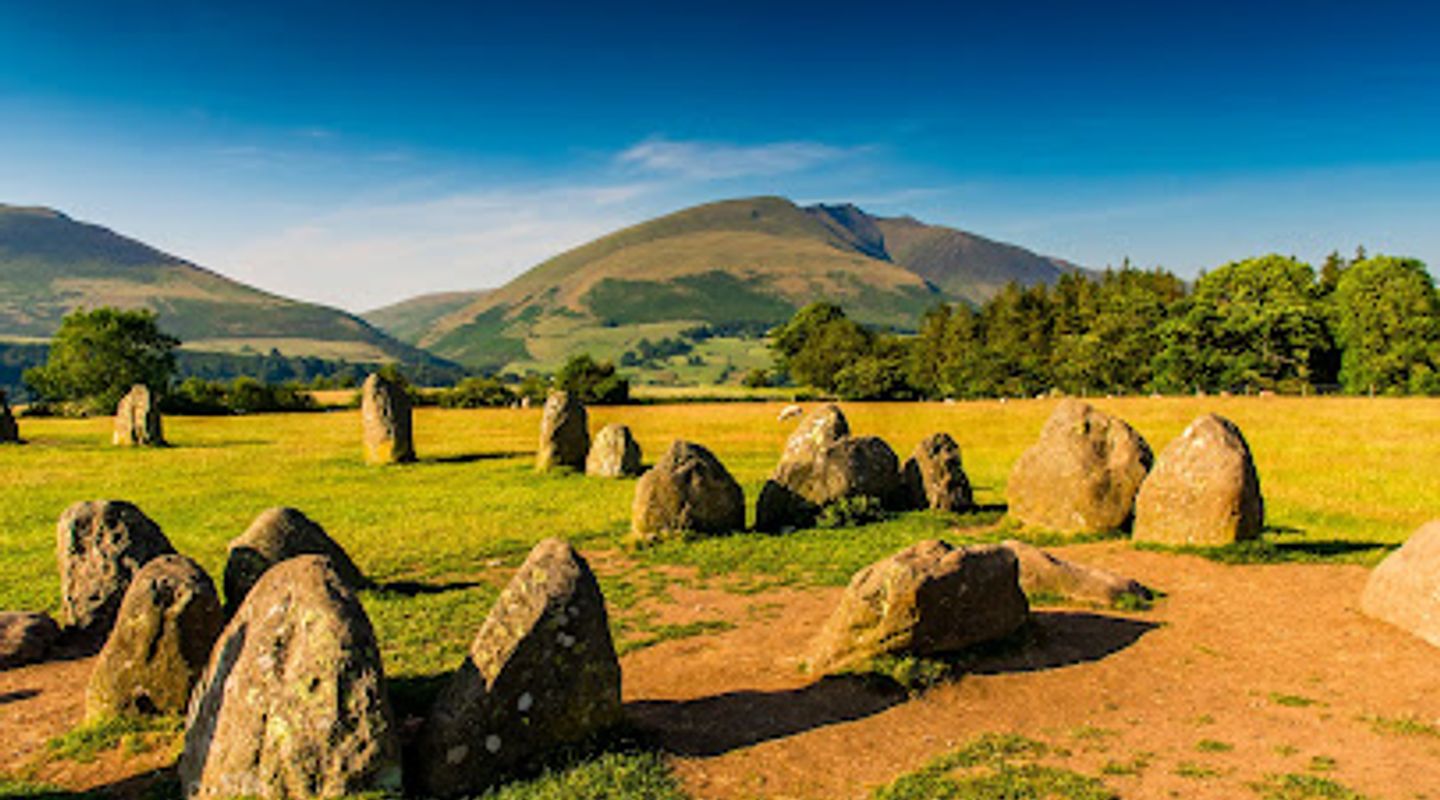
Castlerigg Stone Circle, located near Keswick in the Lake District National Park, is one of Britain's earliest and most atmospheric stone circles. Comprising 38 standing stones arranged in a roughly 30m diameter ring, it dates back to around 3200 BC. The site offers panoramic views of surrounding fells such as Helvellyn and Skiddaw and is believed to have served ceremonial, astronomical, and social purposes. Managed by English Heritage and owned by the National Trust, Castlerigg is open year-round with free admission and limited roadside parking nearby.
On-site amenities
 Information boards
Opening hours
- Every dayOpen 24 hours
Opening hours as listed on the venue’s Google Business Profile. Hours can change for services and special events, so check with the venue before you go.
- Address
- Castle Ln, Keswick CA12 4RN
- Phone
- Website
Getting there
Bus
Car
Walking
Discover more about Castlerigg Stone Circle
Origins and Historical Context of Castlerigg Stone Circle
Castlerigg Stone Circle is a remarkable prehistoric monument dating from the late Neolithic period, approximately 3200 to 3000 BC, making it one of the oldest stone circles in Britain and possibly Europe. Constructed by early farming communities, the circle originally consisted of around 42 stones, of which 38 remain standing today. The stones are locally sourced slate, varying in height from about 0.9 to 2.3 meters, arranged in a near-perfect circle roughly 30 meters in diameter. Uniquely, within the circle lies an inner rectangular setting of ten stones, a feature rare among British stone circles, adding to the site's enigmatic character.
Purpose and Astronomical Alignments
While the exact original purpose of Castlerigg remains unknown, archaeological and archaeoastronomical studies suggest multiple possible functions. It may have served as a ceremonial or religious site where rituals were held, particularly linked to the cycles of the sun and moon. Notably, the tallest stones align with the midwinter sunrise and other lunar events, indicating the circle’s use as an ancient astronomical observatory. The site may also have been a social gathering place or a trading post, especially connected to the nearby Neolithic Langdale axe industry, as several stone axes were found nearby.
Setting and Visual Impact
Perched on a natural amphitheatre above the Thirlmere Valley, Castlerigg offers breathtaking 360-degree views of the Lake District’s dramatic fells, including Helvellyn, Skiddaw, Blencathra, and High Seat. The elevated plateau setting enhances the monument’s mystical atmosphere, allowing visitors to experience the landscape much as ancient peoples might have, without modern intrusions. The site’s natural beauty and panoramic vistas contribute significantly to its enduring appeal.
Conservation and Modern Management
Castlerigg Stone Circle was among the first ancient monuments to receive legal protection under the Ancient Monuments Protection Act of 1882. Since then, it has been maintained by English Heritage, with ownership held by the National Trust following a public subscription campaign in 1913 led by Canon Hardwicke Rawnsley. The site remains open to the public year-round with free admission, though it lacks onsite facilities. Visitors are encouraged to respect the fragile environment and the grazing sheep that share the land.
Visitor Experience and Practical Information
Visitors can explore the stone circle freely, wandering among the stones and absorbing the tranquil yet powerful ambiance. The ground can be muddy and uneven, especially after rain, so sturdy footwear is recommended. Limited free roadside parking is available adjacent to the site, with additional parking options in Keswick town, about 1.5 miles away. The walk from Keswick to Castlerigg takes around 30 minutes along scenic paths. Dogs on leads are welcome, but visitors should be mindful of sheep grazing nearby. Nearby Keswick offers a range of amenities including cafes, restaurants, and restrooms.
Legacy and Cultural Significance
Castlerigg has inspired poets and historians alike, including Samuel Taylor Coleridge, who visited in 1799 and remarked on its mystical qualities. The stone circle remains a focal point for solstice celebrations and attracts archaeologists, historians, and visitors fascinated by its blend of natural beauty, ancient mystery, and cultural heritage. Its enduring presence offers a tangible link to Britain’s distant past and the early peoples who shaped the landscape.
Evendo Review Centre
 Google
Guest reviews
Best time to go
Quietest: Jan, Feb & Dec · before 6am or at 10pm
Busy times are Evendo estimates for a typical year, to help you plan. Actual crowds vary with events, school holidays and the weather.
Explore Castlerigg Stone Circle on the map
A handpicked selection of must-see spots near Castlerigg Stone Circle, mapped for you.
Get your free copy of our complete guide to Castlerigg Stone Circle, delivered straight to you.
Everything on this page, from opening hours and how to get there to Eve’s tips and the best time to go, in one PDF you can read offline, print or share.
Already have an account? Sign in
Your Castlerigg Stone Circle guide is ready.
We'll send it to · Not you? Sign out

Getting your guide ready…
We are putting together a fresh copy of the Castlerigg Stone Circle guide. This can take up to a minute.
This can take a few moments. If your browser asks, choose Allow so the download can start. You'll find the guide in your Downloads folder.
Nothing happened? Download it again
Sorry, the guide is taking longer than usual. Please try again in a minute, or get it by email instead.
Unlock the best of Castlerigg Stone Circle
Skip-the-line tickets, guided tours with entry, and walking tours of the area, booked in a few clicks.


Other nearby places you may find interesting
The closest places of the same kind, if this one is not quite what you had in mind.
-
-
-
-
-


Swipe for more places
More to explore near Castlerigg Stone Circle
-
 Best experiences near Castlerigg Stone Circle
-
 Best hotels near Castlerigg Stone Circle
-
 Best landmarks near Castlerigg Stone Circle
-
 Best attractions near Castlerigg Stone Circle
-
 Best shops near Castlerigg Stone Circle
-
 Best restaurants near Castlerigg Stone Circle
-
 Best bars near Castlerigg Stone Circle


Do you manage this location?
Take control to get all the benefits, like improved information, better appearance, and stronger visibility across AI-powered discovery.
Explore more

Explore more of Cumbria
Discover the natural beauty and rich heritage of Cumbria, from the stunning Lake District to historic landmarks and vibrant local culture.
Explore Cumbria
Explore more of United Kingdom
Discover the United Kingdom: A blend of rich history, stunning landscapes, and vibrant cities, offering a unique travel experience for every visitor.
Explore United Kingdom