
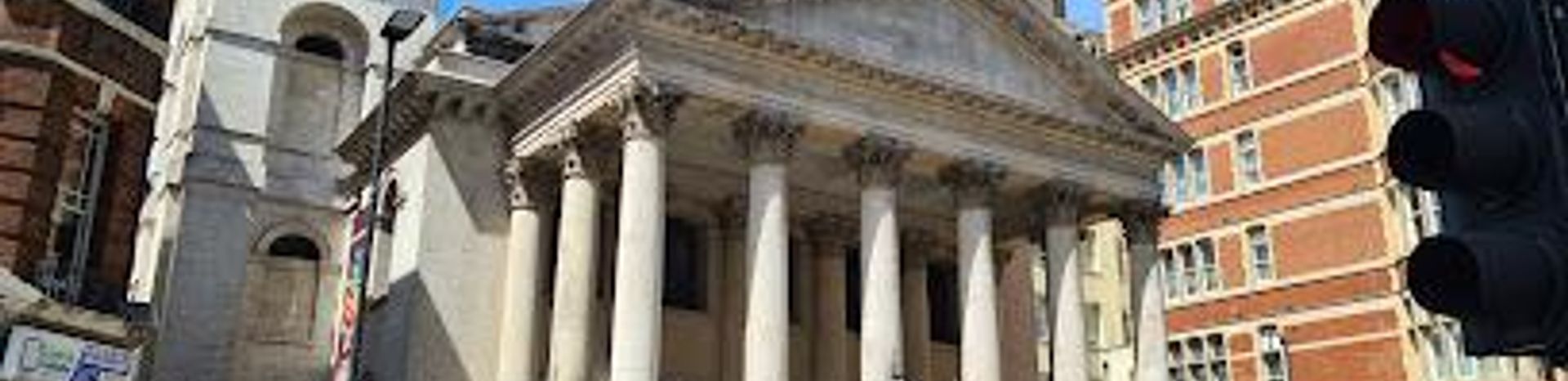
St George's Church, Bloomsbury: Hawksmoor's English Baroque Masterpiece
Discover Hawksmoor’s last London church, a Baroque gem with a striking stepped tower and rich history in the heart of Bloomsbury.
St George's Church in Bloomsbury, London, is the last London parish church designed by Nicholas Hawksmoor, consecrated in 1730. Known for its striking English Baroque architecture, the church features a unique stepped tower inspired by the Mausoleum at Halicarnassus and a portico modeled on the Temple of Bacchus in Baalbek. Its rich history includes ties to notable figures and events, and it underwent major restoration to return to Hawksmoor’s original east-west orientation.
A brief summary to St George's Church, Bloomsbury.
- Bloomsbury Way, London, WC1A 2SA, GB
- +442072421979
- Visit website
- Duration: 0.5 to 1.5 hours
- Free
-
 Outdoor
- Mobile reception: 4 out of 5
Local tips
- Visit during daylight hours to fully appreciate the church’s intricate architectural details and natural lighting inside.
- Look for the lions and unicorns sculptures around the tower base, symbolic of early 18th-century political history.
- Explore the church’s website for information on special services and cultural events held within this historic space.
- Notice the statue of King George I atop the tower, a unique feature reflecting the church’s Hanoverian connections.

For the on-the-go comforts that matter to you
- Restrooms
- Seating Areas
- Information Boards
Getting There
-
London Underground
Take the Central Line to Tottenham Court Road station, approximately a 10-15 minute walk to St George's Church. The station is well-served and accessible, with frequent trains running throughout the day. No additional fare beyond standard London Underground pricing applies.
-
Bus
Bus routes 24, 29, 73, and 390 stop near Bloomsbury Way, within a 5-minute walk of the church. Buses run regularly with fares payable by Oyster card or contactless payment. Note that traffic can affect bus timings during peak hours.
-
Taxi or Rideshare
A taxi or rideshare from central London locations typically takes 10-20 minutes depending on traffic. This option offers door-to-door convenience but can be more expensive, with fares generally ranging from £8 to £15.
-
Walking
If you are staying nearby in Bloomsbury or the West End, walking to St George's is a pleasant option, taking about 10-20 minutes over mostly flat, paved streets. The route is wheelchair accessible and passes through vibrant London neighborhoods.
St George's Church, Bloomsbury. location weather suitability
-
 Any Weather
-
 Clear Skies
-
 Mild Temperatures
Discover more about St George's Church, Bloomsbury.
Architectural Genius of Nicholas Hawksmoor
St George's Church stands as the final London parish church designed by Nicholas Hawksmoor, a pupil of Sir Christopher Wren and a master of English Baroque architecture. Constructed between 1716 and 1731 and consecrated in January 1730, it showcases Hawksmoor's distinctive style characterized by monumental forms and eclectic classical references. The church’s imposing hexastyle portico draws inspiration from the Roman Temple of Bacchus in Baalbek, Lebanon, while its iconic stepped tower is modeled after Pliny the Elder's description of the Mausoleum at Halicarnassus, one of the ancient world's seven wonders. Atop this tower sits a statue of King George I dressed as a Roman emperor, symbolizing the Hanoverian dynasty's authority.Historical and Social Context
The church was commissioned under the 1711 Act for Fifty New Churches to serve the rapidly growing Bloomsbury area, which was then part of the parish of St Giles in the Fields. The site, known as the ‘Ploughyard,’ was purchased from Lady Russell, widow of the Whig rebel Lord John Russell. St George’s was built to provide a place of worship for the more respectable residents of Bloomsbury, deliberately distancing them from the notorious slums of nearby St Giles, famously depicted in Hogarth’s print 'Gin Lane' where the church spire is visible. Over the centuries, the church has been linked to notable historical figures, including novelist Anthony Trollope and suffragette Emily Davison, whose funeral was held here in 1913.Unique Design and Orientation Challenges
Unlike traditional churches oriented strictly east-west, St George’s was constructed on a narrow north-south plot due to site constraints, initially defying the Commissioners’ stipulation for an east-west axis. This unusual alignment caused liturgical and spatial challenges, leading to alterations over the centuries such as the relocation of the altar and the addition and removal of galleries on all four sides—making it perhaps the only London church to have had galleries on every wall at one time. A major restoration completed in the early 21st century reinstated Hawksmoor’s original east-west orientation and removed later modifications to recover the church’s intended spatial harmony.Symbolism and Sculptural Details
The church’s tower is adorned with statues of fighting lions and unicorns, emblematic of the recent suppression of the 1715 Jacobite Rising. These creatures reference a popular nursery rhyme reflecting the political struggle between the Hanoverian and Stuart claimants to the British throne. The original sculptures were removed in the 19th century but have been faithfully recreated in recent restorations by sculptor Tim Crowley. The church’s exterior and interior thus communicate a rich narrative of political allegiance and religious authority, set against the backdrop of early 18th-century London.Restoration and Modern Role
By the late 20th century, St George’s had fallen into disrepair, but a major restoration effort, supported by the World Monuments Fund and private donors, revived its structure and artistic features. The restoration focused on structural repairs, reinstating original design elements, and reviving the church’s prominence in the Bloomsbury community. Today, St George’s remains an active Anglican parish church and a significant heritage landmark, celebrated for its architectural innovation and historical resonance.Visitor Experience and Cultural Significance
Visitors to St George’s can admire its bright, detailed interior illuminated by natural light, its classical portico, and the striking silhouette of its stepped tower against the London skyline. The church’s layered history—from its role in social reform movements to its architectural symbolism—offers a profound glimpse into London’s religious and cultural evolution. Its proximity to academic institutions and Bloomsbury’s literary heritage further enriches the visitor experience, making it a compelling destination for architecture enthusiasts, historians, and cultural travelers alike.For the vibe & atmosphere seeker
- Tranquil
- Scenic
- Unique
- Historic
For the design and aesthetic lover
- Vintage Styles
- Art Deco Styles
For the architecture buff
- Historic
- Landmarks
- Sacred Sites
For the view chaser and sunset hunter
- Iconic Views
- Sunrise Spots
- Sunset Spots
For the social media creator & influencer
- Instagrammable
- Photo Spots
- Architectural Shots
For the eco-conscious traveler
- Public-Transport Accessible
For the kind of experience you’re after
- Cultural Heritage
- Photowalk
- Day Trip
- Weekend Getaway
For how adventurous you want the journey to be
- Easy Access
Location Audience
- Family Friendly
- Senior Friendly
- Child Friendly
- Teen Friendly
- Wheelchair Access
- Solo Friendly
- Couple Friendly
- Solo Female Friendly


