
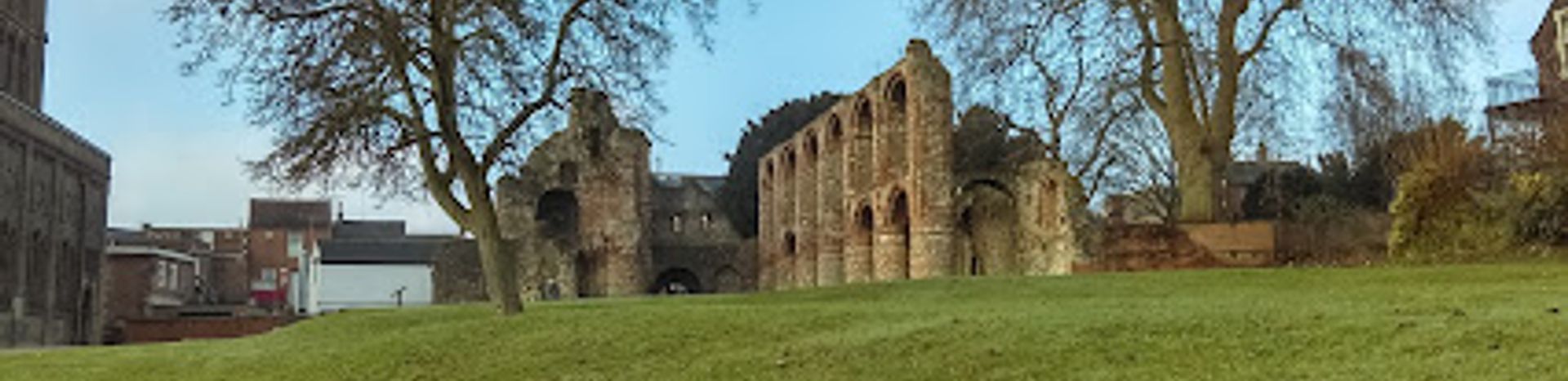
St Botolph's Priory: Norman Heritage and Ruined Majesty in Colchester
Explore the evocative ruins of England’s first Augustinian priory, showcasing Norman architecture and Civil War history in the heart of Colchester.
St Botolph's Priory in Colchester is a striking ruin of one of England’s earliest Augustinian houses, founded around 1100. The site showcases impressive Norman architecture with massive circular pillars, round arches, and an elaborate west front built from flint and reused Roman bricks. Damaged during the 1648 Civil War siege, it remains a poignant reminder of medieval ecclesiastical history, set near Colchester’s Roman walls and town centre.
A brief summary to English Heritage - St Botolph's Priory
- St Botolph's Church Walk, Colchester, CO2 7EE, GB
- +443703331181
- Visit website
- Duration: 0.5 to 1.5 hours
- Free
-
 Outdoor
- Mobile reception: 4 out of 5
Local tips
- Wear comfortable footwear as the site has uneven ground and ancient ruins to explore on foot.
- Visit nearby Colchester town centre for restrooms and food options, as the priory itself has no facilities.
- Bring a guidebook or use online resources to fully appreciate the Norman architectural details and historical context.
- Combine your visit with nearby historic sites like Colchester Castle and St John’s Abbey Gate for a comprehensive heritage experience.

For the on-the-go comforts that matter to you
- Information Boards
Getting There
-
Train and Walk
From Colchester Town railway station, a 10-15 minute walk through the town centre leads to St Botolph's Priory. The route is mostly flat and accessible, with nearby public toilets available at the station.
-
Bus and Walk
Local buses serving Colchester town centre stop within 500 meters of the priory. From the bus stop, expect a 5-10 minute walk on paved streets. Check local bus schedules for frequency and fares, typically £2-£4 per journey.
-
Car and Walk
Public parking is available at Britannia Car Park near St Botolph's Circus, about a 5-minute walk to the priory. Parking charges apply, generally around £1.50-£3 per hour. No on-site parking is available.
English Heritage - St Botolph's Priory location weather suitability
-
 Any Weather
-
 Clear Skies
-
 Mild Temperatures
Discover more about English Heritage - St Botolph's Priory
Origins and Augustinian Foundations
St Botolph's Priory was established between 1093 and 1100 as the first Augustinian priory in England, founded by two priests who transformed an earlier Saxon church dedicated to St Botolph. The priory gained a royal charter from William Rufus, affirming its autonomy and authority over other Augustinian houses. Its foundation marked a significant moment in English religious history, introducing the Augustinian rule and establishing a center of ecclesiastical influence in Colchester.Architectural Grandeur in Ruins
Despite its ruined state, the priory church remains an impressive example of early Norman architecture. Constructed primarily from flint rubble and incorporating Roman bricks salvaged from nearby Roman buildings, the structure features massive circular pillars and grand round arches that evoke the scale and solemnity of its original form. The elaborate west front, with its chevron ornamentation and remnants of a large circular window, stands as one of the finest surviving Norman façades in England.Medieval Life and Decline
The priory functioned both as a religious community and a parish church, serving local townsfolk as well as the Augustinian canons. Over the centuries, it held authority over other Augustinian houses and managed various lands and churches in the region. However, the Dissolution of the Monasteries under Henry VIII in 1536 led to its closure, with much of the monastic buildings demolished. The nave continued as a parish church until the mid-17th century.Siege of Colchester and Lasting Damage
During the English Civil War in 1648, Colchester was besieged by Parliamentarian forces, and St Botolph's Priory suffered extensive damage from cannon fire. The church was left in ruins and never restored, with the nave later used as a burial ground. The scars of the siege remain visible on the west front, providing a tangible connection to this turbulent period in English history.Modern Preservation and Visitor Experience
Today, the priory ruins are managed by English Heritage and are freely accessible to the public. The site offers a compact but rich historical experience, ideal for visitors interested in Norman architecture, medieval monastic life, and English Civil War history. Although there are no visitor facilities on-site, its proximity to Colchester town centre and transport hubs makes it an easy and rewarding stop.Context within Colchester’s Heritage Landscape
St Botolph's Priory sits near Colchester’s famous Roman walls and other historic sites such as St John's Abbey Gate and Colchester Castle. This setting enriches the visitor’s understanding of the layered history of one of England’s oldest towns, from Roman times through the medieval period and into modernity.For the vibe & atmosphere seeker
- Tranquil
- Scenic
- Historic
- Unique
For the design and aesthetic lover
- Rustic Designs
- Vintage Styles
For the architecture buff
- Historic
- Landmarks
For the view chaser and sunset hunter
- Iconic Views
For the social media creator & influencer
- Instagrammable
- Photo Spots
For the eco-conscious traveler
- Public-Transport Accessible
- Locally Managed
For the kind of experience you’re after
- Cultural Heritage
- Photowalk
- Day Trip
- Weekend Getaway
For how adventurous you want the journey to be
- Easy Access
Location Audience
- Family Friendly
- Senior Friendly
- Child Friendly
- Solo Friendly
- Couple Friendly


