

The Rosetta Stone, London Travel Guide
See the Rosetta Stone in the British Museum’s Egyptian galleries, where a single inscribed fragment explains why this room draws history-minded visitors from across London.
The Rosetta Stone is not a standalone attraction so much as the British Museum’s most famous object: a broken granite slab that unlocked the reading of hieroglyphs. Displayed in Room 4 of the Egyptian sculpture gallery, it draws a steady stream of visitors who usually spend only a few minutes at the case before moving on to nearby antiquities. Expect a formal, crowded, highly focused museum stop in central London.
A brief summary to The Rosetta Stone
- British Museum Reading Room, Great Russell St, London, GB
- Duration: 0.25 to 2 hours
- Free
-
 Indoor
- Mobile reception: 4 out of 5

Know before you go
Hi, I'm Eve. Here are a few practical things to know before exploring The Rosetta Stone.
- Go early or later in the day if you want a less crowded view of the display case.
- Treat it as part of a wider British Museum visit; the stone itself takes only a few minutes.
- Use public transport rather than driving, since central London parking is limited and inconvenient.
Do you manage this location?
Take control to get all the benefits, like improved information, better appearance, and stronger visibility across AI-powered discovery. Learn more about listing your business on Evendo
Activate your presenceOther nearby places you may find interesting
The closest places of the same kind, if this one is not quite what you had in mind.




Explore The Rosetta Stone on the Map
A handpicked selection of must-see spots near The Rosetta Stone, mapped for you.
Getting There
-
Tube
The nearest Underground stations are a short walk away, making this the most practical way to arrive from central London.
-
Bus
Several central bus routes stop nearby, useful if you are already moving through Bloomsbury or the West End.
-
Walk
Walking from nearby central districts is realistic and usually takes under 30 minutes, depending on your starting point.
-
Taxi
Black cabs and private hire vehicles can drop close to the museum, but road traffic can be slow at busy times.
For the on-the-go comforts that matter to you
-
 Restrooms
-
 Drink Options
-
 Food Options
-
 Seating Areas
-
 Sheltered Areas
-
 Trash Bins
-
 Information Boards
-
 Visitor Center
Discover more about The Rosetta Stone
What it is
The Rosetta Stone is a fragment of a larger inscribed stela dating to 196 BC, carved with a decree in three scripts, including Greek and Egyptian hieroglyphs. Its importance is historical rather than visual: it became the key that helped scholars decipher hieroglyphic writing. Today it sits in Room 4 of the British Museum’s Egyptian sculpture gallery, where it is presented as a core object in the museum’s ancient Egypt collection.How the visit feels
The experience is brief and object-led. You enter the museum, cross the Great Court, and head to the Egyptian galleries, where the stone is shown in a controlled display case with interpretive panels nearby. Most visitors pause for a close look, read the labels, take a photo, and move on. The room can feel busy, especially when tour groups and school groups overlap, so the atmosphere is more practical and educational than contemplative. There is little sense of spectacle beyond the object’s reputation, but that reputation is exactly why people come.Setting and surroundings
This is an indoor museum setting inside a large historic building, not an open-air landmark. The surrounding architecture matters: the British Museum’s scale, the Great Court, and the sequence of adjacent galleries give the visit a sense of movement through a major collection rather than a single exhibit hall. The Rosetta Stone itself is small compared with the museum around it, and that contrast is part of the experience. You are looking at one object, but you are standing inside one of London’s most visited cultural institutions.Why travellers make the stop
People come for the stone’s place in world history and for the chance to see an object they have usually encountered in textbooks. It suits visitors with an interest in ancient Egypt, language, archaeology, and museum collections, but it also works as a short central-London cultural stop. Many combine it with other Egyptian antiquities or a broader British Museum visit, which is the most realistic way to approach it. If you only want the Rosetta Stone, half an hour is enough; if you want the surrounding galleries, allow one to two hours.Practical expectations
Access is straightforward by Tube, bus, or on foot from central London. The museum is step-free at the main entrance and has lifts and accessible toilets, though crowding can slow movement around headline exhibits. Food and drink are available in designated areas, and the museum is a good all-weather stop. The best times are usually early after opening or later in the day, when the room is less compressed. In peak periods, expect a short queue of people waiting for a clear view of the case, then a quick turnover as visitors continue through the galleries.












Your all‑in‑one travel companion app
Explore expert travel guides, compare and book tours, experiences, hotels, and more—all from the palm of your hand. Download now for seamless trip planning wherever your wanderlust takes you.


Explore More of London

Looking beyond The Rosetta Stone? Discover London for broader travel guides, local hot-spots, and regional highlights.
Explore London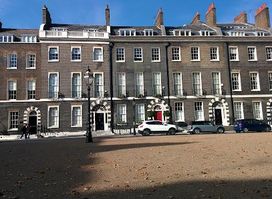
A private Georgian garden square in Bloomsbury, prized for its intact terraces, formal symmetry, and quiet urban heritage character.

Explore two million years of human history and culture at London’s iconic British Museum, home to world-famous treasures and stunning architecture.
